









Executive Summary
For the past decade, the evolution of global financial markets has been strictly defined by two parallel vectors: the digitization of traditional assets via blockchain technology, and the automation of trading execution via algorithmic logic. The rise of DeFi from 2020 to 2024 provided a permissionless, composable, and globally accessible architecture for value transfer. Concurrently, the explosion of Large Language Models (LLMs) and generative Artificial Intelligence radically redefined the boundaries of machine reasoning, contextual understanding, and task execution.
However, as we progress through the first quarter of 2026, these two parallel technological vectors have violently and decisively collided to create a fundamentally new economic paradigm: Agentic Finance (AgentFi).
AgentFi represents the definitive, historical transition from human-operated financial systems to machine-operated sovereign economies. It is the absolute financialization of autonomous AI agents. These are not the rigid, rule-based algorithmic high-frequency trading (HFT) bots of the 2010s, nor are they passive chatbots providing market sentiment summaries. AgentFi consists of sovereign digital entities possessing dynamic reasoning capabilities, native cryptographic wallets, and the autonomous agency to execute complex, multi-step financial strategies across highly fragmented blockchain networks in real-time.
This comprehensive, institutional-grade research report defines the underlying architecture of Agentic Finance. We explore the macroeconomic and technological catalysts that triggered its explosive emergence. Crucially, we incorporate the latest market intelligence—specifically the definitive 2026 Agentic Finance Landscape mapped by Cambrian—to dissect the specific protocols and sectors driving this revolution. We analyze how AgentFi is actively democratizing quantitative strategy, neutralizing toxic MEV (Maximal Extractable Value), and creating entirely new asset classes for traders. Finally, we provide a neutral, objective assessment of the systemic risks, exploring how Wall Street and the Web3 ecosystem view the imminent reality of trillion-dollar machine-to-machine (M2M) economies.
Part 1: The Ontological Shift – Defining Agentic Finance
To truly understand AgentFi, one must discard the traditional, legacy definitions of algorithmic trading, grid bots, and Automated Market Makers (AMMs).
The Evolution from Algorithms to Sovereign Agents
Traditional HFT algorithms and standard DeFi arbitrage bots operate on deterministic, hard-coded logic trees: If X condition is met on Exchange A, execute Y trade on Exchange B. They are exceptionally fast, executing in microseconds, but they are fundamentally brittle. If market conditions deviate even slightly from their hard-coded parameters—such as an unexpected smart contract upgrade or a sudden liquidity drain—they either fail, halt operations, or execute erroneously, often leading to catastrophic losses. They entirely lack adaptability, contextual awareness, and cognitive synthesis.
Agentic Finance introduces reasoning, intent, and agency into the execution layer. An autonomous financial agent in 2026 is powered by sophisticated foundation models (like advanced iterations of Claude 3.5, GPT-5 class models, or specialized, open-source financial models fine-tuned on on-chain data).
These agents possess the ability to:
Synthesize Qualitative and Quantitative Data: A modern trading agent can read a breaking regulatory announcement from the SEC, cross-reference it with real-time on-chain stablecoin capital flows, and gauge the social sentiment of the crypto ecosystem simultaneously.
Formulate Dynamic Strategies: Based on that real-time synthesis, the agent autonomously devises a strategy that was not explicitly hard-coded by its human creator.
Autonomous Execution & Portfolio Management: The agent autonomously deploys capital, signs transactions using its own cryptographic wallet, routes liquidity securely across multiple Layer-2 rollups, and dynamically hedges its position using perpetual futures to maintain delta-neutrality.
The Anatomy of an AgentFi Actor
In the 2026 market structure, a fully realized financial agent is a complex amalgamation of distinct technological stacks. It consists of four core components:
The Brain (Cognitive Engine): The underlying LLM or Small Language Model (SLM) responsible for intent parsing, risk assessment, strategy formulation, and probabilistic decision-making.
The Senses (Data Infrastructure): Real-time integrations with decentralized oracle networks (e.g., Chainlink, Pyth), blockchain indexers (e.g., The Graph), and specialized Web2 API scrapers. This allows the agent to "see" the market.
The Hands (Execution & Custody): Account Abstraction (ERC-4337) smart contract wallets. This is the critical breakthrough. It allows the agent to independently hold capital, pay for its own gas fees, and cryptographically sign transactions on permissionless ledgers without requiring a human to click "Approve" on a MetaMask popup.
The Trust Layer (Verification & Security): Because agents operate autonomously in a highly adversarial environment, they utilize cryptographic proofs—such as Trusted Execution Environments (TEEs) or Zero-Knowledge Machine Learning (zkML)—to mathematically prove to counterparties that their trading logic was not tampered with by hackers and that they executed tasks faithfully.
In short, AgentFi is the ecosystem where capital allocation, risk management, and portfolio management are entirely outsourced to non-human, hyper-rational software entities that interact natively with blockchain rails.
Part 2: The Genesis – Why Did AgentFi Emerge Now?
The concept of AI-assisted trading is not novel. Elite quantitative hedge funds like Renaissance Technologies and Two Sigma have utilized machine learning for decades. However, true Agentic Finance—where the AI operates as a sovereign, self-custodial entity rather than a mere statistical tool wielded by a human portfolio manager—could only emerge in the specific technological and economic climate of 2025–2026. This genesis was triggered by three converging macro-catalysts:
1. The Breaking Point of Human Cognitive Capacity (The Liquidity Fragmentation Crisis)
By 2025, the proliferation of Layer-2 (L2) and Layer-3 (L3) rollups on Ethereum (Arbitrum, Optimism, Base, Scroll), alongside high-throughput parallelized EVMs (like Monad) and alternative Layer-1s (Solana, Sui, Aptos), created an untenable, hyper-fragmented environment for human traders.
Liquidity became scattered across hundreds of different chains, bridges, and Decentralized Exchanges (DEXs). A human trader attempting to find the most capital-efficient route to execute a $5,000,000 swap, while simultaneously managing bridge latency, slippage tolerances, and gas optimization, simply could not compete. The UX (User Experience) of Web3 had become too complex for mass adoption.
The market demanded an abstraction layer. AgentFi emerged to solve this exact bottleneck: users now simply state their "intent" in natural language (e.g., "Take my 100 ETH on Arbitrum, find the safest yield-bearing protocol across any EVM chain yielding at least 6% APY, and bridge the funds there while hedging against a 10% market drawdown"), and the autonomous agent handles the labyrinthine execution routing across 50 different protocols in seconds.
2. The Maturation of "Agentic" AI Models and Tool-Calling
Early LLMs were prone to catastrophic hallucinations, making them entirely unfit for financial operations where a single hallucinated decimal point could result in a $10 million loss. However, the models released between late 2024 and 2025 introduced advanced reasoning, multi-step planning, and, crucially, native tool-calling (API integration) capabilities. Frameworks like Anthropic's Model Context Protocol (MCP) and customized Agent-to-Agent (A2A) communication standards allowed models to securely interact with external financial tools, read smart contract code to detect vulnerabilities, and verify mathematical logic before executing trades.
3. Sub-Cent On-Chain Compute and Settlement
Agentic Finance requires near-constant communication, negotiation, and high-frequency micro-transactions. If an AI agent needs to ping 15 different order books, negotiate with three other specialized agents, and execute a multi-hop cross-chain trade, it cannot mathematically do so in an environment where gas fees are $5.00 to $50.00 per transaction (as seen in previous Ethereum bull markets). The maturation of EIP-4844 (Proto-Danksharding) on Ethereum L2s, and the rise of ultra-high-throughput chains like Solana, natively brought transaction costs down to fractions of a cent. This provided the cheap, high-bandwidth financial blockspace absolutely required for machine-to-machine economies to flourish.
Part 3: The 2026 AgentFi Landscape – A Sector-by-Sector Analysis
To understand the practical application of AgentFi for traders and institutions, we must analyze the specific actors building this ecosystem. According to the authoritative "Agentic Finance Landscape in 2026" mapped by Cambrian, the market has rapidly stratified into four distinct, highly specialized quadrants. These quadrants do not operate in isolation; they interact with each other to form a cohesive, autonomous financial network.
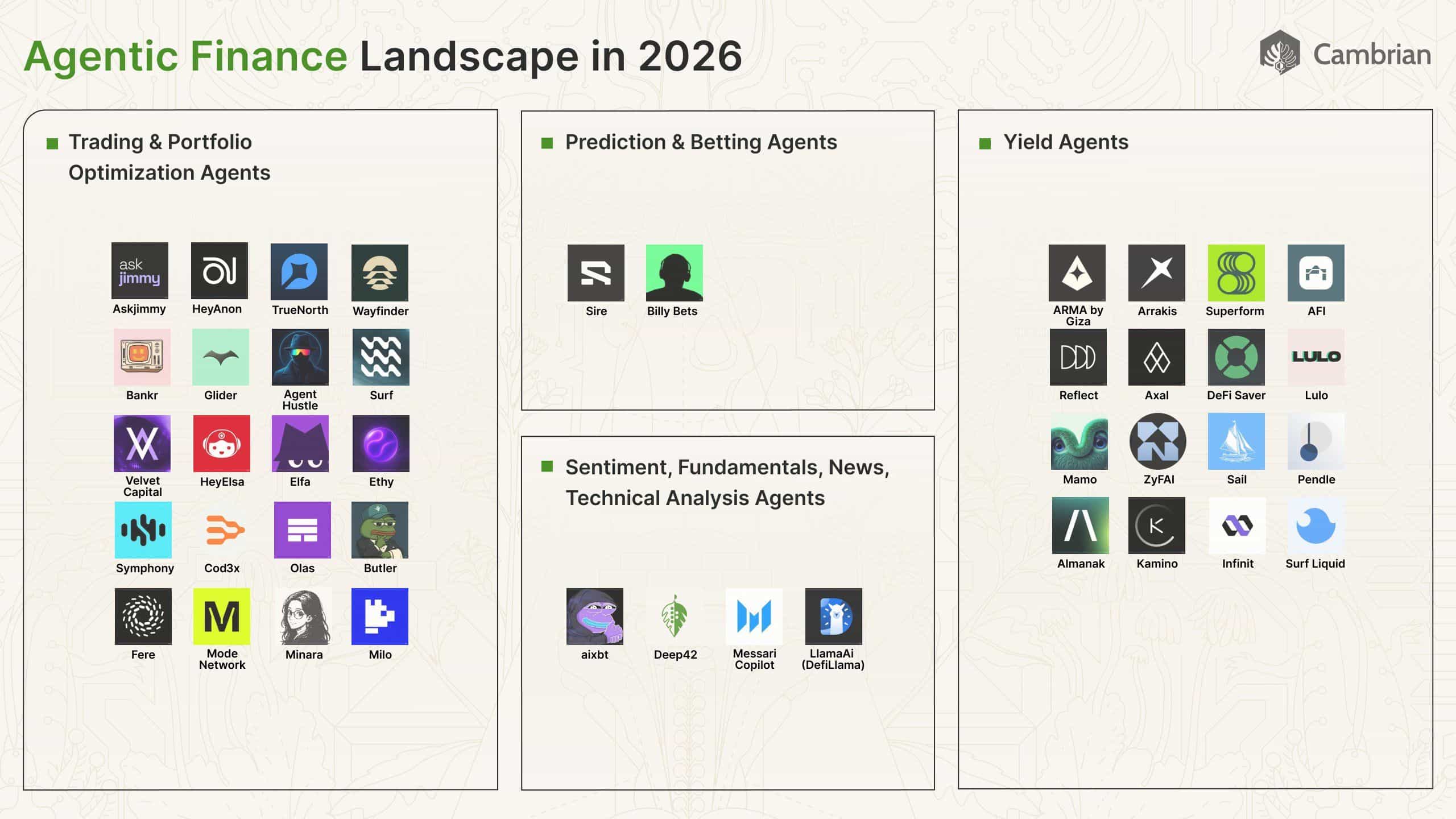
Quadrant 1: Trading & Portfolio Optimization Agents
This is the most heavily populated and critical sector of AgentFi. These agents act as the autonomous portfolio managers and execution routers for both retail users and institutional funds.
Notable Protocols: Askjimmy, HeyAnon, Wayfinder, Velvet Capital, Olas, Mode Network, Bankr, Glider, Agent Hustle, Surf, HeyElsa, Elfa, Ethy, Symphony, Cod3x, Butler, Fere, Minara, Milo.
Mechanics & Utility: Protocols like Wayfinder and Olas are building the foundational routing and coordination networks for agents. When a user wishes to execute a complex, cross-chain portfolio rebalancing, these agents autonomously map the most efficient route. Velvet Capital and Mode Network provide the underlying DeFi infrastructure that allows these agents to construct, manage, and tokenize dynamic portfolios.
The Trader Impact: A quantitative trader no longer manually adjusts grid bots. They employ an agent like HeyAnon or Bankr to continuously monitor their portfolio's risk parameters. If an asset's volatility spikes beyond an acceptable threshold, the portfolio optimization agent autonomously unwinds the position, routes it through the most liquid DEX aggregator, and parks the capital in a yield-bearing stablecoin.
Quadrant 2: Yield Agents
While Trading Agents focus on capital appreciation and routing, Yield Agents are specialized entirely in maximizing capital efficiency, liquidity provision, and interest rate arbitrage.
Notable Protocols: ARMA by Giza, Arrakis, Superform, AFI, Reflect, Axal, DeFi Saver, Lulo, Mamo, ZyFAI, Sail, Pendle, Almanak, Kamino, Infinit, Surf Liquid.
Mechanics & Utility: Yield in DeFi is notoriously volatile. A liquidity pool paying 20% APY today might pay 2% tomorrow. Yield Agents automate the relentless pursuit of the highest risk-adjusted returns. Arrakis and Kamino (a dominant force on Solana) utilize sophisticated algorithms and AI integrations to actively manage concentrated liquidity positions on AMMs (like Uniswap V3 or Raydium), ensuring the trader's capital is always in range to earn fees while minimizing impermanent loss. Superform acts as a cross-chain yield router, allowing an agent to deposit funds on one chain and earn yield on another. Pendle allows these agents to tokenize and trade the future yield itself, creating highly complex, fixed-income strategies.
The Trader Impact: Institutional allocators can deploy capital into a Yield Agent protocol (like DeFi Saver or ZyFAI), instructing it to maintain a delta-neutral yield farming strategy. The agent will autonomously monitor lending rates across Aave, Morpho, and Kamino, moving collateral seamlessly between chains the millisecond a higher, safe yield becomes available.
Quadrant 3: Sentiment, Fundamentals, News, and Technical Analysis Agents
These agents form the "Sensory Nervous System" of the AgentFi economy. They do not hold funds or execute trades directly; instead, they ingest massive datasets and provide highly refined, actionable intelligence to the Trading and Yield agents.
Notable Protocols: aixbt, Deep42, Messari Copilot, LlamaAi (DefiLlama).
Mechanics & Utility: aixbt has emerged as a powerhouse for parsing the chaotic, hyper-fast sentiment of "Crypto Twitter" and Telegram alpha groups. It uses NLP (Natural Language Processing) to detect narrative shifts and insider accumulation before it reflects in the price action. LlamaAi (built atop the massive DefiLlama database) and Messari Copilot act as autonomous fundamental analysts. They can instantly query millions of rows of on-chain data—such as TVL fluctuations, protocol revenue, and token unlock schedules.
The M2M Synergy: A Trading Agent from Quadrant 1 (e.g., Surf) will continuously ping LlamaAi and aixbt via API. If aixbt detects massive bullish sentiment around a new Layer-2 token, and LlamaAi confirms that the TVL is genuinely growing (proving it's not a fake social manipulation), the Trading Agent will autonomously execute a long position.
Quadrant 4: Prediction & Betting Agents
A rapidly growing niche focused on probabilistic outcomes and information arbitrage.
Notable Protocols: Sire, Billy Bets.
Mechanics & Utility: With the explosion of decentralized prediction markets like Polymarket, a massive opportunity for arbitrage emerged. Agents like Sire and Billy Bets utilize deep learning models to parse geopolitical news, election polling data, weather patterns, or sports statistics. They cross-reference this data against the current odds on prediction markets, identifying mispriced contracts and autonomously placing bets to capture the spread.
Part 4: Impact on Traders and the Transformation of Alpha Generation
The critical question posed by traditional macro hedge funds and institutional desks is: How does AgentFi materially impact Alpha generation, and can traditional traders utilize this?
The integration of the protocols mapped by Cambrian is fundamentally altering the day-to-day operations of both retail day-traders and institutional quantitative desks.
1. The Democratization of the Quantitative Desk
Historically, sophisticated delta-neutral yield farming, cross-chain statistical arbitrage, and MEV extraction were the exclusive domains of elite algorithmic firms (e.g., Jane Street, Jump Trading, Wintermute) employing legions of PhDs in mathematics and C++ developers.
AgentFi entirely levels the playing field. A retail trader or a small, boutique crypto fund can now employ a fleet of AI agents to execute Wall Street-grade strategies. A trader no longer needs to code Python scripts; they simply configure an agent from the Cambrian landscape. The agent writes the necessary transaction calldata, manages the private keys securely via Account Abstraction, and executes flawlessly 24/7. AgentFi is the democratization of the Quant.
2. Advanced Risk Management & Portfolio Defense (Sentinel Agents)
Human reaction time is vastly too slow to survive black swan events in the cryptocurrency market. AgentFi introduces autonomous, millisecond-reaction defensive mechanisms.
Traders are deploying specialized "Sentinel Agents" (often utilizing infrastructure from protocols like DeFi Saver). These agents continuously scan Twitter for regulatory FUD, monitor the Ethereum mempool for malicious smart contract hacks related to the trader's portfolio, and track the on-chain movement of massive whale wallets. If a Sentinel Agent detects a highly probable exploit occurring on a lending protocol where the trader has deposited funds, the agent autonomously withdraws the funds and bridges them to a safe multisig wallet—long before the human trader even wakes up to check the news.
3. The Neutralization of Toxic MEV and the Rise of "Protective Swarms"
For years, retail traders executing large swaps on Decentralized Exchanges were the victims of toxic MEV—front-running and sandwich attacks executed by highly sophisticated, predatory bots.
AgentFi fundamentally changes this dynamic. Traders now use protective order-routing agents (such as those being developed by Olas or Wayfinder). When a trader wants to execute a massive $10M swap, their agent breaks the order into encrypted micro-transactions, and negotiates directly with block builders or sophisticated off-chain dark pools, entirely bypassing the public mempool. This autonomous negotiation protects the trader from slippage and predatory sandwich bots, ensuring institutional-grade execution for the retail participant.
4. Trading "Agentic Yield" as a New Asset Class (AIOs)
As the AgentFi ecosystem matures, the agents themselves are becoming tradable assets. Professional traders are no longer just analyzing tokenomics or protocol revenue; they are analyzing the on-chain performance metrics of autonomous trading agents. Identifying and investing in an undercapitalized but highly efficient AI trading agent early in its lifecycle has become a highly lucrative new vector for alpha generation. We are witnessing the birth of **Agentic Initial Offerings (AIOs)**—where buying a governance token gives you a claim on the proprietary trading profits generated by a specific AI agent. It is the Web3 equivalent of buying equity in a highly successful proprietary trading desk.
Part 5: The Symbiotic Imperative – Why AgentFi and Crypto are Inseparable
A common, skeptical critique from traditional finance is: Why do AI agents need the blockchain? Why can't they just trade traditional equities via Web2 APIs on Robinhood, Charles Schwab, or Interactive Brokers?
The answer lies in the fundamental, unyielding architecture of the traditional financial (TradFi) system versus the cryptographic ecosystem. AgentFi and Crypto are locked in a deep, mutually dependent symbiosis. They require one another to survive.
Why TradFi Fiat Rails Fail Autonomous Agents
The traditional financial system is fundamentally, legally, and technologically hostile to non-human actors.
Identity and KYC (Know Your Customer): An AI agent cannot produce a driver's license, a passport, or a Social Security Number. Therefore, under current global AML (Anti-Money Laundering) laws, it cannot open a traditional bank account or a brokerage account. It cannot legally "exist" in the eyes of the SWIFT banking system.
API Gatekeeping and Execution Reversibility: TradFi operates on heavily permissioned APIs that can be shut down instantly by a centralized corporation. Furthermore, fiat transactions take days to settle (T+2 settlement) and are highly reversible. An AI agent engaged in high-frequency, cross-market arbitrage cannot mathematically operate in an environment where settlement is delayed by 48 hours and trades can be retroactively canceled by a central clearinghouse.
Why Crypto is the Perfect Native Substrate for Machine Economies
Public blockchains are fundamentally designed for machines, not humans.
Permissionless Identity: An AI agent can generate a cryptographic wallet (a public/private key pair) in milliseconds. That wallet is its sovereign identity. It requires no KYC, no permission, no credit check, and no corporate approval to interact with the global financial system.
Programmable Money: Cryptocurrencies (specifically fiat-pegged stablecoins like USDC) are native to the internet. They are programmable, instantly verifiable, and universally accepted across the Web3 ecosystem.
Deterministic Finality: When an agent executes a smart contract swap on Ethereum or Solana, the execution is mathematically deterministic and final within seconds. This allows agents to chain together highly complex, risk-free flash loans and arbitrage routes with absolute certainty. The code is the law, and the machine understands the code.
Conversely, Crypto desperately needs AgentFi.
The Web3 industry has suffered for years from a horrific user experience and a lack of sustained, non-speculative volume. AgentFi entirely abstracts away the complexity of crypto for the end-user. Furthermore, the constant, high-frequency interactions of millions of AI agents—negotiating, trading, and paying for decentralized compute—provide the persistent, fundamental baseload volume and utility that blockchain networks desperately need to justify their massive multi-billion-dollar infrastructure valuations.
Part 6: Market Sentiment, Regulatory Headwinds, & Systemic Risks
As AgentFi transitions from theoretical frameworks to mainnet reality, the reaction from the broader macroeconomic market is deeply bifurcated. Wall Street, regulatory bodies, and crypto-natives view this paradigm shift through vastly different lenses.
The Bull Case: The Pinnacle of Market Efficiency (The Optimists)
Venture Capital firms (e.g., a16z, Paradigm, Framework) and crypto-native hedge funds are overwhelmingly bullish, aggressively deploying billions in capital into the infrastructure layer supporting the Cambrian map.
The optimistic view posits that AgentFi will result in the most hyper-efficient, liquid financial markets in human history. By entirely removing human emotion, panic selling, and manual execution latency, markets will price assets with unprecedented accuracy.
Optimists argue that AgentFi realizes the true promise of DeFi: the democratization of high finance. It gives the average retail user a dedicated, highly intelligent, emotionless fiduciary agent that works 24/7 to protect their capital.
The Bear Case: Systemic Risk and The "Flash Crash 2.0" (The Skeptics)
Traditional macroeconomic institutions, regulatory bodies (SEC, CFTC), and legacy risk managers view the rise of AgentFi with profound trepidation. Their concerns center around systemic fragility, algorithmic cascading failures, and the total lack of accountability.
The "Agentic Flash Crash": The primary fear is a correlated algorithmic hallucination. What happens if a breaking, highly sophisticated, AI-generated "deepfake" news story hits the internet? If 100,000 highly leveraged, autonomous trading agents ingest the fake news via protocols like aixbt, synthesize it simultaneously, and all rush for the exit at the exact same millisecond, the result would be a catastrophic liquidity vacuum. Because agents act exponentially faster than human circuit breakers can respond, an "Agentic Flash Crash" could wipe out billions in DeFi Total Value Locked (TVL) in seconds, causing a cascading liquidation spiral.
The Hallucination of Financial Logic: While LLMs have improved drastically, they still hallucinate. If an agent misinterprets the decimal placement in a smart contract, or hallucinates a non-existent arbitrage opportunity across a bridge, it could autonomously burn millions of dollars of client funds in a completely irrational execution loop before a human could intervene.
The Accountability Void: The most pressing legal question of 2026 is one of liability. If an autonomous AI agent identifies a vulnerability in a decentralized lending protocol, autonomously executes an exploit, and drains $50 million to maximize its portfolio yield, who is responsible? The creator of the foundational LLM model? The developer who deployed the agent? The retail user who funded it? Or is it simply considered a legitimate, albeit predatory, market transaction executed by a sovereign entity? The complete absence of legal frameworks for non-human economic actors terrifies traditional regulators.
The Market Consensus (Current State)
Despite the glaring regulatory uncertainties and the undeniable systemic risks, the market consensus in Q1 2026 is that the genie is firmly out of the bottle. The financial incentives driving the adoption of AgentFi are too immense to halt. Institutional trading desks are quietly integrating Agentic tools to maintain their competitive edge. Capital is rotating heavily away from rudimentary "infrastructure-only" tokens and flowing aggressively toward the application layer—specifically, the AgentFi protocols mapped by Cambrian that facilitate Agentic Commerce.
Conclusion: The Inevitability of the Machine Economy
The emergence of Agentic Finance (AgentFi) in 2026 marks a watershed moment in the history of capital markets. It is the profound realization that money, in its purest digital form, is simply information—and AI models are the ultimate processors of information.
For professional traders, institutional allocators, and macro funds, AgentFi represents both an existential threat to legacy quantitative methods and an unprecedented, highly lucrative toolkit for alpha generation. Those who adapt to an intent-centric trading paradigm—utilizing the swarms of autonomous agents mapped across the Cambrian landscape to route liquidity, manage risk, and execute strategies across a fragmented blockchain ecosystem—will unequivocally dominate the next decade of finance.
The intersection of permissionless cryptographic ledgers and sovereign machine intelligence has created a new economic reality. AgentFi is no longer science fiction relegated to whitepapers. It is executing on-chain today, it is relentlessly optimizing, it is learning, and it does not sleep. The transition to the autonomous machine economy is not approaching; it has already arrived.
