









Key Takeaways
An agent payment protocol is a machine-readable payment standard that lets software agents autonomously discover prices, authorize payments, and unlock services without manual checkout or account-by-account billing.
The clearest live example today is x402, an open protocol started by Coinbase that revives the HTTP 402 Payment Required status code so APIs, apps, and autonomous agents can pay for access with stablecoins directly over HTTP.
Agent payment protocols matter because traditional payment rails were built for humans, not AI systems that need to buy data, tools, compute, and workflows automatically in real time.
In practice, these protocols combine several pieces: a machine-readable paywall, a wallet or identity layer, a payment asset such as stablecoins, and a verification or settlement layer that confirms payment and unlocks the resource.
The biggest use cases include paid APIs, agent-to-agent services, MCP tools, microtransactions, workflow orchestration, and automated commerce. The biggest risks include fragmentation, trust, wallet security, and the fact that the sector is still early.
Crypto has spent years trying to make payments more global, faster, and easier to program. AI is now creating a new version of that problem. The question is no longer just how humans send value online. It is also how autonomous software pays for information, tools, and execution in a way that works at internet speed. That is where the idea of an agent payment protocol comes in.
An AI agent can already search the web, summarize documents, route tasks, and interact with tools. But the moment it needs to cross a commercial boundary, most of the internet still assumes a human will step in. Typical flows require account creation, API keys, billing dashboards, subscriptions, card rails, checkout pages, or manual top-ups. Those systems work for people. They are awkward for agents.
An agent payment protocol tries to solve that mismatch. Instead of forcing a bot or agent through a human-style purchasing flow, it gives software a native way to request a resource, receive the payment terms, send value programmatically, and continue the task. In other words, it turns payment into part of the machine-to-machine workflow itself.
That may sound niche today, but it touches a very big future market. If AI agents are going to buy data, pay for model calls, trigger paid workflows, license digital tools, or hire other agents, they need a payment standard built for software rather than people.
What an Agent Payment Protocol Actually Is
The simplest definition is this: an agent payment protocol is a standardized way for software agents to make and receive payments automatically as part of a task or network request. It is not just a wallet, not just a token, and not just a payment app. It is the rule set that tells machines how to negotiate paid access and settle it.
That distinction matters. A wallet stores value. A stablecoin provides a payment asset. A payment processor routes transactions. A protocol sits one level deeper and answers a broader question: how does a client know payment is required, what needs to be paid, where it goes, how it is verified, and what unlocks after payment succeeds?
The current best-known implementation is x402. Coinbase’s documentation describes x402 as an open payment protocol that enables instant, automatic stablecoin payments over HTTP by activating the long-unused HTTP 402 Payment Required code. When a client requests a paid resource, the server replies with payment requirements, the client pays programmatically, and then the resource is delivered.
An agent payment protocol is a machine-native payment layer for APIs, services, and workflows, often using stablecoins and web standards so agents can transact automatically.
Why the Internet Needs Agent-Native Payments
The old internet was designed around humans typing, clicking, subscribing, and logging in. The new internet increasingly includes agents that can search, reason, compare options, and execute tasks. That creates a structural mismatch between intelligence and commerce.
Imagine an agent that wants to do any of the following:
buy a premium market data feed for one query,
pay a micro-fee for a web crawl,
unlock a paid research endpoint,
call a specialized MCP server,
trigger a third-party workflow,
hire another agent to complete a subtask.
Every one of those actions involves value transfer. Traditional API monetization usually expects a human developer to create an account, enter billing details, manage keys, and pay on a monthly basis. That is inefficient when the actual consumer is a software system making granular decisions in real time.
x402 embeds payment negotiation directly into web communications so clients such as AI agents can receive structured machine-readable instructions for what must be paid and where. That is a major shift from human checkout to software-native commerce. This is why the category matters. Agent payment protocols are not just about making crypto payments cooler. They are about giving the machine economy a way to buy things as easily as it reads and writes data.
How an Agent Payment Protocol Works
Although implementations may differ, the basic flow is becoming fairly clear. First, the agent requests a resource. That might be an API call, a document, a tool invocation, or an external workflow. If the resource is free, the request proceeds normally. If it is paid, the server responds with a machine-readable notice that payment is required. In x402, this is done with the HTTP 402 Payment Required response.
Second, the server includes the payment terms. Those terms can include price, accepted payment method, destination, and whatever metadata the client needs to pay correctly. The key point is that this is not presented as a human checkout screen. It is presented in a format software can understand.
Third, the agent or wallet layer submits payment programmatically. In x402, this usually means stablecoin payment, with the wallet acting as both a payment mechanism and a form of identity. Coinbase’s docs explicitly say that wallet addresses serve as identifiers for buyers and sellers within the protocol.
Fourth, a verification layer confirms payment. In x402, the facilitator acts as an independent verification and settlement layer. Coinbase says it helps servers confirm payments and submit transactions onchain without requiring every developer to build direct blockchain infrastructure.
Finally, the paid resource is returned or the service is unlocked. At that point, the payment and the digital interaction become one continuous workflow instead of two separate systems awkwardly connected together.
The Building Blocks of an Agent Payment Protocol
To understand the category better, it helps to break it into components. The first component is the request-and-response standard. This is the language that lets a service say, “payment is required, and here are the terms.” In the x402 model, that standard is built around HTTP 402, which had long existed in the web standard but was rarely used.
The second component is the payment asset. Most current agent payment discussions revolve around stablecoins because they are digitally native, programmable, and better suited to machine-to-machine transfers than card networks. Coinbase’s x402 documentation and product pages repeatedly emphasize stablecoin payments over HTTP.
The third component is the wallet layer. A protocol still needs a way for agents or users to hold funds and sign transactions. Coinbase’s docs say the wallet in x402 functions both as the payment mechanism and identity layer.
The fourth component is the verification or facilitator layer. This matters because the merchant or service provider needs confidence that payment happened and the buyer needs confidence that the resource will unlock properly. Coinbase’s facilitator documentation describes this as an independent verification and settlement layer within the x402 protocol.
The fifth component is discovery. A machine economy becomes much more useful when agents can find payable services in a standardized way. Coinbase’s x402 Bazaar is a discovery layer that lets agents browse and search x402-enabled services using metadata and trust signals.
Together, these pieces show that an agent payment protocol is not just a payment button for bots. It is a full stack for machine-readable commerce.
Why Stablecoins Fit So Naturally Here
Stablecoins are not the only possible payment medium, but they are the obvious early favorite for agent payment protocols. They settle digitally, can be transferred programmatically, work across borders, and are far easier to integrate into software workflows than bank wires or card networks. For software agents making low-value or frequent transactions, traditional payment rails often create too much friction. Stablecoins reduce that friction by making value movement behave more like an internet primitive.
This makes stablecoins particularly attractive for micropayments and per-request billing. Instead of requiring monthly API subscriptions, an agent can pay exactly for the query, dataset, workflow, or action it needs. That pricing model is much better aligned with autonomous systems, which often operate dynamically rather than through fixed human purchasing plans. In short, stablecoins make agent payments feel less like legacy e-commerce and more like native internet transactions.
The Most Important Use Cases
The most immediate use case is paid APIs. This is where x402 is most straightforward: an agent calls an endpoint, receives 402 Payment Required, pays, and gets the response. That is a direct upgrade over API keys, prepaid credits, and monthly billing for many use cases.
A second important use case is MCP and tool access. Coinbase’s docs specifically show how x402 can be used with an MCP server so LLMs and AI agents can make paid API requests through MCP infrastructure. That is especially relevant as tool-using agents become more common.
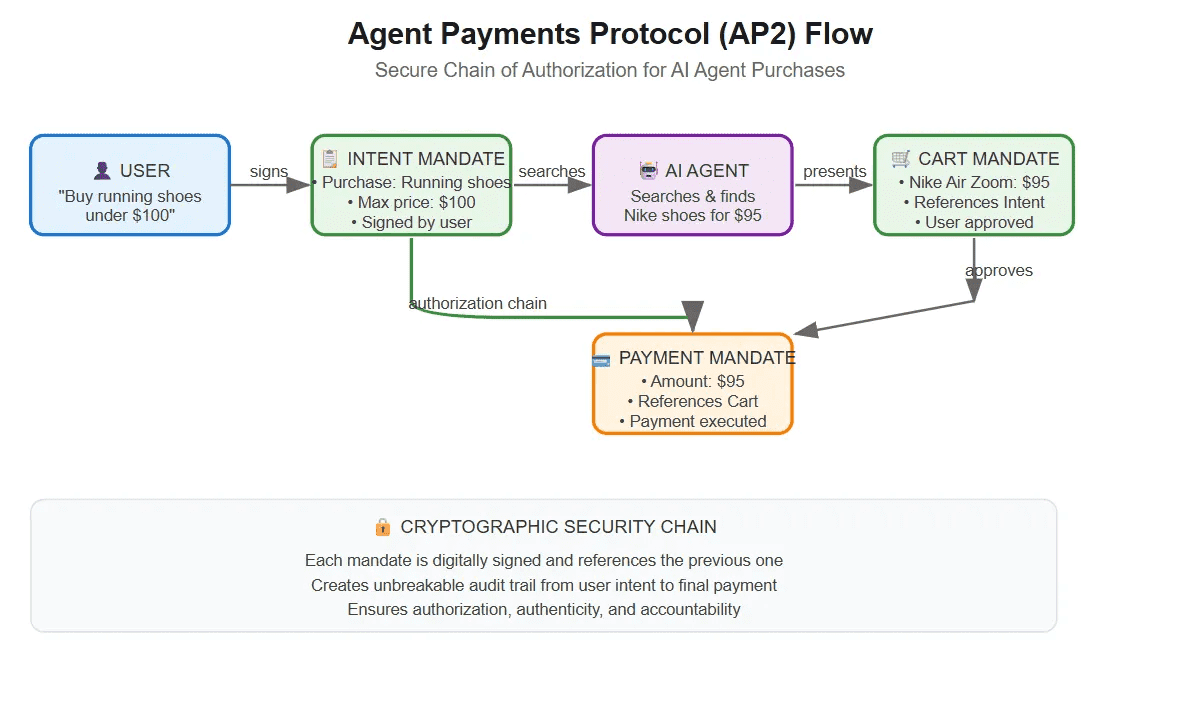
A third use case is agent-to-agent commerce. Coinbase’s launch page for the Google Agentic Payments Protocol + x402 says the protocol enables agents to monetize their own services, pay other agents, and handle micropayments on behalf of users. This suggests a future where agents do not just consume tools, but also sell services to other agents.
A fourth use case is workflow orchestration. Chainlink’s CRE integration with x402 shows how an AI agent could pay to trigger external workflows. That matters because many valuable outputs are not simple API responses. They are chains of actions, and payment has to fit into those chains programmatically.
A fifth use case is content and data monetization. Paid research, web content, private documents, and structured datasets all become easier to sell in smaller units when the payment protocol is native to the request itself. Coinbase’s product materials explicitly mention APIs, content, and digital services as x402 monetization targets.
Why This Could Matter for Crypto
Agent payment protocols are important for crypto because they give digital assets a stronger claim on real utility.
Crypto has often struggled with a credibility gap: plenty of tokens, not enough everyday usage beyond trading. But if agents begin paying for data, compute, workflows, and digital services using stablecoins and onchain settlement standards, that creates a genuine economic role for crypto rails in the broader internet.
This could also reshape how crypto users think about value accrual. In older models, protocols mostly monetized through tokens, staking, or exchange activity. In agent-native commerce, the core unit of value may increasingly be machine-generated demand for digital resources. That is a different growth engine.
The Main Risks and Limitations
This category is promising, but it is still early. The first risk is fragmentation. A protocol only becomes powerful if many services and clients support it. If every platform creates its own incompatible agent payment method, the market could become messy before standards settle. Coinbase’s move to put x402 under more neutral stewardship through the Linux Foundation was clearly meant to address this concern, but the broader standardization process is still young.
The second risk is wallet security and identity design. If agents control money, then wallet management becomes a central security issue. Coinbase’s docs frame wallets as both payment mechanism and identity, which is elegant, but it also means poor wallet design could become a major failure point.
The third risk is trust and abuse. A protocol can standardize payment, but it cannot automatically guarantee that every seller is honest, every dataset is good, or every service is worth the fee. Discovery and trust layers like Bazaar help, but reputation and quality assurance will remain essential.
The fourth risk is regulatory and merchant adoption friction. Just because a machine-native payment flow is technically elegant does not mean every enterprise will adopt it quickly. Legacy billing systems, compliance rules, and internal procurement processes still matter, especially outside crypto-native industries. This is an inference from the nature of enterprise adoption, but it follows from the gap between technical capability and institutional rollout.
The Bigger Picture: From API Payments to Agentic Commerce
The most interesting thing about agent payment protocols is that they point toward a bigger future than just paid APIs. Coinbase’s policy and product materials increasingly talk about agentic commerce. That phrase matters because it implies an economy where software does not just retrieve information. It evaluates services, chooses between providers, pays for results, and composes multi-step workflows on behalf of users or other agents.
That is a meaningful shift. The old internet economy mostly assumed humans consume and software assists. The agentic economy assumes software can also transact. Once that becomes normal, the payment protocol stops being a side feature and becomes one of the core rails of the system.
Conclusion
An agent payment protocol is a machine-readable standard that lets AI agents and software services pay for data, tools, workflows, and digital resources automatically. It matters because the internet is moving from a human-only commerce model toward one where agents increasingly need to transact value as part of their job.
The best live example today is x402, which uses HTTP 402 Payment Required, stablecoins, wallets, and a verification layer to turn web requests into programmable payment flows. That makes APIs, MCP tools, microservices, and agent-to-agent transactions far easier to monetize and consume automatically.
The category is still early, and there are real risks around standards, wallets, trust, and adoption. But the direction is clear. If the future internet includes autonomous agents buying and selling digital services, then agent payment protocols will likely become one of the most important pieces of infrastructure behind that economy.
Register](https://phemex.com/register?group=7916&referralCode=CUFKP8%22>Register) on Phemex Now
