









Key Takeaways
Agent orchestration is the process of coordinating multiple specialized AI agents, tools, and workflows inside one system.
It is used to break down complex tasks, route work to the right agent, manage execution order, and combine outputs.
Common orchestration patterns include sequential, concurrent, handoff, group-chat, and manager-agent designs.
Modern orchestration increasingly includes memory, guardrails, observability, human-in-the-loop controls, and durable execution.
As of 2026, agent orchestration is becoming a core layer in enterprise AI, coding agents, multi-agent workflows, and autonomous software systems.
Artificial intelligence is moving beyond single chat interfaces and into more complex systems made up of multiple agents, tools, memory layers, and workflow controls. But once you have more than one agent involved, a new problem appears: who decides what happens next? That is the job of agent orchestration. IBM defines AI agent orchestration as the process of coordinating multiple specialized AI agents within a unified system to achieve shared objectives efficiently, while Microsoft’s Agent Framework documentation describes orchestration patterns such as sequential, concurrent, handoff, group chat, and manager-led coordination for multi-agent systems.
At a high level, agent orchestration means the logic, architecture, and control layer that tells AI agents how to work together. Instead of relying on one all-purpose model to do everything, an orchestrated system can break a task into parts, assign them to the right agents or tools, manage dependencies, and combine outputs into a final result. AWS describes this as agentic AI orchestration that lets models interpret user goals, invoke tools or APIs, ground outputs in knowledge, and generate structured results dynamically.
This matters because the next generation of AI products will not just be one agent answering one prompt. They will often be multi-step, multi-agent, tool-using systems that need reliability, memory, observability, and control.
What Does Agent Orchestration Actually Mean?
If one AI agent is like one worker, then orchestration is the manager, routing system, scheduler, and workflow logic that decides how many workers are involved, which one handles which task, when they act, and how their outputs get combined. IBM’s definition emphasizes coordinated specialized agents inside a unified system, and Microsoft’s orchestration docs show this concretely through built-in workflow patterns for multi-agent collaboration.
For example, imagine a research system. One agent might plan the work, another might search sources, another might summarize findings, and another might verify claims. Anthropic’s write-up on its multi-agent research system describes exactly this kind of setup: one agent plans the research process, then creates parallel agents that search simultaneously. That is agent orchestration in practice.
The key point is that orchestration is not just “having many agents.” It is the coordination layer that makes many agents useful together.
Why Agent Orchestration Matters
Single-agent systems can do a lot, but they often struggle when tasks become:
long-running,
multi-step,
domain-specific,
tool-heavy,
or parallelizable.
Anthropic’s materials distinguish between simpler agent designs and more advanced multi-agent orchestration, and its engineering posts on long-running agents emphasize that success often depends on the harness around the model, not just the model itself. AWS makes a similar point by contrasting static rule-based workflows with AI-native orchestration that can interpret intent, choose tools, and execute dynamically.
This matters because real-world work is rarely a single prompt. A useful AI system may need to:
plan the task,
call APIs,
retrieve knowledge,
hand work to specialists,
run sub-tasks in parallel,
evaluate outputs,
and ask for human approval when needed.
Without orchestration, these systems become brittle. With orchestration, they become much more scalable and reliable. LangGraph’s overview says the capabilities most important for orchestration include durable execution, streaming, and human-in-the-loop controls, which shows how central orchestration has become in production agent systems.
Agent Orchestration vs a Single Agent
A single agent may still use tools, memory, and multi-step reasoning. It can be highly capable. Anthropic’s research on building effective agents notes that many successful systems actually use simple, composable patterns rather than immediately jumping to complex multi-agent designs.
But once a system includes:
multiple specialized agents,
division of labor,
task routing,
coordination rules,
and shared state or output merging,
it enters orchestration territory. Microsoft’s Agent Framework makes this very explicit by listing multiple orchestration patterns specifically for multi-agent systems. AWS also distinguishes between deterministic workflow automation and AI-native orchestration that can interpret goals and coordinate execution more dynamically.
So a good shorthand is:
single agent = one agent handles the whole workflow itself
orchestrated system = one layer coordinates several agents and tools across a workflow
That does not mean multi-agent is always better. In fact, Anthropic’s guidance suggests developers should not use more orchestration than they need. But when tasks grow more complex, orchestration becomes more valuable.
The Main Functions of Agent Orchestration
Agent orchestration usually performs several core jobs.
Task Decomposition
The system breaks a large goal into smaller tasks. Anthropic’s multi-agent research system did this by having a planning agent create multiple search agents. Microsoft’s orchestration patterns likewise assume a larger task can be divided and routed.
Agent Routing
The orchestrator decides which agent should handle which task. This is critical when different agents have different specialties, permissions, or tools. IBM’s definition of orchestration as coordinating specialized agents directly supports this function.
Execution Control
The orchestrator decides the execution order. Some tasks should happen in sequence; others can happen in parallel. Microsoft’s framework explicitly lists sequential and concurrent patterns, while AWS discusses orchestration models ranging from rule-based to AI-native.
Tool Invocation
Many orchestration systems also decide when agents should use tools, APIs, or knowledge bases. AWS Bedrock Agents says agents orchestrate interactions between foundation models, data sources, software applications, and user conversations, and automatically call APIs when needed.
State and Memory Management
Multi-agent systems need to preserve state across steps. LangGraph emphasizes durable execution and long-running stateful agents, while CrewAI documentation highlights guardrails, memory, and knowledge as orchestration features.
Output Aggregation
After multiple agents act, the orchestrator often combines their outputs into one final result. Anthropic’s multi-agent research example is a strong illustration: multiple search agents work in parallel, then their findings must be synthesized into a useful answer.
Governance and Safety
In production systems, orchestration is also where policies, approval steps, and human oversight often live. IBM’s watsonx Orchestrate emphasizes visibility and control, and LangGraph highlights human-in-the-loop as a core orchestration capability.
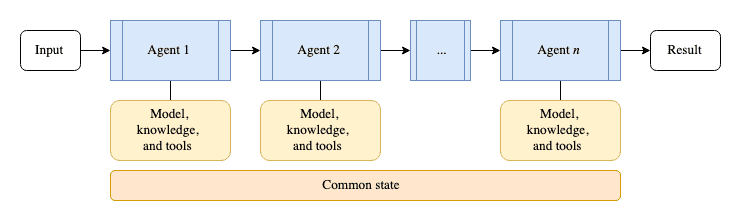
Common Agent Orchestration Patterns
One of the most useful things Microsoft’s Agent Framework docs do is name the major orchestration patterns directly. These are worth understanding because they show that orchestration is not one architecture but a family of architectures.
Sequential Orchestration
In a sequential pattern, agents act one after another in a defined order. This is useful when each step depends on the previous one. Microsoft lists this as a built-in pattern.
Example:
Planning agent defines the work
Research agent gathers information
Writer agent drafts output
Reviewer agent checks quality
Sequential orchestration is easier to reason about and often safer, but it may be slower than parallel execution.
Concurrent Orchestration
In a concurrent pattern, multiple agents work in parallel. Microsoft lists this as a built-in orchestration style, and Anthropic’s research system uses parallel search agents as a concrete real-world example.
This is useful when tasks can be split independently, such as:
searching multiple sources,
evaluating multiple strategies,
or running multiple domain specialists at the same time.
Handoff Orchestration
In a handoff pattern, one agent transfers control to another based on context. Microsoft includes this as a core orchestration type.
This is useful when one agent recognizes that another specialist is better suited to the next step. For example, a general assistant might hand a legal question to a legal agent or a code issue to a coding agent.
Group Chat Orchestration
In a group-chat pattern, several agents collaborate in a shared conversation or shared working space. Microsoft lists this too, and IBM’s broader orchestration vision similarly emphasizes coordinated multi-agent collaboration.
This can be useful for brainstorming, debate, or iterative collaborative refinement, though it may be more complex to control.
Manager-Agent or “Magentic” Orchestration
Microsoft’s docs call this magentic orchestration: a manager agent dynamically coordinates specialized agents. This is one of the clearest examples of agent orchestration as most people imagine it — an AI “manager” decides who should do what.
This pattern is powerful because it can be adaptive, but it also introduces more complexity and more room for failure if the manager agent makes poor routing decisions.
Agent Orchestration vs Workflow Automation
These two ideas overlap, but they are not identical.
Traditional workflow automation is usually deterministic. The path is predefined. A trigger happens, then step A, then B, then C. AWS’s orchestration-models guide explicitly contrasts rule-based orchestration with AI-native orchestration. Rule-based systems are reliable and repeatable, while AI-native orchestration adds intent interpretation, tool selection, and autonomous execution.
LangGraph’s workflows-and-agents guide makes a similar distinction:
workflows have predetermined code paths
agents are dynamic and define their own processes and tool usage.
So agent orchestration is generally more dynamic than classic workflow automation. It may still include deterministic steps, but it usually adds some level of:
flexible planning,
adaptive tool use,
dynamic routing,
or autonomous delegation.
That is why orchestration is becoming more important in AI systems: it allows software to handle ambiguity and changing goals better than static workflow engines alone.
Agent Orchestration in Production Systems
In real deployments, orchestration is not only about routing prompts. It is also about making agent systems operable.
LangGraph’s overview stresses durable execution, streaming, and human-in-the-loop. CrewAI’s documentation emphasizes production readiness, with guardrails, memory, knowledge, and observability baked in. IBM watsonx Orchestrate focuses on connecting agents, tools, and workflows across systems with centralized governance.
This shows a broader truth: once agents leave the demo stage, orchestration becomes an operational discipline. A production orchestration layer often needs:
retries and failure handling,
logging and tracing,
state persistence,
permissions and policies,
cost management,
and evaluation systems.
Anthropic’s engineering posts on evals and harnesses for long-running agents reinforce this point. Good orchestration is not just “who does what.” It is also “how do we make this reliable over hours or days?”
Why Agent Orchestration Is Hard
Agent orchestration sounds elegant, but it is difficult for a few reasons.
Too Much complexity can hurt reliability
Anthropic’s practical guidance on building effective agents warns that successful systems are often simpler than people expect. Over-engineered orchestration can add more failure points than value.
More agents mean more coordination overhead
Every extra agent adds:
communication overhead,
context handoff issues,
state synchronization problems,
and more opportunities for divergence.
This is one reason orchestration frameworks emphasize durable execution and observability.
Memory and context management become difficult
Long-running multi-agent systems can span many context windows. Anthropic’s engineering posts on long-running harnesses are essentially about this problem: how do agents keep making progress when the work is longer than a single context window?
Evaluation gets harder
A bad result in a multi-agent system might be caused by:
the planner,
the routing logic,
the wrong tool call,
a bad handoff,
or a specialist agent’s output.
Anthropic’s evals post highlights how important good evaluation becomes as systems get more complex.
Governance and trust matter more
If orchestrated agents are acting across customer support, coding, finance, or enterprise systems, businesses need visibility and control. IBM and Microsoft both emphasize governance, telemetry, and control as orchestration concerns.
Benefits of Agent Orchestration
Despite the complexity, the benefits can be substantial.
Better specialization
Instead of forcing one general-purpose agent to do everything, orchestration lets specialists handle what they do best. IBM’s definition of orchestration around specialized agents captures this directly.
Better scalability
Parallel or distributed work can let systems handle larger tasks faster. Anthropic’s use of parallel search agents is a strong example.
Better reliability through structure
When done well, orchestration creates explicit patterns for how work should move through the system instead of leaving everything to one opaque agent loop. Microsoft’s built-in orchestration patterns are a direct reflection of this idea.
Better human oversight
Human-in-the-loop checkpoints, approval steps, and observability often live naturally in the orchestration layer. LangGraph and IBM both emphasize this.
Better fit for real-world tasks
Most enterprise and developer workflows are not one-step problems. They are messy, multi-step, and collaborative. Orchestration is often what makes agents usable in those environments. AWS and Anthropic both frame orchestration as key to production agent systems.
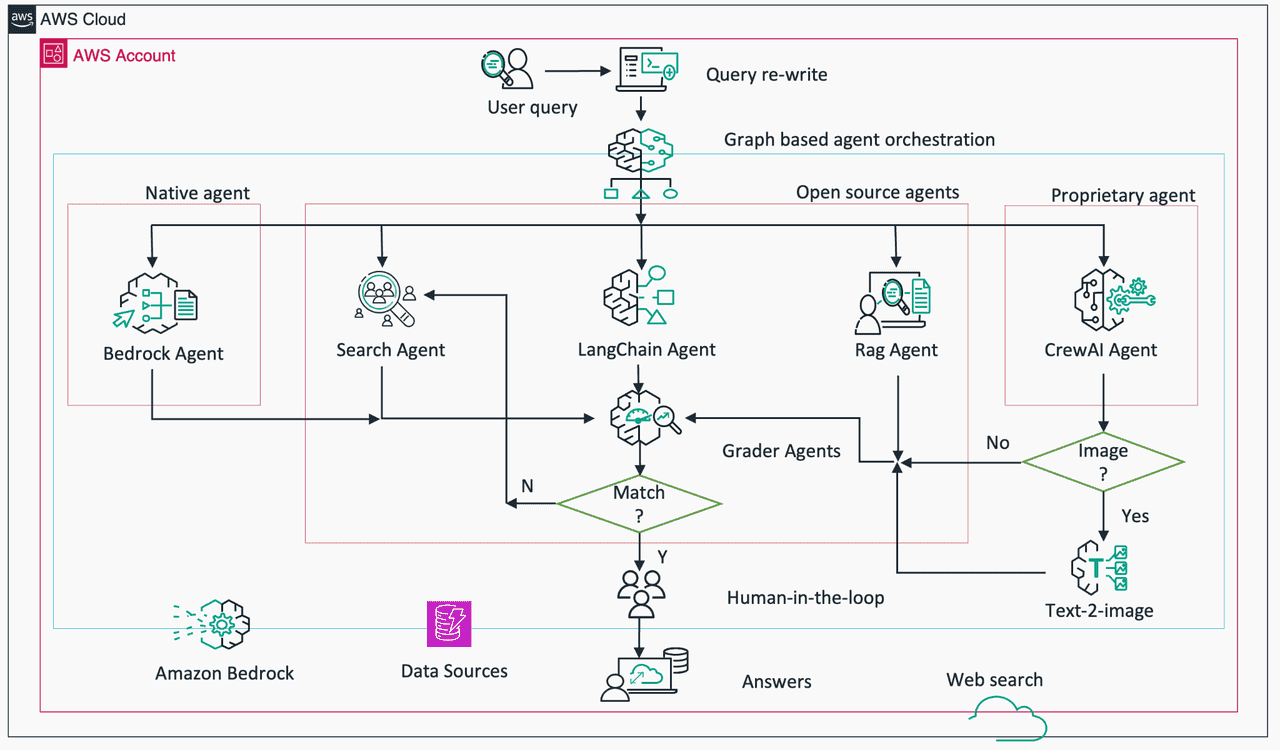
Real-World Uses of Agent Orchestration
Agent orchestration is already showing up in several practical areas.
Research systems
Anthropic’s research system uses a planner plus parallel search agents to handle information gathering more effectively.
Coding systems
Anthropic’s 2026 coding trends report says the primary human role in software increasingly shifts toward orchestrating AI agents, evaluating outputs, and guiding system design.
Enterprise assistants
AWS Bedrock Agents and IBM watsonx Orchestrate both position orchestration as central to enterprise-grade assistants that work across tools, workflows, and knowledge sources.
Customer support
AWS Connect’s orchestrator AI agent is explicitly designed to resolve customer interactions across self-service and agent-assistance use cases, coordinating tools and MCP integrations.
Multi-agent developer frameworks
CrewAI, LangGraph, and Microsoft Agent Framework all provide orchestration as a first-class concept, which is a strong signal that this is no longer a niche idea.
Why Agent Orchestration Matters for Crypto and Web3
As AI agents become more involved in:
autonomous trading,
agent wallets,
onchain research,
A2A commerce,
and DeFAI systems,
they will increasingly need orchestration. A trading system may need one agent for market analysis, one for risk control, one for execution, and one for reporting. An agentic commerce system may need orchestration between negotiation, payment authorization, and settlement steps.
This is partly inference, but it follows naturally from the production patterns now emerging in agent systems. If crypto is going to become more machine-native, agent orchestration will likely be one of the control layers that makes that possible. The same infrastructure themes — memory, guardrails, observability, and dynamic tool use — are already central in mainstream orchestration frameworks.
Conclusion
Agent orchestration is the layer that coordinates multiple AI agents, tools, and workflows so they can function like a coherent system instead of a pile of disconnected models.
It includes task decomposition, routing, execution control, state handling, tool use, and often safety and observability too. Microsoft, IBM, AWS, Anthropic, LangGraph, and CrewAI are all treating orchestration as a foundational design layer for modern agent systems, which is a strong sign that the concept is moving from theory into production practice.
As AI agents, autonomous workflows, and machine-native markets continue to evolve, agent orchestration is becoming an increasingly important topic for both builders and traders. For users looking to stay ahead of emerging narratives—from AI agents and autonomous systems to RWAs, chain abstraction, and PayFi—Phemex offers a secure and user-friendly platform to explore the market, monitor new opportunities, and sharpen your trading edge.
Register](https://phemex.com/register?group=7916&referralCode=CUFKP8%22>Register) on Phemex Now
