









Key Takeaways
Phemex’s Prediction Market product lets users trade the outcomes of real-world events, with market prices functioning as live probability signals.
The basic user flow is straightforward: log in, enter the Prediction Market section, choose a market, select YES or NO, enter your stake, and confirm the trade.
Prediction-market contracts should be read probabilistically: a higher YES price generally means the market sees that outcome as more likely.
Before trading, users should pay close attention to market wording, timing, and settlement conditions, because a prediction market is only as clear as its resolution rules.
Prediction markets are one of the most interesting products to emerge at the intersection of crypto, information, and trading. Instead of buying or shorting an asset, users trade the probability of a future outcome. A market may ask whether Bitcoin will reach a target, whether a policy decision will happen, or whether a real-world event will resolve one way or another. The result is a live price that reflects what the crowd currently believes.
For users who are new to the format, the mechanics can seem unfamiliar at first. What does it mean to buy YES? What happens after a market resolves? How do you actually place a trade on the platform?
This guide walks through the process step by step. It explains how to access Prediction Markets on Phemex, how to choose a market, how to buy a YES or NO position, what to watch before confirming a trade, and how outcomes are settled after resolution.
What Are Prediction Markets on Phemex?
Phemex’s Prediction Markets are designed around outcome trading. Rather than trading BTC, Ethereum, or a perpetual contract, users trade a view on whether a specific event will happen.
That makes this product different from conventional spot markets or futures trading. In spot markets, traders buy and sell crypto assets directly. In futures, they trade derivatives tied to asset prices. In prediction markets, the core object being traded is uncertainty itself.
Before You Start: What You Need
Before placing your first prediction-market trade on Phemex, make sure the basics are in place.
First, you need a Phemex account. Second, KYC may matter for access to certain campaigns or product participation. Third, you should make sure your account is funded. Finally, remember that prediction markets involve risk so don’t trade more than you are willing to lose.
Step 1: Log In to Your Phemex Account
The first step is simple: sign in to your Phemex account, or create one if you are a new user. If you are brand new to the platform, complete any required identity-verification steps and make sure your account is ready for product access before you try to trade.
Step 2: Navigate to the Prediction Market Section
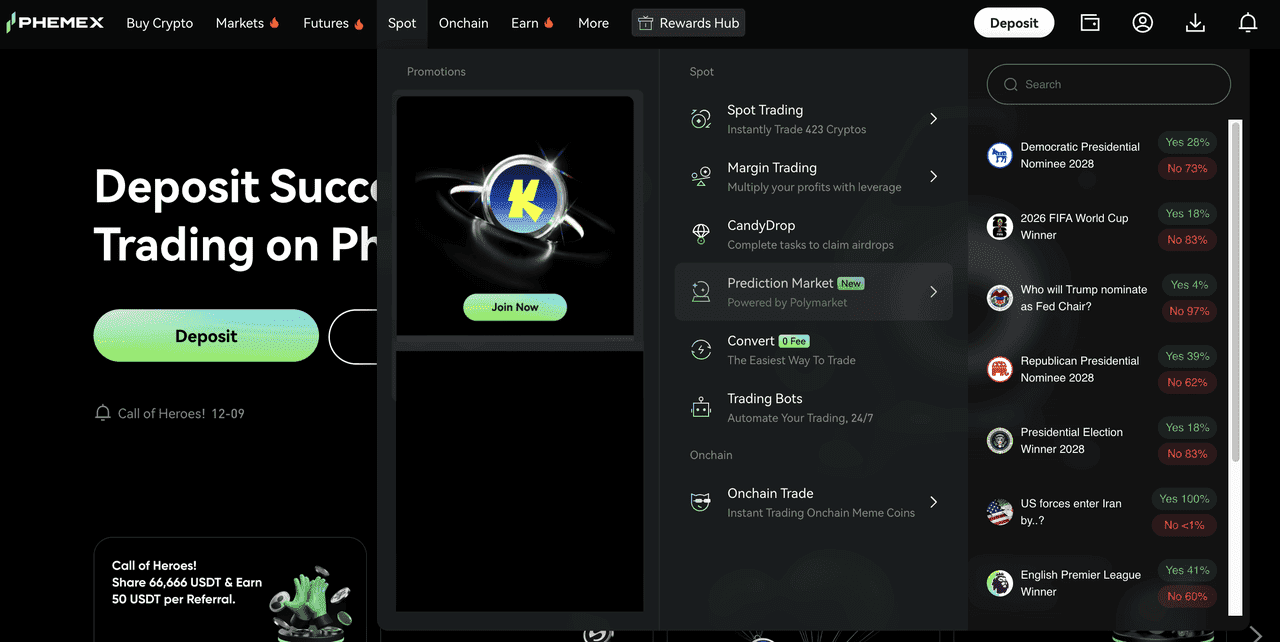
Navigate to the Phemex Prediction Market product by hovering over the Spot tab on the top navigation bar, then clicking on Prediction Market On the main Prediction Market page, you will see many open markets to wager on.
Step 3: Browse Available Markets
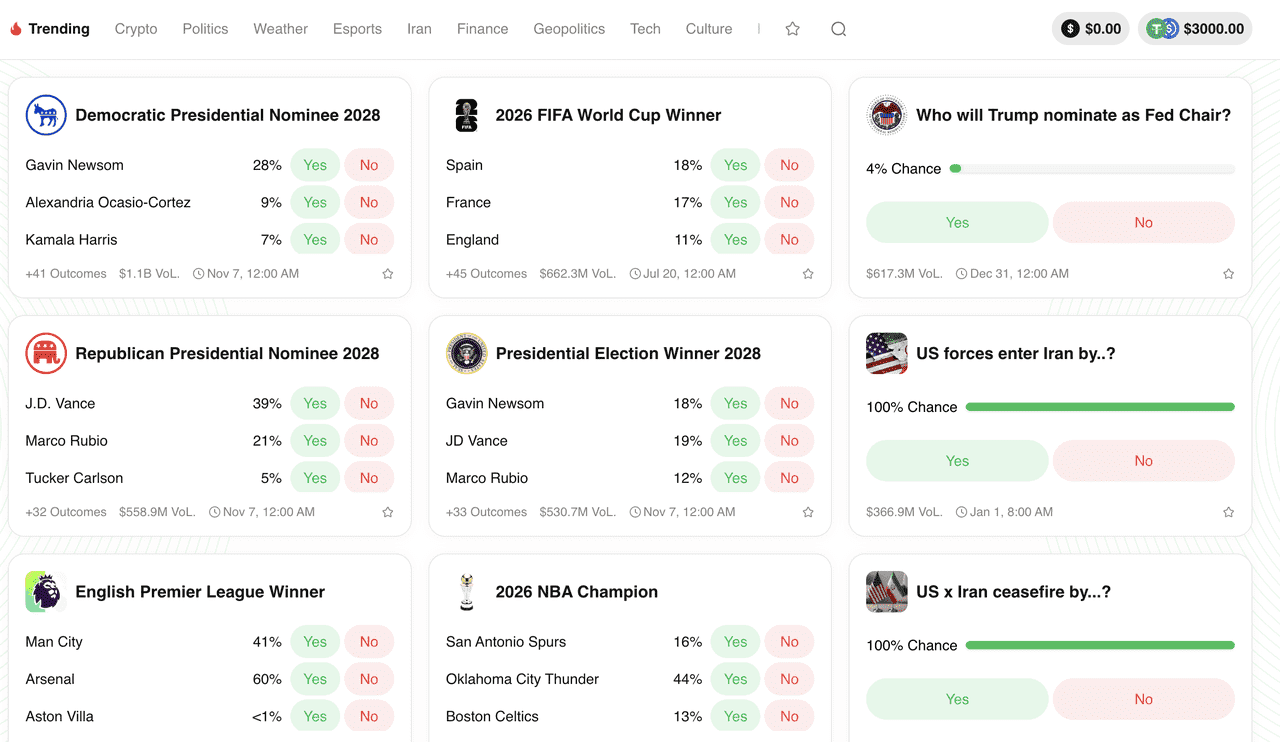
After entering the Prediction Market page, you will be presented with available event markets. The event markets can be browsed by categories, ranging from crypto to politics to weather, sports, geopolitics, and more. You’ll also be able to view your available funds on the upper right corner.
At this stage, do not rush into the first trending market you see. Browse carefully and ask a few basic questions:
What exactly is the event being asked?
Is the deadline clearly stated?
Does the event depend on a price level, a date, a public announcement, or a measurable outcome?
These questions matter because prediction markets are only useful when the event wording is clear. A trader should never assume they understand a market just because the headline sounds familiar.
Step 4: Read the Market Carefully Before Trading
A prediction market may look simple on the surface, but careful reading matters. Before placing a trade, check:
The exact wording of the market
The event deadline or cutoff time
Whether the condition must happen before, on, or by a certain date
Whether the outcome is based on a public source, market close, official release, or final result
How many outcomes are available for the market.
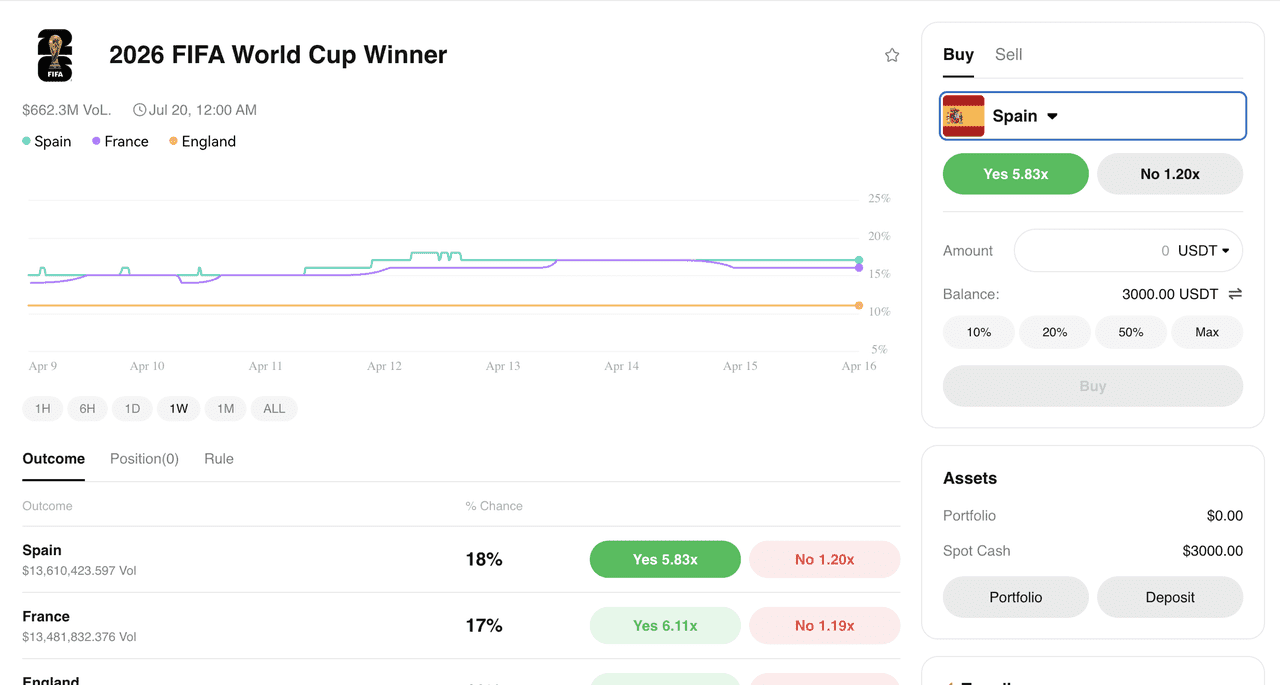
You can do this by clicking the specific event. You’ll arrive at a page that shows a graph of how each outcome has been priced over a specified previous timeframe. Scroll down to view each event outcome in detail especially in regards to its pricing. You can also click the “Rule” tab to read exactly how the market will resolve.
This step is not just administrative. It is central to how prediction markets work. In outcome trading, getting the interpretation wrong can be as costly as getting the forecast wrong.
Step 5: Choose YES or NO
Once you have selected a market, the next step is to choose to trade YES or NO.
For any market, you can trade YES or NO on whether a certain outcome will occur. The following is the core directional decision in a prediction market:
YES means you believe the event will happen as defined.
NO means you believe it will not happen as defined.
This structure is what makes prediction markets easy to understand conceptually. Instead of building a complex derivatives position, you are taking a direct stance on an event. Remember that you are entering a market whose pricing reflects crowd expectations. That means the level at which you enter matters, not just whether your opinion is directionally correct.
Step 6: Enter Your Trade Size
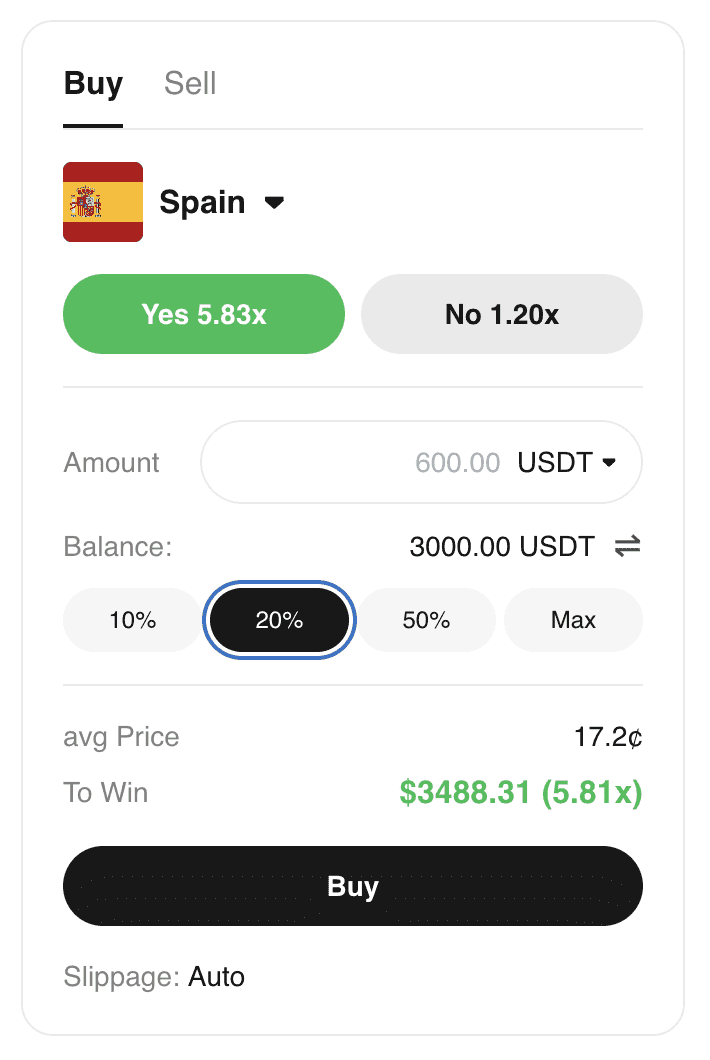
After selecting the outcome you want to trade, simply click on YES or NO and then the interface will show a field to enter your trade size. On the same window, you’ll see the minimum order size as well as how much you can win based on the outcome, your directional prediction, and your current trade size. Currently, you can trade in USDT or USDC. After entering your desired amount, click the “Buy Yes” or “Buy No” button below.
Even if you strongly believe an outcome is mispriced, you should still think carefully about:
How much capital you want to risk
Whether the market is volatile
How certain you actually are
Whether the potential reward justifies the risk
Prediction markets can feel deceptively simple because the interface is cleaner than many futures products. But simple does not mean low-risk. A binary contract can still go to zero on the wrong side of the outcome.
Step 7: Confirm the Trade
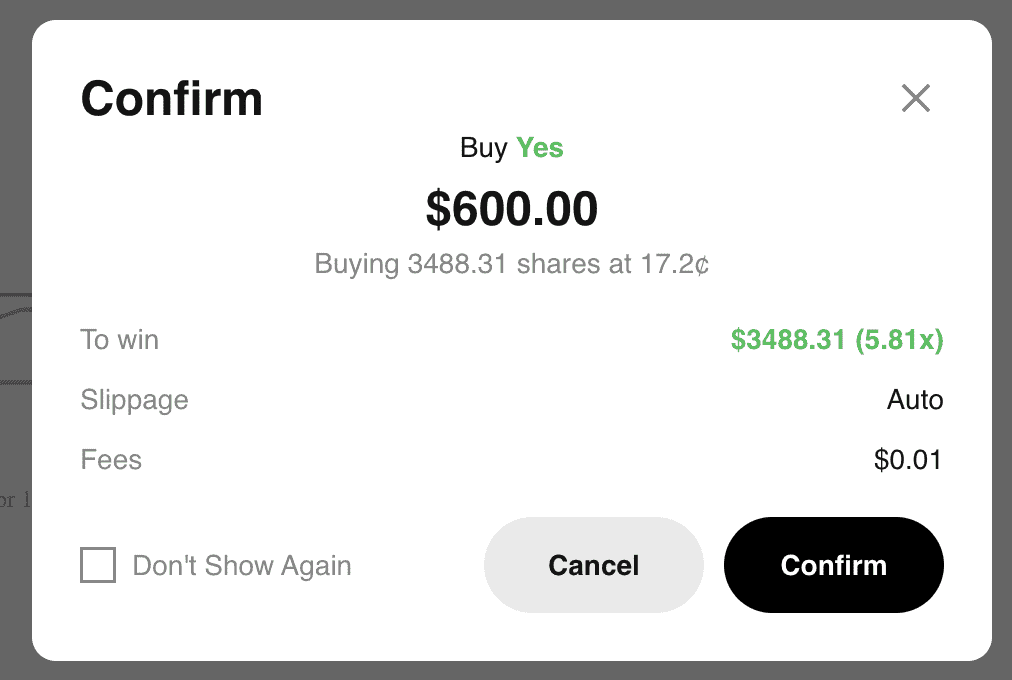
Once you have chosen your side and entered the amount, a pop up will appear asking you to confirm the order. Review the details, including trade size, amount you stand to win, slippage, and fees and then click to confirm.
This is a good moment to double-check what you actually entered:
Did you buy the intended side?
Did you commit the correct amount?
Are you comfortable holding through the event?
Do you understand what must happen for your side to win?
Step 8: Monitor Your Position
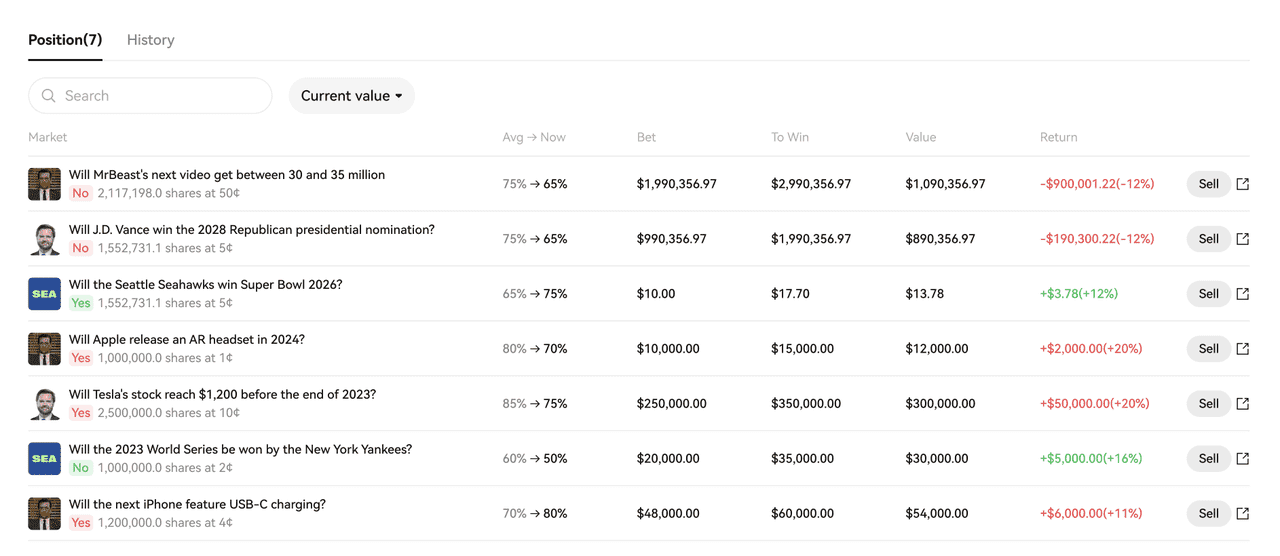
After the trade is placed, you can monitor it from the event page by scrolling down to the Positions tab. You’ll be able to track how many shares you have in each directional outcome, the probability movement over time, your trade size, the amount you stand to win, the value of your current shares, and your current returns.
Once your position is open, it is worth watching how the market evolves. In prediction markets, prices often shift as new information enters, so it’s imperative to constantly review your positions.
Step 9: Wait for the Outcome to Resolve
Prediction markets do not settle like an ordinary spot trade. They settle when the event resolves. Once the results of the prediction have been released, users can collect winnings in the relevant action section.
This means there is an important distinction between:
the trading phase, when users take positions on the outcome
the resolution phase, when the event becomes known
the settlement or collection phase, when eligible winnings are claimed
The exact timing depends on the event itself. Some markets resolve quickly after a known result. Others may require waiting for final confirmation from an official source or closing value.
Common Mistakes Beginners Make
Trading the headline without reading the rules
A market title may seem obvious, but details matter. Always read the exact condition and timing.
Confusing high probability with certainty
Even if the crowd strongly favors one side, that side can still lose.
Oversizing positions
Binary markets can look simple, which tempts users to bet too much on a single thesis.
Ignoring event timing
Some trades are not about direction alone. They are about whether something happens within the required time window.
Treating prediction markets like entertainment only
Phemex frames these markets around crowd probability and event outcomes. The smarter way to approach them is as information-rich trading products, not just quick guesses.
Risk Management Tips for Prediction-Market Traders
Prediction markets may be easier to understand than some derivatives, but they still require discipline.
A few practical habits can help:
risk only a small portion of capital per event
avoid chasing a market after a dramatic move unless you understand why it moved
prefer markets with clear wording and clear timelines
keep emotion separate from event interpretation
remember that being directionally confident is not the same as having a good entry
Risk management is key.
Conclusion
Trading prediction markets on Phemex is conceptually simple: log in, navigate to the Prediction Market section, choose a market, select YES or NO, enter your stake, confirm the trade, and monitor your positions. But using the product well requires more than knowing where to click. The real edge comes from understanding what you are trading: not just an event, but the market’s current estimate of that event’s probability. The better you get at reading market wording, interpreting odds, and managing risk, the more useful prediction markets become.
