









SpaceX is the most valuable private company on the planet — internally valued north of $400 billion in late-2025 secondary rounds — yet not a single share trades on the Nasdaq, NYSE, or any retail brokerage. That paradox is why how to buy SpaceX stock is currently a Google Trends Breakout query across the US, UK, India, and the Philippines.
This guide walks you through every realistic path to SpaceX exposure available to retail investors in 2026, ranks them by accessibility, and shows you step-by-step how to use the newest and most accessible option: the SPCXUSDT Pre-IPO Perpetual contract, now live on Phemex.
Quick Answer (For Featured-Snippet Readers)
You cannot buy SpaceX stock directly in 2026 because the company is private and has no IPO date. Retail investors have three indirect options: (1) accredited-investor private secondaries (requires $1M net worth, $50K+ minimums), (2) pre-IPO funds (high fees, long lockups), or (3) a pre-IPO perpetual contract like SPCXUSDT Perp on Phemex — the only path with 24/7 access, fractional sizing from ~$200, and two-way (long/short) directionality.
Step 1: Understand Why SpaceX Has No Public Stock
SpaceX has stayed private by founder design. Elon Musk has repeatedly said the parent company will not list publicly until Starship is reliably running cargo and crew to Mars — a milestone analysts place beyond 2027. A Starlink-only IPO has been rumored for late 2026 or 2027, but no S-1 has been filed.
That means three things for retail:
- No ticker symbol exists on any traditional stock exchange.
- Search engines surface dozens of "how to buy SpaceX stock" pages, almost all of which either gate you behind accreditation or redirect you to indirect proxies.
- The information asymmetry between insiders (who can buy at $185–$210 in secondary rounds) and retail (who cannot buy at all) has been the main driver of the search-volume breakout.
Step 2: Evaluate the Three Realistic Exposure Paths
Option A — Accredited Private Secondaries
Who qualifies: US investors with $1M+ net worth (excluding primary residence) or $200K+ annual income. Minimum check size: Typically $50,000–$100,000 per share lot. Lockup: Often 12–60 months, with transfer restrictions. Verdict: Effectively inaccessible for the average retail trader. Skip unless you already qualify.
Option B — Pre-IPO Funds and SPVs
Structure: Pooled vehicles (often Reg D or Reg S) that hold private SpaceX positions and pass through fractional exposure. Fees: 2% management + 20% carry is standard, sometimes plus a 5–10% upfront placement fee. Liquidity: Limited or none until SpaceX IPOs. Some funds offer occasional secondary-window exits at the GP's discretion. Verdict: Workable for high-net-worth investors who can lock capital for years, but the fee drag is meaningful and the unit economics rarely favor the LP.
Option C — Pre-IPO Perpetual Contracts (SPCXUSDT Perp on Phemex)
Structure: A USDT-settled derivative that tracks an index built from private secondary-market quotes for SpaceX equity. You do not own the underlying shares; you hold a synthetic long or short position. Minimum: 0.01 contracts — roughly $1.88 of notional at the current ~$187.95 mark, or under $200 in margin even with conservative leverage. Liquidity: 24/7, including weekends and US holidays. Direction: Long or short — the only retail option that lets you express a bearish view on SpaceX's private valuation. Verdict: The only legitimate, low-minimum, two-way pathway for retail in 2026.
Step 3: Read the Live SPCX Tape Before You Trade
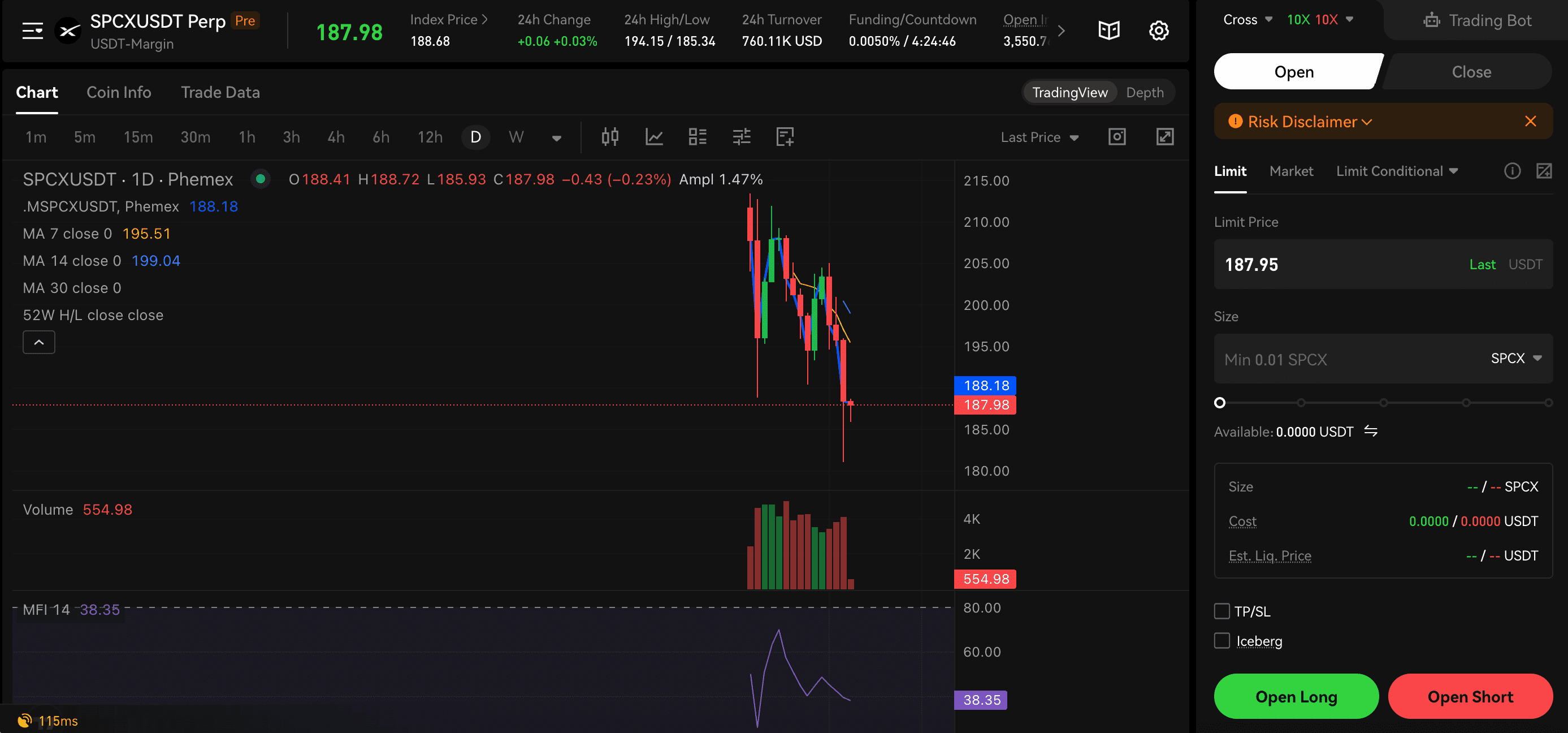
Before opening any position, anchor your decision in current data. Here is the SPCXUSDT Perp (Pre) tape on Phemex at the time of writing:
- Index Price: $188.63
- Last Price: $187.95
- 24h Change: −0.20% (−$0.39)
- 24h High / Low: $194.15 / $185.34
- 24h Turnover: ~$765,000 USD
- Open Interest: 3,559.7 contracts
- Funding Rate: +0.0050% (next funding in ~4h 40m)
- Max Leverage: 10x cross
The 7-day moving average ($195.50) and the 14-day ($199.04) both sit above spot, signaling a short-term cooldown from a recent run. The Money Flow Index reads 38.37 — below the neutral 50 line, approaching but not yet at the oversold threshold (<20).
The funding rate is the single most important number on the page. At a marginally positive +0.005%, longs are paying shorts a near-zero premium. That confirms a balanced book — no crowded long, no panic short — which is exactly the kind of tape that typically precedes the second leg of a Google Trends breakout, not the blow-off top.
Step 4: Open a Position on Phemex — A Walkthrough
If you decide Option C is your path, here is the exact flow:
- Create or log into your Phemex account. Complete KYC if you haven't already; pre-IPO perpetual products are gated to verified users in eligible jurisdictions.
- Deposit USDT. SPCXUSDT Perp is USDT-margined, so you'll fund the contract account with USDT (TRC-20, ERC-20, or any supported network).
- Navigate to Trade → USDT-M Perpetual → SPCXUSDT (Pre). The "Pre" badge indicates a pre-IPO contract; the orange Risk Disclaimer panel appears on first entry — read it.
- Set leverage. The default is 10x cross. For first-time pre-IPO traders, dial this down — 2x to 3x is the sensible starting envelope.
- Choose order type. Limit, Market, or Limit Conditional. Limit orders avoid slippage on a low-turnover tape like SPCX; market orders are fine for small size.
- Set position size. The minimum is 0.01 SPCX. The slider lets you scale up by percentage of available margin.
- (Optional) Configure take-profit and stop-loss. Pre-setting take-profit and stop-loss levels is strongly recommended — verbal stops do not survive a 5% news spike.
- Click Open Long or Open Short. The platform confirms cost, size, and estimated liquidation price before execution.
Step 5: Manage Risk Like a Pro, Not a Tourist
Pre-IPO perpetuals are a higher-volatility instrument than spot crypto and traditional equities. Four risks deserve real attention:
- Index dislocation. Private secondary quotes update less frequently than public stocks. Gaps between index price and perp price can widen suddenly around news (Starship launch results, Starlink subscriber prints, IPO rumors).
- Funding-rate swings. A quiet +0.005% can flip to +0.05% or higher overnight if a Starlink IPO headline hits. Crowded longs pay aggressively.
- Liquidation on leverage. At 10x, a ~9–10% move against you wipes the position. SPCX's 24h range above shows ~4.7% intraday volatility is normal — 10%+ moves on news are entirely plausible.
- No earnings anchor. Unlike a public stock, the pre-IPO valuation is reflexive — driven by narrative and secondary supply, not quarterly cash flows.
The professional position-sizing rule for pre-IPO perps: 1–3% of total trading capital per trade, with pre-set hard stops. That single discipline is the line between a measured allocation and a casino chip.
For more on risk management, see our professional guide.
Step 6: Know What You Are Actually Buying
Repeat this to yourself before you click confirm: a perpetual contract is not equity. You do not get cap-table representation, voting rights, dividends (SpaceX pays none anyway), or any claim on Starlink, Starshield, or Starship revenues. What you own is a USDT-denominated derivative whose mark price tracks — but is not identical to — the private secondary-market valuation of SpaceX shares.
That distinction matters. It is also the reason a pre-IPO perp can offer 24/7 access and a $200 minimum: it is a synthetic, not a security registration.
Start Trading TradFi on Phemex
Bottom Line
The honest answer to "how to buy SpaceX stock" in 2026 is that you can't, in the literal sense. But for the first time, retail investors have a legitimate, fractional, two-way way to express a directional view on SpaceX's private valuation: the SPCXUSDT Pre-IPO Perpetual on Phemex. Used with sensible leverage, pre-set stops, and 1–3% position sizing, it turns a search-engine dead end into a tradable thesis.
The Google Trends curve suggests retail interest in the private rocket economy isn't fading before the next Starship test flight or Starlink IPO rumor. The traders who do well in that window will be the ones who treat SPCX as a precision instrument, not a lottery ticket.
