



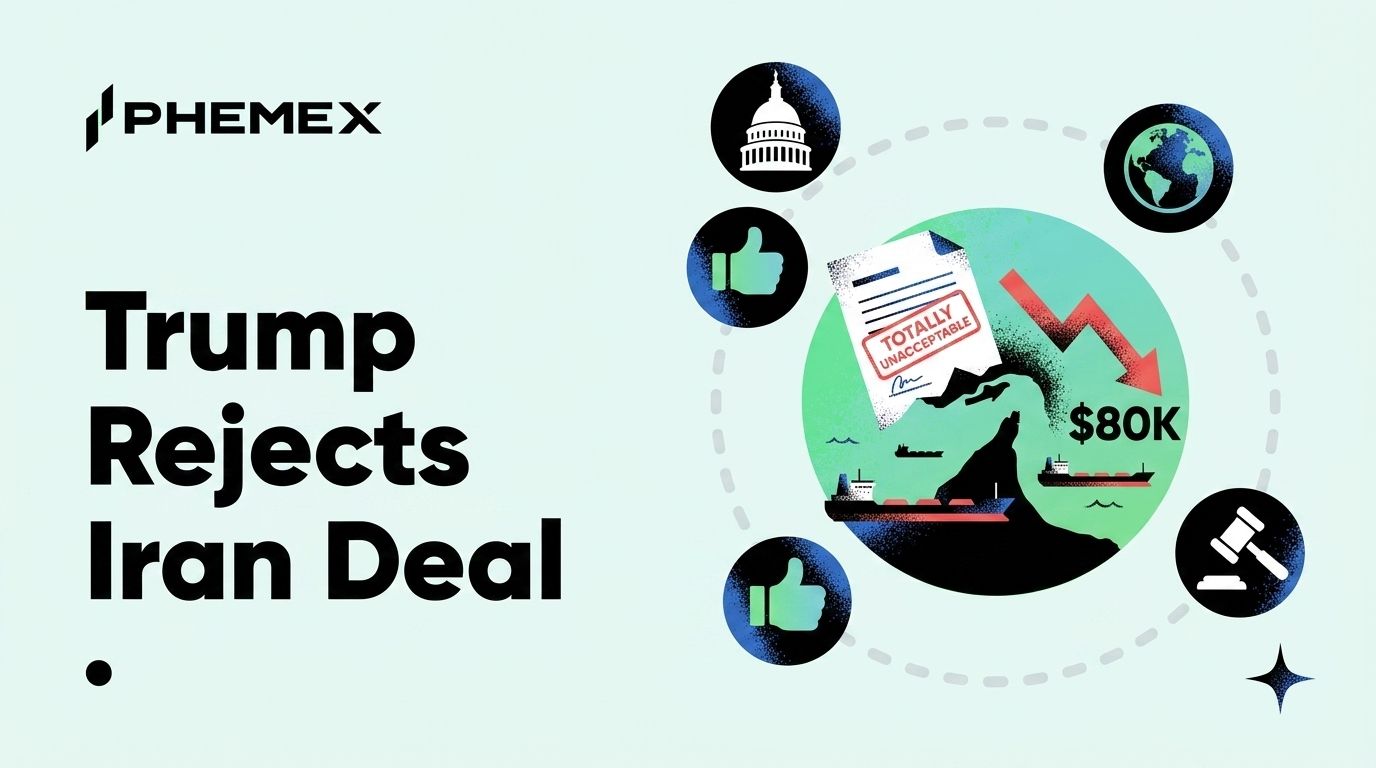
Bitcoin briefly traded above $82,400 on Sunday before slipping under $81,000 and sliding toward the $80,000 handle after President Trump rejected Iran's latest counteroffer on May 11, 2026, calling the proposal "totally unacceptable" in a Truth Social post that landed in the middle of crypto's thin weekend tape. Trump's exact phrasing was direct. "I have just read the response from Iran's so-called 'Representatives.' I don't like it. TOTALLY UNACCEPTABLE!" He followed it by telling reporters the cease-fire is on "massive life support" and "unbelievably weak," and the White House announced a fresh round of sanctions hours later.
This is not a continuation of last week's headlines. This is the specific rebuke that flipped the negotiation framework from "close to a deal" back to "preparing for re-escalation," with Project Freedom (the US naval escort operation Trump paused on May 5) now on the table again and oil pushing $98.70 a barrel. Here is what Iran actually proposed, why Trump killed it, and what every level on the BTC chart says about how the market is positioning.
What Iran Actually Asked For
Iran's counterproposal was not a small ask. It was a staged framework with four hard demands stacked in the opening phase, and Trump's team rejected it before the second phase could even be discussed.
The proposal called for the immediate removal of all US sanctions, the immediate withdrawal of the US military blockade from the Strait of Hormuz, formal Iranian sovereignty over the Strait, and a deferral of nuclear talks to later negotiation rounds. The structure was designed to lock in Iran's strategic wins before the nuclear question was even reopened.
From Trump's perspective, the sequencing was the dealbreaker. The US position has been that Iran must formally halt its nuclear program for at least 10 years and surrender its 440-kilogram stockpile of highly enriched uranium as a precondition, not a closing chapter. Iran offering to talk about nuclear compromises "later" was, in the administration's reading, a way to extract every concession while preserving the breakout capability that started the conflict.
The "totally unacceptable" line is the cleanest signal yet that the US will not accept a phased deal where Iran banks the geopolitical wins first. That changes what the market should price.
Why the Bitcoin Reaction Was Whipsaw, Not Crash
The BTC tape over the 48 hours surrounding the rejection looked schizophrenic, and that is worth unpacking because it tells you who is actually positioning into this conflict.
Bitcoin opened the weekend session above $82,000, briefly tagged $82,400 on the initial Trump headline (a short squeeze that erased roughly $64 million per Coinglass data), then reversed and slipped to $80,520 within three hours as traders digested the sanctions follow-on. ETH followed the same path, hitting a weekly high of $2,375 before fading to $2,331. XRP held its zone, testing support around $1.45 without breaking it.
The whipsaw makes sense once you separate two flows. The first is the safe-haven bid. Since the US-Iran conflict erupted on February 28, BTC has gained 29.7%, outperforming gold and the S&P 500. That bid shows up every time the headlines suggest the conflict is widening. The second flow is the leveraged long unwind from traders who positioned for a "ceasefire deal soon" narrative through last week's CNBC coverage. Trump's rejection forced those positions out within hours.
You can see the unwind in the liquidation data. Roughly $91 million in long positions were closed in the move from $82,400 down to $80,520, and the funding rate flipped from mildly positive to flat across the major perps. That is a controlled unwind, not a panic flush, and the takeaway is that the market is not pricing capitulation but extended uncertainty.
The Project Freedom Wildcard
The single piece of this story that most traders are underweighting is Project Freedom, the US naval escort operation that Trump paused on May 5 to give negotiations room to work.
Project Freedom is the US Navy's plan to escort commercial vessels through the Strait of Hormuz under direct military protection, which would functionally end the Iranian crypto toll regime currently extracting an estimated $600-800 million per month from transiting tankers, a regime we covered in detail in our earlier piece on Iran's Bitcoin tolls in the Strait of Hormuz. The pause was the soft cease-fire gesture, and the rejection means the pause is now on a timer.
If Project Freedom restarts, two things happen in fast sequence. First, oil traders will price an immediate Iran response (mining the Strait, drone attacks on escort vessels, or asymmetric strikes), which means oil over $100 and a risk-off pulse across every asset class. Second, the IRGC's crypto toll revenue gets cut off, and the BTC bid that revenue stream represented gets removed from spot. That is a structural negative for the safe-haven thesis that most traders are not modeling yet.
The market does not yet know which direction Trump will move. The administration has said only that Trump will "meet with his top military commanders to discuss next steps," and that ambiguity is the reason BTC is whipsawing rather than directional.
Key Levels to Watch on BTC, ETH, and XRP
BTC is the cleanest chart in the group right now. The market is pinned between a clear shelf and a clear ceiling, and the next move depends on which one breaks.
$80,000 is the line in the sand. This is the round-number psychological support and the level where weekend liquidation cascades have stalled three times in the last six weeks. A clean break below $80K with continuation through $78,500 invalidates the safe-haven bid thesis and points to $76,000 as the next meaningful support (the April 21 cease-fire-extension swing low).
$82,400-$83,000 is the resistance. This is where last week's rally failed and where the Sunday spike was sold. BTC needs to reclaim $83,000 on increasing spot volume to confirm the rejection headline was a buy-the-dip moment rather than the start of a slide.
$74,000-$76,000 is the must-hold zone if conflict re-escalates. If Project Freedom restarts and oil pushes $105, BTC will likely see a sharp risk-off move first before the safe-haven flow reasserts. The 2025-2026 conflict pattern shows BTC sells off with risk assets on initial escalation, then decouples and rallies as the safe-haven bid takes over. $74K-$76K is the zone where that decoupling has historically begun.
On ETH, $2,300 is the level holding the structure. A break of $2,300 opens $2,180 as the next test, and below that the April lows in the $2,050 zone become live. ETH has been the laggard in this cycle and a Hormuz re-escalation will not help that ratio.
XRP at $1.45 is binary. Hold and the asset stays in its consolidation pattern with upside resistance at $1.62. Break and the air pocket extends to $1.32, the April pivot. The chart has been respecting these levels closely, so a clean break either way is likely to follow through.
How This Fits Into the Broader Iran-Crypto Pattern
This is the third major leg of the Iran story for crypto markets in 2026, and the pattern has been remarkably consistent. The market is not pricing the conflict itself so much as it is pricing the negotiation expectations.
When Trump extended the cease-fire on April 21, BTC hit an 11-week high at $77,500 within hours. When Iran rejected the framework on May 7, BTC slipped 4%. When Trump rejected Iran's counteroffer on May 11, BTC whipsawed but held above $80K. The amplitude of each move has been shrinking, which is what you would expect as the market gradually prices in a longer-duration conflict rather than a fast resolution.
The structural backdrop matters here too. FXStreet's weekly crypto recap flagged that the BTC rally stalled this week on three converging pressures. Iran tensions, fresh inflation prints, and a heavy token release calendar all hit at once. The Iran story is the proximate catalyst, but the broader risk-off backdrop (inflation reaccelerating, Fed higher-for-longer, dollar strength) is what is keeping the floor from rising.
For traders, Iran headlines are now a tactical signal, not a regime change. Each escalation is a short opportunity into resistance and each de-escalation is a long opportunity into support, but the broader range ($76K-$88K on BTC) has held for six weeks and there is no reason yet to think this rejection breaks it.
What the Sanctions Round Means
The new sanctions package announced alongside Trump's rejection deserves a closer look because it targets the financial plumbing of the IRGC crypto operation.
Treasury's Office of Foreign Assets Control added 14 wallet addresses and three Iranian-linked OTC desks to the SDN list, all of which were involved in moving the Strait of Hormuz toll BTC revenue. The desks were operating primarily out of Dubai and Istanbul, converting incoming BTC tolls into stablecoins and onward to Iranian rial through informal hawala channels. Sanctioning the desks does not stop the tolls, but it makes the off-ramping significantly harder.
The market implication is twofold. First, expect short-term sell pressure on BTC from sanctioned wallets racing to liquidate before further enforcement. Chainalysis data has shown roughly 4,200 BTC ($337 million) sitting in addresses linked to the targeted desks, and even half of that getting force-sold over the next two weeks adds incremental supply at exactly the wrong moment. Second, the enforcement signals that the US views the crypto toll regime as a strategic vulnerability for Iran and will keep escalating financial pressure regardless of the military track. That is a slow-burn structural negative for any narrative that relied on Iranian flows.
Frequently Asked Questions
What did Trump actually reject in Iran's proposal?
Trump rejected Iran's phased counteroffer that demanded immediate sanctions removal, withdrawal of the US naval blockade from the Strait of Hormuz, and Iranian sovereignty over the Strait, while deferring nuclear program negotiations to later phases. His objection was the sequencing. The US wants Iran's nuclear stockpile and a 10-year halt as a precondition, not a closing chapter. Trump called the proposal "totally unacceptable" on Truth Social and said the cease-fire is on "massive life support."
Why did Bitcoin go up before going down on the rejection news?
Two flows hit the tape simultaneously. The safe-haven bid drove BTC briefly above $82,400 as traders priced in extended geopolitical uncertainty, squeezing roughly $64 million in short positions. Then leveraged longs that were positioned for a "deal soon" narrative got forced out as traders realized the rejection meant prolonged conflict, which unwound about $91 million in long positions and pushed BTC back under $81,000.
Is Project Freedom going to restart?
The honest answer is nobody knows yet, and the administration is keeping the optionality open. Trump said he would meet with his top military commanders to discuss next steps, which is administration language for "all options are on the table but no decision today." If Project Freedom restarts, expect oil over $100, an immediate risk-off pulse across crypto, and then a potential decoupling as the safe-haven bid takes over. The market is currently pricing roughly a 40% probability of restart within 30 days based on prediction-market data.
What level should I watch on BTC to know if the safe-haven thesis is still working?
$80,000 is the line. As long as BTC holds above $80K on Iran-related selling, the safe-haven thesis is intact and the broader $76K-$88K range stays valid. A clean break below $78,500 invalidates that thesis and opens $76,000 as the next test. If $76K breaks, the structural narrative shifts from "BTC as safe haven" to "BTC as risk asset selling off with everything else."
Bottom Line
The Iran-US negotiation framework is now functionally on hold for at least the rest of May, and the market needs to price duration rather than resolution. Trump's "totally unacceptable" line was the cleanest signal in two months that the administration will not accept a phased deal where Iran banks geopolitical wins first, which means the conflict baseline gets pushed out by several weeks.
For BTC, the relevant trade is the $80,000 line. Hold above it through this week and the safe-haven bid is intact, with a re-test of $83,000 likely once Project Freedom uncertainty resolves either direction. Lose $78,500 with continuation and the air pocket down to $76,000 opens fast. ETH at $2,300 and XRP at $1.45 are the equivalent levels for their respective charts.
The bigger picture is that each Iran headline is now producing a smaller amplitude move than the one before. The market has learned the pattern, and the rejection on May 11 will not be the last twist. Position for the range, not for the resolution.
This article is for informational purposes only and does not constitute financial or investment advice. Cryptocurrency trading involves substantial risk. Always conduct your own research before making trading decisions.