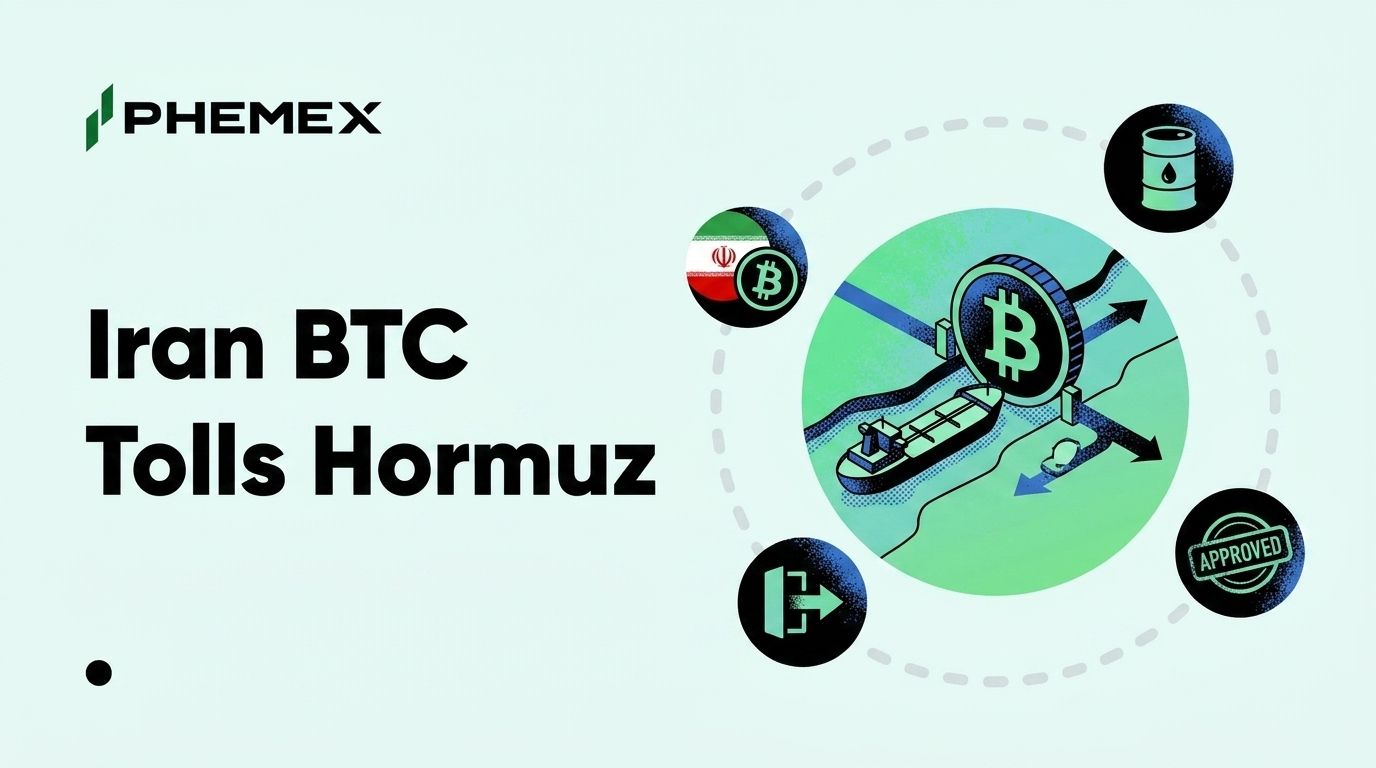
Since mid-March 2026, the Islamic Revolutionary Guard Corps has been charging oil tankers and LNG carriers up to $2 million each to pass through the Strait of Hormuz, and it wants payment in Bitcoin, USDT, or Chinese yuan. The toll runs approximately $1 per barrel of crude cargo, meaning a fully loaded very large crude carrier hauling 2 million barrels pays $2 million before it clears the waterway. At current traffic levels, roughly 21 million barrels of oil per day, that translates to an estimated $600-800 million per month once LNG vessels are included.
This is not a hypothetical policy proposal or a think tank scenario. Iran's Oil, Gas and Petrochemical Products Exporters' Union confirmed the fee structure, and the Iranian parliament formally codified it as the "Strait of Hormuz Management Plan" on March 30-31, 2026. Ships are reportedly given seconds to transfer the exact amount in Bitcoin to an Iran-controlled wallet. The logic from Tehran's perspective is straightforward. Crypto payments are harder to trace, harder to freeze, and harder to sanction than anything running through SWIFT.
Why the Strait of Hormuz Matters This Much
About 20% of the world's oil supply and a significant share of global LNG passes through the Strait of Hormuz every day. The waterway sits between Iran and Oman, stretching roughly 21 miles at its narrowest point, and there is no alternative route for tankers leaving the Persian Gulf. Saudi Arabia, Iraq, Kuwait, the UAE, and Qatar all depend on it for the bulk of their energy exports.
When Iran closed the strait briefly earlier this year, Bitcoin was the only major global asset that could be traded in real time because traditional markets were shut. BTC hit an intraday high of $72,825 during that episode before settling around $71,587. The reopening under a ceasefire agreement normalized roughly 20% of global oil supply flows overnight, and oil prices crashed 16% on the news.
That context matters because Iran is now leveraging its geographic chokepoint to build a revenue stream denominated entirely outside the dollar system. Every tanker that pays the toll in crypto or yuan is a transaction that bypasses SWIFT, bypasses correspondent banking, and bypasses the sanctions architecture that the U.S. Treasury has spent two decades constructing.
How the Toll System Actually Works
The fee structure is tiered based on cargo volume, with oil tankers paying approximately $0.50-$1 per barrel of crude they are carrying. A fully loaded VLCC at 2 million barrels faces a $2 million toll, while smaller vessels pay proportionally less but the per-barrel rate stays consistent.
Iran accepts three payment methods, and Bitcoin is the headline, but USDT (Tether's dollar-pegged stablecoin) appears to handle the majority of actual volume according to reporting from Fortune. Chinese yuan routed through Kunlun Bank via CIPS (China's alternative to SWIFT) is the third option, and it handles the non-crypto portion.
The speed requirement is notable. Crews reportedly have seconds to complete the transfer to an Iran-controlled wallet address. That operational detail tells you something about the infrastructure behind this, because Iran is not improvising. The IRGC has been building crypto payment rails for years, processing transactions through a network of exchanges and wallets that Chainalysis estimated received $7.8 billion in 2025 alone, up from $3.17 billion in 2023. The Hormuz toll system is the most visible application of infrastructure that was already running at scale.
The Revenue Math Is Hard to Ignore
At 21 million barrels per day transiting the strait and $1 per barrel, the gross daily intake from oil tankers alone reaches $21 million. That is $630 million per month from crude traffic. Add LNG carriers and the number climbs toward the $800 million monthly ceiling that multiple analysts have cited.
Bitcoin Magazine estimated the annualized figure at north of $7.6 billion if the toll operates continuously at full capacity. That number assumes no disruptions, no ceasefire changes, and no rerouting, so it represents a ceiling rather than a forecast. But even at half capacity, $3-4 billion per year in crypto and yuan revenue flowing to the IRGC represents a funding stream that exists entirely outside Western financial surveillance.
For comparison, Iran's total crypto inflows from all sources hit $7.8 billion in 2025. The Hormuz toll system alone could match or exceed that figure in its first full year of operation. The scale of what is happening here is not a rounding error in global crypto flows. It is a structural shift in how a nation-state funds itself.
What the Blockchain Analytics Firms Are Seeing
Chainalysis and TRM Labs are both actively tracking on-chain flows connected to Iranian wallets. The picture is complicated.
TRM Labs confirmed that Iranian-linked wallet clusters have seen increased inflows since the toll system went live, but attributing specific transactions to Hormuz toll payments versus other IRGC commercial activity remains difficult. The IRGC uses layered wallet structures, mixers, and cross-chain bridges to obscure the origin and destination of funds. Chainalysis noted that IRGC-associated addresses accounted for over 50% of all value received by Iranian crypto services by Q4 2025, with IRGC facilitation network volumes spiking to over $3 billion that year alone.
The stablecoin angle adds another layer. USDT on Tron handles a disproportionate share of sanctioned-entity transactions globally because Tron's low fees and fast confirmation times make it operationally practical for high-volume payments. If the Hormuz tolls are primarily flowing through USDT on Tron, that has implications for Tether's ongoing regulatory conversations and for the broader stablecoin legislation working through Congress.
One data point that stands out from the CoinDesk investigation is that there is currently no confirmed on-chain evidence of BTC specifically being used for toll payments. The Bitcoin headline grabs attention, but USDT and yuan may be doing the heavy lifting operationally. Bitcoin's role might be more strategic signaling than transactional reality, at least for now.
Why This Changes the Sanctions Conversation
The U.S. Treasury's Office of Foreign Assets Control (OFAC) has been escalating crypto-related sanctions enforcement. In January 2026, OFAC designated two UK-registered exchanges, Zedcex and Zedxion, specifically for processing cryptocurrency transactions for the IRGC. That was the first time OFAC targeted digital asset exchanges explicitly for operating within Iran's financial sector.
But the Hormuz toll system presents a problem that exchange designations cannot solve. The payments happen peer-to-peer between ship operators and IRGC-controlled wallets. There is no centralized exchange to designate, no KYC checkpoint to enforce, and no correspondent bank to pressure. The shipping companies paying the toll face a binary choice. Pay and transit, or refuse and reroute around the Cape of Good Hope, adding weeks and millions in fuel costs.
That dynamic is why Bloomberg reported that most operators are simply paying. The economic calculus makes refusal irrational for any individual shipping company, even if the collective effect undermines the sanctions regime. This is the classic free-rider problem applied to geopolitical enforcement, and crypto is the tool that makes it frictionless.
What This Means for Bitcoin and Crypto Markets
The Hormuz situation is a live demonstration of Bitcoin's value proposition in adversarial conditions. A nation-state under sweeping international sanctions is using crypto to extract hundreds of millions of dollars per month from the global shipping industry, and the existing financial enforcement architecture has no effective countermeasure.
For Bitcoin specifically, the narrative cuts both ways. Bulls see validation because BTC is functioning as intended, as permissionless money that no government can block. The fact that Iran chose Bitcoin (alongside USDT) reinforces the asset's role as a neutral settlement layer in a world where the dollar system is increasingly weaponized.
Bears see regulatory risk. If crypto becomes synonymous with sanctions evasion at nation-state scale, the political pressure for aggressive regulation in the U.S. and Europe intensifies. Every congressional hearing on stablecoin legislation will now include a question about Hormuz. Every exchange licensing discussion will reference Iranian toll payments.
The honest answer is that both of these things are true simultaneously, and the market will price them differently depending on the news cycle. The structural reality is that Bitcoin processed these transactions because it was designed to process any transaction without permission. That property does not change based on who is using it or why.
Frequently Asked Questions
Is Iran actually collecting Bitcoin for ships passing through the Strait of Hormuz?
Iran formalized the toll system through the "Strait of Hormuz Management Plan" on March 30-31, 2026, and multiple shipping industry sources confirm payments are occurring. Bitcoin is one of three accepted payment methods alongside USDT and Chinese yuan, though stablecoins appear to handle more of the actual transaction volume based on available evidence.
How much money could Iran make from crypto tolls at Hormuz?
At $1 per barrel and 21 million barrels per day transiting the strait, oil tanker tolls alone generate an estimated $21 million daily or $630 million per month. Including LNG carriers pushes the estimate to $600-800 million monthly, with an annualized ceiling near $7.6 billion at full continuous operation.
Can the United States stop Iran from collecting crypto tolls?
The peer-to-peer nature of the payments makes traditional sanctions enforcement extremely difficult. There is no centralized exchange to target and no banking intermediary to pressure. OFAC can designate wallets and entities, but individual ship operators face a rational economic incentive to pay rather than reroute around the Cape of Good Hope at far greater cost.
Does this make Bitcoin a sanctions evasion tool?
Bitcoin processes transactions without requiring permission from any authority. That property makes it useful for sanctions evasion, but it also makes it useful for legitimate commerce, remittances, and financial inclusion. The protocol does not distinguish between users. The regulatory and political debate around that design choice is intensifying because of events like the Hormuz tolls.
Bottom Line
Iran is pulling in an estimated $20 million per day in crypto and yuan by taxing the world's most critical oil chokepoint, and the existing sanctions infrastructure has no effective way to stop it. The Hormuz Management Plan transformed what was an informal shakedown into a codified revenue system backed by the IRGC's control over a waterway that 20% of global oil depends on.
For crypto markets, the implications play out over months, not days. Stablecoin regulation will accelerate because USDT's role in sanctioned-entity flows is now front-page news. Bitcoin's narrative as neutral, permissionless money gets reinforced and challenged at the same time. And the next OFAC enforcement actions targeting Iranian wallet clusters will likely cite Hormuz toll flows specifically. Watch the Chainalysis and TRM Labs reports for on-chain confirmation of BTC-denominated toll payments. If that evidence materializes, the conversation shifts from "Iran accepts Bitcoin" to "Iran depends on Bitcoin," and that is a fundamentally different headline for the market to price.
This article is for informational purposes only and does not constitute financial or investment advice. Cryptocurrency trading involves substantial risk. Always conduct your own research before making trading decisions.