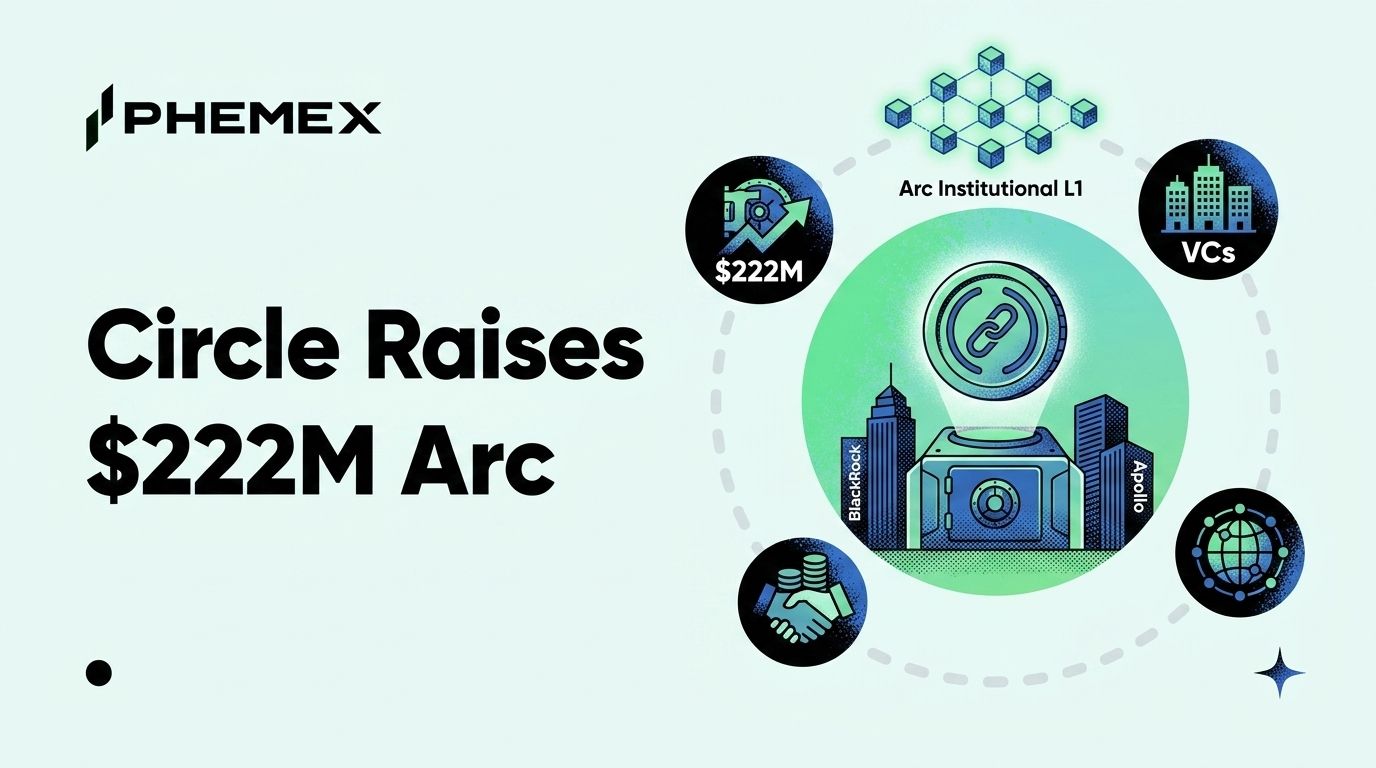
Circle just closed a $222 million presale for ARC tokens at a $3 billion fully diluted valuation, with BlackRock, Apollo Funds, and the parent company of the New York Stock Exchange writing checks alongside a16z crypto. The round was disclosed in Circle's Q1 2026 earnings filing with the SEC on May 11, with Andreessen Horowitz leading at $75 million and Circle selling 740 million ARC tokens at $0.30 each.
The list of co-investors reads like a who-is-who of legacy finance trying to get on-chain. Apollo, ICE, SBI Group, Janus Henderson, Standard Chartered Ventures, ARK Invest, General Catalyst, Marshall Wace, Bullish, IDG Capital, and Haun Ventures all participated.
That mix matters because it is not a crypto-native funding round dressed up with one strategic LP. This is the world's largest asset manager, the parent of the New York Stock Exchange, and a top-three private equity firm collectively betting that the company behind USDC can build the rails the rest of the financial system eventually runs on.
What Arc Actually Is
Arc is a Layer 1 blockchain Circle is building specifically for stablecoin payments and institutional finance, with mainnet expected sometime in 2026. The pitch is that existing general-purpose chains were not designed around stablecoins as the unit of account, and Arc is.
CEO Jeremy Allaire described the ambition in plain terms when the company announced the round. Arc, in his framing, is being built so it "can run the actual economy." That is a notably different positioning from how most L1 founders pitch their networks. It is not framed as a faster Ethereum or a cheaper Solana. It is framed as settlement infrastructure for businesses that already move money for a living and want a programmable substitute for ACH, SWIFT, and correspondent banking.
The token sold for $0.30 in the presale, which prices the fully diluted network at $3 billion before a single transaction settles. That number tells you how the market is valuing the optionality. Circle does not need Arc to become the dominant chain. It needs Arc to capture even a single-digit share of stablecoin settlement volume to justify the valuation.
Why BlackRock, Apollo, and ICE Are in This Round
The composition of the cap table is the actual news here. Each of these investors is signaling something different, and reading the signal is what matters more than the headline number.
BlackRock. The world's largest asset manager already custodies most of the reserves backing USDC through its money market fund, BUIDL. BlackRock having direct equity exposure to the rails USDC settles on closes a vertical loop. CEO Larry Fink has spent the last two years saying tokenization is the future of finance. Writing a check into Arc is putting capital behind the sentence.
Apollo Funds. Apollo runs roughly $700 billion in private credit, real estate, and alternative assets. Tokenizing those assets requires a settlement layer that institutional counterparties trust. Circle's compliance posture, audited reserves, and regulator relationships make Arc a more comfortable destination than a permissionless L1 with a pseudonymous founder.
Intercontinental Exchange. ICE owns the New York Stock Exchange, and the parent company of the largest equities venue on the planet investing in a stablecoin-native blockchain is the strongest signal yet that traditional venues see programmable settlement as the next layer of the market structure, not a competing one.
SBI, Standard Chartered, Janus Henderson. These three are the global plumbing players in this round, with SBI handling cross-border payments across Asia, Standard Chartered running corporate banking in 50-plus jurisdictions, and Janus Henderson managing roughly $370 billion in client assets. Their combined presence makes Arc credible for actual enterprise rollouts in the regions where regulated capital lives.
Crypto-native names round it out. ARK, Haun, General Catalyst, Marshall Wace, IDG, and Bullish bring distribution into the digital asset community and the ETF ecosystem.
How This Fits Into Circle's Q1 2026 Earnings
The Arc raise was disclosed inside Circle's Q1 2026 earnings package, which itself produced a mixed signal for CRCL stock. The company beat consensus on earnings per share but missed on revenue. USDC supply has continued to grow through the first quarter, but the rate of growth has slowed compared to the 2025 ramp.
Circle's stock has been under pressure for a different reason. Earlier this year, the GENIUS Act's restrictions on stablecoin yield distribution hit CRCL's expected revenue model, and the equity sold off hard. Phemex covered that drawdown in detail in Circle Stock Just Crashed 20% in One Day. The Arc raise is, in part, an answer to that overhang. If yield on stablecoin balances is constrained at the federal level, Circle needs revenue lines that do not depend on it. Owning the underlying chain is one of them.
Arc generates economic value through transaction fees, validator economics, and the surface area for institutional products built on the network. Each of those revenue lines stands on its own even if Circle is barred from paying yield to USDC holders.
The ARC Token and What It Is Not
Here is the part traders need to understand carefully. The ARC token sold in this presale is not currently trading on any exchange, the mainnet has not launched, and the 740 million tokens that sold at $0.30 went to accredited investors, strategic partners, and the institutional buyers named above. They will likely sit under vesting and lockup terms that do not start unlocking until well after mainnet goes live.
There is also a separate token already trading under the ARC ticker on some venues that refers to a different project entirely (an AI agent framework called AI Rig Complex). Do not confuse the two. Circle's ARC is a presale-only asset tied to a chain that does not yet exist in production. Anyone seeing "ARC up 30%" on a price tracker is almost certainly looking at the other project.
For now, the cleanest way to express a view on Circle's stablecoin thesis is through USDC itself, the broader stablecoin ecosystem, or CRCL stock on the equity side. Trading the ARC token directly is not a retail option until mainnet and a token generation event.
How Arc Compares to Other Stablecoin Chains
Arc is not the first L1 pitched as stablecoin infrastructure. Stripe-affiliated Tempo, Tether's Plasma, and Stable have all been announced or launched in the past year with similar positioning. What separates Arc is the depth of the institutional cap table and the regulatory posture Circle brings.
|
Project
|
Backer
|
Status
|
Differentiator
|
|
Arc
|
Circle
|
Mainnet 2026
|
Institutional cap table, USDC-native, regulated issuer
|
|
Tempo
|
Stripe-affiliated
|
Live
|
Payments-focused, Stripe distribution
|
|
Plasma
|
Tether
|
Live
|
USDT-native, fee-free transfers
|
|
Stable
|
Independent
|
Live
|
High-throughput stablecoin settlement
|
The competitive question is simple. Do stablecoin issuers actually need their own chains, or do Ethereum, Solana, and Tron continue to capture the majority of stablecoin settlement volume because liquidity, tooling, and developer mindshare already live there?
The honest answer is nobody knows yet. Stablecoin volume on Tron settles trillions per year today without an issuer-controlled chain, Plasma launched with significant fanfare and has struggled to take material share, and Tempo has real distribution through Stripe. Arc enters this race with the most legitimacy on the institutional side and the least on the developer side, which is a structurally different positioning from any of the others.
What the $3 Billion Valuation Says About the Market
The fully diluted $3 billion price tag at presale is the part professional allocators are circling, because it values Arc at roughly 7% of Circle's public market cap before a single transaction has settled. That is a number that needs Arc to capture material stablecoin settlement volume to look reasonable in two years.
For context, Solana currently has a fully diluted valuation in the low tens of billions and processes meaningful stablecoin volume. Tron's market cap is in the same range and dominates USDT settlement. A $3 billion FDV for a chain that does not exist yet implies investors are pricing in either a fast share grab or a slow, durable accumulation of institutional flow. Probably both.
The presale investors are not pricing for a 2x. They are pricing for the case where Arc becomes the default settlement layer for the tokenized assets that BlackRock, Apollo, and the major asset managers actually move on-chain over the next decade, which is a different bet entirely.
Frequently Asked Questions
Can I buy the ARC token right now?
Not on a public exchange. The 740 million ARC tokens sold in the May 11 presale went to accredited investors and strategic partners under vesting terms that do not begin unlocking until after mainnet. There is a separate token also trading as ARC on some venues, but it is a different project entirely (an AI agent framework), and confusing the two is the most common mistake retail makes here.
When does the Arc mainnet launch?
Circle has guided to a 2026 launch without committing to a specific quarter. The CNBC report covering the raise referenced 2026 as the target, and Circle's earnings filing did not narrow that further. A token generation event would typically follow mainnet rather than precede it.
Why is BlackRock investing in a blockchain?
BlackRock already custodies most of USDC's reserves through its BUIDL money market fund. Equity exposure to the chain those reserves settle on closes a vertical loop. Larry Fink has called tokenization the future of finance for two years. This is the company putting capital behind that statement rather than just commentary.
How does Arc affect CRCL stock?
It adds a revenue line that does not depend on stablecoin yield distribution, which the GENIUS Act constrained earlier this year. The market will only re-rate CRCL on the Arc thesis once Circle proves it can ship. The Q1 2026 earnings beat on EPS and miss on revenue suggests investors are still trying to figure out which number to anchor on.
Bottom Line
A $222 million raise at a $3 billion FDV with BlackRock, Apollo, and the parent of the NYSE on the cap table is the clearest signal yet that the largest pools of capital in the world are positioning for stablecoin settlement infrastructure to become a category of its own. Circle is not trying to win developer mindshare here. It is trying to own the rails that BlackRock's tokenized money market funds, Apollo's tokenized private credit, and the next generation of institutional flow eventually settle on.
The risk is execution and the timeline. Mainnet is still 2026, the token is not tradeable, and the chain has to ship something competitive against Tempo, Plasma, and the existing stablecoin networks on Ethereum, Solana, and Tron. Watch three things from here. The mainnet launch date once Circle finalizes it, the first announced enterprise integration (BlackRock or Apollo would carry the most weight), and the eventual TGE structure, which will tell traders if ARC is built to hold value or built to subsidize adoption. The capital is in, now it has to build.
This article is for informational purposes only and does not constitute financial or investment advice. Cryptocurrency trading involves substantial risk. Always conduct your own research before making trading decisions.