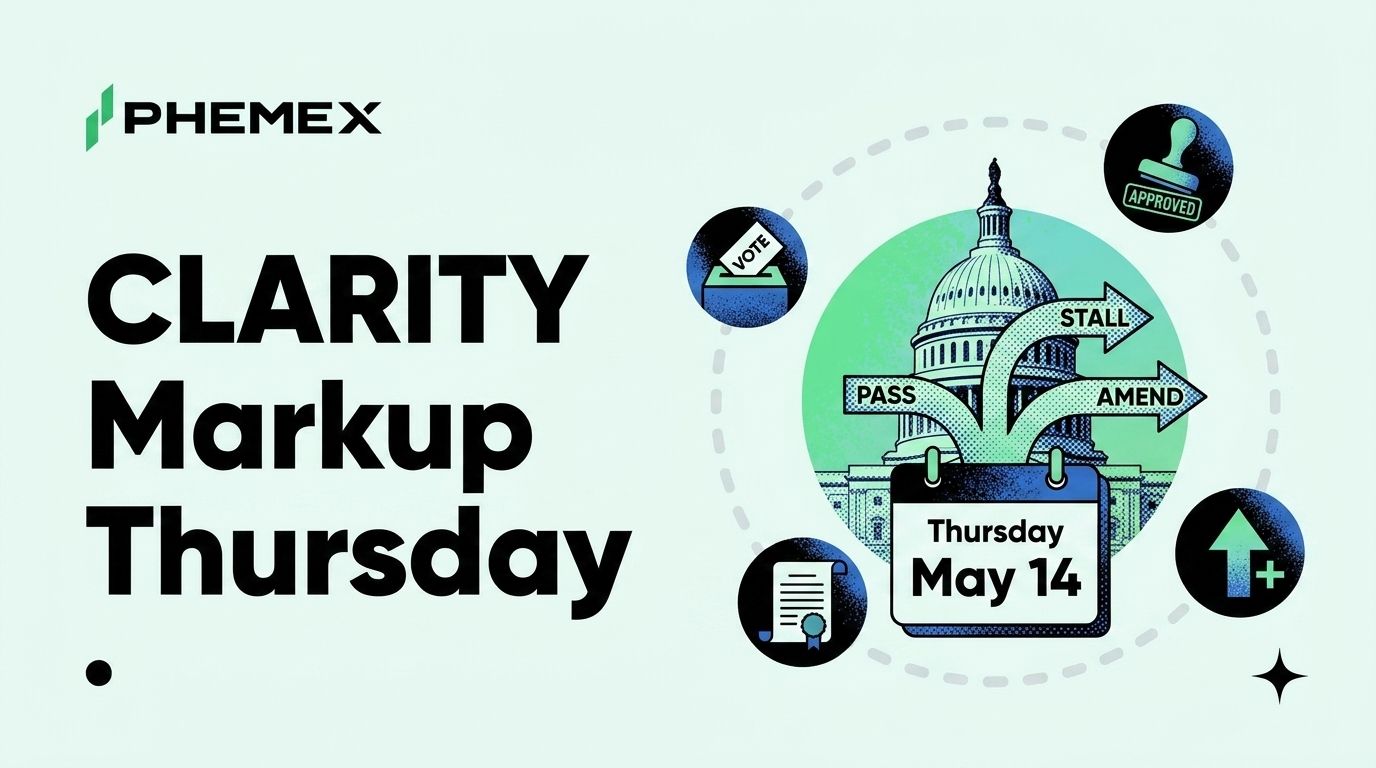
The Senate Banking Committee will mark up the CLARITY Act on Thursday, May 14 at 10:30 AM ET in the Dirksen Senate Office Building, with Chair Tim Scott still publicly committed to holding the vote despite a wall of last-minute bank lobbying. That is two days away as of this morning, and the entire US market structure framework for crypto is sitting in front of a committee that could pass it cleanly, gut it, or quietly table it.
The bill that emerges from this room decides if the SEC-CFTC commodity ruling from March 17 becomes permanent law or remains an interpretive position that the next administration can rewrite. Here is what is actually on the table, who is fighting over what, and the three realistic ways Thursday ends.
What the Committee Is Actually Voting On
The CLARITY Act (H.R. 3633) is the same bill that passed the House 294-134 with bipartisan support in July 2025. It codifies the commodity-versus-security taxonomy into federal statute, formally splits jurisdiction between the SEC and CFTC, redefines who counts as a "broker" or "dealer" for crypto purposes, and lays the groundwork for stablecoin issuance under federal rules. None of that is new. What is new is the Tillis-Alsobrooks stablecoin compromise attached to the Senate version.
Senators Thom Tillis (R-NC) and Angela Alsobrooks (D-MD) negotiated a framework that lets stablecoin issuers pay limited "activity-based rewards" to holders without those rewards turning the stablecoin into a yield-bearing security. The compromise is the reason Scott was able to schedule a markup at all. It also happens to be the exact provision that the bank lobby is now trying to kill before Thursday.
Phemex has a dedicated breakdown of what is actually inside that compromise here for traders who want the line-by-line. The short version is that activity-based rewards (think loyalty points, transaction rebates, or staking-like yield that depends on user behavior) become permissible up to a defined cap, while pure interest payments on a deposit balance stay banned.
Why the Bank Lobby Is Fighting This Late
The Independent Community Bankers of America, the Bank Policy Institute, and the American Bankers Association have all sent letters to Banking Committee members in the past 10 days opposing the activity-based rewards carve-out. Their argument is structural. If stablecoin issuers can pay anything that looks like yield, deposit competition shifts. Community banks rely on cheap, sticky deposits to fund loans, and a Circle or Tether product that returns 4% in "rebates" pulls those deposits out of the regional banking system.
The crypto industry's counter is that the cap inside the Tillis-Alsobrooks language is intentionally narrow, that the rewards are framed around user activity rather than passive balance, and that blocking the entire compromise to protect community bank deposit margins is exactly the kind of incumbency lobbying the bill was designed to route around.
Both sides know the markup vote is the moment this gets decided. Once the bill clears committee with a specific stablecoin framework inside it, amending that framework on the Senate floor is procedurally much harder. So the bank lobby is throwing everything at the next 48 hours.
The Three Outcomes Worth Pricing
There are exactly three realistic ways Thursday morning resolves. None of them are 50-50, but none of them are off the table either.
|
Outcome
|
What It Means
|
Crypto Read-Through
|
|
Clean markup passes
|
Tillis-Alsobrooks compromise survives, bill moves to full Senate floor
|
Bullish, full Senate vote within weeks, bipartisan ceiling intact
|
|
Stall in committee
|
Scott delays or tables the markup under bank pressure
|
Bearish, market structure effectively dies for 2026
|
|
Substantive amendment fight
|
Bipartisan amendments rewrite stablecoin yield and broker definition
|
Mixed, bill emerges weaker, House reconciliation gets hard, timing slips
|
Outcome 1: Clean Markup Passes
This is the scenario the industry is pricing as the base case. Scott holds the line on the Tillis-Alsobrooks language, the committee votes the bill out without major amendment, and CLARITY heads to the full Senate floor with the same stablecoin compromise that the House version is already close to.
In this path, the full Senate floor vote happens within weeks, not months. The Senate Agriculture Committee already cleared its piece in January 2026, so Banking is the last committee gate. From the floor, the bill goes to reconciliation with the House version, and President Trump's stated support for crypto legislation makes a signing ceremony before the August recess realistic. This is the path where the SEC-CFTC March 17 ruling stops being an interpretation and becomes statute.
Outcome 2: The Markup Stalls
This is the bank lobby's preferred result and it is more achievable than the crypto industry wants to admit. Scott does not need to publicly oppose the bill to kill it. He just needs to delay the vote, push the markup to a later date, and let the calendar do the work. The Senate has a famously short legislative year, and 2026 is a midterm cycle. Every week that slips past June makes a signed bill less likely.
Coinpedia reporting earlier this month noted that Scott had already weighed pushing the markup into late May before settling on the 14th. If he reverses that call, it signals the bank letters worked. For crypto traders, this is the outcome that quietly reverts everything to the March 17 interpretive rule as the only legal foundation, which is exactly the durability gap the industry has been worried about all along.
Outcome 3: The Amendment Fight
The most likely scenario if Scott holds the markup but cannot fully protect the stablecoin language. Senators on both sides offer amendments. Some try to narrow the activity-based rewards cap to something closer to zero. Others try to expand the broker-dealer definition to cover DEX front-ends and software developers in a way the House version explicitly carved out. A few try to tighten the CFTC jurisdictional handoff so the SEC retains residual authority over secondary-market trading.
The bill survives, but it emerges from committee meaningfully different from the House version. That triggers a conference reconciliation that takes weeks at minimum, and during that window stablecoin issuers, DEX projects, and ETF issuers planning multi-asset commodity baskets all sit on their hands waiting for the final language. The legislative win still happens, but the timeline slips from "weeks" to "fall 2026 at the earliest," and the chance of a clean signing ceremony before midterms drops.
What Is Actually at Stake Inside the Bill
Beyond the stablecoin compromise, the markup is the moment the Senate decides four other questions that matter for every active crypto user.
The SEC-CFTC jurisdictional split. The bill formalizes which agency regulates which tokens, and the March 17 ruling already named 16 assets as digital commodities under CFTC jurisdiction, but only legislation makes that permanent. If Banking weakens the split during markup, the next SEC chair regains discretion to claim jurisdiction over assets like SOL, XRP, or ADA on Howey grounds.
The activity-based rewards allowance. This is the Tillis-Alsobrooks carve-out and the focal point of the entire bank fight. Phemex has a fuller breakdown of the stablecoin yield politics and why community banks see this provision as existential for their deposit base.
The broker-dealer redefinition. Buried inside the bill is the question of how a DEX user interface, a wallet front-end, or a software developer who never holds custody should be treated, and if any of them count as a "broker" subject to registration. The House version explicitly carves out non-custodial software. If Banking amends this to include software interfaces, every DEX team operating in the US gets dragged back into a registration regime that the March 17 ruling was supposed to resolve.
Crypto vault yield product clarification. This is the line that determines if platform-based "earn" products on commodity-classified tokens are legal under the new framework. The current draft language says yes for non-securities crypto. If amended, the legality of every on-platform yield product in the US shifts.
What This Looks Like to Markets
BTC and ETH spot have priced in roughly a 60-65% probability of a clean markup based on Polymarket order flow and crypto policy desks at the major firms. That implies a measurable but not extreme reaction to either tail outcome on Thursday. A clean pass likely produces a modest immediate bid, with the bigger trade being durability of the rally into the full Senate vote. A stall or kill would create a sharper short-term drop, particularly in the altcoins that benefited most from the March 17 commodity ruling (SOL, XRP, ADA, LINK).
The amendment fight scenario is the trickiest to trade. Markets typically read "bill survives committee" as bullish on the headline. The damage shows up later, when reconciliation drags into Q3 and the signed-bill probability for 2026 quietly compresses. That tends to weigh on altcoin-heavy portfolios more than BTC.
For traders positioning into Thursday, the leveraged play is asymmetric in either direction depending on conviction. The cleaner trade is keeping the broader exposure stable and treating the markup as a known catalyst window where volatility is likely to spike regardless of outcome.
Frequently Asked Questions
When exactly is the Senate Banking Committee markup?
Thursday, May 14, 2026, at 10:30 AM ET in the Dirksen Senate Office Building. The committee is chaired by Senator Tim Scott (R-SC), and the agenda has the CLARITY Act listed as the headline item. Live streams typically run through the committee's website and C-SPAN.
Why is the markup needed if the House already passed CLARITY?
Both chambers have to pass the same version of a bill before it can go to the President. The House passed its version 294-134 in July 2025, but the Senate has its own version that includes the Tillis-Alsobrooks stablecoin compromise. The markup is where the Banking Committee votes on advancing that Senate version to the full Senate floor.
What happens if the markup gets delayed?
A delay is functionally the same as the bill dying for 2026. The Senate calendar is constrained, midterm campaigning eats summer and fall floor time, and any version that does not clear committee by early June is unlikely to get a floor vote before recess. The March 17 SEC-CFTC commodity ruling remains in force as an interpretive rule, but it stays vulnerable to reversal by a future administration.
Does any of this affect BTC, ETH, or stablecoin prices immediately?
Short-term, yes, on headline risk. Longer-term, the bill's biggest effect is on altcoins that benefited from the March 17 commodity ruling and on stablecoin issuers waiting for permanent yield framework clarity. BTC is the least directly affected because its commodity status was never the question. ETH benefits indirectly through staking ETF clarity. Stablecoins live or die on the Tillis-Alsobrooks language inside the bill.
Bottom Line
The crypto industry has spent a year saying that only legislation can make the regulatory clarity permanent. Thursday morning is the meeting where the Senate decides if that legislation actually moves. A clean markup sends CLARITY to the full Senate floor with the stablecoin compromise intact, and a signed bill before August becomes realistic. A stall or table sends the entire framework back into interpretive-rule territory for the rest of 2026, which is a structurally weaker position than the industry currently trades at. The amendment fight is the most likely path and the hardest to price, because markets read "passed committee" as bullish while the actual damage shows up in reconciliation weeks later. Watch the 10:30 AM ET committee feed on Thursday. The next 90 days for crypto market structure get decided in that room.
This article is for informational purposes only and does not constitute financial or investment advice. Cryptocurrency trading involves substantial risk. Always conduct your own research before making trading decisions.