

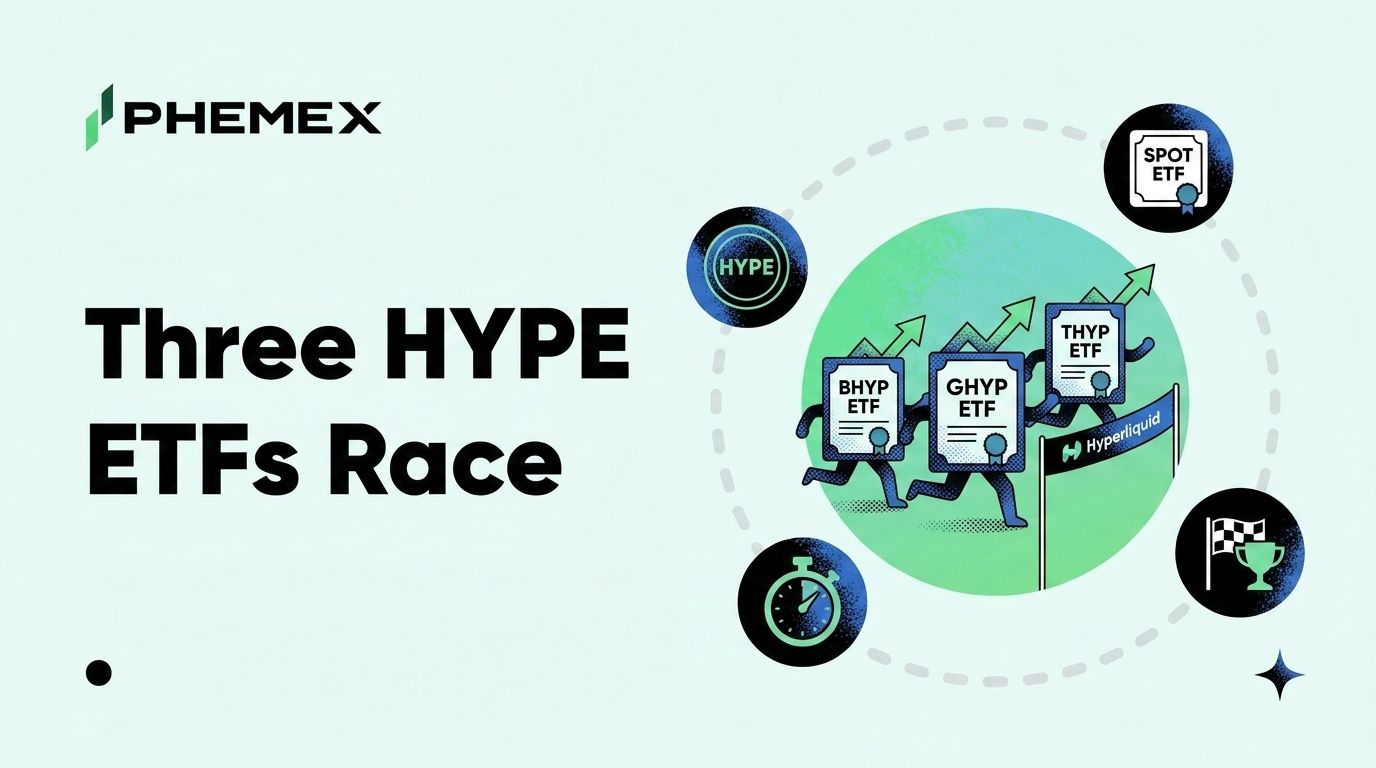
Three of the biggest names in crypto asset management are now competing to launch the first spot ETF for HYPE, the native token of decentralized perpetuals exchange Hyperliquid. Bitwise filed its BHYP product back in September 2025, Grayscale followed with GHYP in March 2026, and 21Shares filed its second THYP amendment on April 14, 2026. All three want a Nasdaq or NYSE Arca listing, and all three have now converged on the same custodian. HYPE trades around $43.32 today, up 5.7% on the week, and the filings keep getting refiled because issuers can sense the SEC is closer to a decision than the market thinks.
This is the first time a DeFi-native token has attracted this kind of simultaneous institutional ETF interest outside of the original spot BTC and ETH approvals. Here is what each filing actually contains, why all three converged on Anchorage Digital, and what HYPE holders should be watching as the staking-yield ETF question moves to the front of the SEC's queue.
Who Filed What and When
The race started quietly last September when Bitwise filed its initial S-1 for BHYP on NYSE Arca. The filing sat for months without much movement until Bitwise refiled an updated S-1 in April 2026, suggesting active dialogue with the SEC. Grayscale joined the race in March 2026 when it filed GHYP on Nasdaq, slotting the product into its broader crypto ETF lineup alongside its existing BTC, ETH, and SOL vehicles. 21Shares closed the trio when it filed Amendment No. 2 for THYP on April 14, 2026, also targeting a Nasdaq listing.
All three sponsors are pursuing structurally similar products. Each one would hold HYPE directly, track spot price, and offer some form of exposure to staking yield. The fee tiers and custody arrangements are where they differ, and those differences are what the SEC tends to focus on during the comment period.
Bitwise BHYP. NYSE Arca listing, 0.67% annual management fee, custody handled by Anchorage Digital. The staking component is the most aggressive of the three, with the fund retaining approximately 85% of staking rewards after fees and passing the rest through to investors. The S-1 has been updated multiple times since the original September 2025 submission, with the most recent amendment landing in April 2026.
Grayscale GHYP. This Nasdaq-listed product was originally filed with Coinbase Custody as the named qualified custodian. Grayscale then amended the filing on April 20, 2026, replacing Coinbase with Anchorage Digital Bank as the qualified custodian. That switch tells you something about how the SEC is viewing federally chartered crypto banks versus state-chartered trust companies for newer staking-yield products. GHYP would join Grayscale's existing crypto ETF lineup and inherit its institutional distribution.
21Shares THYP. Nasdaq listing, with Anchorage Digital Bank and BitGo Bank & Trust as joint custodians. Staking operations are outsourced to Figment, the same staking infrastructure firm that handles Ethereum staking for several other 21Shares products. Between 30% and 70% of the fund's HYPE holdings would be actively staked, with the remainder kept liquid for redemptions. Reports point to a 2% management fee, though that number is still being finalized in the amendment cycle and worth checking against the final pricing supplement.
Why All Three Filings Converged on Anchorage
The single most interesting detail across these filings is that all three sponsors now name Anchorage Digital Bank in some capacity, even though Grayscale originally tried to use Coinbase Custody. Anchorage holds the only federal trust charter issued to a crypto-native institution by the OCC, which means it can act as a qualified custodian under federal banking rules rather than state trust company rules. For a staking-yield ETF, that federal status matters because the SEC has been clear that staking inside an ETF wrapper requires custody arrangements that satisfy both the Investment Company Act and the Custody Rule.
Coinbase Custody is a New York trust company. It is the most widely used crypto custodian in existing spot BTC and ETH ETFs, but it does not have a federal banking charter. For pure spot products that do not stake, that distinction has not mattered. For HYPE ETFs that want to capture staking yield, the federal charter appears to be turning into a de facto requirement during the SEC review process. The April 20 GHYP amendment swapping Coinbase for Anchorage is the clearest evidence of that.
21Shares hedged by naming both Anchorage and BitGo Bank & Trust as joint custodians. BitGo also recently received federal trust authority, giving 21Shares two federally chartered options inside a single fund. That redundancy is likely what the SEC asked for during the first amendment round.
How the Staking-Yield Mechanics Actually Work
This is the part that has not existed in any approved US crypto ETF before. The existing spot BTC and ETH ETFs do not stake. Even the recently approved Ethereum staking ETFs from BlackRock and Bitwise use carefully constrained staking models that limit the percentage of underlying assets that can be locked at any one time. The HYPE filings are pushing further on this front.
Bitwise's BHYP keeps approximately 85% of staking rewards inside the fund after fees, meaning the staking yield gets compounded into NAV rather than distributed to shareholders. The remaining 15% covers operational costs and fund expenses. This is functionally similar to how a closed-end fund handles dividends, and it shifts the staking yield into capital appreciation rather than income, which has tax implications worth noting for US holders.
21Shares takes a different approach with Figment as the staking partner. Between 30% and 70% of HYPE holdings are actively staked at any given time, with the rest held in liquid form to handle redemptions. That liquidity buffer is the answer to the SEC's biggest concern about staking ETFs, which is what happens when investors want their money back but the underlying is locked in a 21-day unbonding period.
Grayscale has not yet disclosed its full staking mechanics in public filings, but the structure is expected to be conservative given Grayscale's larger institutional client base and its history of preferring lower-risk product wrappers. The April custody change to Anchorage suggests Grayscale is moving toward an actively staked structure rather than a pure spot product.
Why HYPE Specifically and Why Now
Hyperliquid is not a generic alt. It is the dominant decentralized perpetuals exchange, built on its own Hyperliquid Layer-1 chain with a custom consensus mechanism designed specifically for orderbook trading. The protocol generates real revenue. Phemex's own research desk has tracked Hyperliquid's annualized fee run rate at $676 million to $843 million, which makes it one of the highest-revenue protocols in crypto outside of stablecoin issuers.
Ninety-seven percent of that revenue flows into the Assistance Fund, which executes daily on-market buybacks of HYPE and burns the purchased tokens. That mechanic puts HYPE in a deflationary phase whenever protocol revenue exceeds new emissions, and it has been doing so consistently since Q1 2026. Whale accumulation has been visible on-chain throughout the spring, with several seven-figure wallet additions tracked in the week before each ETF amendment filed.
The asset managers behind these filings understand all of this. ETF demand follows narratives that institutional allocators can underwrite, and the combination of real revenue, on-chain buybacks, and a staking yield component gives HYPE a story that pure DeFi tokens like UNI or AAVE have never had. The bitcoin ETF flow playbook is now being applied to a DeFi-native asset for the first time at scale.
|
ETF
|
Sponsor
|
Exchange
|
Custody
|
Filing Date
|
Fee
|
Staking
|
|
BHYP
|
Bitwise
|
NYSE Arca
|
Anchorage Digital
|
September 2025 (S-1)
|
0.67%
|
~85% retained
|
|
GHYP
|
Grayscale
|
Nasdaq
|
Anchorage Digital Bank
|
March 2026
|
TBD
|
Conservative
|
|
THYP
|
21Shares
|
Nasdaq
|
Anchorage + BitGo (joint)
|
April 14, 2026 (Amend. 2)
|
~2% (TBD)
|
30-70% via Figment
|
What Could Go Wrong
The bullish case is straightforward and the bearish case deserves equal weight. Three risks matter most.
SEC approval timing is uncertain in a way that BTC and ETH ETFs never were. Those products had years of futures-market history, well-established custody patterns, and clear commodity classification before approval. HYPE has none of that. It is a newer asset, it trades on a smaller set of regulated venues, and the staking yield component is genuinely novel inside an ETF wrapper. The honest answer is nobody knows how long the SEC will take, and analysts who give specific dates are guessing.
HYPE liquidity, while substantial for a non-major coin, is still smaller than BTC or ETH by an order of magnitude. ETF authorized participants need to be able to source and redeem HYPE in size without moving the market materially. A 20% slip on a $50 million creation order would make market makers unwilling to quote tight spreads, which would widen the premium and discount versus NAV. The 30-day average daily volume across centralized venues will need to support the expected fund size before any of these products can scale.
Staking-yield mechanics inside ETFs are still novel and the regulatory framework is being written in real time. The SEC has signaled openness to staking inside ETFs based on the recent ETHB and BAVA-style approvals, but a HYPE ETF would be the first DeFi-native staking ETF. New product categories tend to come with new disclosure requirements, and that adds review time that pure spot products never face.
Frequently Asked Questions
When will the first HYPE ETF launch?
There is no announced approval date, but the cadence of amendment filings suggests active SEC dialogue rather than a stalled review. Most analysts watching the queue expect a decision window in late 2026 or early 2027, with 21Shares and Bitwise positioned slightly ahead given how far through the comment cycle their products are.
Will I be able to stake HYPE through the ETF the same way I do directly?
No. The staking inside an ETF is handled by the fund manager, and the rewards are either retained inside NAV (Bitwise model) or distributed as income (potential 21Shares model). You would not control validator selection or unbonding timing, and you would pay the management fee on top of whatever staking yield the fund captures.
Why are all three sponsors switching to Anchorage Digital?
Anchorage holds a federal OCC trust charter, which the SEC appears to be treating as a near-prerequisite for staking-yield ETFs. State-chartered trust companies like Coinbase Custody work fine for pure spot products that do not stake, but the federal banking framework provides clearer ground for products that need to lock the underlying asset.
Is HYPE a good buy ahead of ETF approval?
HYPE has already run from below $10 in late 2024 to $43 today, so the easy money on the ETF anticipation trade has been made. The asset has genuine fundamentals (real revenue, buy-and-burn mechanics, top-five DEX volume), but the deflationary supply phase and ETF tailwinds are largely priced in at current levels. It belongs in the satellite portion of a portfolio (2-5% allocation), not the core.
Bottom Line
Three sponsors with combined assets over $200 billion are now competing to launch the first spot Hyperliquid ETF, and the convergence of Anchorage Digital across all three filings tells you the SEC is shaping a clear regulatory template for staking-yield products in real time. The signals worth watching from here are the next set of S-1 amendments (each one narrows the gap to approval), HYPE spot liquidity expanding to support institutional creation and redemption sizes, and any further custody changes that hint at the SEC's final framework.
The first sponsor to clear the SEC comment cycle gets a meaningful first-mover advantage in distribution, fee compression, and AUM. Bitwise carries the longest filing history at over eight months, Grayscale brings the deepest institutional distribution muscle with its existing ETF lineup, and 21Shares has structured the most aggressive staking yield mechanics of the three. If the SEC approves one before the others, the timing matters far more than the ranking does today. If $43.32 holds as the consolidation floor and Hyperliquid revenue stays at current levels, the deflationary supply alone gives HYPE a structural tailwind into whichever month approval lands.
This article is for informational purposes only and does not constitute financial or investment advice. Cryptocurrency trading involves substantial risk. Always conduct your own research before making trading decisions.