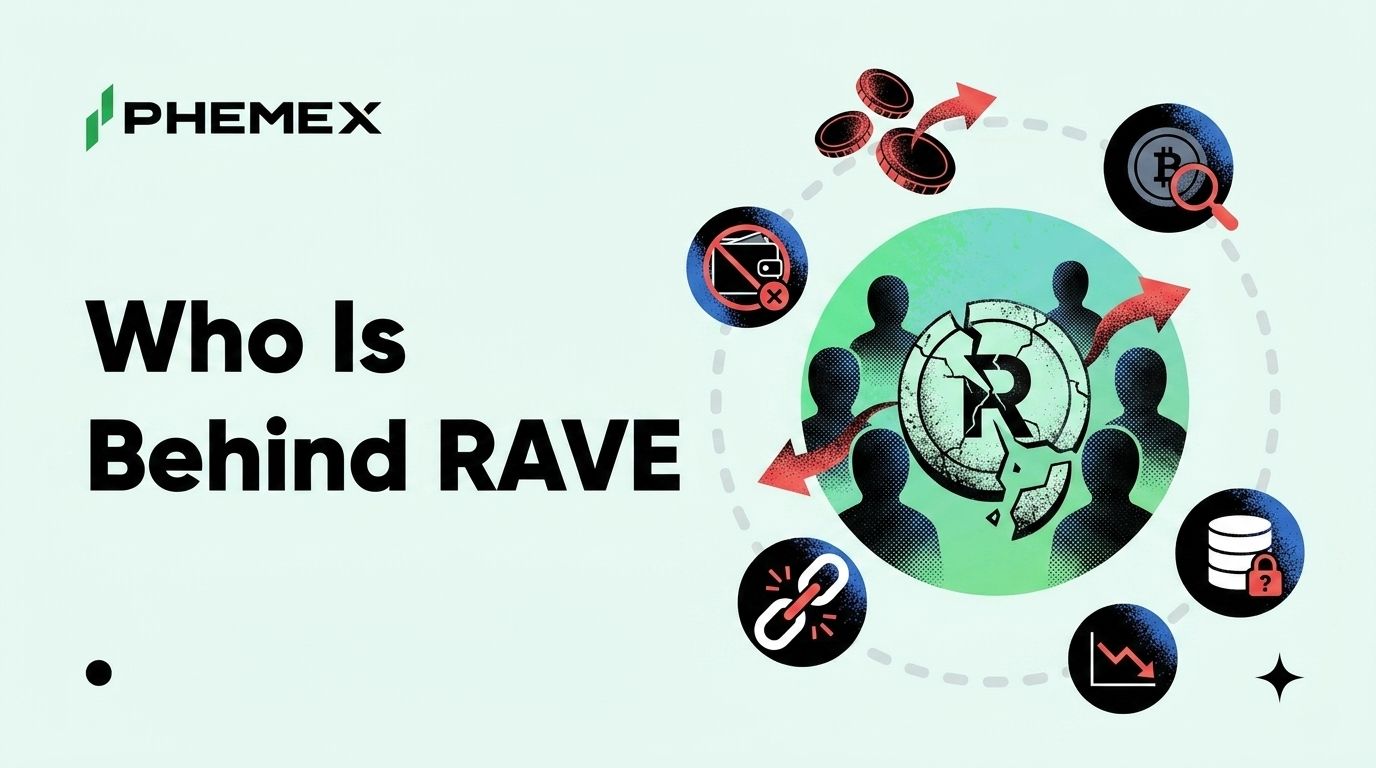
RAVE went from $0.25 to $27.33 in nine days, briefly touching a $6 billion fully diluted market cap before losing 95% of that value in under 48 hours. The crash erased roughly $5.7 billion and left traders who bought above $10 holding tokens worth pennies on the dollar. On-chain investigator ZachXBT flagged three Gnosis Safe multi-signature wallets holding approximately 90% of the entire 1 billion token supply, and Binance, Bitget, and Gate.io have all opened investigations into what happened.
The question is no longer if RAVE was manipulated. The on-chain evidence is fairly clear on that point. The real question is who controlled those wallets, where the funds moved, and what this tells you about identifying similar setups before they blow up.
Who Founded RaveDAO and Why the Team Matters
RaveDAO started as a 200-person afterparty at a crypto conference in Istanbul in November 2023, then expanded to events in Dubai, Singapore, Amsterdam, and Hong Kong. The project bills itself as a "community-driven global rave powerhouse" combining Web3 ticketing, community governance, and electronic music events, with an average attendance of 3,000 per event by late 2025.
The co-founder is Yemu Xu, who goes by @wildwoodmoo on X. Xu has a more established crypto background than most memecoin founders. He previously co-founded ARPA Network, a privacy-focused computation protocol, and Bella Protocol, a DeFi aggregator. Both Xu and his co-founder Felix Xu appeared on Forbes' 30 Under 30 Asia list. Xu is also listed as an ambassador for the environmental magazine Ocean Geographic.
That pedigree makes the RAVE situation harder to dismiss as a random anonymous team launching a throwaway token. These are people with verifiable identities and prior projects still trading on major exchanges. And when ZachXBT reached out to Xu privately eight hours before publishing his investigation, Xu did not reply. His X account has been inactive since February 2026.
What the Wallet Data Actually Shows
The RAVE token launched in December 2025 on Binance Alpha with a total supply of 1 billion tokens. Only about 248 million are circulating, roughly 24-25% of total supply. The remaining 75% sits in three Gnosis Safe multi-signature wallets that on-chain analysts have linked to the team.
The breakdown is specific. One wallet holds 75.2% of total supply, a second holds 9.87%, and a third holds 4.67%, totaling approximately 897 million tokens in just three addresses.
Gnosis Safe wallets are the standard treasury management tool for Web3 projects. They require multiple signers to approve transactions, which means a small group of people collectively control those funds. The top 10 wallets control over 98% of the entire RAVE supply. For context, most large-cap tokens have their top 10 wallets holding 30-50% of supply when you exclude exchange wallets and burn addresses. RAVE's concentration is in a different category entirely.
This structure creates what traders call a "thin float" problem. With only 24% of tokens actually circulating, the effective market cap was a fraction of the fully diluted $6 billion figure. A relatively small amount of buying pressure could move the price dramatically because there simply were not enough tokens in circulation to absorb it.
How the Alleged Pump-and-Dump Played Out
The timeline tells a specific story when you lay the wallet movements alongside the price action.
RAVE was trading around $0.32 on April 9. Over the next nine days, the price surged to $27.33, an increase of roughly 10,800%. During that stretch, RAVE futures generated $43 million in liquidations, ranking third behind only Bitcoin and Ethereum. The vast majority of those liquidations hit short sellers.
Here is where the on-chain data gets damning. Before the price spike began, approximately 18.58 million RAVE tokens (worth roughly $42 million at peak prices) were transferred to Bitget. That deposit looked like preparation for a dump, which naturally attracted short sellers betting the price would crash. But then approximately $32 million worth of RAVE was pulled back on-chain over the following two days while spot price was aggressively pushed higher.
The effect was a short squeeze engineered in stages. First, deposit tokens to bait shorts into opening positions, then pull tokens back to restrict sell-side supply while pumping spot price until shorts get liquidated. The $17-21.72 million in short liquidations within 24 hours versus just $7.12 million on the long side tells you exactly which direction the squeeze targeted.
On April 18, RAVE hit its all-time high near $28.96 before crashing below $1 within 48 hours.
What Exchanges Did (and Did Not Do)
Bitget CEO Gracy Chen confirmed a probe on X. Binance co-CEO Richard Teng said the exchange was reviewing the matter and would "always" do its part to examine signs of market misconduct. Gate.io was also named in ZachXBT's original allegations.
But the investigations came after the damage was done. RAVE was listed on these exchanges, its futures contracts generated tens of millions in liquidations (and therefore trading fees), and the token's extreme supply concentration was visible to anyone running a basic holder analysis. ZachXBT offered a $25,000 bounty for whistleblowers willing to share evidence of who orchestrated the pump, with OKX contributing to the fund.
The pattern here is familiar. Exchanges list low-float tokens with concentrated ownership, enable leveraged trading on them, collect fees from the resulting volatility, and then announce investigations after the crash. The question of exchange responsibility for listing tokens with 90%+ supply concentration is one the industry keeps asking without answering.
RaveDAO's Response and What It Did Not Address
RaveDAO denied involvement in the trading activity. The team said it may sell unlocked tokens to fund operations while exploring future lockup models.
What the response did not address is more telling than what it did. There was no explanation of why three wallets hold 90% of supply, no commitment to a specific vesting schedule or lock-up period, no on-chain proof that team wallets stayed away from exchange deposits during the pump, and no response to the specific wallet transfers ZachXBT identified. Co-founder Yemu Xu's silence in his private messages with ZachXBT, combined with his months-long absence from X, leaves the most basic questions unanswered.
The statement about potentially selling unlocked tokens "to fund operations" is worth noting. If those team wallets do begin selling into what remains of the market, the 248 million circulating tokens would face sell pressure from a pool of 750+ million tokens that the team controls. At current prices around $0.60-0.97, even modest selling from those wallets would overwhelm the available liquidity.
How to Spot This Pattern Before It Costs You
RAVE is not the first token to follow this playbook and it will not be the last. The warning signs were visible before the crash to anyone who checked.
Supply concentration above 80%. Any token where the top 3-5 wallets hold more than 80% of supply outside exchange wallets has a structural manipulation risk. You can check this on Etherscan or block explorers for any chain. RAVE's 90% concentration was publicly visible the entire time.
Low circulating supply relative to total supply. RAVE had only 24% of its 1 billion tokens actually in circulation, meaning 76% could enter the market at any time. When the circulating supply is this thin, the "market cap" number is misleading because it multiplies last traded price by total supply, not by the tokens actually available to trade.
Rapid price increases without matching fundamentals. A 10,800% move in nine days for a project that hosts party events is not driven by adoption metrics. Price action that disconnects completely from any measurable utility is almost always driven by supply manipulation or coordinated buying.
Anonymous or unresponsive teams during critical events. A legitimate project's founders address serious allegations directly and provide on-chain evidence to back their claims. Silence in the face of specific wallet-level accusations is not a defense strategy but an exit signal.
Frequently Asked Questions
Is RaveDAO a rug pull?
The technical definition of a rug pull involves developers draining liquidity and disappearing. RaveDAO has not done that explicitly. What the on-chain data shows is a token with 90% supply concentration in team-linked wallets, coordinated exchange deposits timed with a 10,800% price surge, and $44 million in liquidations that disproportionately hit short sellers. Regardless of the label you apply, the outcome for late buyers was the same.
Who is Yemu Xu?
Yemu Xu is RaveDAO's co-founder, also known as @wildwoodmoo on X. He previously co-founded ARPA Network and Bella Protocol and was featured on Forbes' 30 Under 30 Asia. He has been inactive on social media since February 2026 and did not respond when ZachXBT contacted him privately before publishing the investigation.
Can RAVE recover from here?
Recovery would require the team to lock the 750+ million tokens they control in a verifiable, time-locked smart contract, provide transparent accounting of all wallet movements during the pump, and rebuild trust with a community that watched $5.7 billion evaporate. None of those steps have been taken as of mid-April 2026. The token trades around $0.60-0.97 with extreme volatility and wide price discrepancies across exchanges.
How do I check if a token has concentrated supply?
Use block explorers like Etherscan, BscScan, or the relevant chain explorer and look at the "Holders" tab for any token contract. If the top 5 non-exchange wallets hold more than 50% of supply, treat it as high-risk. Cross-reference with the project's stated tokenomics to see if concentration matches what the team disclosed, and use tools like Arkham Intelligence and Nansen to identify if large wallets belong to known entities.
Bottom Line
The RAVE situation is a case study in what happens when extreme supply concentration meets leveraged derivatives on centralized exchanges. Three wallets holding 90% of a billion-token supply created the conditions for a $6 billion phantom market cap that evaporated the moment real selling pressure arrived. The $44 million in liquidations, mostly from shorts, suggests the pump was not accidental but designed to maximize pain on one side of the trade before the inevitable collapse.
For traders, the actionable lesson is straightforward. Before buying any low-cap token that has already made a parabolic move, check the holder distribution. If three wallets control the supply and the circulating float is under 25%, you are not trading a market. You are sitting at a table where someone else can flip it over whenever they choose.
This article is for informational purposes only and does not constitute financial or investment advice. Cryptocurrency trading involves substantial risk. Always conduct your own research before making trading decisions.