
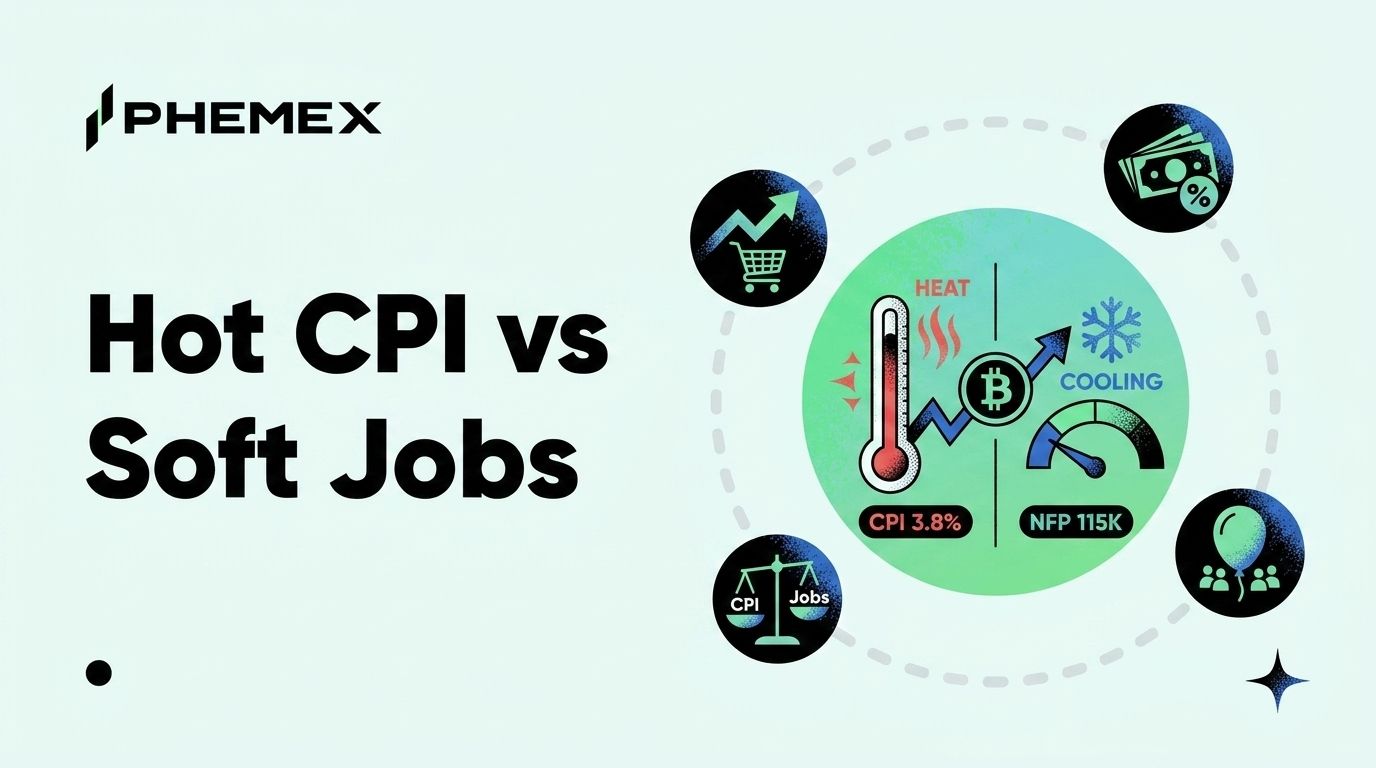
Two macro releases in a single week dropped opposite signals into the same Bitcoin chart. The April Employment Situation report on May 8 showed payrolls of 115,000 with wage growth cooling to 3.6% year over year, a soft enough print that rate cut odds rebuilt. Four trading days later on May 12, the April CPI report ran 3.8% headline against 3.7% expected, with core stuck at 2.8%, and those same rate cut odds collapsed. BTC dipped to $80,600 on the CPI print, held the $80,000 floor, and is now sitting in a market where both releases sent conflicting messages about what the Fed does next.
For traders, the practical question is which release deserves more attention when building positions. The two prints test different parts of the Fed's mandate, move different parts of the yield curve, and produce different decay profiles in BTC over the 7-day window. Here is the side-by-side, the historical reaction data, and the framework that actually works in the ETF era.
What Each Release Actually Measures
CPI is one number reading on a single question. It tells you what the basket of consumer prices did in a specific month, and the Bureau of Labor Statistics publishes a single headline figure along with core CPI as a secondary read. Markets focus on two data points at 8:30 AM ET on the day, both compared to a survey median. The release is binary in framing. The number is hotter than expected, cooler than expected, or in line.
The jobs report is a different animal. The Employment Situation release contains three independently market-moving data points. Nonfarm payrolls is the headline, but the unemployment rate from the household survey and average hourly earnings from the establishment survey each carry significant weight on their own. April illustrated the complication. Headline payrolls came in at 115,000 versus a 62,000 consensus, which on its own would read as hot. The unemployment rate stayed at 4.3%, neutral. Average hourly earnings ran 3.6% YoY against 3.8% expected, which is unambiguously soft and rate-cut friendly.
That structural difference matters because it determines how the market digests each release. CPI lands as a clean directional signal in the first five minutes. The jobs report often takes 30 to 60 minutes for the market to weight the components and decide if the net read is hawkish or dovish. The Cleveland Fed maintains an inflation nowcasting model that traders use to set expectations before CPI, but no equivalent exists for jobs because the components rarely move in the same direction.
How Hot CPI Hits Bitcoin
The textbook reaction to a hot CPI print is hawkish for the Fed and negative for risk assets. Higher inflation forces the Fed to hold rates longer or hike further, which strengthens the dollar, lifts bond yields, and pulls capital out of speculative assets. BTC has historically reacted within the first hour of release and bottomed within 24 hours.
The August 2022 hot print is the canonical example. CPI came in at 8.5% versus 8.2% expected, the 2-year yield jumped 15 basis points, and BTC fell 9% in the following 48 hours. September 2023 produced a 5% drop on a similar magnitude surprise. January 2026 ran 0.1 percentage points hot and BTC dropped 3.4% in 24 hours and 6.8% over the following week.
April 2026 broke the pattern. The headline ran 0.1 percentage points hot, core stuck at 2.8%, and June rate cut probability collapsed from 48% to under 8% on CME FedWatch. BTC dipped less than 1% on the print itself, held $80,000, and stabilized while equities kept bleeding. CoinDesk attributed the muted reaction to the structural ETF bid that has absorbed roughly $9.4 billion in net inflows over the past 45 days.
The takeaway is that CPI still moves BTC, but the magnitude has compressed. The 7-day decay window is where the damage shows up now, not the first hour. Cooler prints produce sustained 5% to 8% rallies. Hotter prints produce 2% to 4% drawdowns that often partially recover within five trading days if no second macro shock arrives.
How a Soft Jobs Print Hits Bitcoin
Soft jobs reports are messier because they pull in two directions at once. Weak hiring is dovish for the Fed (good for crypto via cheaper money) but also signals recession risk (bad for crypto via risk-off flows). The dominant force depends on where the market sits in the cycle and which component drove the surprise.
April 2026 is a clean case study. Payrolls came in well above the 62,000 consensus at 115,000, which is technically hot. But the wage growth component cooled to 3.6% YoY against 3.8% expected, and that single line item was the market mover. Wage growth is what feeds back into services inflation through the Phillips curve. Cooler wages give the Fed cover to cut. Within an hour of the release, June rate cut odds had pushed from 38% to 48%, and BTC rallied from $82,400 to $84,100 before the late-week pullback.
Compare that to the August 2025 weak jobs print where payrolls missed by 110,000 and the unemployment rate jumped 0.2 percentage points. Markets initially rallied on rate cut hopes, then sold off four hours later as recession-fear narratives took over. BTC ended the day down 2.7% despite the dovish read.
The lesson is that jobs report reactions are sticky. CPI produces a fast move that often unwinds. Jobs reports produce slower moves with longer follow-through because the recession-versus-inflation debate keeps the print relevant for days. That is also why the 7-day window after a jobs release tends to be more volatile than the 7-day window after a CPI print.
Side By Side Comparison
The table compares the two release types across the dimensions that matter for positioning a trade.
|
Dimension
|
CPI
|
Jobs report
|
|
Components watched
|
Headline + core (2 numbers)
|
Payrolls + unemployment + wages (3 numbers)
|
|
Release time
|
8:30 AM ET, mid-month
|
8:30 AM ET, first Friday
|
|
Speed of reaction
|
First 5 to 15 minutes
|
First 30 to 60 minutes
|
|
Dominant rate driven
|
Front of the curve (2Y yield)
|
Belly of the curve (5Y yield)
|
|
Typical BTC 1-hour move
|
1.5% to 3%
|
1% to 2%
|
|
Typical BTC 24-hour move
|
2% to 5%
|
1.5% to 3%
|
|
Typical BTC 7-day decay
|
Often unwinds 50% of move
|
Often extends the initial direction
|
|
Cleanness of signal
|
High (one clear number)
|
Mixed (components can conflict)
|
|
2026 ETF era impact
|
Buffered significantly
|
Buffered less consistently
|
CPI hits harder in the first hour. Jobs hits longer over the week. CPI is the cleaner signal because there is one number to react to. Jobs is the more nuanced read because it tests both inflation pressure (through wages) and recession risk (through payrolls and unemployment).
Why the ETF Era Buffers CPI More Than Jobs
This is the part that has changed in 2025 and 2026. Spot Bitcoin ETFs have created a structural bid that does not pause for macro releases. Pension funds rebalance monthly, registered investment advisors allocate on a quarterly cycle, and family offices commit on a longer cadence still. None of those flows respond to a 24-hour news cycle.
That structural buffer cushions CPI moves more effectively than jobs moves for a specific reason. CPI is a one-shot data point. The number prints, the algorithmic flow front-runs the macro funds, and within a day the market has digested it. ETF allocators ride through the volatility because the next quarterly rebalance is what matters to them, not Tuesday morning.
Jobs is different because the second-derivative debate keeps the data live. If the print is soft, the market spends three days arguing if it is dovish (rate cuts) or recessionary (sell risk). ETF allocators that follow a recession-watch process can actually pause inflows on a string of weak jobs prints, which is when the buffer thins. The August 2024 carry-trade unwind began with a weak jobs print, not a CPI miss.
For 2026 specifically, BTC has held $80,000 through two consecutive hot CPI prints (March and April) precisely because the ETF bid mechanically absorbed the dip. The next test is if it can hold through a weak jobs report that triggers recession fear rather than a hot CPI that triggers Fed-hawkish positioning. Those are structurally different shocks.
How to Position Before Each Release
The playbook for CPI is the simpler one. Reduce leverage going in, wait for the first algorithmic flush in the first five minutes, and enter on the second wave 10 to 30 minutes after release once the institutional flows have weighted the print. The Phemex CPI trading guide walks through specific position sizing rules and stop placement for high-volatility macro days. The framework that works is to size at 50% to 70% of normal and cap leverage at 3x maximum.
The jobs report playbook requires more patience. Watch all three components in the first 15 minutes (payrolls, unemployment, wages), then wait for the bond market to settle which one is driving the move. The 5-year yield is usually the cleanest tell. If yields drop and stay down through the cash open, the dovish read is winning. If yields recover within an hour, the market is interpreting the print as either neutral or recession-risk negative.
The shared rule across both releases is to avoid trading the first 5 minutes. Algorithmic strategies front-run the macro funds in the opening minutes and produce volatility that does not reflect the eventual settled direction. Phemex's academy guide on CPI and crypto covers the mechanics of how the print works through Fed expectations into risk asset pricing, which is useful background for sizing the macro view.
Frequently Asked Questions
Which release moves Bitcoin more on the day, CPI or NFP?
CPI typically moves BTC more in the first hour, with average 1-hour moves of 1.5% to 3% versus 1% to 2% for the jobs report. The reason is that CPI delivers one cleaner number that algorithmic flows can act on immediately, while the jobs report contains three components that the market needs time to weigh.
Does soft jobs data always rally Bitcoin?
No, and that is one of the most common misconceptions in macro crypto trading. Weak jobs prints can rally BTC if the dominant interpretation is dovish (rate cuts incoming) but can sell it off if the dominant interpretation is recessionary (risk-off flows). The August 2025 weak print initially rallied BTC, then closed it down 2.7% as recession fear took over the rate-cut narrative.
Why did BTC barely react to the April hot CPI print?
Two structural reasons. Spot Bitcoin ETFs have absorbed roughly $9.4 billion in net inflows over the past 45 days, creating a programmatic bid that does not pause for macro releases. The April 2024 halving also cut new BTC issuance to roughly 450 coins per day, which is less than the ETFs absorb on positive flow days, leaving thin available supply for macro selling to chew through.
Which macro release should I prioritize watching as a crypto trader?
CPI for short-term volatility trades and jobs for swing positions. CPI prints produce sharper moves that often unwind within 5 trading days. Jobs report reactions tend to be stickier with longer follow-through, which makes them more relevant for traders holding positions through the following week.
Bottom Line
CPI is the cleaner signal and produces sharper first-hour moves. Jobs is the messier release with the longer 7-day tail. In the ETF era, CPI shocks are being buffered more effectively than jobs shocks because the structural bid responds to monthly and quarterly rebalances rather than to single data points. April 2026 confirmed both halves of that thesis. The 3.8% hot CPI barely scratched BTC at $80,000, but the soft wage component of the jobs report four days earlier moved rate cut odds by 10 percentage points and is still echoing through the curve.
For traders building positions around the next pair of releases, the practical rule is to fade the first-hour CPI move and ride the first-day jobs move. The May jobs report arrives on June 6 and the May CPI print follows on June 11, giving traders a clean back-to-back test of which framework actually works in the current setup. Watch the 2-year yield for CPI, the 5-year yield for jobs, and the ETF flow data for both. If the ETF bid breaks before the macro data does, the buffer goes away and the playbook flips back to the pre-2024 reaction patterns.
This article is for informational purposes only and does not constitute financial or investment advice. Cryptocurrency trading involves substantial risk. Always conduct your own research before making trading decisions.