


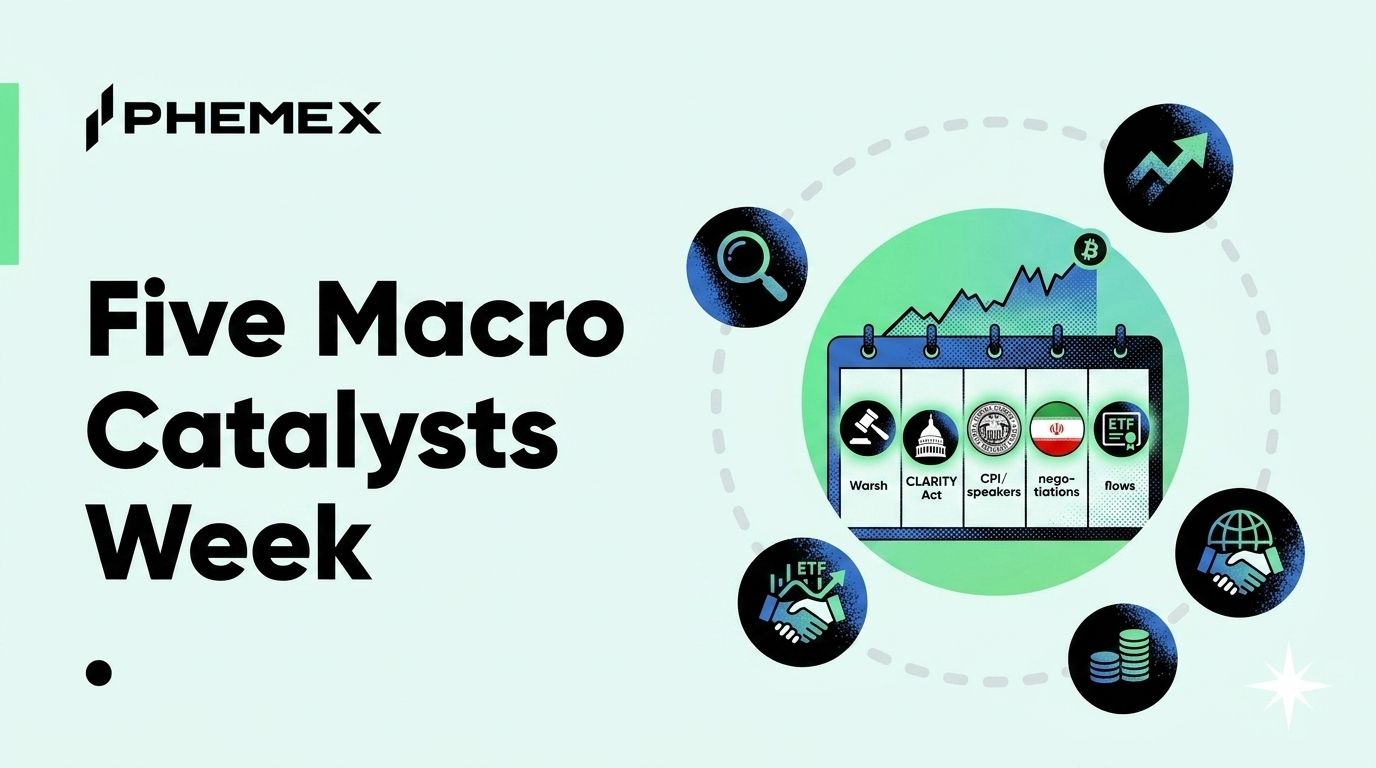
Bitcoin is trading around $103,400 as of May 13, sitting roughly 18% below its $126,000 all-time high but coiled inside the tightest weekly range since February. Five distinct macro events stack between Wednesday and Friday, and each carries enough weight to move BTC five to ten percent on its own. A Fed chair transition, a Senate markup of the most important crypto bill of the cycle, fresh Fed speakers reacting to last week's hot CPI print, the Iran negotiation limbo, and daily ETF flow prints make this the densest macro week of 2026 so far.
Here is what each catalyst could trigger and which signal to watch first.
Catalyst 1: The Warsh Fed Chair Transition (May 13-15)
The Senate holds the full chamber vote on Kevin Warsh as Fed chair on Wednesday May 13, Powell's term ends Friday May 15, and Warsh is sworn in the same day. This is the first Federal Reserve chair change since Powell was confirmed in early 2018, and it lands in the middle of the most contested rate path debate of the cycle.
The bull case is that Warsh is read as more rules-based and less reactive than Powell, telegraphing a clearer framework that markets interpret as a path back toward rate cuts once disinflation resumes. If his first remarks lean toward eventual cuts and a faster balance-sheet adjustment, the dollar weakens, real yields drift lower, and BTC has a clean shot at reclaiming $108,000 and then $112,000 where supply has stacked since April.
The bear case is the inverse. Warsh has a long-standing hawkish reputation on inflation, and last week's 3.8% CPI gives him an obvious reason to lean restrictive in his first appearances. If his confirmation speech signals that 3.8% headline inflation is unacceptable and the Fed will hold longer, the dollar firms, real yields press higher, and BTC tests the $100,000 line. A daily close below $99,400 invalidates the bullish wedge that has held since the March bottom.
Trigger level to watch: $100,000 on a daily close. Hold it and Warsh is a non-event for BTC. Lose it and the next confluence support is $95,200 at the 200-day moving average.
Catalyst 2: CLARITY Act Senate Banking Markup (Thursday May 14, 10:30 AM ET)
Senate Banking chair Tim Scott has publicly committed to running the markup, and the crypto industry is treating Thursday as the make-or-break moment for U.S. market structure legislation in 2026. The bank lobby has spent two weeks pushing against the Tillis-Alsobrooks compromise that would let payment stablecoin issuers offer modest on-platform yield, and that fight runs through this markup.
Three scenarios are realistic from Thursday, and each one has a distinct price implication for BTC into the back half of the week.
The bill passes the markup roughly clean. Tillis-Alsobrooks survives, the SEC/CFTC split lands intact, and the bill heads to a Senate floor vote later in May or June. Institutional risk officers stop using "regulatory uncertainty" as their reason to block crypto allocations. BTC could break $108,000 within hours, with $112,000 to $115,000 in play over the following two weeks.
The markup stalls. Tim Scott pulls the vote under bank pressure, or enough committee Democrats peel off that there are not 11 yes votes in the room. CLARITY effectively dies for the 2026 calendar, and the regulatory premium quietly building in BTC since the SEC/CFTC March commodity ruling unwinds. Expect an immediate 3-5% selloff and a test of $100,000 within 24 hours.
The amendment fight goes ugly. The markup happens but the bill emerges with stablecoin yield gutted, weaker DeFi protections, or carve-outs that infuriate Coinbase and Circle. The headline says "passed markup" but the content disappoints. BTC chops between $100,000 and $104,000 while the market figures out if the modified bill can survive the full Senate.
Trigger level to watch: ETH/BTC. Alts and ETH have a much higher beta to U.S. regulatory clarity than BTC does. If the markup passes clean, ETH/BTC catches a bid first and BTC follows. If alts are flat or down by Friday close, the market is telling you the bill emerged damaged.
Catalyst 3: Post-CPI Fed Speakers (Wednesday Through Friday)
April CPI printed at 3.8% headline on Monday, well above the 3.4% consensus and the hottest reading since November. Fed funds futures now assign roughly 12% odds of a June cut, down from 38% before the print, and June is effectively off the table unless something breaks. Multiple Fed governors and regional presidents speak between Wednesday and Friday, and any one of them can shift the curve.
The dovish path is straightforward. If Waller or Miran (the two most consistent cut advocates on the committee) repeat their case that the labor market is softening fast enough to justify cuts despite the inflation print, the market starts rebuilding June and July cut odds. That alone is enough to pull BTC back toward $106,000 by Friday.
The hawkish path is structurally more dangerous. If a centrist governor like Jefferson signals that 3.8% changes the committee's thinking, or if Schmid or Kashkari say no cuts in 2026, futures push the first cut into Q4 or 2027. Real yields rise, the dollar firms, gold pulls back, equity multiples compress, and BTC traders sell the disappointment.
This is also the last week of speakers before the FOMC blackout period, so whatever is said Wednesday through Friday is the message the committee wants the market to carry for three weeks. Read it as coordinated policy intent rather than personal opinion.
Trigger level to watch: The 10-year Treasury yield is the cleanest single proxy. If 10-year yields punch back above 4.55% on hawkish Fed commentary, BTC tests $100,000. If yields hold below 4.40%, the post-CPI selloff is fully digested and BTC has room to rebuild upside.
Catalyst 4: Iran Negotiations in Limbo
President Trump rejected the latest Iranian counter-proposal on May 11, and Project Freedom is now formally on hold without being formally dead. The negotiating team has not been recalled, the sanctions framework has not been re-tightened, and oil is pricing the limbo as roughly 50/50 on the odds that talks resume meaningfully within ten days. That uncertainty is itself the catalyst.
The bull case is that talks resume by Friday with a face-saving framework. Oil falls toward $68, the Middle East risk premium bid into Treasuries since March compresses, and BTC reclaims $106,000 to $108,000 inside 48 hours.
The bear case is the mirror image. Trump escalates verbally, Tehran responds, and the market starts pricing in a real possibility of a maritime incident in the Strait of Hormuz. Oil spikes through $80, headline inflation projections move higher (feeding back into the Fed problem), and BTC tests $98,000 to $100,000.
This is the catalyst with the widest five-day window. Iran is a slow-burning risk with no specific date and the power to ruin every other scenario above.
Trigger level to watch: Brent crude. Above $78, BTC inherits Middle East risk-off flows regardless of Fed or Senate action. Below $72, Iran is back-burner.
Catalyst 5: ETF Flow Momentum
Spot Bitcoin ETFs now hold roughly $109 billion in AUM, an all-time high, and the 10:1 ratio between ETF holdings and miner production is the structural reason BTC's drawdowns this cycle have been shallower than 2018 or 2022. Daily flow prints from Farside and Bitbo are the cleanest read on institutional demand rebuilding after the early-May choppiness.
Three consecutive days of net positive flows during a week this loaded with catalysts is real fuel. It signals institutional allocators leaning in rather than waiting on the sidelines, and any positive macro surprise becomes more powerful because the demand floor is already firming.
Two consecutive days of net negative flows is the opposite signal. Institutions are derisking into the catalyst calendar, and any negative macro surprise hits a market already stepping back. The April 18 dip to $96,400 happened on three straight days of net ETF outflows, and the same setup this week points toward $98,000 to $100,000.
ETF flow data prints with roughly a 12-hour lag, so Wednesday's flows show Thursday morning and Thursday's flows print Friday morning. Use it to size for the back half of the week, not as a real-time trigger.
Trigger level to watch: The total flow line for the week. Positive net flows above $300 million by Friday close is structurally bullish into the next two weeks regardless of the catalyst outcomes. Negative net flows below $200 million confirms institutional caution and biases BTC toward range-trading at best.
The Five Catalysts in One Table
|
Catalyst
|
Bull Outcome for BTC
|
Bear Outcome for BTC
|
Trigger Level to Watch
|
|
Warsh Fed Chair Transition (May 13-15)
|
Reclaim $108,000, run at $112,000
|
Test $100,000, lose support to $95,200
|
$100,000 daily close
|
|
CLARITY Act Senate Markup (May 14)
|
Break $108,000 within hours, $115,000 in two weeks
|
Immediate 3-5% selloff, test of $100,000
|
ETH/BTC ratio Friday close
|
|
Post-CPI Fed Speakers (Wed-Fri)
|
Recover toward $106,000 on dovish tone
|
Test $100,000 on hawkish push
|
10-year yield 4.40%-4.55%
|
|
Iran Negotiations (5-day window)
|
Talks resume, BTC reclaims $106,000-$108,000
|
Escalation, oil through $80, BTC at $98,000
|
Brent crude $72-$78 range
|
|
ETF Flow Momentum (Daily)
|
Three positive days fuels breakout
|
Two negative days fuels correction
|
$300M weekly net flow
|
How These Catalysts Interact
The danger of a calendar this packed is correlation. Each event alone moves BTC three to five percent, but stacked the wrong way they compound to ten percent in one direction. A hawkish Warsh tone, stalled CLARITY markup, and ETF outflows all week loses $100,000 and exposes the low $90,000s. The mirror scenario breaks $108,000 and carries momentum chasers toward $115,000.
The realistic base case sits between the extremes. The trade is not to predict the exact outcome but to identify trigger levels before the events fire, define risk, and let Friday's price action tell you which scenario the market is settling into. Arthur Hayes recently argued the structural setup favors a return to $126,000 in the second half of 2026, but this single week shapes if that path starts now or after another corrective leg.
Frequently Asked Questions
Why is the Warsh confirmation getting less attention than it should?
Most of the market priced in Warsh because his nomination was telegraphed for months and the Senate Banking confirmation cleared him in April. The underpriced risk is the first-impression effect. A single phrase from Warsh on the inflation outlook can shift the curve more than a 25 bps cut from a familiar chair, and the complacency around the transition is itself a setup for volatility.
What happens to BTC if the CLARITY Act dies this week?
Short term you get a 3-5% selloff and a quick test of $100,000 as the regulatory premium unwinds. Medium term the impact is less catastrophic than it sounds because the SEC and CFTC already moved administratively on commodity classification. The real losers in a CLARITY death are mid-cap altcoins and stablecoin yield products that needed legislative cover.
Is the 3.8% CPI print enough by itself to push BTC lower this week?
It already did most of its damage on Monday. The bigger risk is how Fed speakers interpret it, not the print itself. If three or more governors come out hawkish and the market fully unwinds 2026 cut expectations, BTC has another leg lower. If speakers split or lean dovish, the CPI shock is mostly absorbed.
Should I sit out the week or trade through it?
Sitting out is defensible given how many independent catalysts can fire. Traders with defined risk and small position sizes can navigate a week like this, but anyone leveraging into a single directional bet ahead of five catalysts is taking the wrong kind of risk. The pattern that works is to wait for the first one or two events to fire, see what the market is rewarding, then position into the back half.
Bottom Line
Five separate catalysts converge between Wednesday and Friday, and any one can move Bitcoin five percent on its own. The single most important level is $100,000 on a daily close. Hold it through Friday and the bullish wedge from the March low remains intact, setting up a run at $108,000 and then $112,000 in the back half of May. Lose it and the next visible support is the $95,200 confluence at the 200-day moving average. Trade the levels, not the headlines, and let Friday's close tell you which path the next month sits on.
This article is for informational purposes only and does not constitute financial or investment advice. Cryptocurrency trading involves substantial risk. Always conduct your own research before making trading decisions.