

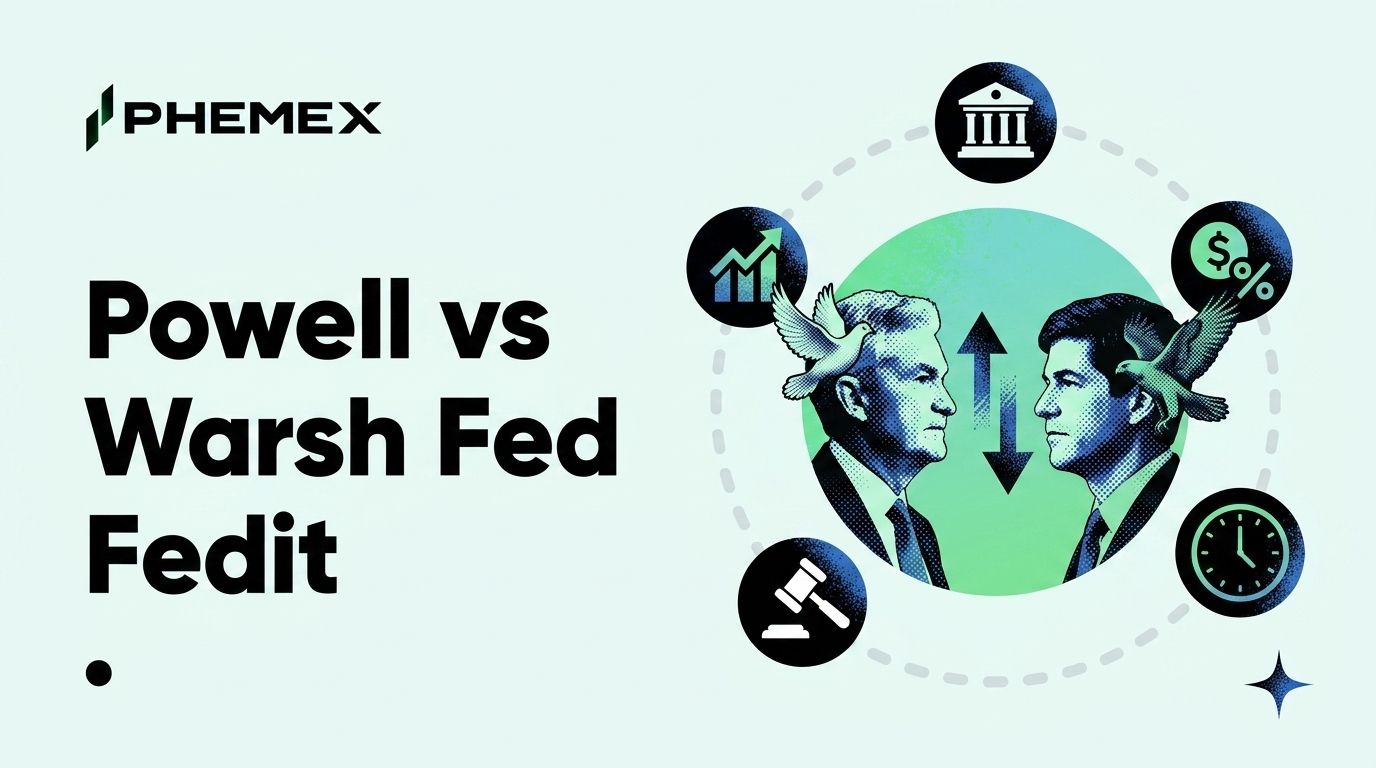
Jerome Powell will likely oversee his final FOMC vote on April 29, holding rates steady at 3.50-3.75% for what could be the last time under his watch. Kevin Warsh, the man replacing him on May 15, called the post-pandemic rate response "the biggest policy error in 40 to 50 years" and disclosed over $100 million in assets that include direct investments in Bitwise Asset Management, Electric Capital, Polychain Capital, and Polymarket.
The transition from Powell to Warsh goes far beyond a leadership swap. It represents a fundamental shift in how the Fed thinks about inflation, productivity, and the role of digital assets in the financial system. BTC is trading near $79,000 with the April FOMC meeting underway, and the next 12 months under a new chair could reshape the macro backdrop that drives crypto markets.
How Powell Ran the Fed and What It Meant for Markets
Powell's tenure will be remembered for two things. He navigated the most aggressive rate-hiking cycle in 40 years, taking the federal funds rate from near zero in March 2022 to 5.25-5.50% by July 2023, and then he brought it back down through a series of gradual cuts that landed at 3.50-3.75% by December 2025.
His approach was data-dependent to a fault. Every press conference included the same refrain about "watching the data" and waiting for "greater confidence" before moving. Markets learned to parse his sentences word by word, and crypto traders learned to sell the news after nearly every FOMC announcement. BTC dropped after 8 of the last 9 FOMC meetings under Powell, regardless of the actual decision.
The Powell playbook for Bitcoin was predictable. Gradual easing kept risk assets supported in the background, but the pace was slow enough that traders who expected a fast pivot to zero rates kept getting disappointed. BTC hit its all-time high of $126,198 in October 2025 during a period when rate cuts were accelerating, then pulled back as the cuts slowed and geopolitical risk picked up. By April 2026, BTC had fallen roughly 37% from that peak, sitting near $79,000 with the market waiting for clarity on what comes next.
Who Kevin Warsh Is and Why His Background Changes Everything
Warsh is not a typical central banker. He served as the youngest-ever Fed Governor from 2006 to 2011, where he helped orchestrate the Bear Stearns and AIG rescues during the 2008 financial crisis, and before that he worked as a Morgan Stanley investment banker. After leaving the Fed, he spent 15 years in Silicon Valley venture capital, advising firms like Electric Capital and investing across DeFi, Layer 1 networks, prediction markets, and Bitcoin payments infrastructure.
His Senate confirmation hearing on April 21 laid out what he calls a "regime change" at the Fed. He wants to abandon forward guidance entirely, stop telling markets where rates are headed, and define price stability as "a change in prices such that no one's talking about it." He also pledged independence from Trump, telling senators he would not be a "sock puppet" on rate decisions.
The difference from Powell could not be clearer. Powell spent years as a lawyer and Treasury official before joining the Fed, approaching monetary policy like a careful regulator who moved slowly and communicated constantly. Warsh spent his post-Fed career immersed in tech and venture capital, and he sees the economy through the lens of productivity gains and technological disruption rather than employment data and CPI prints alone.
The Policy Frameworks Compared
The differences between Powell and Warsh go deeper than personality. Their core assumptions about how the economy works point in different directions.
|
Dimension
|
Powell (2018-2026)
|
Warsh (May 2026 onward)
|
|
Inflation approach
|
Data-dependent, wait for confirmation
|
Forward-looking, "don't wait for data to show productivity"
|
|
Rate philosophy
|
Gradual, predictable, well-telegraphed
|
Less transparent, no forward guidance commitment
|
|
Key economic thesis
|
Labor market and CPI drive decisions
|
AI productivity is "structurally disinflationary"
|
|
Balance sheet
|
Slow QT, cautious unwinding
|
Likely to tighten balance sheet more aggressively
|
|
Communication style
|
Regular press conferences, dot plot emphasis
|
May reduce press conferences, abandon dot plot signaling
|
|
Crypto stance
|
Neutral to cautious, no personal holdings
|
Personal investments in Bitwise, Electric Capital, Polychain, Polymarket
|
|
Crisis experience
|
Managed pandemic monetary response
|
Called pandemic response "biggest policy error in 40-50 years"
|
What Warsh's AI Productivity Thesis Means for Rate Cuts
This is where the 12-month outlook gets interesting for Bitcoin.
CNN reported in February that Warsh's central argument for rate cuts is built on artificial intelligence rather than economic weakness. He has described AI as "the most productivity-enhancing wave of our lifetimes" and argued it could prove "structurally disinflationary," meaning prices naturally fall as technology makes production cheaper and faster.
If Warsh is right, the logic works like this. AI boosts productivity, which increases supply without proportionally increasing demand, which keeps inflation contained even with lower rates. That gives the Fed room to cut without reigniting price pressures. J.P. Morgan expects Warsh to push for rate cuts after taking office based on this framework.
But the market is not fully buying it yet. CME FedWatch data shows traders have priced in only about 50 basis points of additional cuts through the end of 2026. That implies markets expect rates to land around 3.00-3.25% at best by December, not the aggressive cutting cycle that some Bitcoin bulls are hoping for. CNBC's analysis flagged that Warsh's agenda could be tripped up by the same elevated energy prices and geopolitical tensions that constrained Powell.
And there is a genuine tension in Warsh's framework. He told senators that the economy is "running close to full employment," which is traditionally an argument against cuts. If AI productivity gains take years to materialize in the data, Warsh may find himself trapped between his thesis and the numbers on his desk.
The Warsh Paradox for Bitcoin
When Trump announced Warsh's nomination on January 30, BTC dropped 6% that day and fell another 8% over the following 10 days for a cumulative 14% decline. Markets initially read the nomination as the worst-case hawkish scenario, and the damage spread fast. Gold crashed 9% in its worst session in over a decade, silver dropped 30%, and risk assets sold off across the board.
But the longer-term picture is more nuanced than that first reaction suggested. Warsh is arguably the most crypto-literate Fed chair in history. His ethics disclosure revealed equity positions in more than a dozen blockchain and digital asset companies spanning DeFi lending, decentralized derivatives, Layer 1 and Layer 2 networks, and Bitcoin payments infrastructure. Through fund holdings, he has indirect exposure to Solana, Optimism, and the Lightning Network. He told CNBC in 2021 that "if you're under 40, Bitcoin is your new gold" and that Bitcoin "does not make me nervous."
The paradox is this. Warsh may tighten the balance sheet faster than Powell would have, which pressures liquidity and risk assets in the short term. But if his AI productivity thesis leads to rate cuts in the second half of 2026, that creates exactly the macro environment where Bitcoin has historically thrived. Lower rates with a Fed chair who personally understands digital assets is a combination that has never existed before.
Three Scenarios for BTC Over the Next 12 Months
The honest answer is that nobody knows how a Warsh-led Fed actually plays out, but mapping the scenarios helps frame what to watch for and where to position.
Scenario 1, where Warsh cuts rates and the AI thesis holds. Rates move toward 3.00% or below by Q1 2027. Dollar weakens, liquidity improves, risk assets rally. BTC has historically responded well to rate-cutting cycles, and a Fed chair with personal crypto investments removes any regulatory overhang at the monetary policy level. This is the bull case, and it points toward BTC retesting highs above $100,000.
Scenario 2, where Warsh holds steady because inflation stays sticky. Energy prices from Middle East tensions keep CPI elevated. Warsh wants to cut but the data does not cooperate. Rates stay in the 3.25-3.75% range for most of 2026. BTC trades sideways in a $70,000-$90,000 range as traders wait for a catalyst. This is the base case that markets are currently pricing.
Scenario 3, where Warsh tightens aggressively and surprises the market. Balance sheet reduction accelerates, forward guidance disappears, and markets lose their anchor. Volatility spikes across all asset classes, and BTC could retest the $60,000-$65,000 support zone as risk appetite contracts. This is the tail risk that caused the initial 14% selloff on the nomination news.
The reason most traders get the Fed transition wrong is that they bet on one scenario instead of positioning for the range. All three paths are plausible, and the sequencing could include elements of each.
Frequently Asked Questions
When does Kevin Warsh officially replace Powell as Fed chair?
Powell's term as chair ends May 15, 2026. Senator Tillis lifted his blockade of Warsh's confirmation on April 26 after the DOJ dropped its criminal probe of Powell, clearing the path for a Senate vote before that date. Warsh is expected to be confirmed and take office by mid-May or, at the latest, the mid-June FOMC meeting.
Is Kevin Warsh bullish or bearish for Bitcoin?
The answer depends entirely on the timeframe you are looking at. Short-term, his hawkish reputation and balance sheet tightening bias could pressure risk assets including BTC. Longer-term, his AI productivity thesis supports rate cuts, and his personal crypto investments make him the most digitally literate Fed chair ever. The net effect comes down to how inflation behaves and how much room he has to act on his cutting ambitions.
Will Warsh cut interest rates in 2026?
Markets currently expect about 50 basis points of additional cuts through year-end, bringing rates to roughly 3.00-3.25%. Warsh's AI productivity thesis supports cuts, but sticky inflation from energy prices and a full-employment labor market could delay them. His Senate testimony suggested he will not cut under political pressure from Trump, so timing depends entirely on economic data.
How did Bitcoin react to Warsh's nomination?
BTC fell 14% in the 10 days following the January 30 announcement, dropping from around $105,000 to $91,000. The selloff reflected markets pricing the worst-case hawkish scenario. Since then, BTC has continued declining to around $79,000 amid broader macro headwinds, but some of that move is attributable to geopolitical tensions and oil price spikes rather than the Warsh nomination alone.
Bottom Line
The Fed chair transition on May 15 goes beyond one person replacing another. A cautious, data-watching regulator is being replaced by a Silicon Valley venture capitalist who thinks AI will reshape the economy and who has personally invested in the crypto ecosystem he will now indirectly influence.
For Bitcoin over the next 12 months, the key variable is not how Warsh feels about crypto. It is how inflation behaves and how much room that gives him to act on his rate-cutting thesis. If energy prices stabilize and AI productivity shows up in the data, Warsh has both the intellectual framework and the personal conviction to create the most favorable macro environment for BTC since the 2020-2021 cycle. If inflation stays sticky, his hawkish instincts and balance sheet tightening will dominate. Watch the June and July FOMC meetings for the first real signals of which Warsh shows up. The market priced in the fear on January 30. The opportunity gets priced over the next 90 days.
This article is for informational purposes only and does not constitute financial or investment advice. Cryptocurrency trading involves substantial risk. Always conduct your own research before making trading decisions.