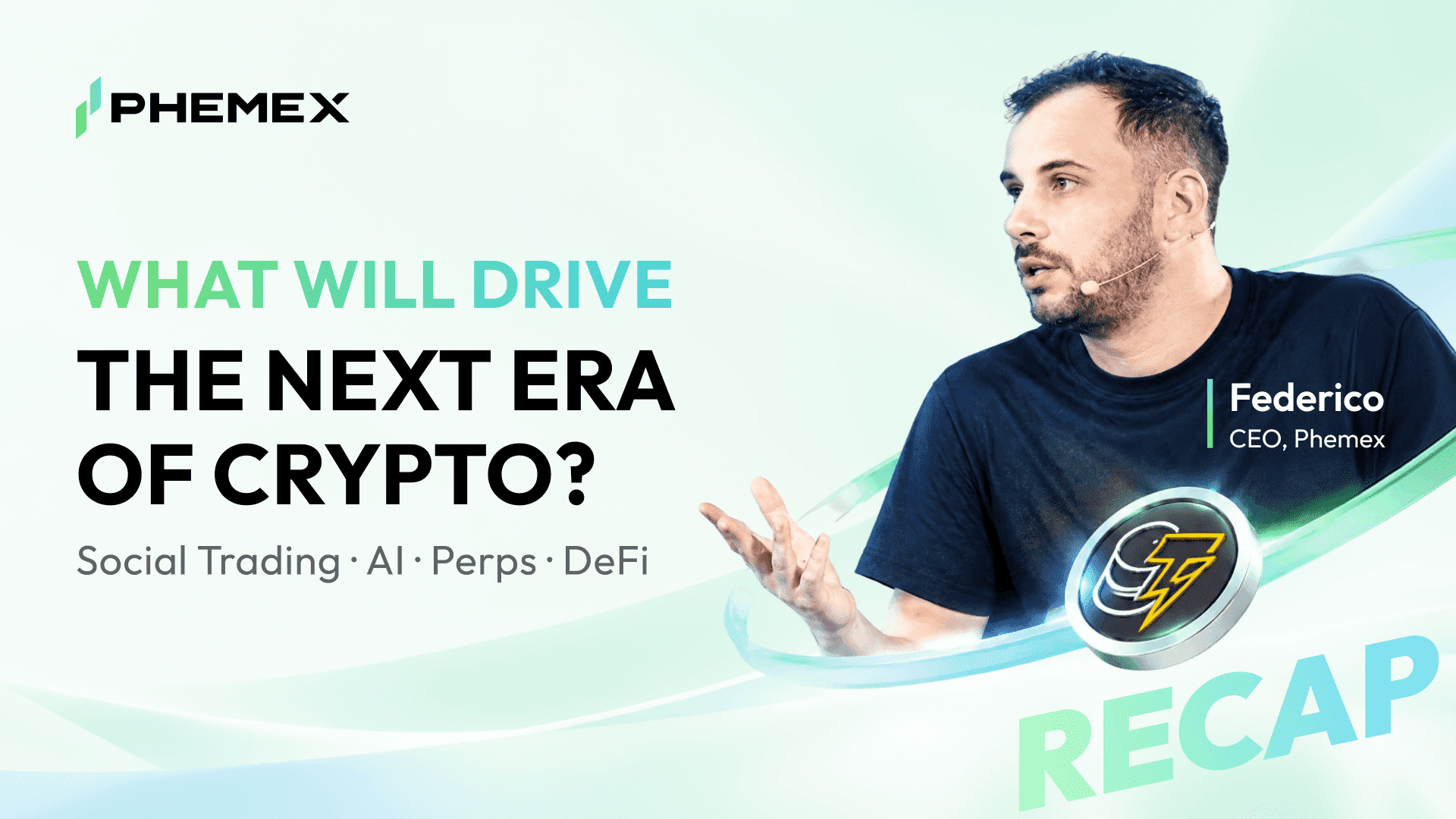

By Federico Variola, CEO of Phemex
When we founded Phemex in 2019, exchanges were defined by order books. You listed tokens, matched buyers with sellers, and competed on fees and execution speed. That model defined the first era of crypto. It will not define the next.
The next era belongs to platforms that operate intelligently. Not platforms that add an AI feature, but platforms where intelligence sits at the core. It shapes internal decisions and allows products to adapt to market conditions in real time.
This is the direction Phemex is taking. On February 19, 2026, we announced our AI‑native shift. It marked a change in how we build the company from this point on.
What Changed
Crypto exchanges have evolved more quickly than most people realize.
Seven years ago, the core product was simple. Spot trading for a limited set of tokens. Today, users on major platforms can trade perpetual contracts, access traditional financial assets, copy professional traders, earn yield, and deploy automated strategies from one account. Everything settles in stablecoins and runs continuously.
At Phemex, that evolution has been tangible. We launched TradFi futures to bring stocks and precious metals into the same USDT‑settled environment as crypto derivatives. We built a copy trading network with more than 17,000 experienced traders and 80,000 active users. We expanded our trading bot suite to include grid strategies, funding rate arbitrage, and AI‑generated parameters. All of this runs on an engine built for 300,000 transactions per second with millisecond latency.
The platform is no longer an exchange in the traditional sense. It is a financial interface. The question now is how all these capabilities work together intelligently.
Why AI Is Not a Feature
Many exchanges treat AI the way they once treated stablecoins. As an added capability rather than infrastructure. They introduce a chatbot or a signal tool and present it as innovation.
That view misses the shift underway.
AI is not something you attach to a platform. It is an operating layer that changes how the entire system functions. How risk is modeled across hundreds of pairs that trade nonstop. How products are developed and refined. How internal workflows run. How the platform responds to conditions faster than any team can react manually.
When I describe Phemex as AI‑native, I mean the company structure itself is changing. Workflows are being redesigned so AI‑driven processes handle tasks where machines outperform humans, such as scale and continuous monitoring. Human teams focus on judgment, strategy, and community building.
This is not about replacing people. It is about increasing what every person at Phemex can achieve with intelligent systems alongside them.
What This Looks Like in Practice
The AI Bot we launched on February 24, 2026, is the clearest visible example. It analyzes market volatility, historical drawdowns, and price structure, then generates trading parameters for Futures Grid, Spot Grid, and Futures Martingale strategies. Users deploy with one click. The system prioritizes risk by limiting leverage according to historical downside behavior.
The AI Bot is one product. The transformation beneath it is broader.
AI agents are being embedded across operations. Product cycles are accelerating through AI‑assisted iteration. Risk modeling is expanding to process market data at a scale manual monitoring cannot match. Internal workflows that required repetitive human effort are increasingly handled by intelligent systems.
The AI Bot exists because this internal layer exists. The same analytical capabilities used for internal risk assessment power the parameter generation users see at deployment. The user product and the operational shift are not separate. They are the same initiative expressed at different layers.
Every Cycle Redefines What Competitive Means
I have seen this industry move through several phases. Each changed what it meant to compete.
In 2019, the differentiator was speed and uptime. We built a matching engine with 99.999 percent availability and sub‑10 millisecond latency, drawing on experience from Morgan Stanley.
In 2022, the differentiator was trust. After industry failures, we implemented Proof of Reserves with Merkle Tree verification so users could confirm solvency directly.
In 2024, the differentiator was breadth. Platforms that combined spot, derivatives, copy trading, earn products, and fiat access gained users from those that did not.
In 2026, the differentiator is intelligence. Exchanges will compete on how deeply technology is integrated into their core architecture. Platforms that process data more effectively at the operational level will create better products at the user level. That advantage compounds.
This is why we invest in AI at the infrastructure layer rather than the feature layer. A better bot can be replicated quickly. An AI‑native operational architecture that informs every decision, risk model, and workflow requires years. We are building it now.
What Comes Next
Our roadmap is defined by milestones rather than slogans.
In the near term, the focus is the AI revolution. We are refining parameter generation, expanding supported strategies, and measuring how effectively it lowers the barrier to automated trading.
Over the next six to twelve months, the AI layer expands. AI‑driven risk upgrades. Smarter parameter optimization. An AI Insights dashboard that provides market context. An AI market analysis module. Each is a visible step built on the operational layer already in place.
Longer term, the direction is clear. Phemex becomes a platform where intelligence is present in every interaction. This applies to experienced traders configuring complex derivatives, beginners deploying their first AI Bot, and eventually autonomous agents executing strategies programmatically.
We are building for how markets are evolving, not how they existed before.
A Note to Our Users
Transformation at this scale does not happen instantly. Not every product will be perfect from the start. The AI Bot is an early step and will improve as models learn from more data and market scenarios.
What I can state with certainty is this. Every product decision going forward will be informed by intelligent systems. The platform you use today will be measurably smarter within six months. Within a year, the difference between Phemex and a non‑AI‑native exchange will be substantial.
We built Phemex for traders. That remains unchanged. What has changed is how we build. Intelligence is no longer an addition to the platform. It is the platform.
Federico Variola is the CEO and co-founder of Phemex__, a user-first crypto exchange trusted by over 10 million traders worldwide. The platform offers spot and derivatives trading__, copy trading__, TradFi futures__, and wealth management products__.
Cryptocurrency trading carries inherent risk. Automated trading tools do not guarantee profitability. Users are responsible for all trading decisions and outcomes.