
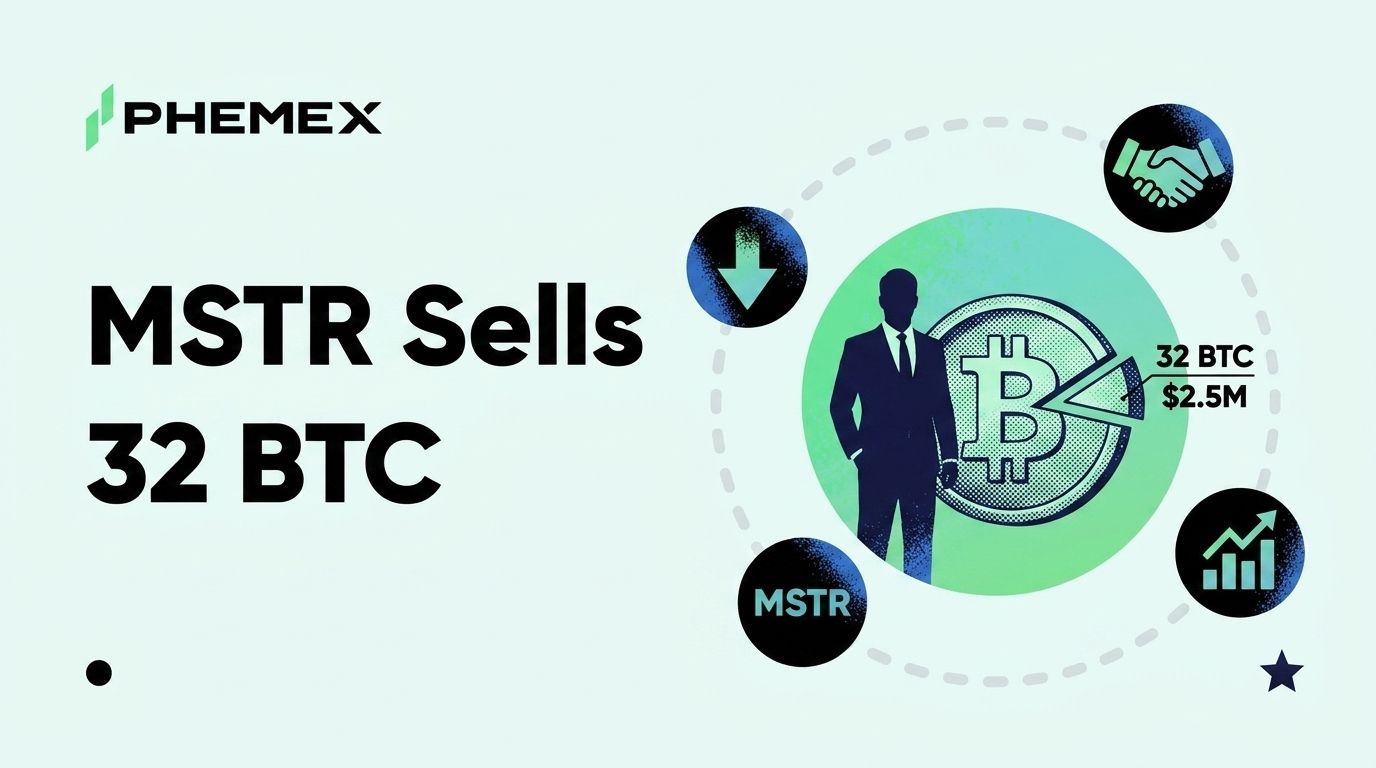
Strategy (formerly MicroStrategy) sold 32 BTC for approximately $2.5 million in late May 2026, marking the firm's first Bitcoin sale since 2022. The total Strategy treasury still sits at 843,738 BTC, the largest corporate Bitcoin holding in the world. A 32-coin sale against an 843,738-coin position is a rounding error in dollar terms, but the symbolic break from the "Saylor never sells" narrative is the entire story.
The sale matters not because of the dollar amount but because of what it signals about how Strategy thinks about its own playbook in 2026.
What Actually Changed in the Strategy Playbook
Three structural changes in 2026 explain why a 32-coin sale could happen at all. The first is the STRC preferred-share dividend obligation. STRC carries a programmatic dividend payment that Strategy has to fund from operating cash or from selective treasury operations. The 32-coin sale aligns almost exactly with the quarterly dividend run-rate, and the timing (late May, ahead of the quarterly distribution window) is consistent with funding the obligation rather than expressing a directional view on BTC.
The second is the tax-loss harvesting angle. BTC has traded in a wide range in 2026 (highs near $89,000 in April, lows near $66,000 in late May), and the corporate treasury has tax-lot tracking that creates optimization opportunities around specific entry prices. Selling 32 coins acquired at a higher cost basis and replacing them with equal exposure at a lower basis is a clean tax-efficiency move that does not reduce net BTC holdings.
The third is signaling. Strategy has spent five years building a public reputation around the "we will never sell" position, and breaking that narrative even at the 32-coin level is an explicit communication that the playbook is now operationally flexible rather than ideologically rigid.
Why 32 BTC Is a Rounding Error and Symbolism Is the Real Story
Thirty-two coins against 843,738 coins is 0.0038% of the position. The sale does not change Strategy's status as the largest corporate Bitcoin holder, does not change the company's mNAV math in any material way, and does not change the broader institutional accumulation narrative. What it does change is the binary "Saylor never sells" framing that has been the single most-cited Strategy talking point since 2020. The Phemex breakdown of how Strategy overtook BlackRock walks through how MSTR built the position, and the Bitcoin ETF flows primer covers the parallel institutional-flow architecture.
The shift matters because a substantial portion of MSTR's equity premium has historically been pegged to the credibility of the "never sell" position. If the market begins to model Strategy as a treasury operator that will sell selectively to fund dividend obligations or optimize tax position, the equity premium has to be re-priced against that more flexible playbook. The re-price may be small or it may be meaningful, depending on how the next 12 months of treasury operations actually look.
What This Means for the Saylor Never Sells Narrative
Michael Saylor's public posture has not changed. He has continued to post Bitcoin-maximalist content, has not publicly addressed the sale in detail, and has framed Strategy's overall trajectory as continuing accumulation. The 32-coin sale was disclosed in routine SEC filings rather than announced as a strategic shift.
That filing-only disclosure is itself a tell. If the sale were genuinely a strategic pivot, Strategy would have controlled the narrative through a public statement explaining the rationale. The decision to let the disclosure surface through routine filings suggests the firm wants the sale to be technically transparent but narratively minimal. The market caught it anyway, but the framing battle is unresolved.
What mNAV Math Looks Like at $74,000 BTC
Strategy's mNAV (the ratio of MSTR's market cap to the underlying Bitcoin treasury value at current spot) has been the cleanest single metric for valuing the equity. At a BTC price of $74,000, the 843,738-coin treasury is worth approximately $62.4 billion. MSTR's current market cap reflects a meaningful premium over that figure, which is the structural feature that lets Strategy raise capital at favorable terms and recycle into more BTC.
The mNAV premium expands when the market models Strategy as a leveraged BTC vehicle with structural advantages (perpetual capital, tax-loss harvesting, debt-financed accumulation). The premium compresses when the market begins to model the firm as a treasury operator that will sell selectively. The 32-coin sale is not large enough to compress the premium on its own, but it is large enough to introduce that compression risk into the analyst models.
Why This Is the Cleanest MSTR Setup of 2026
For traders looking at MSTR tokenized stock on Phemex, the current setup has three tradable layers. The first is the BTC correlation, which remains the dominant single driver of MSTR price action. The second is the mNAV premium dynamic, which adds idiosyncratic volatility around BTC moves. The third is the new sale-disclosure factor, which has not yet been fully digested by the equity tape and represents fresh information that could move the stock independently of BTC over the next two to four weeks.
The asymmetry is interesting. If BTC rallies back to $80,000 and Strategy continues to operate the new "flexible" playbook, MSTR can compound both the BTC move and a recovering mNAV premium. If BTC stays range-bound and the market re-prices Strategy as a more conventional treasury operator, MSTR can underperform BTC even in a flat tape.
What to Watch Going Forward
Three signals will tell you if the 32-coin sale is the first of many or a one-off operational adjustment. The first is the Q2 treasury report, which will disclose if Strategy has continued selective sales or returned to pure accumulation. The second is any public commentary from Saylor or other Strategy leadership that frames the new playbook explicitly. The third is the equity tape itself, because a meaningful mNAV compression over the next 60 days would tell you the market has already begun re-pricing the firm.
Frequently Asked Questions
Did Saylor personally approve the 32 BTC sale?
Strategy treasury operations are board-approved and executed by the corporate treasury function. Saylor remains executive chairman and the public face of the firm, but routine treasury operations of this size do not require individual sign-off. The 32-coin sale would have been a standard treasury authorization rather than a discretionary Saylor decision.
Why does a 32 BTC sale matter when Strategy still holds 843,738 coins?
The dollar size of the sale is immaterial to the underlying treasury position. The narrative break against the "never sell" framing is the material part. Strategy has built a substantial portion of its equity premium around the "never sell" position, and the disclosed sale is the first concrete evidence that the playbook is operationally flexible. The market response is driven by the signal, not by the amount.
Is the sale linked to STRC dividend funding?
The timing aligns with the quarterly dividend cycle and the dollar amount aligns with the dividend run-rate, but Strategy has not explicitly confirmed the linkage. The most likely explanation is that the sale funds the STRC obligation, but the firm is also using the sale to tax-loss-harvest specific cost bases.
Does this change the long-term Strategy thesis?
The long-term thesis (Strategy as the largest publicly-traded BTC accumulator) is intact. What has changed is the operational nuance. The market now has to model Strategy as a treasury operator that will sell selectively for specific obligations rather than as a pure accumulator with no exit. The mNAV premium will reflect that updated model.
Bottom Line
The 32 BTC sale is symbolic, not structural. The dollar amount is trivial against the 843,738-coin treasury, the operational explanation (STRC dividend funding or tax-loss harvesting) is straightforward, and Strategy's long-term BTC accumulation thesis remains intact. What changed is the public credibility of the "never sell" position. The market now has to weigh a more operationally flexible Strategy against a more rigid one, and that re-price will play out in the mNAV premium over the next 60 days. For MSTR traders, the current setup offers BTC correlation plus mNAV idiosyncrasy plus fresh information that has not been fully digested by the equity tape. Watch the Q2 treasury report.
This article is for informational purposes only and does not constitute financial or investment advice. Trading involves substantial risk. Always conduct your own research before making trading decisions.