

Market Snapshot
- AMD $553.22 at the latest snapshot, roughly 17% below its record high
-
Each Helios rack packs 72 Instinct MI455X GPUs with 31TB of combined HBM4
-
Aggregate bandwidth reaches 1.4PB/s per rack, and a double-wide version scales to 3 AI exaflops
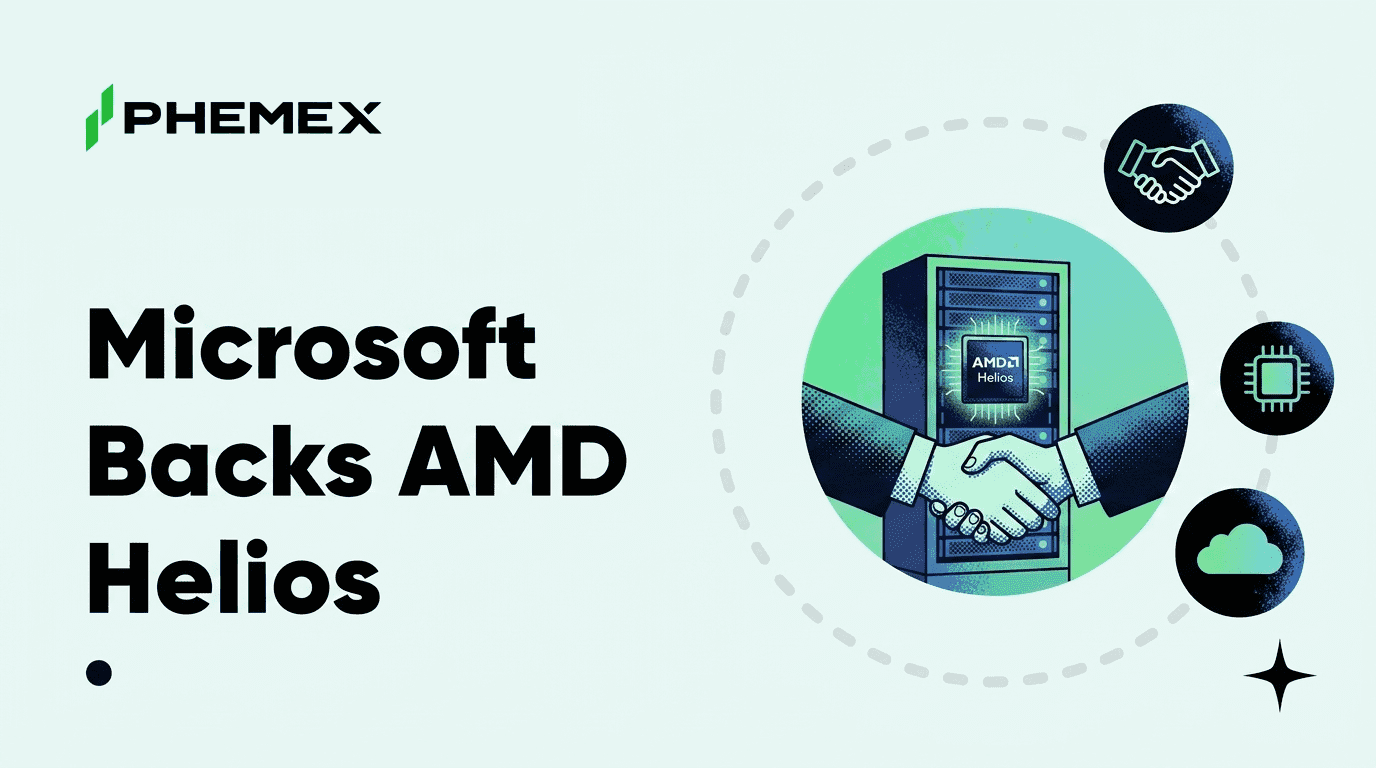
- Microsoft will deploy Helios in Azure, joining Meta, OpenAI, and Oracle on the customer list
- Zen 6 EPYC "Venice" server chips launched on TSMC's 2nm process
AMD used the opening day of its AI event on Wednesday, July 22, to roll out the full MI400 accelerator lineup, and Microsoft confirmed the same day that it will deploy the new Helios racks across Azure, per CNBC. Helios is AMD's rack-scale AI system, a complete data-center rack of Instinct MI455X accelerators sold as one integrated unit rather than as individual chips a customer has to assemble. The stock walked into the event well below its record high, which means the market showed up to this launch with real doubt already priced in.
The spec numbers deserve a close look, and they get one below. But the question that actually decides the trade is a different one. Does Microsoft joining the deployment list change what AMD's AI business is worth?
What AMD Put on the Table on Day One
The MI400 family is the new accelerator generation, and Helios is how AMD wants to sell it. Instead of shipping GPUs for cloud providers to integrate themselves, AMD is packaging compute, memory, and interconnect into a finished rack that a data center can order the way an airline orders a plane.
The packaging choice matters because integration time has become the real bottleneck for AI buildouts. A cloud provider that buys accelerators piecemeal spends months on networking, cooling, and firmware before a single model trains, while a pre-integrated rack compresses that timeline to installation and power. AMD is selling deployment speed as much as raw compute, and deployment speed is the thing capacity-constrained hyperscalers are actually short of in 2026.
The day-one numbers, collected in one place.
|
Helios spec
|
Number
|
|
GPUs per rack
|
72 Instinct MI455X
|
|
Combined HBM4 memory
|
31TB
|
|
Aggregate bandwidth
|
1.4PB/s
|
|
Double-wide configuration
|
Up to 3 AI exaflops
|
|
Slated availability
|
Q3 2026
|
The memory figure carries its own signal. Pulling that much HBM4 into every rack makes AMD one of the heaviest buyers of next-generation memory on the market, a demand wave that flows straight to the memory makers, which is why SK Hynix's HBM trajectory is worth tracking alongside AMD's own numbers.
Day one belonged to the products. Lisa Su's keynote is scheduled later today, so the strategic framing around these launches is still to come, and nothing in it can be assumed in advance.
The Customer Roster Is the Real Product
For years the objection to AMD's AI accelerator business was never the spec sheet. Paper performance has been competitive for multiple generations. The objection was the absence of marquee customers committing at scale, because in AI infrastructure the buyer list is the proof that software, supply, and support actually work outside a lab.
That is what changed on July 22. Microsoft committing Azure to Helios puts a fourth hyperscale name next to Meta, OpenAI, and Oracle, and Oracle's own infrastructure buildout has been one of the year's louder stock stories, covered in our Oracle stock outlook. Four of the largest AI capacity buyers on earth have now publicly attached themselves to AMD's rack-scale platform.
The commitment also says something about software. The historical knock on AMD accelerators was that the hardware arrived ready while the tooling made customers do the last mile of work themselves. Hyperscalers do not commit production cloud capacity to a platform their engineers cannot support at scale, so four names on this roster is indirect evidence that the software gap has narrowed enough for the biggest buyers in the market to live with it.
Nvidia remains the incumbent, and nothing announced this week changes who collects most of the industry's accelerator spending today. Our NVDA outlook covers how deep that position runs. But hyperscalers have spent two years engineering their way out of dependence on a single supplier for the most expensive line item in their capex budgets. Part of that diversification flows into custom chips, the Marvell and Broadcom side of the AI-silicon complex, and part flows to the one merchant vendor offering a credible rack-scale alternative.
Think of it the way airlines think about engines. Nobody switches suppliers casually, but every airline wants two viable engine makers bidding on the next order, because the second source disciplines the first on price and delivery. The hyperscalers just told the market, in public, that AMD is the second engine maker.
Venice on 2nm Is the Quieter Big Deal
Alongside the accelerators, AMD launched its Zen 6 EPYC "Venice" server processors on TSMC's 2nm process. This got a fraction of the Helios coverage and arguably deserves more, because a rack is never GPUs alone. The CPUs that schedule work, move data, and run everything around the model matter to total system performance, and shipping server silicon on the industry's leading-edge node is a statement about execution as much as speed.
It also lands at an awkward moment for the competition. Intel is still working through the foundry and delay problems we broke down in our Intel 18A analysis, and every quarter AMD ships leading-edge server parts on schedule, the switching argument for data-center buyers gets simpler. Venice will not headline anyone's AI coverage this week. It will quietly show up in server market share numbers over the next year.
If you hold AMD for the AI story, Venice is also the part of the announcement that protects the downside. Server CPUs are a business with existing revenue, existing share, and repeat buyers, and that business keeps compounding even in quarters where the accelerator narrative stalls or a rack date slips.
The 1,000x MI500 Claim Deserves a Discount Rate
AMD also teased the generation after this one. The MI500, built on the CDNA 6 architecture with HBM4E memory on a 2nm-class process, is slated for 2027, and AMD claims it will deliver 1,000x the AI performance of the MI300X.
Treat that multiple as a vendor benchmark until independent numbers exist, because that is what it is. Chipmakers earn headline multiples through accumulated choices. Lower-precision number formats, sparsity assumptions, rack-versus-single-chip baselines, and favorable workload selection can each contribute a factor, and multiplying enough factors together produces four digits without any single lie being told. Nvidia's generational claims have used the same playbook, so this is industry practice rather than an AMD-specific sin.
The honest read is that MI500 is a statement of intent with a two-digit real-world gain buried somewhere inside a four-digit marketing number. The intent matters, the cadence matters, and the specific multiple should carry close to zero weight in a valuation model.
What $553 Prices In
AMD trades at $553.22 on our latest snapshot, roughly 17% off its record. A stock sitting that far below its high while announcing its strongest customer roster ever is a market saying one thing. Prove the revenue.
And that skepticism has a defensible basis rather than a sentimental one. Deployment announcements are commitments, and commitments only become recognizable revenue when racks physically ship, which the slide says begins in Q3 2026 for the double-wide configuration. Day-one reactions to AI events are also historically unreliable signals in both directions, so the live tape on AMD's Nasdaq quote page matters more than any single session's read, and with a Fed decision landing next week, macro can move every chip stock regardless of product news.
For traders rather than investors, the sequencing matters more than the thesis. Event weeks compress a quarter's worth of headlines into a few sessions, and the keynote is a scheduled volatility point sitting inside an already-moving story. Chasing the first green candle after a product announcement has been a losing pattern across this cycle's AI events, while letting the post-event range form has generally produced better entries in both directions.
What would close the gap to the high is boring and specific. Confirmed Helios installations, data-center revenue acceleration in the next two earnings prints, and evidence that Azure's deployment is a volume order rather than an evaluation. What would widen it is a slipped ship date, because in this market a delayed AI product is treated as a broken one.
Frequently Asked Questions
What is AMD Helios?
Helios is AMD's rack-scale AI system, a complete data-center rack that integrates 72 of its Instinct MI455X GPUs into a single deployable unit with 31TB of shared HBM4 memory. Cloud providers buy AI capacity by the rack instead of assembling individual accelerators, and a double-wide version rated at up to 3 AI exaflops is slated for Q3 2026.
Is AMD a good buy in 2026?
AMD sits well below its record high while holding its strongest AI customer list to date, so the setup rewards buyers if deployments convert to revenue and punishes them if timing slips. The stock can move double digits on a single earnings print, which argues for sizing any position around that volatility rather than around conviction alone.
Which companies are deploying AMD Helios racks?
Microsoft, Meta, OpenAI, and Oracle have all attached themselves to Helios, with Microsoft's Azure commitment announced July 22, 2026, per CNBC reporting. Microsoft was the newest addition and the one that pushed the roster to four of the largest AI infrastructure buyers in the world.
When will the AMD MI500 launch?
AMD has slated the MI500 generation for 2027, built on CDNA 6 with HBM4E memory. The company claims 1,000x the AI performance of the MI300X, a figure that comes from AMD's own benchmarks and has no independent verification yet, so treat it as directional rather than literal.
Bottom Line
Three observables decide this trade from here, and the first is keynote follow-through. Su speaks later today, and any added customer names or volume specifics would compound the roster story that day one started. Second, the first confirmed Helios deployments against the Q3 2026 slide date, because the announcement-to-installation gap is where AI infrastructure stories either become revenue or become excuses. Third, the roughly 17% distance to the record high, which closes on shipment confirmations rather than on spec sheets. If racks land on schedule and Azure's order proves to be volume, that gap was the opportunity. If Q3 passes without confirmed installations, it was the warning.
This article is for informational purposes only and does not constitute financial or investment advice. Cryptocurrency trading involves substantial risk. Always conduct your own research before making trading decisions.