

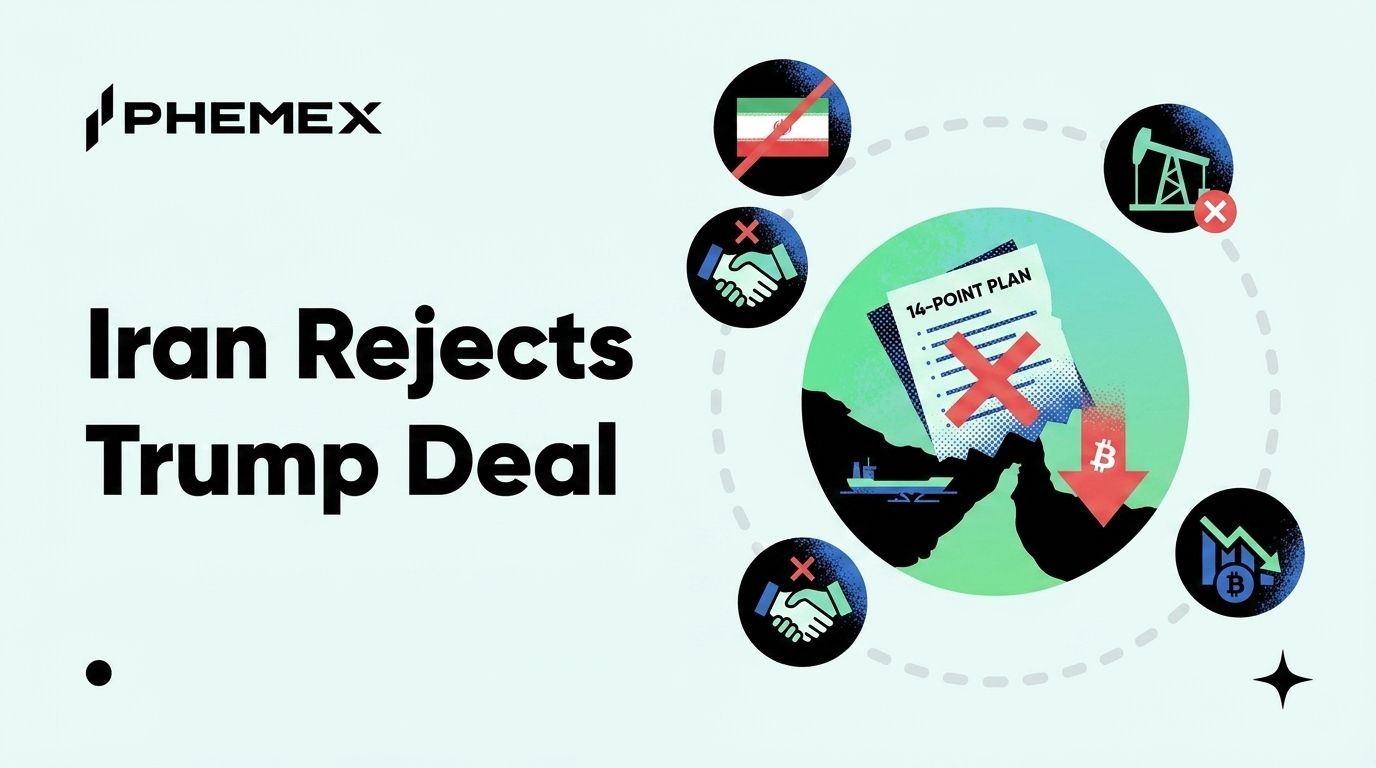
Bitcoin slid from $82,833 to under $80,000 on May 7 within hours of a senior Iranian official telling Tehran's domestic press that Trump's 14-point memorandum of understanding on the Strait of Hormuz was "unrealistic" as drafted. The rejection wiped $91 million in long positions on the spot, and total crypto liquidations across the May 7 retreat reached $270 million as the market cap pulled back to $2.74 trillion. Two days earlier, Trump had suspended Project Freedom, the US naval escort operation in the Gulf, on the assumption a deal was within reach. That assumption just got tested in real time on the tape.
The setback is specific rather than terminal. Iran is not walking from the table, Witkoff and Kushner are still on the phone with Tehran, and the framework as drafted is what got rejected. The gap between what Trump's team wrote and what Iran is willing to sign has more to do with reparations and Lebanon than it does with shipping lanes.
What Iran Actually Rejected
The 14-point MOU is the framework Trump's negotiating team, fronted by Steve Witkoff and Jared Kushner, has been shopping in Tehran since late April. It addresses the toll regime Iran has been enforcing in the Strait of Hormuz, freedom-of-navigation language for tanker traffic, and a phased de-escalation that would let Trump claim a foreign policy win and let Iran avoid further sanctions damage.
According to the Iranian official quoted in news.bitcoin's report, the framework as written ignores the Iranian position on two non-negotiables. The first is reparations for war damage. Tehran wants compensation language for the strikes that hit Iranian infrastructure during the 2025-2026 escalation, and the current MOU does not contain it. The second is Lebanon. Iran's position is that any Hormuz deal must be paired with a halt to the Israel-Hezbollah fighting, and Israel has shown no willingness to pause its Lebanon campaign.
Without those two pieces, the MOU is a document Iran cannot domestically defend. The official's "unrealistic" framing is the diplomatic version of "your draft is not serious."
How Bitcoin Reacted
BTC entered May 7 around $82,833, sitting in the recovery channel that built off the late-April peace-deal optimism. Within roughly six hours of the Iranian rejection hitting English-language wires, BTC printed below $80,000 for the first time since the May 4 missile-report sell-off that briefly took it back to $79,000.
The mechanics of the move tell the same story they told on May 4. Pre-event positioning was crowded long. Funding rates had pushed positive across major perpetual venues as traders front-ran the expected deal announcement, and the rejection unwound that anticipation trade in a single news cycle. The $91 million long flush was the leverage component. The remaining gap to the $270 million in total liquidations came from spot dumps, short-position covering on the way up that got reversed, and ETH-led altcoin pain.
CoinSpectator's tape of the move shows the bulk of the liquidation cascade hit between $81,500 and $80,200, the band where May 5 longs entered after Trump paused Project Freedom and the deal narrative looked locked in. That cohort just got stopped out at break-even or worse.
Project Freedom Is the Variable
Project Freedom is the US naval escort operation Trump set up earlier in the cycle to convoy commercial tankers through the Strait of Hormuz after Iran began enforcing toll demands on transit traffic. It is also the leverage Trump has been holding over the negotiation. On May 5, with the MOU close to a draft both sides were quietly previewing, Trump suspended the operation as a goodwill gesture.
The suspension is not cancellation. With the framework now rejected as drafted, Project Freedom can reactivate at any time. The market knows this, which is why the May 7 drop was a clean leverage flush rather than a panic crash. Reactivating the naval escort operation would mark a meaningful escalation. It would put US ships back in direct contact with Iranian patrol vessels in a contested waterway, and it would tell Tehran the diplomatic window is closing.
For now, the operation is paused and the negotiating window is open. Witkoff and Kushner are still working the file. The question is what the next 7-14 days produce. Either a redrafted framework Iran can accept, or one of the secondary catalysts (a Lebanon flare-up, an Iranian patrol incident, an Israeli strike that crosses a new line) forces Trump's hand.
Why the Reparations Demand Is the Sticking Point
Trump's domestic politics make reparations language nearly impossible to include in any agreement his team signs. Paying Iran for damage caused during a US-backed Israeli campaign would be a political non-starter for the White House regardless of how small the actual dollar figures might be. Reframing reparations as "infrastructure assistance" or "humanitarian funding" is the diplomatic workaround typically used in cases like this, but Iran's negotiators have explicitly rejected that euphemism in past rounds.
The Lebanon piece is even harder. Israel views the Hezbollah front as part of a broader regional war that started before the Hormuz situation and operates on its own timeline. Tehran wants a single deal that closes both fronts. Israel wants to keep Lebanon hot. Trump cannot deliver an Israeli pause as part of a US-Iran deal without explicit Israeli buy-in, and that buy-in is not on offer.
This is why the rejection is structural rather than tactical. The gap between what Iran wants and what Trump can deliver is not bridgeable with better wording. It requires a separate agreement involving Israel and Lebanon, and that agreement is not on any table right now.
What the Tape Shows for Crypto Risk
|
Date
|
BTC catalyst
|
BTC price action
|
Liquidation scale
|
|
May 4
|
Iran missile report
|
$82K to $79K
|
Heavy long flush
|
|
May 5
|
Trump pauses Project Freedom
|
$79K to $83K
|
Short squeeze
|
|
May 7
|
Iran rejects MOU as drafted
|
$82,833 to under $80K
|
$91M longs, $270M total
|
The pattern across the May 4 to May 7 window is a market trying to price binary geopolitical outcomes with leverage that overshoots in both directions. Each headline produces an outsized move because positioning is crowded on the side that just got proven wrong, and each reversal sets up the next overshoot. This is the regime BTC is in until either the deal closes or it formally collapses.
What Could Reaccelerate the Drawdown
Three things would push BTC meaningfully below the $79K-$80K zone from here.
A formal Project Freedom restart. If Trump reauthorizes the US naval escort operation in response to the rejection or to any Iranian provocation in the Strait, BTC's geopolitical risk premium re-prices higher and the May 4 missile-report low at $79,000 becomes the test level rather than the floor. The historical oil-price spikes from Hormuz tension have correlated with crypto drawdowns more than most retail traders track.
A Lebanon escalation. Hezbollah has tied its operational tempo to the broader Iran negotiation. If the Hormuz framework collapses, the Lebanon front intensifies. An Israeli strike that produces meaningful Iranian-aligned casualties forces Tehran to respond, and a Tehran response is what hit the tape on May 4 with the missile-report headline.
An ETF-flow rotation. The May 7 spot ETF flow data is the cleanest read on how institutions treated the rejection, as a buy-the-dip event or a risk-off trigger. Heavy outflows on May 8 alongside a failure to reclaim $82K would tell you the institutional bid that had been supporting the recovery channel has stepped back, and the floor moves lower.
What Could Reverse the Move Quickly
The same structure that produces overshoot drawdowns produces overshoot rallies. A redrafted MOU that Iran can accept, even an interim de-escalation that does not solve Lebanon but addresses Hormuz tolls and reparations language, would put BTC back above $84,000 inside a single session. The infrastructure for that rally is already there. Funding rates have flipped negative on the move, short positions are building into the $79K-$80K zone, and a positive catalyst would force the kind of cascading liquidation flush that produced the May 5 squeeze in reverse.
The historical comparison to the 2025 Iran ceasefire windows is the closest tape. Each ceasefire announcement produced a 4-7% BTC rally inside 24 hours, followed by a fade as the structural problems reasserted. Each rejection produced a 3-5% drawdown inside 24 hours, followed by a stabilization. The May 7 move fits the rejection template cleanly, which is why this is more likely a range-bound chop than the start of a trend.
Frequently Asked Questions
Why did Bitcoin drop on Iran rejecting the deal when no actual conflict happened?
Because the recovery channel above $80,000 was built on deal-optimism positioning. When Trump paused Project Freedom on May 5, traders read it as confirmation a deal was close and added long exposure into $82K-$83K. The May 7 rejection invalidated that thesis, and the leverage that had stacked on the long side flushed. No new fighting needed to happen. The mechanical unwinding of the anticipation trade did the work.
Is the deal completely dead or still being negotiated?
It is still being negotiated. The framework as drafted got rejected, but Witkoff and Kushner remain in active contact with Tehran, and Iran has not walked from the table. The realistic outcome is a redrafted MOU that adjusts the reparations language and addresses the Lebanon question through some kind of separate parallel track. That redraft could take days or weeks. The market is now pricing both the deal and the no-deal outcome rather than just the deal.
Will Project Freedom restart automatically because of the rejection?
No, not automatically. Trump's team will likely keep the operation paused as long as Iran stays at the table. A restart becomes more likely if Iran moves to enforce tolls more aggressively in the Strait, if a tanker incident happens, or if Tehran walks from the negotiation entirely. The pause is the diplomatic carrot, and Trump knows pulling it back ends the negotiation prospect.
What level should I watch on BTC if this drags out?
$79,000 is the May 4 missile-report low and the immediate floor. A clean break below that level on heavy volume would suggest the geopolitical risk premium is repricing higher, and the next meaningful support sits closer to $76,500. On the upside, $82,800 is the May 7 pre-rejection level. Reclaiming that zone on a positive headline would tell you the rejection has been absorbed and the recovery channel is intact.
Bottom Line
The Hormuz framework is rejected as drafted, not dead. BTC priced the setback cleanly at $80K with $270M in liquidations, then stabilized rather than cascading lower, which tells you the market still views the diplomatic window as open. The next 7-14 days are the test. Either Witkoff and Kushner produce a redrafted MOU Iran can sign, in which case BTC retests $84K within a session, or Trump reactivates Project Freedom and the May 4 low at $79K becomes the immediate fight. The trade is not directional from here. It is binary on the next headline, and the headline that matters is the redrafted framework. Specifically, how it addresses Lebanon and reparations in a way both sides can live with.
This article is for informational purposes only and does not constitute financial or investment advice. Cryptocurrency trading involves substantial risk. Always conduct your own research before making trading decisions.