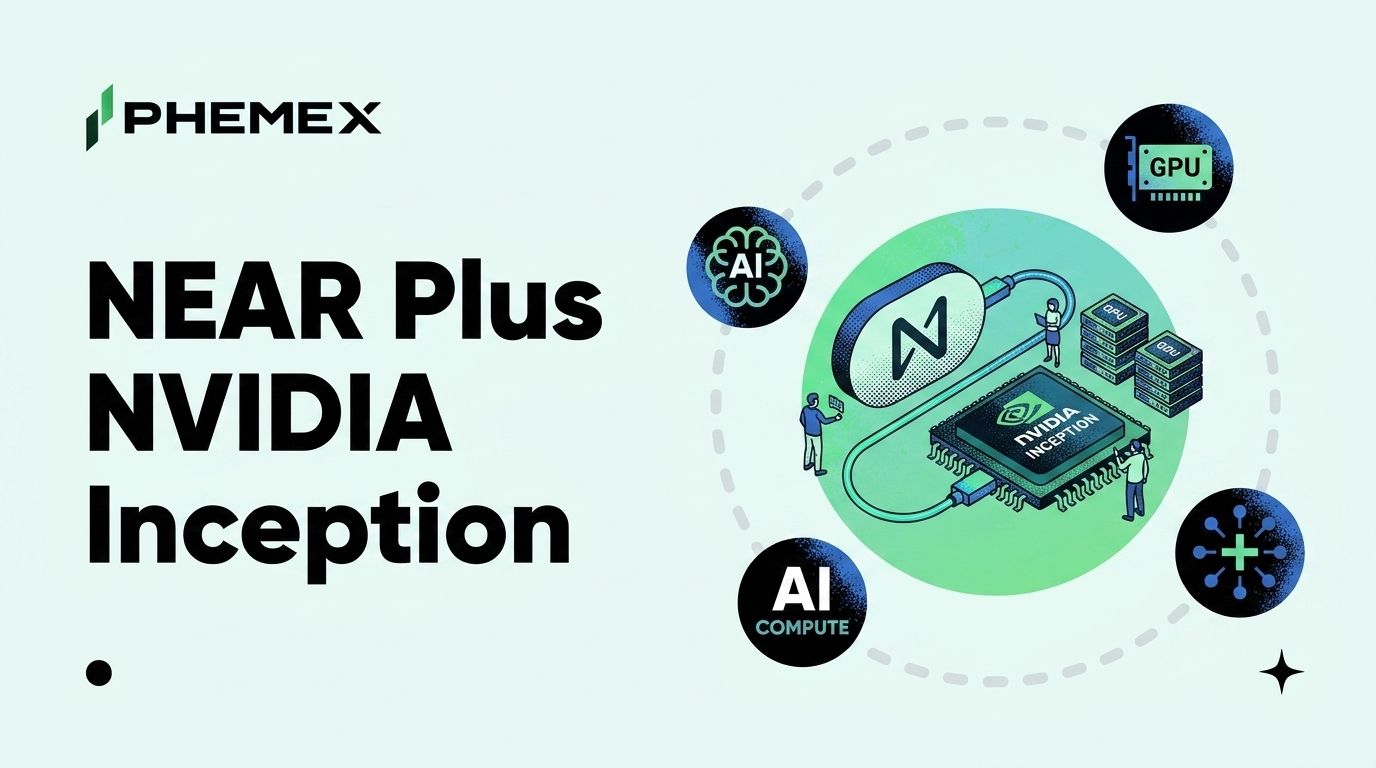
NEAR rallied 12.66% in 24 hours on May 9, 2026, after the NEAR Foundation rolled out four product announcements that reframe the network as the leading AI-native Layer-1. NEAR AI joined NVIDIA's Inception Program, launched a decentralized AI Agent Market where agents transact with full economic agency, shipped the IronClaw AI assistant, and opened a confidential GPU marketplace built on Trusted Execution Environments. The thesis the Foundation has been pushing for two years just got real product surface.
This article covers what each launch actually does, why the NVIDIA partnership matters more than the marketing copy suggests, and where NEAR sits against ICP, Akash, and Bittensor in the decentralized AI competition. Co-founder Illia Polosukhin, one of the eight authors of the original "Attention Is All You Need" Transformer paper at Google, is now driving this AI thesis at NEAR. That credential changes the credibility of the announcements.
What the NEAR AI Agent Market Actually Does
The AI Agent Market is the most consequential of the four announcements. It is a decentralized infrastructure layer for what NEAR calls agentic commerce, meaning AI agents can hold value, transact, and coordinate with other agents without a human pressing send for every transaction. Agents are paid instantly in NEAR tokens, the marketplace settles natively onchain, and the protocol is compatible with major agentic frameworks including OpenClaw, Claude, Codex, and others.
The interesting part is what "full economic agency" means in practice. An AI agent on the marketplace can hire another AI agent for a sub-task, pay it on completion, settle a payment to a human contributor, and reconcile all of those flows in a single onchain audit trail. That is the kind of multi-agent workflow that breaks under traditional payment rails because card networks were not designed for machine-to-machine micropayments at second-by-second cadence.
NEAR's positioning here is that crypto is the only viable settlement layer for agentic commerce. The argument has been around for years, but having compatible agent frameworks plus a working marketplace plus an L1 that already does sub-second finality and sub-cent fees is the first time the pieces line up. The remaining question is adoption depth, which the next 90 days will answer.
Why NVIDIA Inception Matters More Than the Headline
On its face, NVIDIA Inception is a startup support program. NVIDIA has admitted thousands of companies into it. Treating the partnership as a major institutional endorsement misreads the structure.
But the practical access matters. Inception members get prioritized access to NVIDIA GPU resources, technical expertise from NVIDIA engineering teams, and inclusion in the developer tooling ecosystem that runs on CUDA and the broader NVIDIA AI stack. For a project trying to build a decentralized GPU marketplace, that relationship is a hard precondition. You cannot run privacy-preserving AI inference at scale without enterprise GPU access, and you cannot get enterprise GPU access without proving you understand the stack. Inception is the entry credential.
The signal value is real even if the partnership itself is not exclusive. NEAR is now publicly aligned with NVIDIA's AI infrastructure roadmap rather than fighting it from outside. For a network competing with ICP, Akash, and Bittensor for the decentralized AI mindshare, that is a structural advantage. Phemex covered the partnership when it was first announced earlier this year in its news article on the NVIDIA Inception expansion, and the May 9 product drops are the operational follow-through.
The Confidential GPU Marketplace and NEAR AI Cloud
The second product launch is a decentralized confidential GPU marketplace running on Trusted Execution Environments, packaged as NEAR AI Cloud. TEEs are hardware-secured enclaves that let computation happen on data without the operator of the hardware seeing the data itself. For AI training and inference, this solves a specific problem.
The problem is that most enterprise AI workloads cannot run on permissionless infrastructure because the data is regulated. Healthcare data, legal data, financial models, and proprietary training datasets cannot be shipped to a random GPU operator hoping for the best. TEEs provide a cryptographic guarantee that the operator cannot inspect the workload, which lets enterprises rent decentralized compute the way they currently rent AWS GPU instances, but with built-in confidentiality.
NEAR is not the only project building TEE-based AI compute. Raptor Group's coverage of the launch frames it as a direct response to enterprise concerns about cloud data sovereignty, and that framing is accurate. The competitive angle against Akash, which runs uncensored decentralized compute without TEE-level privacy guarantees, is that NEAR is targeting the regulated enterprise tier rather than the developer-grade workload market. Different customer, different price point, different sales cycle.
IronClaw and Why a Branded AI Assistant Ships With This Bundle
The IronClaw AI assistant is the smallest of the four launches but it serves a specific function. It is the front-end interface that demonstrates the agentic stack working end-to-end. A user can talk to IronClaw, request multi-step actions involving payments, data lookups, and coordination with other agents, and watch the workflow execute through the AI Agent Market and settle on NEAR.
Without an end-user product, the agentic infrastructure is invisible to anyone who is not a developer. IronClaw is the storefront. It does not need to be the best AI assistant in the world. It needs to be the assistant that proves the underlying stack is real and usable by humans who do not want to read protocol documentation.
This is the same playbook OpenAI used with ChatGPT to demonstrate GPT-3.5. The model existed for nine months before ChatGPT shipped, but it took the consumer interface to make the technology visible.
How NEAR Stacks Against ICP, Akash, and Bittensor
The decentralized AI thesis is contested. Four projects now have legitimate claims to it, and each frames the problem differently.
|
Project
|
Core thesis
|
Privacy approach
|
Token utility
|
|
Internet Computer (ICP)
|
Run full applications onchain at native speed
|
Replicated state, no TEE
|
Cycles burn, governance
|
|
Akash
|
Marketplace for permissionless cloud compute
|
Uncensored, no privacy guarantee
|
Stake to validate, fees in AKT
|
|
Bittensor
|
Subnet incentive layer for AI model training
|
Subnet-specific, varies by subnet
|
TAO emissions to top-performing subnets
|
|
NEAR
|
AI-native L1 plus agentic commerce plus confidential compute
|
TEE-based on AI Cloud
|
NEAR for fees, staking, agent payments
|
NEAR is not trying to be Akash. It is trying to combine settlement (its core L1 advantage), agent coordination (the Agent Market), and privacy-preserving compute (NEAR AI Cloud) into a single full-stack offering. The bet is that enterprises do not want to assemble a decentralized AI stack from three separate projects, and that vertically integrated infrastructure wins the regulated tier of the market.
The risk is the opposite. If the modular thesis wins, where Akash provides compute, Bittensor provides model incentives, and a third party provides settlement, NEAR's full-stack pitch becomes overhead rather than advantage. The next 12 months of enterprise adoption will resolve that.
What the 12.66% Move Tells You
NEAR is up 12.66% in 24 hours on the news, which is a meaningful move for a top-30 market cap asset on a product announcement rather than a macro catalyst. The market reaction is doing several things at once.
First, it is rerating NEAR from "general L1 with AI flavor" to "leading AI-native L1," which carries a different multiple. The same price action happened to FET, AGIX, and OCEAN through 2024 when the AI narrative first took over crypto, and NEAR has spent most of 2025 underperforming that narrative despite Polosukhin's credentials.
Second, the move is partially short covering. NEAR was sitting near multi-month support before the announcement and short interest had built up against the broader L1 weakness. A four-headline drop with a credible AI angle is exactly the catalyst that flushes that positioning.
Third, the move is small relative to what an actual breakout would look like. A 12% rally on news of this magnitude is consistent with cautious buying rather than reflexive narrative chasing. The follow-through over the next 5 to 10 trading sessions matters more than the initial reaction. If NEAR holds the breakout level through the next macro print, the rerate is real. If it gives it back, the announcement gets priced as a one-day pop.
Bitget's coverage of the launch lists the same four product drops and matches the price reaction on its data feed, confirming the move is broadly observed across exchanges rather than a single venue artifact.
How This Fits With NEAR's Existing Stack
NEAR has been laying the groundwork for this announcement for over a year. The network already supports confidential cross-chain DeFi via Confidential Intents, which uses similar TEE architecture to the new AI Cloud product. Chain Signatures, the multi-chain account abstraction layer, lets a NEAR account control assets on Bitcoin, Ethereum, Solana, and other chains directly. Combined with the Agent Market, that means an AI agent on NEAR can hold and move assets across most of the relevant chains in crypto without bridging.
This is what makes the agentic commerce thesis non-trivial. An agent that can only move NEAR tokens is interesting. An agent that can hold and move BTC, ETH, USDC across chains, settle in NEAR, and run within a TEE-enforced privacy boundary is qualitatively different. NEAR has been quietly building each layer, and the May 9 announcements are the moment those layers get packaged as a single offering.
Frequently Asked Questions
What is the NEAR AI Agent Market?
It is a decentralized marketplace where AI agents can transact, hire other agents, and settle payments instantly in NEAR tokens with full economic agency. The marketplace is compatible with major agentic frameworks including OpenClaw, Claude, and Codex, which means agents built in those ecosystems can plug into NEAR's settlement layer without rebuilding.
Did NVIDIA actually invest in NEAR through this Inception partnership?
No, not at all. Inception is NVIDIA's startup program that provides GPU access, developer tools, and technical resources to accepted projects. It does not include direct investment or exclusivity. The signal matters because NEAR is now formally aligned with NVIDIA's AI infrastructure stack, but it is not a strategic equity partnership.
How is NEAR AI Cloud different from Akash?
NEAR AI Cloud uses Trusted Execution Environments to provide cryptographic privacy guarantees, which lets enterprise customers run regulated workloads on decentralized GPU infrastructure. Akash provides permissionless decentralized compute without TEE-level privacy, targeting a different tier of customer. The two products are competitive at the margin but solve different problems for different buyers.
Why does Illia Polosukhin's background matter?
He is one of the eight authors of the 2017 Google paper "Attention Is All You Need," which introduced the Transformer architecture that powers every modern LLM including GPT, Claude, and Gemini. That credential gives NEAR's AI strategy a credibility floor that most crypto AI projects do not have. The relevant question is execution at the protocol level, but the founder credential closes one debate before it starts.
Bottom Line
NEAR's May 9 product bundle is the moment the AI-native L1 thesis goes from pitch deck to working stack. The Agent Market plus NEAR AI Cloud plus IronClaw plus the NVIDIA Inception relationship together form a credible vertical offering for enterprises that want decentralized AI infrastructure with privacy guarantees and onchain settlement.
The price move tells you the market noticed. The 5 to 10 day follow-through tells you if the rerate sticks or gets faded as another narrative pop. Watch for two things specifically. First, the Agent Market needs real agent registrations and transaction volume in the first 30 days, because vaporware burns fast in this cycle. Second, NEAR has to hold its breakout level through the next FOMC print and broader macro tape, because narrative-driven moves on weak macro days tend to give back gains within a week.
If both hold, NEAR enters Q3 2026 as the default answer to "which L1 is winning AI." If either fails, this becomes another headline that did not convert into durable price action or developer mindshare. The infrastructure is real, and the only remaining question now is if enterprise adoption shows up in the data within the next two quarters.
This article is for informational purposes only and does not constitute financial or investment advice. Cryptocurrency trading involves substantial risk. Always conduct your own research before making trading decisions.