



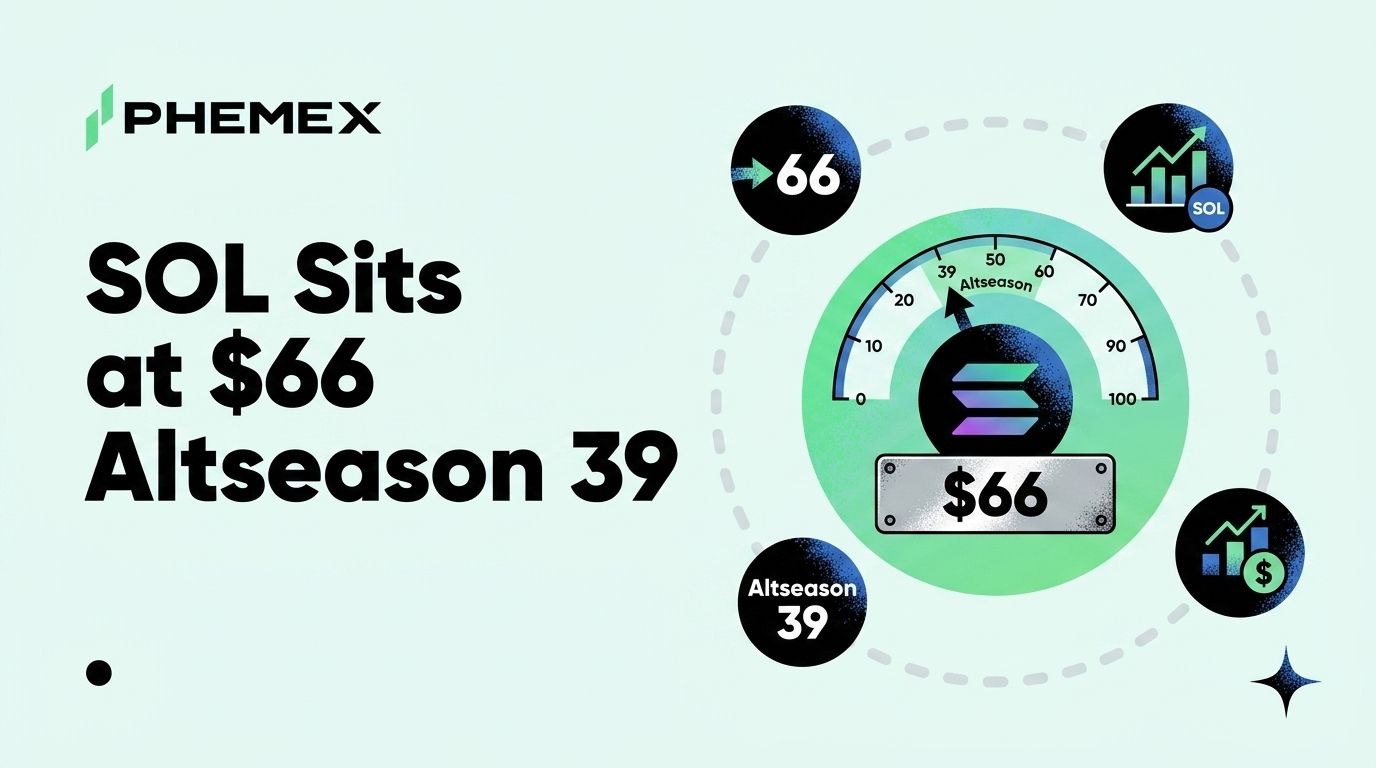
Solana is trading at $66.01, down 0.78 percent on the day, while the CoinMarketCap Altcoin Season Index sits at 39 out of 100, firmly in what the index labels Bitcoin Season. SOL has held the $64 to $70 zone for most of the last three weeks despite the broader risk-off backdrop, and the relative-strength read against ETH and the smaller L1 basket has actually improved over the same window. The combination of an oversold BTC tape, a low altseason reading, and a Solana ecosystem calendar that has three concrete near-term catalysts is the exact backdrop that has historically preceded SOL outperformance.
Here is what the Altcoin Season Index actually measures, why a low reading combined with an oversold BTC is the standard altseason precursor, and where SOL needs to hold for the rotation case to stay alive.
What the Altcoin Season Index Actually Measures
The CMC Altcoin Season Index tracks the percentage of the top 100 altcoins that outperformed Bitcoin over the trailing 90 days. The scale runs 0 to 100. A reading of 75 or higher is labeled Altcoin Season because at least three quarters of the top 100 names have beaten BTC. A reading of 25 or lower is full Bitcoin Season, where only the largest, most BTC-correlated names are holding up.
Source: Coinmarketcap
The current reading of 39 puts the market in the middle band that historically resolves in one of two directions over the following 60 to 90 days. Either BTC continues to dominate and the index drifts down through 25 before snapping back, or BTC consolidates and rotation begins, with the index climbing through 50 and then through 60 as altcoin breadth picks up. The pattern through both 2020 and 2024 was the same. Altseason did not start when the index was already high. It started when the index was low, BTC was technically oversold, and one or two catalyst-driven altcoins ran first and dragged the rest of the basket with them.
That historical pattern is exactly what makes the current reading interesting. Combined with the daily BTC RSI of 15.5, the lowest reading since March 2020, the structural setup matches the early phase of every prior altseason rotation. It does not guarantee the rotation. It does say the timing is closer than the headline index reading suggests.
Why SOL Is the Likely First Mover in a Rotation
The reason SOL tends to lead altseason is mechanical. Solana has the largest combination of liquid spot market depth, large active DeFi TVL, and concentrated retail attention among the non-BTC, non-ETH majors. When rotation capital starts moving down the risk curve, SOL gets the first significant allocation simply because it is the only altcoin large enough to absorb meaningful position sizes without slippage.
The Solana ecosystem catalyst calendar over the next 90 days reinforces that read. The Alpenglow consensus upgrade is on track for a Q3 mainnet activation, the Firedancer validator client continues to ship incremental performance improvements, and a spot SOL ETF approval window opens in mid-July with multiple issuer filings already at the standard SEC EDGAR review stage. None of those individually is a guaranteed catalyst, but the combination produces three separate narrative entry points for capital to start positioning ahead of execution.
SOL on-chain activity also supports the structural read. DEX volume routed through Solana has held above $4 billion daily for most of the last 30 days per the DefiLlama Solana dashboard, Jupiter aggregator volume continues to capture the bulk of routing flow, and the network has not had a sustained outage since the early-2024 series. The technical story has matured.
Source: defillama
The Three Levels That Matter for SOL Right Now
SOL support sits at $64, defined by the May low and the 200-day moving average. A daily close below $64 opens $60, which is the volume cluster from the April basing range. A loss of $60 on a weekly close would shift the SOL read from coiled-rotation-candidate to deeper-correction with $56 as the next level.
Resistance sits at $72, defined by the May 30 high and the upper Bollinger band on the daily chart. A clean daily close above $72 starts the rotation trade in earnest and points toward $78 to $82 as the next supply zone, which is where most spot supply has cleared over the last 60 days. A weekly close above $82 is the level that has historically confirmed that an altseason rotation is fully in motion.
Between $64 and $72, SOL is range-bound and waiting for either a BTC reversal or an idiosyncratic Solana catalyst to break the deadlock. The fact that SOL has held that range while BTC has lost ground tells you the structural bid is real.
What Has to Happen for the Altseason Index to Climb
The Altcoin Season Index climbs when more of the top 100 names beat BTC over the trailing 90 days. The mechanical path through 50 requires roughly 10 to 15 names to deliver clean outperformance versus BTC, and the historical pattern points to two main candidates for the first wave. Large-cap L1 and L2 names (SOL, AVAX, NEAR, ICP, TON) typically run first because they have the liquidity to absorb rotation capital. Sector-specific narrative leaders (the largest names in each of DePIN, AI-token, RWA, and prediction-market sectors) follow.
The Solana ecosystem token complex (JUP, JTO, PYTH, RAY, BONK, WIF, PENGU) usually moves on a 7 to 14 day lag behind SOL itself. The pattern is that SOL prints the breakout, the ecosystem names follow within two weeks, and then the rotation broadens to other L1 complexes once the Solana basket starts cooling. That sequencing is consistent across the 2021 and 2024 cycles, and the Phemex Solana primer covers the ecosystem token taxonomy if the breakdown is unfamiliar.
A push above $72 on SOL is the cleanest signal that the rotation has started. Watching the Solana ecosystem basket for a 7 to 10 day lag confirms it.
Frequently Asked Questions
How reliable is the Altcoin Season Index as a timing tool?
The index works as a directional indicator over 60 to 90 day windows rather than as a precise timing signal. Readings under 30 combined with an oversold BTC structure have correctly preceded rotation in three of the last four cycles, with one false signal during the late-2022 bear market when broader macro pressure overrode the on-chain setup.
Why does SOL outperform other large-cap L1s during altseason?
Liquidity and retail attention. SOL has the largest combination of spot order book depth, active DEX volume, and consumer-facing application activity among the non-ETH L1s. Rotation capital moves down the risk curve in size, and SOL is the only altcoin large enough to absorb meaningful allocations without dragging the market on the way in.
Does a SOL spot ETF approval automatically trigger altseason?
It supports the case but does not automatically trigger broad rotation. The 2024 ETH ETF approval initially produced a muted price response because flows took several months to scale. A SOL ETF would likely follow a similar slow-burn pattern, but the announcement itself would still produce a clean rerating window over the following weeks.
What invalidates the rotation thesis?
A loss of $60 on a weekly SOL close, combined with the Altcoin Season Index drifting below 25 over the following two weeks, would invalidate the near-term rotation case. The structural bid would then need a fresh catalyst (BTC reversal, ETF approval, macro shift) to reset.
Bottom Line
SOL at $66 with the Altcoin Season Index at 39 sits inside the historical setup that has preceded every prior altseason rotation. The combination of an oversold BTC, a low index reading, a three-catalyst Solana calendar, and a SOL spot tape that has held its range against the broader risk-off backdrop is structurally constructive on a 60 to 90 day horizon.
A clean daily close above $72 starts the rotation trade. A weekly close below $60 invalidates it and shifts the playbook to capital preservation. The Solana ecosystem basket lag is the confirmation signal once the breakout starts, and that sequence has been the reliable pattern across the 2021 and 2024 cycles.
This article is for informational purposes only and does not constitute financial or investment advice. Cryptocurrency trading involves substantial risk. Always conduct your own research before making trading decisions.