










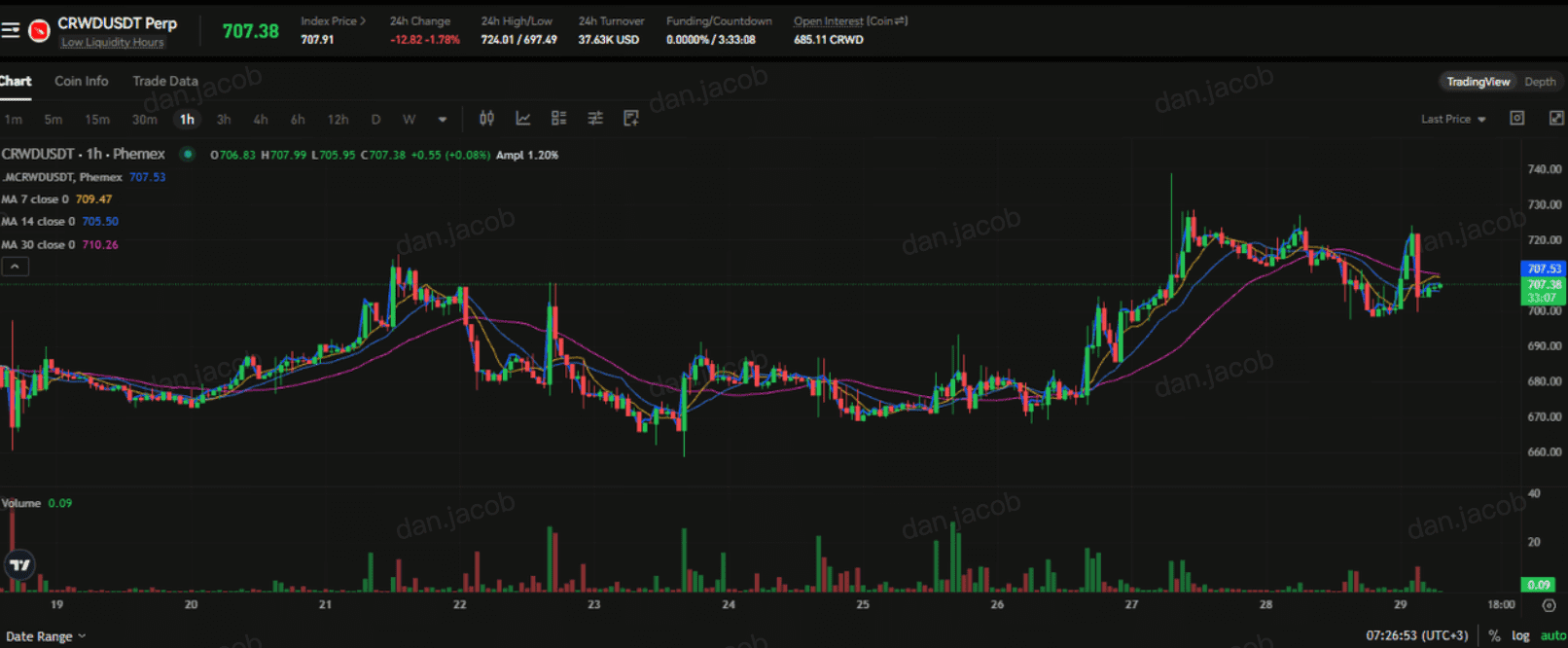
Software and cybersecurity names are having one of their strongest sessions of the year. CrowdStrike (CRWD) is trading at $701.09, up 4.17%, Palo Alto Networks (PANW) is up 7%, Cloudflare (NET) is up 6%, Snowflake (SNOW) is up 10%, and Zscaler (ZS) is up 4%. The move is not a random tech bounce. It is the unwinding of a specific fear that had hung over the sector for months, the idea that artificial intelligence would quietly hollow out software-as-a-service businesses from the inside.
That fear has a nickname on trading desks, the "SaaSpocalypse," and the past few weeks have started to take it apart. Here is what is driving the rotation, why the disruption story is fading, and what a trader watches before chasing the move.
What Is Driving the Software and Cybersecurity Rotation
The simplest read is that money is flowing back into a group that had been left for dead. For most of the spring, the consensus trade was to avoid pure software and pile into the chip and infrastructure layer instead. Capital wanted the companies selling the picks and shovels of AI, not the application vendors those tools might one day replace. That trade got crowded, and crowded trades unwind hard when the story cracks.
The spark was Snowflake's most recent quarter, a blowout print that reframed how investors think about software in an AI world. More on that below. Once SNOW showed that consumption-based software can actually grow faster because of AI, the rest of the group caught a bid as the same logic got applied across security, networking, and data names.
Here is how the day's movers stack up.
|
Company
|
Ticker
|
Move today
|
What it does
|
|
CrowdStrike
|
CRWD
|
+4.17% to $701.09
|
Endpoint and cloud security
|
|
Palo Alto Networks
|
PANW
|
+7%
|
Network and firewall security
|
|
Cloudflare
|
NET
|
+6%
|
Edge network and security
|
|
Snowflake
|
SNOW
|
+10%
|
Data cloud and AI workloads
|
|
Zscaler
|
ZS
|
+4%
|
Zero-trust cloud security
|
Two threads run through that table. The data and platform names are rallying on the AI-as-tailwind story, and the security names are rallying on a separate but related idea, that more AI and more crypto activity means a larger attack surface, which means more security spend, not less. Both threads point the same direction for now. If you want to understand how AI software demand connects back to crypto markets, our explainer on AI agents in crypto covers the same consumption dynamic from the token side.
The SaaSpocalypse Fear and Why It Is Easing
The SaaSpocalypse was a real worry, not a meme. The argument went like this. A huge share of software revenue comes from selling seats, one license per employee who logs in and does a job. If AI agents start doing those jobs, companies need fewer seats, and seat-based software revenue shrinks. Layer on the fear that anyone can now spin up a custom app with an AI coding assistant in an afternoon, and the bull case for paying a vendor thousands of dollars a year starts to look shaky.
That story sent the whole group lower over the spring. Investors marked down forward multiples on the assumption that growth was about to slow or reverse. The problem with the thesis was that it treated all software the same, when the reality is that AI helps some business models and hurts others.
The fear is easing for two reasons. First, the feared revenue collapse simply has not shown up in the numbers. Quarter after quarter, the larger platform vendors keep guiding growth higher, not lower. Second, and more important, the strongest software companies are now showing that AI drives MORE usage of their products, which flows straight to revenue. When the central premise of a bear thesis fails to materialize for two or three reporting cycles, the discount it created tends to reverse fast. That is a large part of what today's tape is showing.
AI-Disrupted Software Versus AI-Boosted Software
This is the distinction that matters, and it is the one the market spent months getting wrong by lumping everything together. Not all software is exposed to AI the same way, and the rally is rewarding the companies on the right side of the line.
AI-disrupted software is the seat-based, workflow-replaceable kind. Tools where the value was mostly "a human uses this to do a task" are genuinely at risk, because the human doing the task is exactly what AI is coming for. A simple ticketing tool or a thin layer on top of a database has a harder road. These are the names that earned the SaaSpocalypse discount, and some of that caution is fair.
AI-boosted software is the opposite. These are companies whose revenue scales with how much work runs through their platform, not with how many humans are logged in. Snowflake is the cleanest example because it charges for compute consumed. When an AI agent queries a database thousands of times to complete a task, that is thousands of billable operations, far more than a human analyst would ever run by hand. AI does not shrink that business. It pours fuel on it. The same logic lifts data infrastructure, observability, and the security layer, where every new AI workload and every new connected service creates something else that has to be monitored and defended.
The Snowflake quarter made the point concrete. The company reported a roughly $6 billion compute commitment with Amazon's AWS to support surging AI workloads, and it leaned hard on its "Coco" AI coding agent, which lets users build and run data jobs in plain language and drives consumption revenue as those jobs execute. The figures sit in the company's filings on Snowflake's investor relations site and in its disclosures on SEC EDGAR. Frame that correctly. It is not today's news, it was the recent catalyst that flipped the narrative, the proof that a software company can turn the AI wave into a revenue tailwind rather than an extinction event. For the broader picture on how AI compute demand has reshaped the hardware layer too, our coverage of NVIDIA's stock outlook and Oracle's cloud buildout tracks the other end of the same trade.
The Cybersecurity Spend Angle
Security is its own story inside this rally, and it may be the most durable thread of all. The reason is simple. Every trend that creates more software, more AI agents, and more connected services also creates more ways to get attacked. Budgets for security rarely get cut when the threat is growing, and right now the threat is growing on several fronts at once.
AI is a double-edged tool here. The same models that help defenders write detection rules also help attackers write phishing campaigns, clone voices, and probe code for weaknesses at machine speed. That arms race is bullish for the companies selling defense. It is why CrowdStrike at $701.09 and Palo Alto up 7% are leading rather than lagging, and why zero-trust names like Zscaler hold a bid even on a broad software up day. CrowdStrike publishes its own growth metrics on its investor relations page, and the broader sector tape is tracked on the CNBC technology markets section. When attackers get faster, the budget to stop them goes up, not down.
Crypto sits right in the middle of this. Digital asset platforms, on-chain protocols, and prediction markets are some of the highest-value targets on the internet because the money moves instantly and is hard to claw back. The day's reminder of that came from the Polymarket hack, a fresh example of how a high-profile crypto venue can be drained when one weak point gets found. Every incident like that pushes both crypto firms and traditional companies to spend more on defense, which is exactly the demand that flows to the cybersecurity names rallying today. To see how attackers exploit infrastructure weak points across the space, our breakdown of DeFi hacks and bridge exploits walks through the common failure modes.
What a Trader Watches From Here
A one-day rip is not a trend, and the honest read is that a lot of today's move is short covering plus a sentiment reset, not fresh fundamental data on every name. That can carry prices further than fundamentals justify, which is exactly when chasing gets dangerous. The job now is to separate the names with a real AI tailwind from the ones just riding the group bounce.
The first thing to watch is the next round of earnings and guidance. The SaaSpocalypse trade dies for good only if consumption and security vendors keep guiding growth higher across another reporting cycle. One blowout quarter from Snowflake started the move, but the market wants confirmation that it generalizes. Watch the consumption revenue and net retention lines for proof they keep climbing.
The second thing is the question of how the leaders behave on the pullback that usually follows a sharp gap up. A name like CRWD near $701 that consolidates above its breakout and refuses to give back the move is acting differently than one that fades straight back into the range. The third is the spread between AI-boosted and AI-disrupted software. If that gap keeps widening, the market is pricing the distinction correctly and the theme has legs. If everything rallies together regardless of business model, it is a sentiment move that can reverse just as fast. For traders comparing how this plays across the chip and semiconductor side, the Samsung versus Broadcom breakdown and the Marvell AI outlook map the hardware leg of the same rotation.
Frequently Asked Questions
Why are software stocks going up?
Software stocks are rallying because the "SaaSpocalypse" fear, the worry that AI would gut software-as-a-service revenue, is fading as companies keep guiding growth higher. The trigger was Snowflake's recent blowout quarter, which showed that consumption-based software can grow faster in an AI world rather than get replaced by it. That reset sent money flowing back into a group that had been heavily discounted.
What is the SaaSpocalypse?
The SaaSpocalypse is the trader nickname for the fear that AI would destroy software-as-a-service businesses by eliminating the seats and workflows they sell. The thesis assumed AI agents would do the jobs that software licenses were sold for, shrinking revenue. It is fading because the feared revenue collapse has not appeared, and the strongest vendors are showing AI actually drives more usage and more billing.
Is CrowdStrike a buy?
CrowdStrike at $701.09 sits in a structurally strong category, since security spending tends to rise as AI and crypto attack surfaces grow, which is a real tailwind. That said, a stock up sharply in a single broad-group rally can give back the move on the pullback that often follows a gap up. The honest answer is that the category trend is favorable, but chasing a sharp one-day spike is where traders most often get hurt, so the entry matters as much as the thesis.
Does the Polymarket hack affect cybersecurity stocks?
Not directly in dollar terms, but every high-profile crypto exploit reinforces the demand story for security vendors. Incidents like the Polymarket hack push both crypto firms and traditional companies to spend more on defense, which is the underlying demand that lifts names like CrowdStrike, Palo Alto, and Zscaler. It is one data point in a broader trend of a growing attack surface.
Bottom Line
The rotation back into software and cybersecurity is a fear unwind, not a hype cycle. The SaaSpocalypse trade priced in AI killing software-as-a-service, and Snowflake's roughly $6 billion AWS deal plus its Coco AI agent showed the opposite, that consumption software can ride the AI wave to faster growth. Watch three things from here, the question of consumption and security vendors guiding growth higher next cycle, the question of leaders like CRWD near $701holding above their breakout levels on the inevitable pullback, and the question of the gap between AI-boosted and AI-disrupted names continuing to widen. If all three hold, the theme has real legs. If the group rallies indiscriminately and then fades, today was a sentiment reset that overshot, and the better entry comes later.
This article is for informational purposes only and does not constitute financial or investment advice. Cryptocurrency trading involves substantial risk. Always conduct your own research before making trading decisions.
