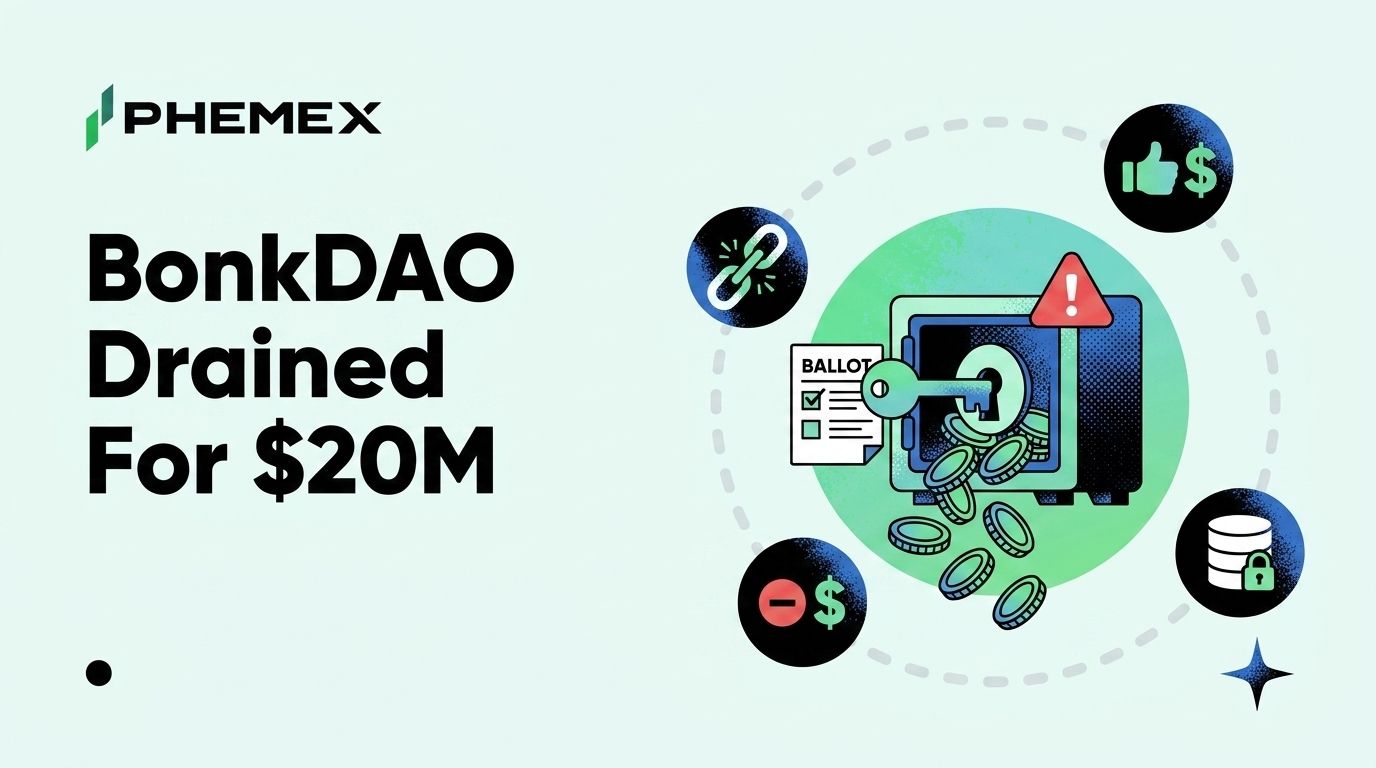
On July 7, 2026, an attacker walked out of the BonkDAO treasury with roughly $20 million in BONK, and they did it without touching a single line of vulnerable code. There was no smart-contract bug, no private-key theft, and no phishing link. The attacker simply bought enough voting power to pass a proposal that told the treasury to pay them, and the rules of the DAO did the rest. BONK fell about 9% as the news spread across Solana.
This is the kind of attack that keeps DAO builders awake, because the code worked exactly as designed. Governance did what governance is supposed to do. Here is how the vote was captured, why the math worked in the attacker's favor, and what token-weighted voting still gets wrong.
How the BonkDAO Treasury Was Drained in a Single Vote
BONK is the memecoin that became a mascot for Solana, and BonkDAO is the community body that governs its treasury through on-chain proposals. Members hold BONK, proposals get posted, and token holders vote yes or no. The more tokens you hold, the heavier your vote counts. That last detail is the entire story.
Sometime before the vote, the attacker moved through several centralized exchanges and spent roughly $4.4 million to accumulate just over 1% of BONK's circulating supply. On paper, 1% of a memecoin sounds like a rounding error. Inside a low-turnout DAO vote, it was enough to become the single most powerful voice in the room.
The proposal was titled "BIP #76 - Sowellian BonkDAO." On the surface it read like routine governance housekeeping. Buried in the fine print was an instruction to transfer 4.43 trillion BONK out of the treasury and into a wallet the attacker controlled. Most members never read that far, and most never voted at all.
When the voting window closed, BIP #76 had passed with 99.9% support. That approval came from just 7 wallets. More than 18,000 BonkDAO members did not cast a vote, which put total turnout at a thin 2.9%. The attacker had not out-argued the community. They had simply shown up to an empty room and cast the loudest ballot.
The Math Behind Buying a Governance Majority
Token-weighted governance runs on two numbers. Quorum is the minimum voting power that must participate for a result to count. The vote tally decides which way that power leans. An attacker who controls both at once controls the outcome, and BIP #76 cleared quorum by one of the narrowest margins a treasury attack has ever needed.
The proposal met the bar by a sliver. The "yes" side carried 882.38 billion BONK against a quorum threshold of 879.95 billion BONK, a gap of less than half a percent. The attacker did not need overwhelming force. They needed to buy exactly enough weight to tip past the line while almost nobody else was watching.
|
Vote metric
|
Figure
|
What it shows
|
|
Cost to buy 1% of supply
|
~$4.4 million
|
The price of a temporary voting majority
|
|
Wallets voting yes
|
7
|
How few holders decided the outcome
|
|
Approval rate
|
99.9%
|
No organized opposition turned up
|
|
Voter turnout
|
2.9%
|
Over 18,000 members stayed silent
|
|
Yes votes vs quorum
|
882.38B vs 879.95B BONK
|
Cleared the threshold by a razor margin
|
|
Treasury drained
|
4.43 trillion BONK (~$20M)
|
The payout hidden in the fine print
|
The economics are what make this dangerous. The attacker spent about $4.4 million to extract close to $20 million, a return of more than four to one before accounting for the market impact of selling the stolen BONK. When the cost of buying a majority is a fraction of the treasury it controls, the attack pays for itself.
What a Governance Attack Actually Is
A governance attack is not a hack in the traditional sense. Nobody breaks in through a flaw. Instead, the attacker acquires enough legitimate voting power to force a decision that drains value from the protocol, then uses the system's own rules to make it happen. Across DeFi, this is one of the hardest threats to defend against, because the exploit and the intended behavior look identical to the code.
The blueprint is almost as old as DAOs themselves. Back in 2016, the original DAO on Ethereum collapsed after an attacker exploited a reentrancy bug and drained a third of its funds, splitting the community and forcing a hard fork. The collapse of The DAO was a code exploit. BIP #76 is its modern cousin, and it is arguably scarier, because it needed no bug at all.
Three conditions turned BonkDAO into a target, and they apply to a long list of other protocols right now:
Low turnout leaves the door open. When 2.9% of members vote, a determined buyer only has to outweigh that tiny active slice. Apathy is the vulnerability, not the smart contract.
Voting power is for sale on the open market. Because governance weight equals token holdings, anyone with capital can rent a majority. The attacker bought 1% of supply through ordinary exchange purchases, no insider access required.
Quorum thresholds can be gamed. A fixed quorum that looked safe during quiet periods becomes cheap to clear when participation collapses. BIP #76 passed by clearing 879.95 billion BONK by less than half a percent.
This is why the same pattern shows up across the security beat. The recurring theme in DeFi exploits during 2026 is that attackers increasingly target governance and economic design rather than raw code, because the human layer is softer than the cryptographic one. BONK's roots as a Solana memecoin, born out of the same launchpad culture that mints new tokens by the hour, meant a large, distributed, and mostly disengaged holder base. That is exactly the profile a governance attacker looks for.
How BonkDAO and Solana Responded
BonkDAO confirmed the attack publicly within hours and moved into damage control. In a statement posted to the project's official X account, the team said it had already traced the exchange wallets the attacker used to buy BONK ahead of the vote, and that it was coordinating with those exchanges, with bridge operators, and with the Solana Foundation to track the stolen funds and freeze what it could.
The response mattered because the attacker's biggest problem now is liquidity. Drained BONK is only worth $20 million on paper. Turning 4.43 trillion tokens into clean, spendable value means routing them through centralized exchanges or cross-chain bridges, and both of those are exactly the chokepoints BonkDAO says it is watching. If the identified deposit addresses get flagged, a large share of that treasury could be stranded.
The market reaction was swift but contained. BONK's roughly 9% drop reflected the shock and the fear of the attacker dumping the stolen supply, though the sell-off did not spread far beyond the token itself. You can track the ongoing price impact through BONK's live market data, and the broader health of the ecosystem through Solana's on-chain DeFi metrics on DefiLlama.
The harder question is philosophical, and the crypto community is already split on it. One camp calls BIP #76 plain theft, a coordinated raid dressed up as a vote. The other camp argues the attacker did nothing the rules forbade. They bought tokens, they voted, and the proposal passed. Under that reading, this was not a crime but a brutal stress test of "code is law," and the fault lies with a governance design that let a temporary majority be bought for pocket change.
Frequently Asked Questions
What is a governance attack?
A governance attack is when someone acquires enough voting power in a DAO to pass a proposal that benefits them at the protocol's expense, using the system's own rules rather than a code exploit. In the BonkDAO case, the attacker bought BONK on the open market, met the quorum threshold in a low-turnout vote, and approved a proposal that sent treasury funds to their own wallet.
How did the attacker only need 1% of BONK to win?
Voter turnout was just 2.9%, so the attacker only had to outweigh the small fraction of members who actually voted. Buying just over 1% of supply for about $4.4 million was enough to control 99.9% of the votes cast and clear the 879.95 billion BONK quorum threshold by a razor-thin margin.
Was the BonkDAO attack technically a hack?
This one does not fit the classic definition of a breach. There was no bug, stolen key, or breached server. The smart contracts executed exactly as written, which is what makes governance attacks so difficult to prevent and why some argue this was rule-exploitation rather than theft.
Can other DAOs be attacked the same way?
Yes, and that is what makes this incident so worrying. Any DAO with token-weighted voting, low participation, and a quorum threshold that can be cheaply met is exposed. Defenses like time-locked proposals, vote delegation, quorum tied to a percentage of active supply, and manual review of treasury transfers all raise the cost of this kind of attack.
The Bottom Line
The BonkDAO drain is a warning about economic design, not code quality. An attacker turned $4.4 million into a $20 million payout because a fixed quorum plus 2.9% turnout made a voting majority cheaper than the treasury it controlled. Three things matter from here. First, can BonkDAO and its partners freeze the identified wallets before the attacker offloads 4.43 trillion BONK into cleaner liquidity. Second, do other Solana treasuries tighten their quorum rules in response before someone runs the same playbook against them. Third, does BONK hold its post-attack floor or bleed further as the market prices in the overhang. For every protocol running token-weighted votes, the lesson is blunt. If your community stops voting, someone will happily vote for them.
This article is for informational purposes only and does not constitute financial or investment advice. Cryptocurrency trading involves substantial risk. Always conduct your own research before making trading decisions.