Summary Box
-
Ticker Symbol: PUMP
-
Current Price: Approximately $0.00150
-
Chain: Solana
-
Market Cap: Approximately $580 million–$600 million
-
Circulating / Max Supply: About 399.5 billion / 1 trillion PUMP
-
ATH / ATL Price: Approximately $0.008819 / $0.001157
-
All-Time ROI: About +29% from the ATL, but roughly -63% from the $0.004 token-sale price
-
Availability on Phemex: Yes
Pump.fun transformed token creation from a technical process into something almost anyone could complete in minutes. That simplicity helped it become one of the defining applications of the Solana memecoin boom. Users could create tokens, seed initial trading through a bonding curve, and attempt to build a community without writing smart contracts or arranging liquidity manually.
The platform also built a remarkably profitable business. It has generated more than $1 billion in cumulative protocol revenue, expanded beyond its original launchpad, and introduced an automated buyback-and-burn mechanism for its native PUMP token.
Yet PUMP has struggled to translate Pump.fun’s commercial success into lasting price appreciation. The token trades well below its July 2025 sale price and more than 80% beneath its historical high. Team and investor vesting has started, platform activity remains highly dependent on speculative memecoin demand, and PUMP does not legally entitle holders to protocol revenue.
What Is Pump.fun?
What is Pump.fun? Pump.fun is a permissionless token-creation and trading platform that allows users to launch crypto assets without coding or supplying a conventional liquidity pool. It belongs to the SocialFi, decentralized trading, and token-launchpad categories, although most assets created through the platform are highly speculative memecoins. A creator chooses a token name, ticker, image, and description. The platform then generates the asset and opens trading through an automated bonding curve. Prices rise as users buy and fall as they sell. Once a token reaches the required threshold, its liquidity migrates into an automated market maker, where open trading continues.
This model solves several practical problems. It removes the need for creators to write smart contracts, reduces the ability to insert malicious custom code, standardizes token launches, and establishes an immediate market for newly created assets. It also makes token creation dramatically more accessible. Pump.fun has since expanded beyond the original bonding-curve product. PumpSwap provides native automated-market-maker infrastructure, while Terminal offers a more advanced trading interface. Livestreaming and creator-fee systems combine social content with token speculation, and newer products have explored bounties, tokenized agents, and multichain activity.
PUMP Price History and Performance Overview
Pump.fun launched its platform in January 2024, but PUMP did not begin trading until July 2025. Before the token launch, Pump.fun had already become one of crypto’s highest-revenue applications by simplifying memecoin creation and collecting fees from bonding-curve activity.
The PUMP sale allocated 33% of the one-trillion-token maximum supply to private and public participants. Eighteen percent went to the private round, while 15% was offered publicly. Both groups paid $0.004 per token, and their sale allocations were fully unlocked from the beginning.
Initial trading was extremely volatile. CoinGecko records an all-time high of $0.008819, while some other market-data providers recorded higher short-lived prices during the earliest trading period. Using the more conservative figure, early public-sale participants briefly held an unrealized gain of more than 100%.
That premium disappeared quickly. Investors questioned PUMP’s limited direct utility, the large insider allocation, and the absence of legally enforceable revenue rights. The token fell toward $0.0012 during October 2025 and continued trading far below its sale price through much of 2026.
Pump.fun responded by strengthening the connection between platform activity and PUMP supply. Buybacks initially supported market purchases, while an April 2026 change programmatically allocated 50% of revenue toward purchases and burns for one year. This helped PUMP recover toward $0.002 during June and July before the latest correction.
Whale Activity and Smart-Money Flows
Whale activity in Pump.fun is dominated by two forces: protocol-funded buybacks and the gradual release of insider tokens. The buyback program is the largest transparent source of recurring demand. By late July 2026, Pump.fun reported spending approximately $414.6 million to purchase and burn 153.73 billion PUMP. Daily purchases during the final reported week frequently ranged from roughly $400,000 to $600,000.
These transactions can support price and reduce supply, but investors should understand their limits. PUMP holders have no contractual right to future purchases. The project has stated that buybacks may be changed, suspended, or discontinued outside the currently programmed commitment. Independent whale activity has also appeared. In June 2026, a wallet that had been inactive for more than a year spent 5,000 SOL—about $358,000 at the time—to acquire approximately 242.7 million PUMP. Other large purchases were publicly observed during July’s recovery.
A reliable current count of wallets holding more than 1% of supply is not available from the accessible public holder views. Many of the largest addresses are likely vesting contracts, treasury-controlled wallets, liquidity accounts, burn addresses, or custodial infrastructure rather than individual investors.
The token reportedly has more than 120,000 holders. Even so, future team and investor unlocks remain important. On August 12, approximately 4.167 billion team tokens and 2.708 billion investor tokens are scheduled to unlock. Together, the release equals about 1.7% of circulating supply at the current float.
For smart-money tracking for PUMP, investors should watch daily burn transactions, insider-unlock wallets, large deposits into liquid markets, changes in protocol revenue, and whether buyers absorb monthly releases without further price deterioration.
On-Chain and Technical Analysis for Pump.fun
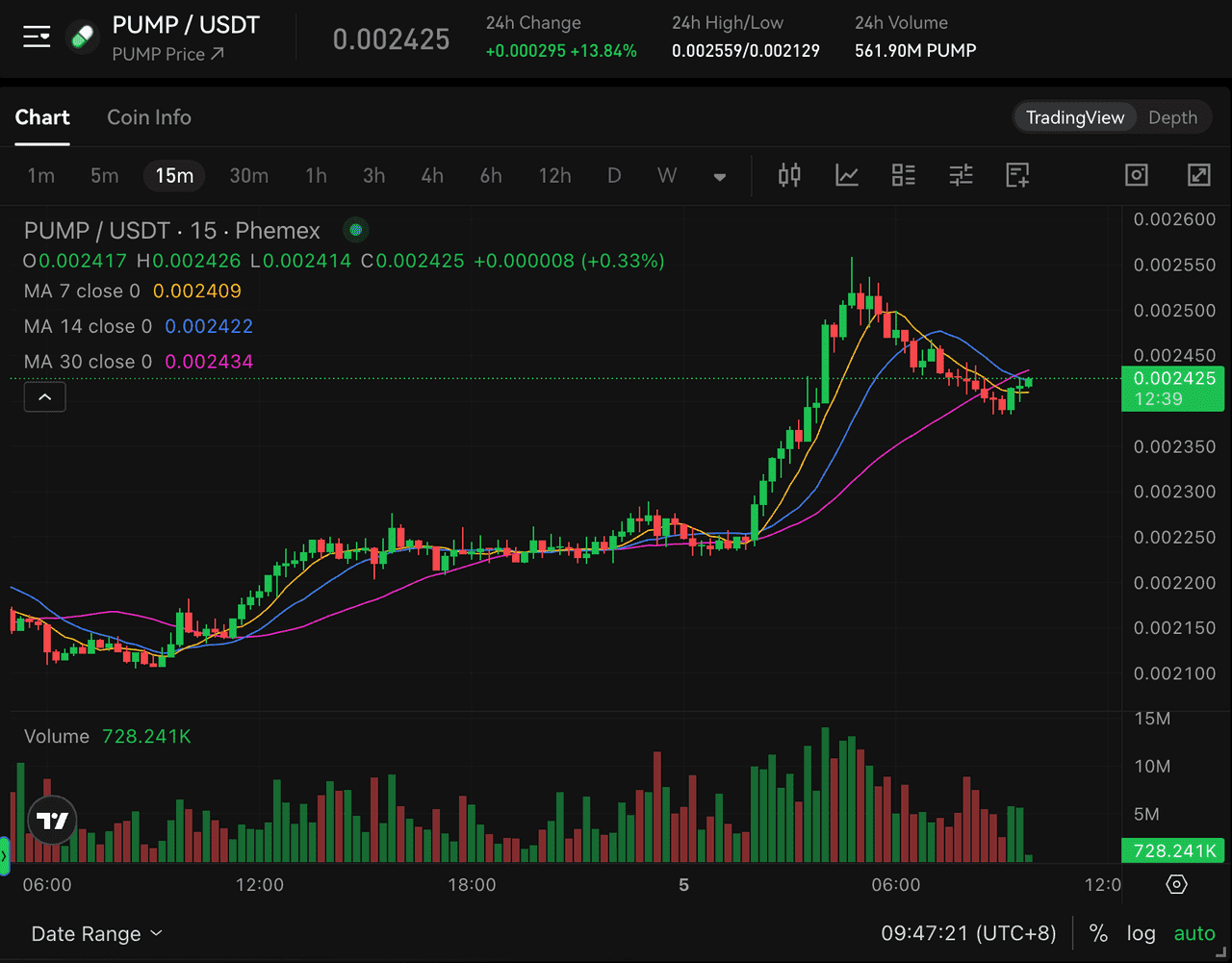
Technical analysis for Pump.fun currently shows a weakened medium-term structure following rejection above $0.002. Immediate support lies around $0.00140 to $0.00145. This area corresponds to recent market pricing and acted as an important trading region during June. If buyers fail to defend it, the next support zone is approximately $0.00125 to $0.00130.
The most important long-term floor remains between $0.00113 and $0.00120, surrounding the historical low and June’s lower price region. A decisive break beneath $0.00113 would place PUMP into new downside price discovery.
Initial resistance lies around $0.00157 to $0.00160. Using the recent swing from roughly $0.00120 to $0.00218, the 61.8% Fibonacci retracement is near $0.00157. Reclaiming that level would represent the first sign that the latest correction is stabilizing. Stronger resistance appears around $0.00169, the 50% retracement, followed by approximately $0.00180 and $0.00190. The key breakout region is $0.00210 to $0.00220. Above it, traders may target $0.00250 and then the $0.004 token-sale price.
Short-Term PUMP Price Prediction for 2026
In the bullish scenario, Pump.fun sustains strong revenue, daily burns continue near recent levels, and platform trading recovers. Successful product expansion through PumpSwap, Terminal, BOOST liquidity features, creator monetization, and multichain activity could help PUMP reclaim $0.00220. Under those conditions, PUMP may trade between approximately $0.0025 and $0.004 by the end of 2026. The $0.004 level is especially important because it represents the original sale price. Recovering it would restore confidence among many early buyers, but it would also create potential selling from participants waiting to exit near breakeven.
In the neutral scenario, buybacks offset part—but not all—of the new supply from team and investor vesting. Protocol revenue remains substantial, but memecoin activity fluctuates. PUMP could trade between approximately $0.0012 and $0.0025 through the remainder of 2026.
In the bearish scenario, unlock pressure accelerates, platform revenue falls, or regulatory concerns weaken user activity. Losing the historical low could push PUMP toward $0.0007 to $0.0012.
The August unlock is not large enough by itself to determine the trend. The more important issue is that team and investor vesting continues monthly. Persistent supply entering a weak market could overwhelm buybacks even when the protocol remains profitable.
Long-Term PUMP Price Forecast for 2027–2030
In the bullish long-term scenario, Pump.fun maintains its dominance as a token-launch and social-trading platform, expands across multiple networks, and develops products beyond short-lived memecoin speculation. Continued revenue-funded burns could reduce supply substantially. PUMP could then trade between $0.005 and $0.012 from 2027 to 2030. A return to the upper end would require a multibillion-dollar circulating valuation, but Pump.fun’s revenue scale makes that scenario more plausible than it would be for a typical memecoin.
In the neutral scenario, Pump.fun remains profitable but faces lower activity and stronger competition. Buybacks continue intermittently, while token utility develops slowly. PUMP may trade between $0.0015 and $0.005.
In the bearish scenario, speculative token launches lose cultural relevance, regulatory restrictions reduce accessibility, or creator activity migrates elsewhere. PUMP could remain between $0.0003 and $0.0015.
Fundamental Drivers of Pump.fun Growth
Pump.fun’s strongest advantage is its network effect. Creators go where traders are, and traders go where new assets and active communities appear. That loop helped Pump.fun establish a recognizable brand and a large user base.
Its revenue model is unusually strong for a crypto application. Recent data showed more than $1 billion in cumulative revenue, approximately $18.5 million in 30-day revenue, and over $1.4 billion in monthly decentralized trading volume. This creates a real financial base for development and buybacks.
The buyback-and-burn mechanism is PUMP’s most important token-specific driver. Removing 153.73 billion tokens has already offset a meaningful share of the original supply. If revenue remains high and burns continue, dilution could become less severe over time.
Product expansion also matters. PumpSwap allows Pump.fun to capture activity after tokens leave their bonding curves. Terminal serves more sophisticated traders, while BOOST redirects otherwise stranded migration liquidity into token purchases and burns. Livestreams, creator fees, bounties, and tokenized agents broaden Pump.fun’s ambition beyond a simple launchpad.
Key Risks to Consider
The risks of investing in Pump.fun are substantial. First, most PUMP supply is not yet circulating. Team and investor allocations total 33% of maximum supply and began unlocking in July 2026. Even with large burns, monthly vesting can create sustained selling pressure. Second, buybacks are not guaranteed forever. Pump.fun explicitly states that PUMP does not provide revenue rights and that purchasers should not expect future market support.
Third, platform activity is extremely speculative. A 2026 study examining more than 832,000 Pump.fun launches found that only about 0.2% reached the platform’s graduation threshold during the observed period. The low success rate may eventually reduce creator and trader enthusiasm. Fourth, sophisticated traders may have an advantage over ordinary users. Research has identified coordinated groups of early-buying wallets across many Pump.fun launches. Although the study did not prove that those groups caused stronger performance, it confirmed that coordinated behavior is widespread enough to merit caution.
Regulatory and reputational risks are also significant. The UK Financial Conduct Authority has warned that Pump.fun may be providing or promoting financial services without authorization. The platform has also faced lawsuits and criticism involving token losses, livestream moderation, and potentially harmful user-generated content. Finally, the PUMP token may remain disconnected from Pump.fun’s business success. A profitable platform does not automatically produce a valuable token when holders have no ownership, governance, or revenue-distribution rights.
Analyst Sentiment and Community Insights
Community sentiment remains active despite PUMP’s weak long-term chart. Recent Phemex social tracking identified more than 7,000 unique participants discussing PUMP and analyzed nearly 12,000 posts. Approximately 28% were bullish, 8% bearish, and the remainder neutral.
The bullish argument focuses on Pump.fun’s revenue and buyback scale. Few crypto protocols generate hundreds of millions of dollars annually or have already spent more than $400 million purchasing their native token.
The bearish argument focuses on dilution and limited utility. PUMP remains below its sale price even after enormous buybacks, suggesting that market purchases have so far struggled to offset unlock expectations and weaker demand.
Google Trends should be interpreted using specific terms such as “Pump.fun token” or “PUMP crypto.” Searching only for “pump” produces too much unrelated data. Interest tends to rise around buyback announcements, unlock dates, major product releases, and renewed memecoin activity.
Is Pump.fun a Good Investment?
Is Pump.fun a good investment? PUMP offers an unusual combination: exposure to a highly profitable protocol, a large user base, and an aggressive supply-reduction program—but without equity, revenue rights, or guaranteed future buybacks.
The long-term bull thesis is stronger than it is for a typical platform token because Pump.fun has already demonstrated an ability to generate substantial revenue. The bear thesis is equally clear. Insider vesting, regulatory pressure, weak direct utility, and dependence on speculative culture may prevent the token from reflecting the platform’s financial success.
Why Trade Pump.fun on Phemex?
Phemex is a top-tier centralized exchange known for security, high-speed execution, and trader-focused innovation. Its platform combines spot markets, futures, automated trading tools, Phemex Earn products, and Pulse as a Web3-native social environment. PUMP/USDT is available on Phemex’s spot market, allowing users to buy or sell PUMP directly. Phemex also supports a PUMPUSDT perpetual contract with leverage of up to 20x and hedge mode, enabling experienced traders to take long and short positions simultaneously.
Trading bots may help automate selected PUMP strategies, although availability should be checked directly before use. Phemex Earn support for PUMP should likewise be confirmed rather than assumed. Because PUMP is sensitive to unlocks, buyback data, and rapid changes in memecoin sentiment, traders should use measured position sizes, limit orders, and clearly defined risk controls.