



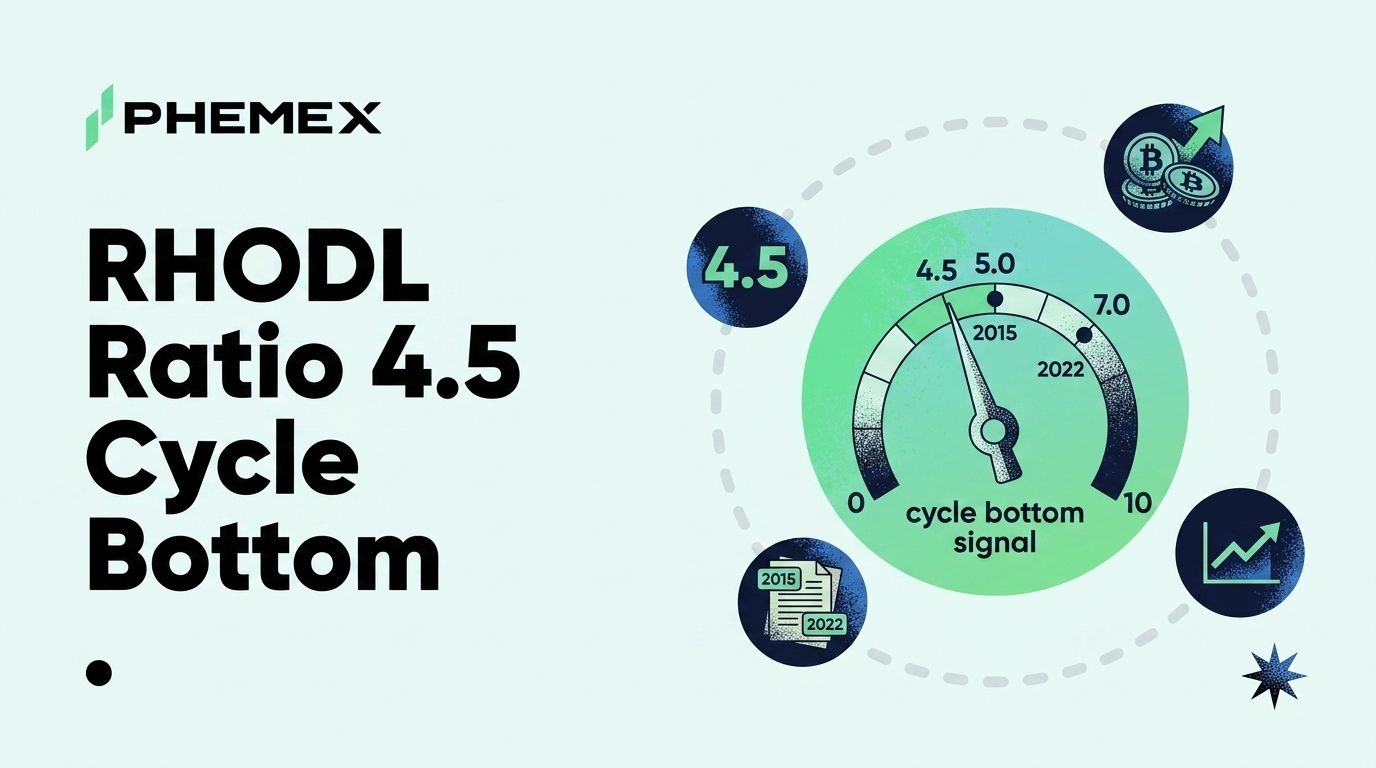
Glassnode's RHODL ratio just printed 4.5, and that number carries weight. In Bitcoin's entire 15-year trading history, the ratio has only been higher twice. The first was in late 2015, when it reached 5.0 with BTC trading near $200. Bitcoin went on to rally from $200 to $20,000 over the next two years. The second was in late 2022, when it hit 7.0 with BTC sitting around $16,000. That bottom preceded a run to $126,000. Both readings marked the exact inflection point where a grinding bear market ended and a sustained bull market began.
The data comes from the joint Coinbase Institutional and Glassnode Q2 2026 report, which concluded that many crypto assets are "forming near-term bottom with recovery expected in Q2." With BTC currently at $78,281 after a roughly 50% drawdown from its $126,000 all-time high, the RHODL ratio is flashing a signal that has a perfect track record across two previous cycles. The sample size is small, but the implications are anything but trivial.
What the RHODL Ratio Actually Measures
The Realized HODL Ratio compares two specific groups of Bitcoin holders. The numerator is the realized value of coins that moved within the last week. The denominator is the realized value of coins held for one to two years. The formula then multiplies by the age of the market in days to normalize for Bitcoin's growing maturity over time.
In plain English, it answers one question. Are the people who bought Bitcoin a year or two ago still holding, or are they selling to new short-term buyers?
When the ratio is high (above 10-15), fresh money is flooding in and short-term speculation dominates. Long-term holders are distributing coins to new entrants at increasingly expensive prices. That pattern has historically marked cycle tops, where the "smart money to retail" wealth transfer is nearly complete.
When the ratio drops below 5, the opposite is happening. Short-term speculators have been largely flushed out by months of declining prices. The coins that remain are concentrated in wallets that bought one to two years ago and refused to sell through the drawdown. These are conviction holders, and their dominance at the expense of short-term activity has historically marked the exhaustion point where selling pressure runs dry.
A reading of 4.5 means the market is heavily dominated by patient capital. The speculative froth that defined the run to $126,000 has been washed out, and what remains is a holder base with a cost basis well below the current price that shows no interest in selling.
The Two Times the RHODL Ratio Was Higher
The historical record is thin but striking. Only two previous readings exceeded the current 4.5 level, and both preceded multi-year bull runs.
|
Cycle
|
RHODL Reading
|
BTC Price at Signal
|
Subsequent Peak
|
Return
|
|
2015 bottom
|
5.0
|
~$200
|
$20,000 (Dec 2017)
|
~100x
|
|
2022 bottom
|
7.0
|
~$16,000
|
$126,000 (Oct 2025)
|
~8x
|
|
2026 current
|
4.5
|
$78,281
|
?
|
?
|
The 2015 signal formed after an 85% drawdown from the 2013 high of $1,200 to the $200 range. Bitcoin spent nearly a year grinding sideways in that zone while retail interest evaporated and mainstream media declared the asset dead. The RHODL ratio climbed to 5.0 because nobody was buying, nobody was selling, and the only coins with meaningful realized value belonged to holders who had survived the entire crash without flinching.
The 2022 signal was even more extreme at 7.0, forming after the FTX collapse drove BTC from $21,000 to $15,500 in a matter of days. That final capitulation event purged the last wave of leveraged longs and short-term holders, leaving a market composed almost entirely of long-term conviction capital. Within 12 months, BTC had tripled. Within 24 months, it had set a new all-time high.
As CoinDesk's analysis of the signal noted, the current 4.5 reading sits below both of those extremes, which is worth noting. Pushing to higher levels would typically require an even deeper collapse in short-term holder activity and near-complete demand exhaustion. The fact that BTC has already bounced roughly 25% from its February lows around $62,000 suggests the market may not need to reach the same depth of capitulation that defined 2015 and 2022. The drawdown structure is different this time, but the holder behavior pattern is rhyming.
Why This Signal Carries More Weight Than Most On-Chain Metrics
On-chain analysts track dozens of indicators. MVRV, SOPR, NUPL, exchange flows, whale wallets, miner reserves. Most of them are useful in aggregate but noisy in isolation. The RHODL ratio has a structural advantage over many of these metrics because it measures something fundamental rather than derivative.
On-chain analysis tools like MVRV compare market price to realized price, which tells you if the average holder is in profit or loss. That is useful, but it can stay in "undervalued" territory for months while the price keeps falling. Exchange flow data tracks coins moving to and from exchanges, but it is easily distorted by internal wallet shuffling and custodial movements.
The RHODL ratio cuts through this noise by measuring the actual conviction of the holder base. It does not ask "is Bitcoin cheap?" It asks "have the weak hands already left?" And when the answer is a definitive yes, as it was in 2015 and 2022, the selling pressure that drives bear markets simply runs out of fuel.
The limitation is obvious, and it deserves a direct acknowledgment. Two data points do not constitute statistical proof. The ratio has existed for Bitcoin's entire history, but the number of full market cycles in that history can be counted on one hand. A sample size of two successful signals followed by bull markets could be coincidence rather than causation. Any trader treating this as a guaranteed bottom call is misreading what the data actually says.
What the data does say, with reasonable confidence, is that the current market structure looks nothing like a cycle top. The speculative excess that drives blow-off peaks is absent. The holder base is dominated by long-term capital. And the two previous times this exact configuration appeared, the price was higher 12, 24, and 36 months later.
What the Broader Q2 2026 Report Says
The RHODL ratio is the headline number, but the Coinbase Institutional and Glassnode Q2 report includes several supporting data points that paint the same picture.
The report found that 75% of institutional investors and 71% of retail investors now rate BTC as undervalued. That level of consensus inside a Fear environment is unusual. Typically, when price has dropped 50%, institutional and retail sentiment diverge sharply, with institutions buying and retail panic-selling. The fact that both groups agree on undervaluation suggests the selling exhaustion visible in the RHODL ratio is also showing up in survey data.
Bitcoin market cycles have followed a roughly four-year pattern tied to halving events since 2012. The April 2024 halving reduced block rewards from 6.25 BTC to 3.125 BTC, and previous post-halving periods have produced the most aggressive price appreciation in each cycle. The current correction is consistent with the mid-cycle drawdowns seen in 2016 (after the 2016 halving) and in 2023-2024 (after prolonged consolidation before the final leg up).
Stablecoin supply has reached new all-time highs above $230 billion, according to the report. That capital is sitting on the sidelines in USDT, USDC, and DAI, earning yield but not deployed into risk assets. When sentiment shifts, that dry powder represents potential buying pressure that did not exist at previous cycle bottoms.
Negative perpetual funding rates across major exchanges reinforce the picture. When funding is negative, short sellers are paying longs to hold positions. This means the market is positioned defensively, which limits the downside from liquidation cascades and creates the conditions for a short squeeze if buying pressure returns.
What Could Invalidate the Signal
The RHODL ratio does not exist in a vacuum, and two macro risks could override the on-chain signal entirely.
The first is a broader equity market breakdown. BTC's correlation with the S&P 500 and Nasdaq has increased during this drawdown. If the U.S. economy enters a recession and equities fall another 15-20%, institutional investors who now hold BTC through ETFs will rebalance portfolios by selling crypto alongside stocks. The RHODL ratio cannot protect against forced selling by institutions managing risk across multiple asset classes.
The second risk is regulatory reversal. The SEC and CFTC commodity classification framework that gave Bitcoin clearer regulatory footing could face legislative challenges or enforcement contradictions. If the regulatory environment deteriorates, the institutional capital that entered through ETFs could exit faster than it arrived.
And there is the simple possibility that this cycle is structurally different. Bitcoin now trades in ETFs, has a $1.5 trillion market cap, and correlates with traditional markets in ways it did not in 2015 or 2022. The argument that "this time is different" is usually wrong in markets, but the market itself is genuinely different from the one that produced those earlier RHODL signals.
The honest assessment is that the signal is historically bullish but not infallible. Two for two is a perfect record, but it is also a very short one.
Frequently Asked Questions
What is the RHODL ratio in simple terms?
The RHODL ratio compares the value of Bitcoin that moved in the last week against Bitcoin held for one to two years. When the ratio is low, long-term holders dominate the market. When it is high, short-term speculators are driving activity. A reading of 4.5 means conviction holders control a historically large share of the network's value.
Has the RHODL ratio ever been wrong?
It has never produced a false positive signal at these levels because it has only reached them twice before, both at confirmed cycle bottoms. But a sample size of two means the indicator has not been tested across enough cycles to guarantee future accuracy. It is a strong signal, not a certainty.
Does a low RHODL ratio mean Bitcoin will go up immediately?
Not necessarily. In 2015, BTC spent several months consolidating after the RHODL ratio peaked before the sustained uptrend began. In 2022, the recovery started within weeks of the signal. The ratio identifies the type of market structure present (accumulation vs. distribution) rather than providing a specific timing trigger for entries.
Where can I track the RHODL ratio myself?
Glassnode offers the RHODL ratio on its free and paid dashboards. Bitcoin Magazine Pro and CoinGlass also display the metric with historical overlays that make it easy to compare current readings against previous cycle bottoms.
Bottom Line
The RHODL ratio at 4.5 is telling you one thing clearly. The speculative capital that drives blow-off tops has been flushed from the market, and what remains is a holder base with conviction and cost bases well below current prices. That exact configuration has appeared twice before, and both times preceded the most profitable periods in Bitcoin's history.
The forward-looking question is not about the signal's validity but about the macro conditions that will determine if the pattern plays out. If equities stabilize, the Fed begins cutting in Q3-Q4 2026, and the $230 billion in sidelined stablecoin capital starts rotating back into BTC, the setup aligns with a recovery that could accelerate through the back half of the year. If equities break down and forced institutional selling overrides on-chain fundamentals, the signal gets delayed but not necessarily invalidated. Watch for sustained ETF inflows and a flip back to positive perpetual funding as the confirmation triggers that the bottom-formation process is transitioning into the early stages of a new uptrend.
This article is for informational purposes only and does not constitute financial or investment advice. Cryptocurrency trading involves substantial risk. Always conduct your own research before making trading decisions.