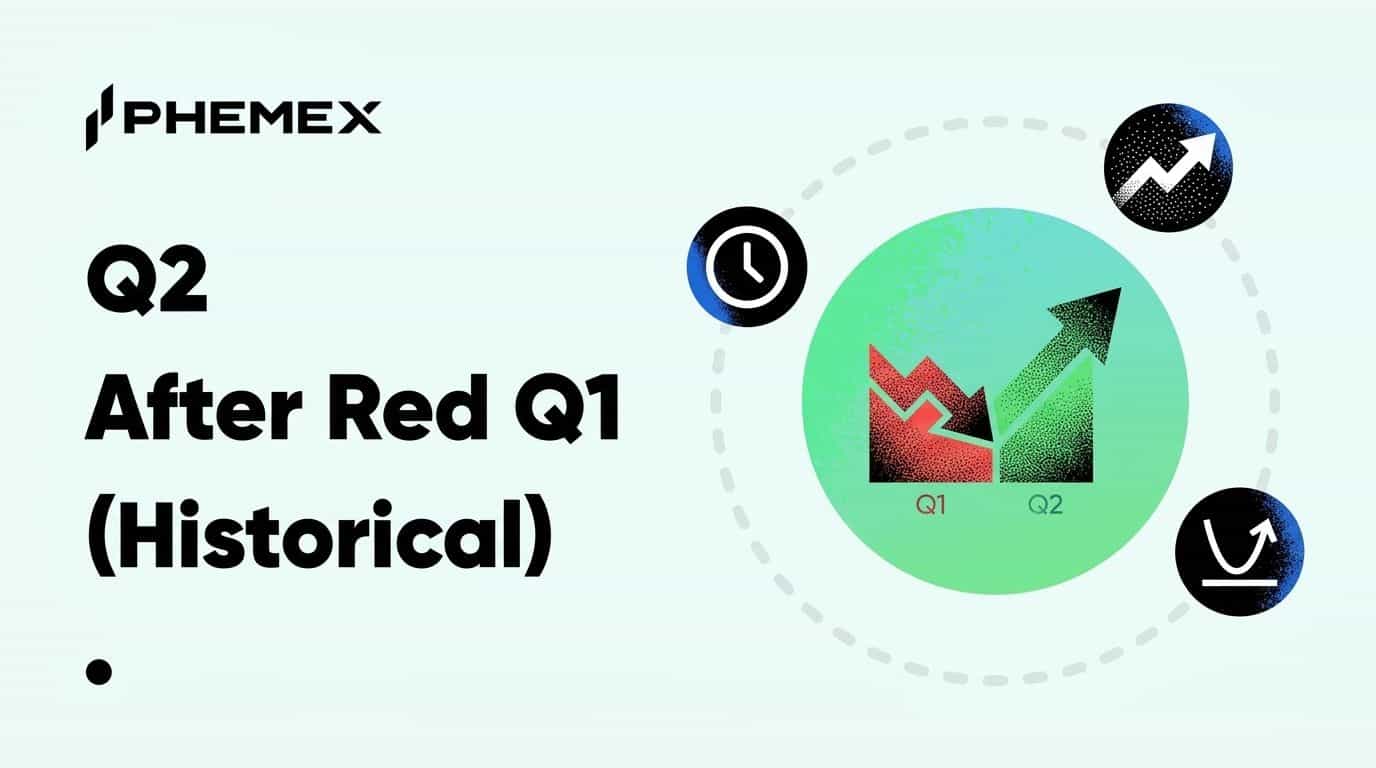
Bitcoin is closing Q1 2026 down approximately 19%, marking the worst opening quarter since 2018 when BTC lost over 50% in the first three months. The price dropped from roughly $84,000 on January 1 to around $67,600 as of March 30, dragged lower by the U.S.-Iran conflict entering its fifth week, renewed tariff uncertainty, and a broader risk-off move that sent every major equity index into the red alongside it. The question every trader is asking right now is straightforward. Does a bad Q1 mean Q2 gets worse, or does history say something different?
The answer from 13 years of Bitcoin quarterly data is more nuanced than the bulls or bears want to hear. Q2 has been positive in 8 of those 13 years with an average return north of 26%, but the years that matter most for 2026 are the ones where Q1 was already red, and those paint a split picture that depends almost entirely on what kind of macro environment was waiting on the other side.
The Full Quarterly Returns Table (2013-2025)
Before interpreting patterns, look at the raw numbers. This table shows Bitcoin's quarterly returns from CryptoRank for every year since 2013.
|
Year
|
Q1
|
Q2
|
Q3
|
Q4
|
Full Year
|
|
2013
|
+577.4%
|
+4.6%
|
+36.4%
|
+468.3%
|
Positive
|
|
2014
|
-39.5%
|
+40.0%
|
-39.7%
|
-17.4%
|
Negative
|
|
2015
|
-23.8%
|
+7.7%
|
-10.4%
|
+82.4%
|
Positive
|
|
2016
|
-3.3%
|
+61.6%
|
-9.3%
|
+58.0%
|
Positive
|
|
2017
|
+11.2%
|
+131.5%
|
+74.1%
|
+226.1%
|
Positive
|
|
2018
|
-50.7%
|
-7.8%
|
+3.4%
|
-43.1%
|
Negative
|
|
2019
|
+8.3%
|
+166.7%
|
-23.5%
|
-13.2%
|
Positive
|
|
2020
|
-10.4%
|
+42.2%
|
+17.8%
|
+169.7%
|
Positive
|
|
2021
|
+103.2%
|
-40.8%
|
+25.5%
|
+5.6%
|
Positive
|
|
2022
|
-1.6%
|
-56.7%
|
-2.1%
|
-14.9%
|
Negative
|
|
2023
|
+72.3%
|
+7.0%
|
-11.4%
|
+56.6%
|
Positive
|
|
2024
|
+68.7%
|
-12.0%
|
+0.8%
|
+47.6%
|
Positive
|
|
2025
|
-11.7%
|
+29.9%
|
+6.4%
|
-23.2%
|
Negative
|
Q2 finished green in 8 of 13 years. The average Q2 return across all years is approximately +28%, though that number is heavily skewed by 2017 (+131.5%) and 2019 (+166.7%). The median Q2 return, which better represents what the "typical" year looks like, sits closer to +7%.
Every Red Q1 and What Q2 Did Next
Seven years since 2013 opened with a negative Q1, and here is exactly what happened in Q2 for each of them.
2014 (Q1 -39.5%, then Q2 +40.0%). Mt Gox collapsed in February, nuking the price from over $800 to around $450, and Q2 saw a significant recovery as the market absorbed the shock and new exchanges picked up volume. But the bounce did not hold, with Q3 giving back almost everything at -39.7% on its way to a deeply negative full year.
2015 (Q1 -23.8%, then Q2 +7.7%). This was the slow grind following the post-Mt Gox bear market, and Q2 offered only a modest shift from active selling to sideways accumulation. The real move came in Q4 with an 82% rally as Bitcoin started its long climb toward the 2017 cycle peak.
2016 (Q1 -3.3%, then Q2 +61.6%). A barely negative Q1 followed by the strongest Q2 rebound in any red-Q1 year, driven by anticipation of the July 2016 halving and the reduced supply issuance it would bring. This is the closest analog to what bulls are hoping for in 2026, given the April 2024 halving cycle positioning.
2018 (Q1 -50.7%, then Q2 -7.8%). The post-2017 bubble burst carried straight through both quarters, with Q1 marking the violent crash from near $20,000 toward $6,000 and Q2 continuing the bleed through denial, dead-cat bounces, and eventual capitulation that would not bottom until December.
2020 (Q1 -10.4%, then Q2 +42.2%). The COVID crash compressed what would normally be a multi-month bear into a two-week liquidation event in March, sending Bitcoin from $9,100 to $3,800 before recovering to $6,400 by quarter-end. Q2 rallied hard as the Fed unleashed $3.3 trillion in quantitative easing within three months, making this a macro-driven V-recovery rather than an organic market bottom.
2022 (Q1 -1.6%, then Q2 -56.7%). The worst Q2 in Bitcoin's history came after a Q1 that was barely negative, and the reason had nothing to do with quarterly momentum. Terra/LUNA collapsed in May, vaporizing $40 billion in value and triggering a cascade of forced liquidations across Three Arrows Capital, Celsius, and Voyager that proved exogenous shocks matter more than seasonal patterns.
2025 (Q1 -11.7%, then Q2 +29.9%). Last year's pattern offered comfort to bulls as a modest Q1 decline driven by profit-taking from the October $126,000 all-time high was followed by a solid Q2 recovery. But the gains did not stick, with Q4 giving back 23.2% as the U.S.-Iran conflict escalated and 2025 finished in the red overall.
What the Pattern Actually Says
The honest read on this data is that a red Q1 tells you very little about Q2 in isolation. Of the seven red-Q1 years, five produced a positive Q2 and two produced a negative Q2, giving a 71% hit rate that sounds encouraging until you realize the sample size is seven and the two misses (2018 and 2022) were catastrophic rather than mild.
The more useful signal is what was happening in the macro environment during Q2, not what Q1 did. The 2020 recovery happened because the Fed printed $3.3 trillion, the 2022 collapse happened because a $40 billion algorithmic stablecoin imploded, and the 2016 rally happened because halving anticipation was pulling in new capital. In each case, the Q2 outcome was driven by its own catalysts rather than by Q1 momentum carrying forward, which means Q1's -19% decline predicts nothing by itself for what comes next.
What Is Different About the 2026 Setup
Several structural factors make the current environment distinct from previous red-Q1 years.
ETF infrastructure now exists. Spot Bitcoin ETFs launched in January 2024 and accumulated approximately $128 billion in assets under management by mid-March 2026, with $2.5 billion in inflows during March alone despite the price decline. Institutional capital now has a frictionless path into Bitcoin that did not exist in any previous red-Q1 year, and that flow data acts as a demand floor that earlier cycles lacked.
The halving cycle is positioned ambiguously. Bitcoin's April 2024 halving placed the typical 12-18 month post-halving appreciation window between April and October 2025, and BTC did peak at $126,000 in October 2025. The current drawdown could represent either the post-peak correction phase or a mid-cycle shakeout before a second leg higher, and the data does not clearly favor one reading over the other.
Macro headwinds are real and ongoing. The U.S.-Iran conflict is in its fifth week with no clear resolution, tariff escalation is compressing corporate margins and feeding stagflation fears, and the Fed has paused rate cuts since January 2026 with the March FOMC dot plot signaling only one cut for the remainder of the year.
On-chain fundamentals tell a different story underneath the price weakness. Long-term holder supply continues to climb, exchange balances are near multi-year lows, and the hash rate hit new all-time highs in March. The market is selling, but it is selling into long-term accumulation by participants who are not reactive to quarterly price swings.
The Bull Case and the Bear Case for Q2 2026
Rather than picking a side, here is what each scenario needs to hold.
The bull case requires Iran de-escalation, at least one Fed rate cut by June, continued ETF inflows at or above March's pace, and BTC holding the $62,000-$65,000 support zone that has acted as a floor multiple times since late 2025. If those conditions converge, a Q2 move toward $78,000-$85,000 is consistent with the average post-red-Q1 recovery of roughly 25-40%.
The bear case requires conflict escalation driving oil above $120 and forcing a stagflationary policy freeze, ETF outflows reversing March's trend, or a systemic event similar in scale to Terra/LUNA or FTX. If $62,000 breaks convincingly on high volume, the next structural support sits around $52,000-$55,000.
The reason most traders get this wrong is they commit to one scenario and size accordingly. The data says both outcomes are plausible after a red Q1, and the winning approach historically has been to stay positioned but manage downside aggressively with stops rather than going all-in on a directional bet.
Frequently Asked Questions
Does Bitcoin always recover in Q2 after a bad Q1?
No. Five of seven red-Q1 years saw a positive Q2, but 2018 and 2022 both delivered further declines. The 71% recovery rate sounds promising, but the two negative Q2s were severe, with 2022 posting a -56.7% return. A red Q1 creates a statistical lean toward recovery, not a guarantee.
What is Bitcoin's average Q2 return historically?
The average Q2 return since 2013 is approximately +28%, but that figure is heavily distorted by outlier years like 2017 (+131.5%) and 2019 (+166.7%). The median Q2 return sits closer to +7%, which is a more realistic baseline expectation for any given year.
Is 2026 similar to 2020's COVID crash recovery?
The structural setup is fundamentally different in several ways. The 2020 Q2 recovery was fueled by $3.3 trillion in Fed quantitative easing that began in March 2020. In 2026, the Fed is pausing rate cuts with no QE on the horizon. ETF inflows provide a different type of demand floor, but the magnitude of monetary stimulus that powered 2020's rebound is absent from the current environment.
What price level should traders watch in Q2 2026?
The $62,000-$65,000 range has acted as support through multiple tests since late 2025. A sustained break below $62,000 on elevated volume would invalidate the consolidation thesis and open the path toward $52,000-$55,000. On the upside, reclaiming $75,000 with conviction would confirm a Q2 recovery is underway.
Bottom Line
The quarterly returns data since 2013 gives a clear but incomplete answer. A red Q1 has been followed by a positive Q2 five out of seven times, but the two exceptions were among Bitcoin's worst quarters ever recorded. The pattern leans bullish, and the lean is real, but it is not a trading signal by itself.
What matters more for Q2 2026 is the specific catalyst environment waiting in April through June. ETF inflows are providing a structural bid that did not exist in any prior cycle, but the Fed is not cutting, a war is still active, and the post-halving peak may already be behind us. The $62,000-$65,000 zone is the line in the sand. If it holds through April and ETF flows stay positive, the historical lean toward Q2 recovery has a legitimate structural foundation this time. If it breaks, the 2018 and 2022 playbooks become the relevant comparisons, and those did not end well for anyone who bought the Q1 dip expecting a quick rebound.
This article is for informational purposes only and does not constitute financial or investment advice. Cryptocurrency trading involves substantial risk. Always conduct your own research before making trading decisions.