

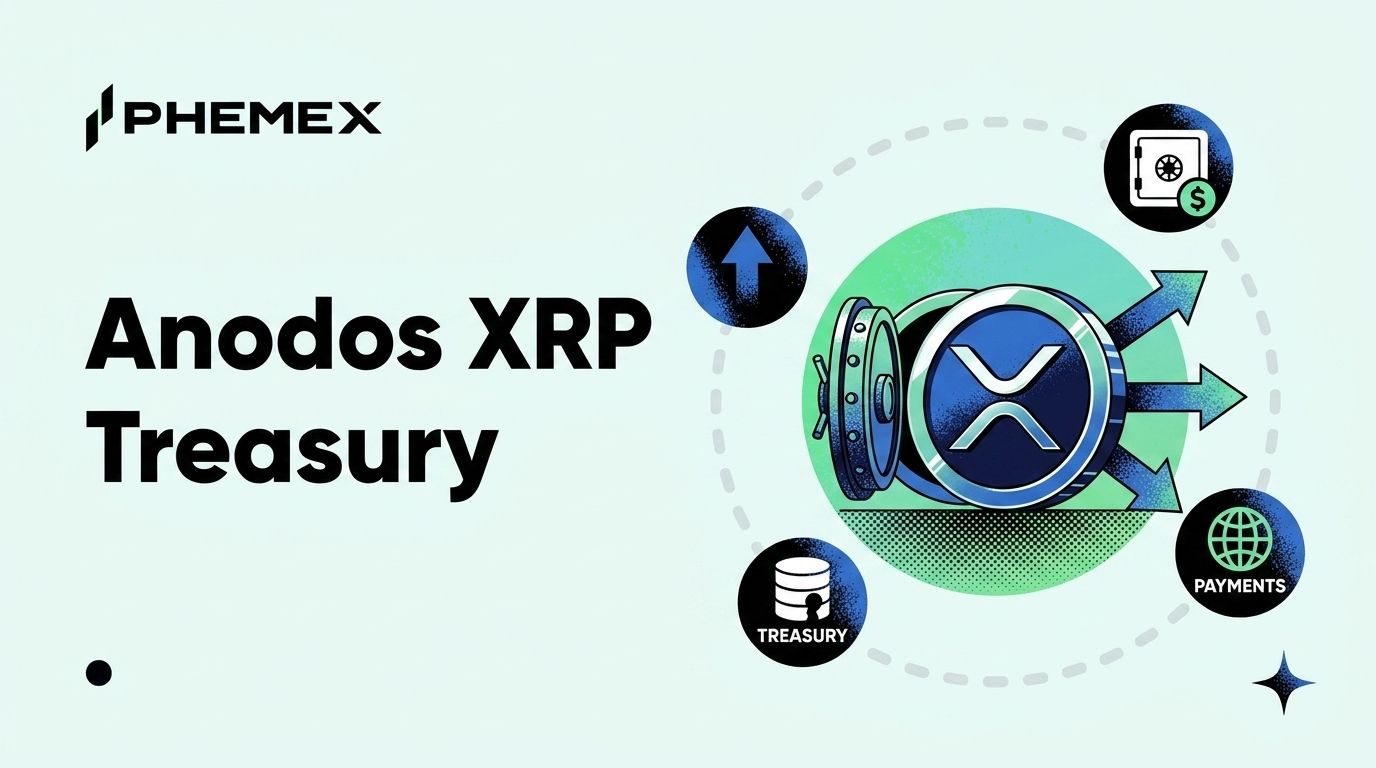
Anodos Finance, a specialized treasury management protocol that supports corporate clients with onchain liquidity, reserve management, and cross-border settlement, added XRP to its supported treasury assets in late May 2026. Corporate clients of Anodos can now use XRP for cross-border liquidity routing, reserve diversification, and onchain treasury settlement alongside the existing stablecoin and major-asset support.
The move matters not because Anodos is the largest treasury platform in crypto, but because the rationale behind the XRP addition tells you something specific about how the institutional treasury cohort is now thinking about XRP utility beyond Ripple's own ODL business.
What Anodos Finance Actually Does
Anodos is positioned in the onchain treasury management category, which sits between the broader DeFi protocol stack and traditional corporate treasury software. The platform's core offering is a unified interface for corporate finance teams to manage onchain assets across multiple chains, execute cross-border settlement, route liquidity efficiently, and produce auditable transaction records for accounting purposes.
The client base skews toward digital-native businesses (crypto companies, web3 product teams, certain DAOs that have grown into corporate-style operations) but increasingly includes traditional businesses that have begun to allocate a portion of treasury to crypto assets. The platform's value proposition is operational rather than speculative. It is software for running a treasury, not a vehicle for taking directional positions.
Anodos competes in a space that includes platforms operated by major custodians and a growing cohort of crypto-native treasury startups. The differentiation has historically been around chain coverage, settlement speed, and audit-grade reporting. The XRP addition extends the chain coverage in a specific direction.
Why XRP Specifically
Three structural properties of XRP and the XRPL chain explain why a treasury platform would add support. The first is settlement speed. XRPL processes transactions in roughly three to five seconds with near-final confirmation, which is meaningfully faster than the equivalent settlement window on Ethereum mainnet or even most Ethereum L2 networks. For high-value institutional transfers where settlement risk is a real cost, that speed difference is operationally significant.
The second is fee structure. XRPL transaction fees are denominated in fractions of a cent, making the chain cost-effective for repeated large-value transfers where Ethereum gas costs (even on L2s) can accumulate into material expense at corporate scale. The fee predictability also makes treasury budgeting cleaner than chains with variable fee markets.
The third is the on-demand liquidity (ODL) infrastructure that Ripple has built around XRP for cross-border settlement. ODL provides a deep liquidity pool for XRP-to-fiat conversions across multiple corridors, which means a treasury that holds XRP can convert into local fiat in many jurisdictions without significant slippage. That infrastructure is harder to replicate than chain-level speed or fee advantages.
What This Means for the XRP Utility Narrative
XRP's utility narrative has historically been concentrated around Ripple's own ODL business and around speculation about institutional cross-border settlement adoption. The Anodos move is a small but specific data point in the second category. A third-party treasury platform (not Ripple) is adopting XRP for treasury operations, which broadens the utility narrative beyond the Ripple-controlled use cases.
The structural significance is that XRP utility narratives have struggled to attract concrete corporate adoption data points outside Ripple's own ecosystem. Most of the institutional XRP commentary in 2024 and 2025 was about expected future adoption rather than realized adoption. The Anodos addition is a realized adoption data point, even if the scale is modest. Each additional data point of this type compounds the utility argument and makes the long-term XRP thesis more defensible against the criticism that XRP utility is concentrated in a single company.
Comparison With USDC and USDT Treasury Adoption
The comparison to stablecoin treasury adoption is the cleanest frame for understanding what Anodos is signaling. Corporate treasuries adopted USDC and USDT for treasury operations because both offered fast settlement, low fees, and broad acceptance across counterparties and venues. The stablecoin adoption curve started slowly in 2020 and 2021 and accelerated significantly in 2024 and 2025 as more platforms added support and more counterparties accepted stablecoin settlement.
XRP's adoption curve is at an earlier stage. The Anodos addition represents the early-stage equivalent of the platform-level support that stablecoins received in 2021 and 2022. The next stage would be broader counterparty acceptance, which is the larger structural challenge. Most corporate counterparties currently do not accept XRP-denominated settlement, which limits the practical utility even when a treasury platform supports it.
The optimistic read of the Anodos move is that platform-level support is the necessary first step toward broader counterparty acceptance. The pessimistic read is that platform-level support without counterparty acceptance is incomplete utility. Both readings are defensible from the current data.
Why ETH and SOL Are Different for Treasury Use
For comparison, ETH and SOL are both supported by most major treasury platforms, but the use cases differ from XRP in specific ways. ETH treasury holdings tend to be allocated for yield generation through staking or DeFi positioning rather than for direct settlement use, because ETH's fee structure and confirmation times are less suited to high-frequency settlement operations. SOL treasury holdings are increasingly common for application-specific use cases (gaming, consumer apps) but have not seen the same level of cross-border settlement adoption that XRP is structured for.
The takeaway is that each major chain has a specific treasury use case where it is best-suited. XRP's specific niche is high-value, low-frequency, cross-border settlement. The Anodos addition fills the gap in their platform for that specific use case.
What to Watch Going Forward
Three signals will define if the Anodos addition is the first of a broader wave or an isolated data point. The first is the adoption curve across other treasury platforms over the next 60 to 90 days, because the platform-level adoption curve will define the broader utility argument. The second is the counterparty acceptance question for XRP-denominated settlement at scale, because that acceptance is the gate to actual realized utility. The third is XRP price action and ETP flow data, which together will reflect any update from the broader market its view of XRP utility based on these incremental data points.
Frequently Asked Questions
Is the Anodos XRP integration a major announcement for XRP?
It is a meaningful but not headline-level data point. The integration extends platform-level support for XRP in a specific corporate treasury use case, which compounds the broader utility argument. It is not a major institutional adoption announcement in the sense of a Fortune 500 corporate treasury announcing XRP holdings.
Does this change the XRP ETF approval outlook?
Only indirectly at this stage of the regulatory process. A growing body of realized-utility data points strengthens the broader case for XRP as a non-speculative asset class, which is one input into the regulatory analysis around ETF approval. The direct path to ETF approval runs through the regulatory framework rather than through corporate adoption announcements.
Why is XRP better for cross-border settlement than stablecoins?
It is not strictly better in every dimension. Stablecoins offer broader counterparty acceptance and direct dollar parity. XRP offers faster final settlement, lower fees in fractions of a cent, and deeper ODL liquidity in certain corridors. The choice between XRP and stablecoin settlement depends on the specific corridor, counterparty, and settlement-speed requirements.
Can retail XRP holders benefit from this utility growth?
Retail XRP holders benefit indirectly through the broader utility narrative supporting price. The Anodos integration does not directly produce yield or revenue for retail holders, but it strengthens the structural case for XRP as a non-speculative asset, which historically correlates with stronger price action and tighter institutional positioning.
Bottom Line
The Anodos Finance XRP integration is a modest but specific data point in the broader XRP utility narrative. A third-party treasury platform (not Ripple) added XRP support for cross-border liquidity, reserve diversification, and onchain settlement, which extends the utility argument beyond Ripple's own ODL business. The integration matters more as a realized adoption data point than as a market-moving event in itself. Watch for additional treasury platform integrations and broader counterparty acceptance of XRP-denominated settlement to define if the Anodos move is the start of a wave or an isolated case. For XRP holders, the underlying signal is that XRP utility is incrementally broadening, which is the structural argument the long-term thesis has always required.
This article is for informational purposes only and does not constitute financial or investment advice. Cryptocurrency trading involves substantial risk. Always conduct your own research before making trading decisions.