








Key Takeaways
Velo is a blockchain-based financial network focused on cross-border settlement, tokenized real-world assets, and PayFi.
The project is no longer best understood as only a remittance token or a simple DeFi app. It is now positioning itself as a broader network that bridges TradFi and Web3.
Velo’s ecosystem currently centers on three main rails: settlement infrastructure, real-world assets, and PayFi for emerging markets.
Its flagship consumer product is Orbit Plus, a super app that lets users off-ramp stablecoins, swap assets, and eventually spend through a virtual crypto debit card.
VELO is the utility token that powers settlement, staking, and governance across the network.
The long-term thesis behind Velo is that global payments and tokenized assets should move on a faster, cheaper, and more compliant blockchain-based rail.
Velo is a crypto project built around one of the oldest and biggest problems in global finance: moving value across borders efficiently. Traditional cross-border payments are often slow, fragmented, and expensive. Money can pass through multiple intermediaries, FX spreads are often unclear, compliance processes are duplicated across systems, and capital gets stuck in pre-funded accounts that do not generate productive returns. Velo’s core argument is that blockchain infrastructure can fix a large part of this problem by creating a more direct settlement layer.
That already makes Velo interesting. But the project has evolved beyond the simple version of that story. Today, Velo is not just talking about remittances or stablecoin transfers. It is positioning itself as a broader TradFi-Web3 bridge, with infrastructure for cross-border settlement, tokenized real-world assets, consumer crypto payments, and PayFi in emerging markets.
What Velo Actually Is
The current Velo website describes the network in a very clear way: one network, three rails for moving value.
Those three rails are:
Settlement network
Real-world assets
PayFi for emerging markets
This framing is important because it shows how Velo wants to be understood today. It is not trying to be just a token. It is not trying to be only a DeFi protocol. And it is not trying to be just a consumer payment wallet either.
Instead, Velo is building a broader financial stack. At the institutional level, it wants to support compliant, crypto-native FX liquidity and cross-border treasury movement. At the asset level, it wants to support the tokenization and settlement of RWAs such as treasuries and gold. At the consumer level, it wants to help stablecoin holders actually use their money in the real world. That combination is what makes Velo broader than many payment tokens from earlier crypto cycles.
The Three Rails of the Velo Network
Settlement Network
This is the institutional side of the Velo story. Velo says its settlement network is designed to move value across borders in real time using compliant, crypto-native FX liquidity. The 2026 roadmap goes further and describes a four-layer PayFi architecture built around licensed fiat infrastructure, crypto liquidity, and real-time global payments.
In simpler language, this means Velo wants to become a treasury and settlement rail for institutions that need to move money internationally without the friction of traditional cross-border systems. This is one of the strongest parts of the project’s current positioning because it ties Velo to a real financial pain point rather than to purely speculative crypto use cases.
Real-World Assets
The second rail is tokenized real-world assets. The current Velo site says the network is being built to tokenize and settle a new generation of RWAs, “from treasuries to gold,” using institutional-grade custody and reserves. Recent Velo announcements also connect the ecosystem to partnerships and products involving Treasury-as-a-Service and tokenized asset infrastructure. This matters because tokenization has become one of the strongest long-term themes in crypto. If Velo succeeds in becoming part of the rails for real-world asset issuance and settlement, then its relevance becomes much broader than retail payments alone.
PayFi for Emerging Markets
The third rail is what gives Velo much of its consumer-facing identity. Velo says it is building secure, low-cost payments and remittances for users and businesses that traditional rails often underserve. This is where the project’s Orbit Plus product becomes especially important. Instead of focusing only on institutional infrastructure, Velo is also building what it calls the “last mile” of PayFi for everyday users.
Orbit Plus: Velo’s Consumer Super App
Orbit Plus is currently the most visible consumer product in the Velo ecosystem. The official product page describes it as a PayFi super app for stablecoins. Users can off-ramp stablecoins like USDT and USDC to their local bank, manage a self-custody wallet, swap tokens across chains, and eventually use a virtual crypto debit card for spending.
This is a meaningful product direction because it moves Velo from abstract infrastructure into practical user experience. A lot of crypto projects say they want to bridge Web3 and real-world finance. Orbit Plus is Velo’s attempt to make that bridge visible in an everyday app. A freelancer paid in stablecoins, a remittance sender, or a trader taking profits all fit the use case the company is describing. The project says Orbit Plus is live across 15 countries, which suggests the team is targeting actual corridor expansion rather than only a demo product.
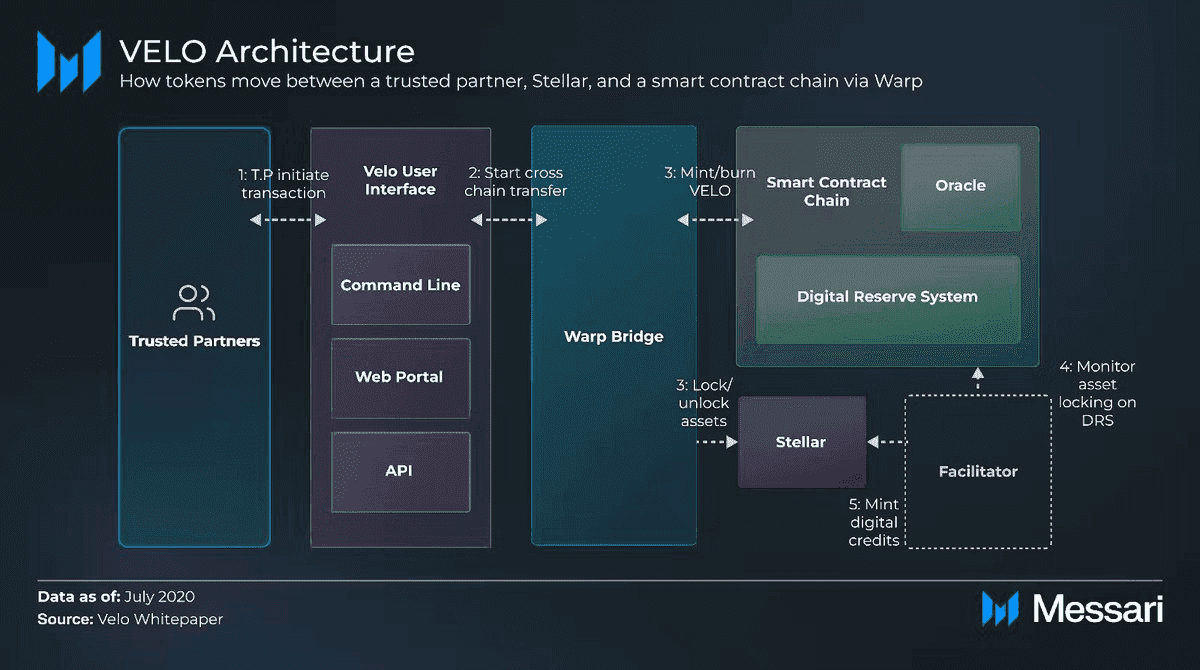
VELO Architecture (source)
Why Orbit Plus Matters
Orbit Plus matters because it makes the Velo thesis easier to understand. Cross-border settlement infrastructure is a strong story, but it can feel distant to ordinary users. A super app that lets people move stablecoins into bank accounts, swap across chains, and spend with card rails is much easier to grasp.
It also shows how Velo is trying to combine regulated payment infrastructure, self-custody wallets, stablecoin usability, and tokenized asset access into one user-facing environment. That is a more ambitious product design than a simple exchange wallet or a narrow remittance app. If it works well, it could make Velo relevant to both retail and institutional audiences at the same time.
Nova Chain
Another major part of the ecosystem is Nova Chain. The official site describes Nova Chain as Velo’s EVM-compatible network built to bridge traditional finance and crypto. It emphasizes EVM compatibility, interoperability, and fast, low-cost settlement. This is important because it gives Velo its own blockchain execution environment rather than forcing every part of the ecosystem to live on someone else’s infrastructure.
For developers and integrators, this means Velo is not just an application layer. It also has chain-level ambitions. Nova Chain is supposed to be the place where parts of the Velo ecosystem can settle and interact more directly. That makes the project feel more like a full network stack than just a payment token with an app attached.
Universe and Warp
Velo’s ecosystem also includes Universe and Warp, which further expand the scope of the project.
Universe
Universe is described as a hybrid DEX that lets users trade global assets with centralized-exchange-style functionality in a decentralized environment. That is notable because it suggests Velo is not limiting itself to payments alone. It also wants to support a broader trading environment around tokenized assets and liquidity.
Warp
Warp is Velo’s multi-chain bridge, which currently connects networks such as Solana and Stellar, with plans for broader support. Its role is to help move assets across chains so users in the Velo ecosystem can maximize utility and interoperability.
Together, Universe and Warp make the ecosystem more complete:
Nova Chain handles Velo’s chain environment,
Universe handles trading,
Warp handles bridging,
Orbit Plus handles consumer access.
That is a much richer product stack than many people probably associate with the name Velo.
What the VELO Token Does
According to the official token page, VELO is the utility token that powers settlement, staking, and governance across the network. That means VELO has three main jobs.
Settlement - This is the most important role conceptually. If Velo becomes a real cross-border and RWA settlement network, VELO sits at the center of that economic flow.
Staking - VELO is also used for staking within the ecosystem, which gives it a network participation role rather than making it only a pass-through payment token.
Governance - The token is also tied to governance, meaning it is part of how the broader network can evolve over time. This gives VELO a more substantial utility story than a token that exists only for speculative trading. Of course, utility alone does not guarantee token value, but it does provide a clearer framework for why the token exists.
Velo’s Strategic Direction in 2026
Velo’s current roadmap gives a good sense of where the project is heading.
The roadmap breaks the network’s evolution into stages:
Delivered: scale, reach, multi-chain expansion, and social trading
Now: Orbit Plus, stablecoins, and wider user access
Next: a compliant settlement network with RWA tokenization at scale
Horizon: PayFi at scale, gold RWA products, and AI-driven settlement
That final point is especially interesting. The project is explicitly tying future growth to AI-driven settlement, which suggests Velo sees programmable finance and automation as part of its long-term infrastructure direction. Whether that becomes meaningful or remains mainly roadmap language is still an open question, but it shows the team is thinking beyond basic transfers.
The Bull Case for Velo
The strongest bull case for Velo is that it is tackling a real financial problem: cross-border value transfer is still inefficient. A second bullish point is ecosystem breadth. Velo now has an institutional settlement narrative, an RWA tokenization narrative, a consumer PayFi super app, an EVM chain, a bridge, and a trading venue. That is a lot more substance than a simple payment token project.
A third bullish point is geographic relevance. The project’s language around ASEAN, emerging markets, and regulated corridor infrastructure gives it a more concrete operating context than many generic global-payments claims. A fourth bullish point is that VELO has a straightforward role in the network: settlement, staking, and governance.
The Risks and Weaknesses
The biggest risk is execution. Velo is trying to do a lot at once, including institution-facing settlement, consumer payments, tokenized RWAs, chain infrastructure, and multi-chain interoperability. That creates many ways to succeed, but also many ways to underdeliver. A second risk is competition. Cross-border payments, tokenized assets, and PayFi are crowded categories. Velo is not the only project trying to connect stablecoins, TradFi rails, and real-world settlement.
A third risk is token-value capture. Even if the ecosystem grows, investors still need to ask whether enough of that growth flows into durable demand for VELO rather than just ecosystem activity around adjacent products. A fourth risk is that some of the bigger institutional and RWA ambitions are still forward-looking. The roadmap is compelling, but investors still need proof of sustained usage and network traction.
What Is Velo in One Sentence?
Velo is a blockchain-based financial network that connects TradFi and Web3 through cross-border settlement, tokenized real-world assets, and consumer PayFi products, with VELO serving as the utility token for settlement, staking, and governance.
Conclusion
Velo is no longer best understood as a simple remittance token or niche payment project. It has evolved into a broader financial network that is trying to serve both institutions and everyday users. Its current ecosystem includes settlement infrastructure for cross-border payments, tokenized RWA ambitions, the Orbit Plus consumer super app, Nova Chain for EVM-compatible settlement, Universe for hybrid trading, and Warp for cross-chain movement.
That makes Velo one of the more interesting payment-and-infrastructure plays in crypto because it sits at the intersection of several strong themes at once: PayFi, stablecoin usability, RWAs, and TradFi-Web3 bridging. The big question is whether the network can turn that broad vision into durable adoption. If it can, VELO could become more important than its current market size suggests. If not, it may remain a project with strong ideas but limited real-world capture.
Register](https://phemex.com/register?group=7916&referralCode=CUFKP8">Register) on Phemex Now
