







Key Takeaways
OriginTrail is a decentralized infrastructure project focused on trusted knowledge for AI, built around its Decentralized Knowledge Graph (DKG) and the NeuroWeb blockchain. OriginTrail describes itself as building collective, trusted memory for AI
The project began in supply chain transparency, then expanded into a broader “verifiable Internet for AI” thesis. OriginTrail’s own ecosystem history says it was founded in 2013 by Tomaž Levak, Žiga Drev, and Branimir Rakić and later evolved from supply chains into trusted AI infrastructure.
The core product is the DKG, a global decentralized data structure that links Knowledge Assets in semantic form and adds provenance, interoperability, and verifiability for AI and other applications.
TRAC is the utility token that powers DKG operations, publishing, staking, and incentives. OriginTrail says TRAC has a fixed supply of 500 million, and its token page says all tokens are in circulation.
NeuroWeb is OriginTrail’s tailored blockchain innovation hub, secured by Polkadot and governed by the OriginTrail community, designed to support DKG growth and AI-related use cases.
OriginTrail is one of the more unusual crypto projects because it does not fit neatly into a single category. It is not just a Layer 1, not just an AI token, and not just a supply-chain protocol. Instead, it sits at the intersection of knowledge graphs, blockchain infrastructure, real-world data, and AI. OriginTrail’s own framing is that it is building a trusted knowledge foundation for AI through the Decentralized Knowledge Graph (DKG) and the NeuroWeb blockchain.
That matters because one of the biggest problems in AI today is not only model quality. It is data quality. AI systems can generate impressive outputs, but they often struggle with provenance, trust, explainability, and persistent memory. OriginTrail’s answer is that AI should not rely only on opaque model weights or centralized databases. It should be grounded in verifiable, structured, and ownable knowledge assets that can be shared and queried across a decentralized network.
Where OriginTrail Came From
OriginTrail did not begin as an AI project. According to its ecosystem history, it was founded in 2013 by Tomaž Levak, Žiga Drev, and Branimir Rakić, initially to improve supply chain transparency and trust. That origin is important because it explains why the project has always cared about data provenance, interoperability, and trust between organizations.
Over time, that supply-chain focus evolved into a broader infrastructure thesis. OriginTrail says it moved from a centralized solution into an open-source decentralized protocol, developed the DKG across multiple industries, and is now focused on “driving trust and transparency in AI” at Internet scale. In other words, the project did not abandon its original problem. It generalized it.
That historical path is one reason OriginTrail stands out. Many crypto projects start with token design and then search for a use case. OriginTrail started with a real-world data problem and gradually expanded into a more ambitious protocol layer for trusted AI and interoperable knowledge.
What the OriginTrail DKG Actually Is
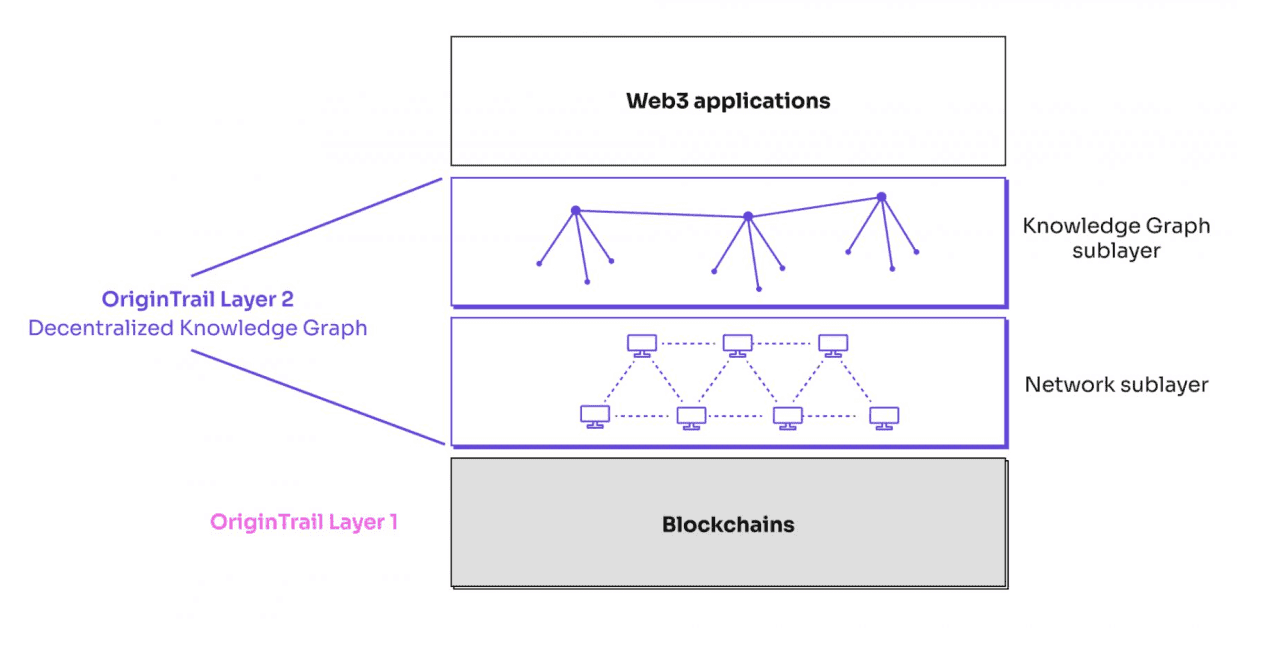
The Decentralized Knowledge Graph (DKG) is the core of the OriginTrail ecosystem. OriginTrail’s docs define it as a global decentralized data structure that interlinks Knowledge Assets in semantic format, hosted on a permissionless peer-to-peer network. The docs say it creates a verifiable knowledge layer for AI and other advanced applications.
A simple way to think about it is this: Bitcoin created a decentralized ledger for money. OriginTrail is trying to create a decentralized graph for knowledge. Its own documentation even uses the phrase, “What Bitcoin did for money, OriginTrail is doing for knowledge.”
The point of a knowledge graph is not just storing data. It is storing data in a way that preserves relationships, context, and meaning. OriginTrail says the DKG combines the trust layer of blockchains, the semantic expressiveness of knowledge graphs, and modern generative AI. That combination is meant to help solve several problems at once: structured memory, data provenance, interoperability, and verifiable context for AI systems.
Why OriginTrail Uses Blockchain
For newcomers, the obvious question is: why does a knowledge graph need blockchain at all? OriginTrail’s documentation gives a fairly direct answer. It says blockchain brings trustless verification, decentralized computation, data integrity, auditability, and tokenization. In the DKG model, blockchains handle identity, anchoring of knowledge, incentives, and verifiable update trails. That means blockchain is not there as a cosmetic add-on. It is there to make knowledge claims harder to tamper with and easier to verify across multiple parties.
This matters especially in settings where data is shared across organizations that do not fully trust one another. A centralized knowledge graph can still be useful, but it places trust in a single operator. OriginTrail’s model aims to make the knowledge layer more neutral and more portable.
That also helps explain why the project now talks about the “Verifiable Internet for AI.” The ambition is larger than a supply-chain database or an enterprise software tool. It is about building a knowledge layer that both humans and machines can use with stronger guarantees around origin and integrity.
What Is NeuroWeb?
NeuroWeb is OriginTrail’s blockchain layer designed to support the DKG and its surrounding economy. OriginTrail describes NeuroWeb as a tailored L1 blockchain innovation hub for the DKG, secured by Polkadot and governed by the OriginTrail community. It is also EVM-compatible and designed to connect across Ethereum and Polkadot ecosystems.
In practice, NeuroWeb gives OriginTrail a more specialized blockchain environment than simply living entirely on Ethereum. Its role is not just to host transactions. It is meant to support DKG growth incentives, governance, AI-related integrations, and new blockchain features tailored to knowledge assets. OriginTrail lists key features such as tight integration with knowledge graphs and AI, community-led governance, scalability, EVM support, and decentralized security through Polkadot.
OriginTrail is not just a token deployed on somebody else’s chain. It now has a broader multichain architecture where the DKG interacts with multiple networks, while NeuroWeb functions as a dedicated environment for the knowledge economy.
What the TRAC Token Does
The TRAC token is the main utility token of the OriginTrail DKG. OriginTrail’s token page says TRAC powers network operations and incentivizes positive behavior from network stakeholders. It was launched in 2018 as an ERC-20 token on Ethereum and has a fixed supply of 500 million tokens. OriginTrail also says all tokens are in circulation.
TRAC is not positioned as a vague governance coin. It has direct operational functions inside the ecosystem. OriginTrail and CoinGecko both describe TRAC as being used for DKG operations such as publishing and updating knowledge assets, while OriginTrail’s token page also highlights delegation to DKG nodes as a source of rewards for token holders.
The multichain aspect also matters. OriginTrail’s TRAC page lists contract support across Ethereum, Base, NeuroWeb on Polkadot, Gnosis, and Polygon, which reflects the project’s broader interoperability strategy. In short, TRAC is meant to do three things at once: pay for network usage, secure participation through staking and delegation, and align incentives across the DKG ecosystem.
What OriginTrail Is Used For
OriginTrail’s use cases have expanded far beyond its original supply-chain roots. Its official solutions pages now span supply chains, healthcare, construction, manufacturing, decentralized science, sports organizations, and Internet content. The company also highlights partnerships or work with organizations including BSI, SCAN, Oracle, GS1, and Parity, among others.
The supply chain use case is still one of the clearest. OriginTrail says the DKG helps create verifiable knowledge assets for data sharing, risk management, and sustainability in global trade. One example on its site is SCAN, whose members include Costco, Walmart, and Target; OriginTrail says SCAN uses the DKG to secure audit data and support privacy-preserving data sharing with agencies tied to U.S. customs programs.
In healthcare and life sciences, OriginTrail says knowledge assets can connect data about medicines, vaccines, medical devices, and product flows across stakeholders, improving transparency and decision-making.
But the newest strategic emphasis is clearly AI. OriginTrail’s docs and academy materials focus heavily on persistent memory, verifiable context, and neuro-symbolic reasoning for AI agents. The project argues that large language models alone are insufficient for trusted AI, and that AI systems need structured, persistent, and provable knowledge.
OriginTrail and AI Agents
This is where OriginTrail’s story starts to become especially relevant in 2026. OriginTrail now presents the DKG as a foundation for AI agents with persistent, verifiable memory. Its docs say AI agents can use the DKG to create and share collective, knowledge-graph-based memory for individuals or agent swarms. Its academy materials go further, explicitly teaching developers how to build “trusted AI agents” with DKG-backed memory and explainable reasoning.
That matters because many AI-agent projects in crypto focus mainly on autonomous action or agent tokens. OriginTrail is targeting a more foundational layer: memory, context, provenance, and verifiable retrieval. Its recent blog writing also frames this as moving from isolated “memory silos” toward shared context graphs for multi-agent systems.
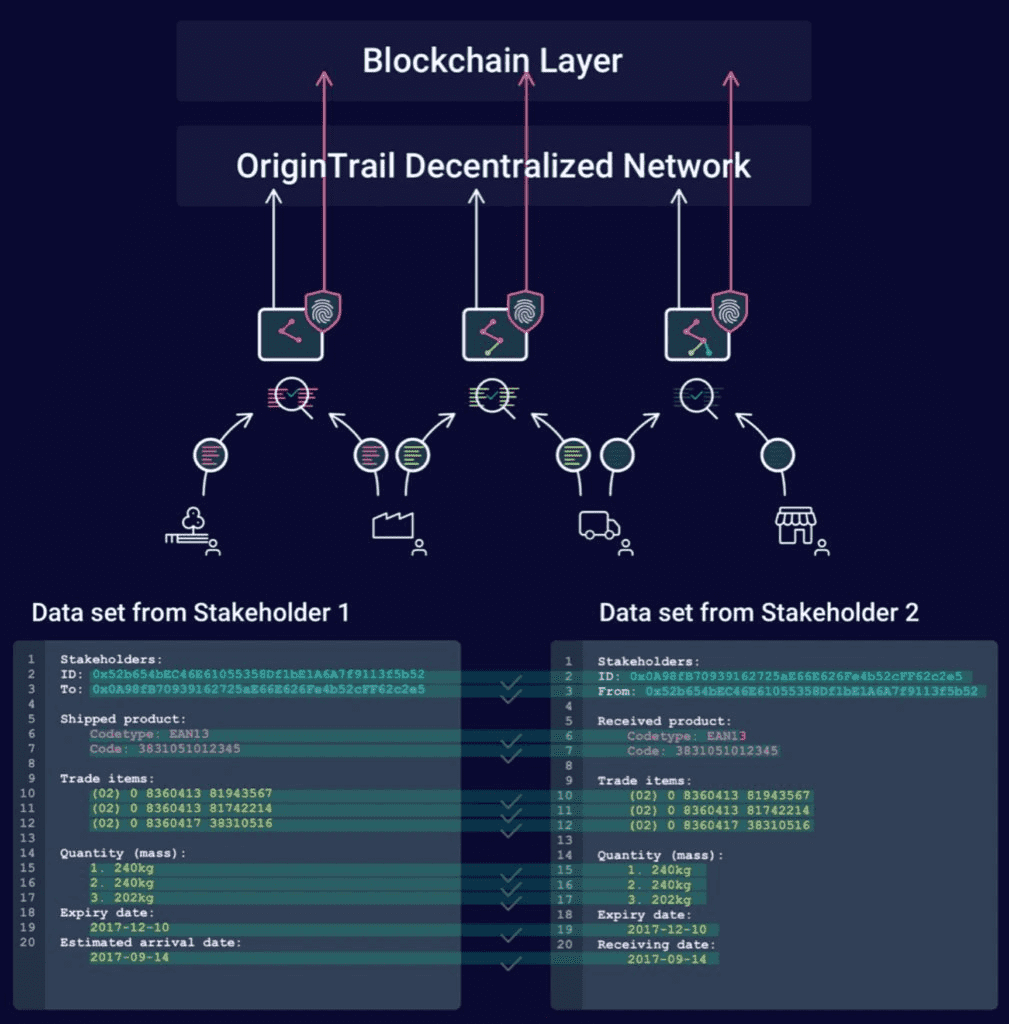
OriginTrail Decentralized Network (source)
TRAC Price and Market Position
From a market perspective, TRAC remains a mid-cap altcoin rather than a mega-cap AI token. As of June 2, 2026, CoinGecko listed TRAC at about $0.3466, with a 24-hour trading volume of about $1.68 million, a market cap of roughly $154.9 million, and a circulating supply of 450 million tokens. CoinGecko also listed an all-time high of $3.50 and an all-time low of $0.003853.
Those numbers matter because they show both opportunity and risk. On one hand, OriginTrail is still small enough that meaningful adoption or narrative strength could materially move the token. On the other hand, it is still far below its all-time high, which tells you the market has not fully repriced it as a dominant AI infrastructure winner.
So investors looking at TRAC should understand that the token is not just trading on generic AI excitement. It is trading on whether OriginTrail can translate its trusted-knowledge thesis into durable demand for DKG operations and network participation.
The Bull Case for OriginTrail
The strongest bullish argument for OriginTrail is that it is working on a real and increasingly important problem: trustworthy data for AI. As AI becomes more widely used, concerns around hallucination, bad sourcing, unverifiable outputs, and fragmented memory become more serious. OriginTrail’s DKG is directly aimed at those problems.
A second bullish point is that the project has real-world roots and enterprise credibility. It did not start as a meme narrative around AI. It started with supply chains, data sharing, and provenance, and it has official materials highlighting partnerships and use cases across major industries.
A third bullish factor is that the token model is relatively easy to understand. TRAC has a fixed supply, clear network utility, delegation-based rewards, and multichain support. That is often easier for investors to evaluate than complex tokenomic systems with heavy inflation or unclear value capture.
The Risks and Weaknesses
First, OriginTrail is building in a crowded thematic area. AI infrastructure is now one of crypto’s most competitive narratives, and being technically thoughtful does not guarantee market dominance. There are many projects claiming to solve AI-related data, compute, or agent problems. OriginTrail still has to prove that its DKG becomes a standard layer rather than a niche tool. This is an inference based on the broader sector, but it follows from the project’s positioning and current market size.
Second, the project’s value proposition can be harder for retail investors to grasp than simpler stories like “AI bot token” or “GPU token.” OriginTrail is about knowledge graphs, provenance, and semantic interoperability. That may be powerful, but it is not always easy to narrate in a hype-driven market.
Third, the token still depends on adoption. A strong technical design is not enough unless enterprises, developers, and AI builders actually publish, query, and secure knowledge assets at scale.
What Is OriginTrail in One Sentence?
OriginTrail is a decentralized knowledge infrastructure project that uses the DKG, NeuroWeb, and the TRAC token to make data more verifiable, interoperable, and useful for AI and real-world applications.
That sentence captures why the project is interesting. It is not trying to be everything. It is trying to become the trusted memory layer for AI and connected data ecosystems.
Conclusion
OriginTrail is one of the more serious infrastructure projects in the overlap between AI, knowledge graphs, and blockchain. It began with supply chain transparency, evolved into the Decentralized Knowledge Graph, and now frames itself as building a verifiable Internet for AI. The DKG gives the project its core identity, NeuroWeb provides a dedicated blockchain environment, and TRAC powers the incentives and operations behind the network.
That makes OriginTrail a different kind of crypto project. It is less about short-term hype and more about whether trusted knowledge becomes a critical layer in the next generation of AI and Web3 applications. If that thesis plays out, OriginTrail could become much more important than its current market cap suggests. If not, it may remain a respected but niche infrastructure project.
