









Key Takeaways
Clearpool is an institutional-focused onchain credit marketplace that connects crypto liquidity to real-world and institutional borrowing opportunities.
Its current product suite includes Dynamic Pools, Prime, Fintech Vaults, RLOC, and the USDX Treasury Pool, showing that the protocol has expanded beyond its original permissionless lending model.
CPOOL is the native utility and governance token, with an initial total supply of 1 billion and uses in delegated staking, borrower staking, LP rewards, and oracle governance.
Clearpool increasingly presents itself as part of the RWA and tokenized-yield narrative, not just DeFi credit. Its 2026 roadmap highlights Treasury yield, private credit, fund strategies, and future commodity and currency exposure.
As of April 2026, Clearpool’s recent direction includes Hex Trust collaboration, USDX Treasury products, X-Pool, PayFi Vaults, and a broader push into tokenized credit infrastructure.
The lending sector in crypto has gone through several phases. Early DeFi lending mostly revolved around overcollateralized borrowing, where users deposited one crypto asset just to borrow another. That model helped DeFi scale, but it left a major gap: real credit. In traditional finance, much of the economy runs on undercollateralized or unsecured lending, not on users posting excess collateral into smart contracts. Clearpool was built to bring more of that real-world credit logic onchain. According to its official documentation, Clearpool positions itself as an open-yield marketplace connecting crypto capital to real-world institutional credit. Its product suite includes the USDX Treasury Pool, Clearpool Prime, Clearpool Dynamic, Fintech Vaults, and Revolving Line of Credit (RLOC) products.
In simple terms, Clearpool is a protocol that lets lenders deploy capital into institutional credit opportunities while letting approved borrowers access liquidity in a more flexible way than traditional DeFi typically allows. Over time, the project has expanded from permissionless institutional lending into a broader tokenized-yield platform spanning Treasury-backed products, PayFi-style financing, and structured vaults tied to real-world activity. Its February 2026 roadmap explicitly frames Clearpool as a “tokenization engine” for the onchain economy, with ambitions well beyond simple crypto lending.
The native token behind this ecosystem is CPOOL, which Clearpool describes as its native utility and governance token. CPOOL is used for staking, borrower requirements, LP rewards, and governance-related oracle participation. That means Clearpool is not just a lending app with a token attached after the fact; the token plays a role in how incentives and protocol operations are coordinated.
What Is Clearpool?
Clearpool is a decentralized credit protocol built around the idea that institutional and real-world borrowers should be able to access onchain liquidity without relying on the fully overcollateralized model common in traditional DeFi. Its official “What Is Clearpool” page says the protocol connects crypto capital to real-world institutional credit and offers curated opportunities across a product suite that now includes Treasury pools, permissionless institutional lending, permissioned institutional credit, fintech financing, and revolving credit facilities.
That makes Clearpool different from a basic retail lending platform. The protocol is aimed much more at credit markets than at retail leverage. On the lender side, users and institutions can deploy capital into different types of yield opportunities. On the borrower side, approved firms can access flexible credit with terms designed around real financing needs rather than just crypto collateral ratios. Clearpool’s lending documentation says Dynamic Pools offer unsecured onchain liquidity with rates that adjust according to utilization, while Prime Pools serve institutional trading firms that need full KYC and AML compliance.
This matters because credit is one of the largest markets in finance, but also one of the hardest to tokenize credibly. You need underwriting, borrower vetting, repayment structures, monitoring, and risk differentiation. Clearpool is trying to build those credit rails onchain, then turn the resulting yield streams into tokenized financial products that can be held, transferred, and eventually integrated into broader DeFi workflows.
How Clearpool Works
Dynamic Pools
Clearpool Dynamic is the protocol’s permissionless institutional lending layer. According to the docs, Dynamic Pools allow any user to provide capital to whitelisted institutional borrowers and earn risk-adjusted returns, with interest rates adjusting automatically according to pool utilization. Clearpool also emphasizes that these are unsecured or overcollateral-free credit opportunities, which is a major differentiator from most DeFi lending systems.
This is one of the most interesting parts of Clearpool’s design. Instead of requiring every borrower to post more collateral than they borrow, the protocol is built around borrower assessment and pool-specific pricing. In practice, that makes it feel closer to real credit markets than to classic DeFi lending.
Prime
For fully permissioned institutional flows, Clearpool runs Clearpool Prime, which is a permissioned institutional lending and borrowing platform for whitelisted counterparties, where all participants must undergo robust KYB and AML verification. Clearpool describes it as a global compliant network for wholesale borrowing and lending of digital assets.
Prime is important because it shows Clearpool is not trying to stay purely permissionless at all costs. Instead, it is acknowledging that some institutional participants want onchain infrastructure but also need compliance controls, identity checks, and customizable terms that fit regulated operations.
Fintech Vaults and PayFi
Clearpool has also moved into Fintech Vaults, which its docs describe as onchain lending vaults facilitating the flow of stablecoin capital from whitelisted lenders to borrowers. Its official introduction and recent blog posts tie these vaults directly to PayFi, or payment financing, where stablecoin liquidity is used to finance real-world payment activity such as remittances and cross-border settlement.
That is a major evolution in the project narrative. Instead of just lending to crypto-native trading firms, Clearpool is increasingly talking about financing the stablecoin economy itself. Its October 2025 Plasma announcement says Clearpool planned to bring cpUSD and PayFi Vaults to Plasma’s stablecoin-focused blockchain, while a related post said Plasma Foundation awarded Clearpool $400,000 in XPL to support this growth initiative.
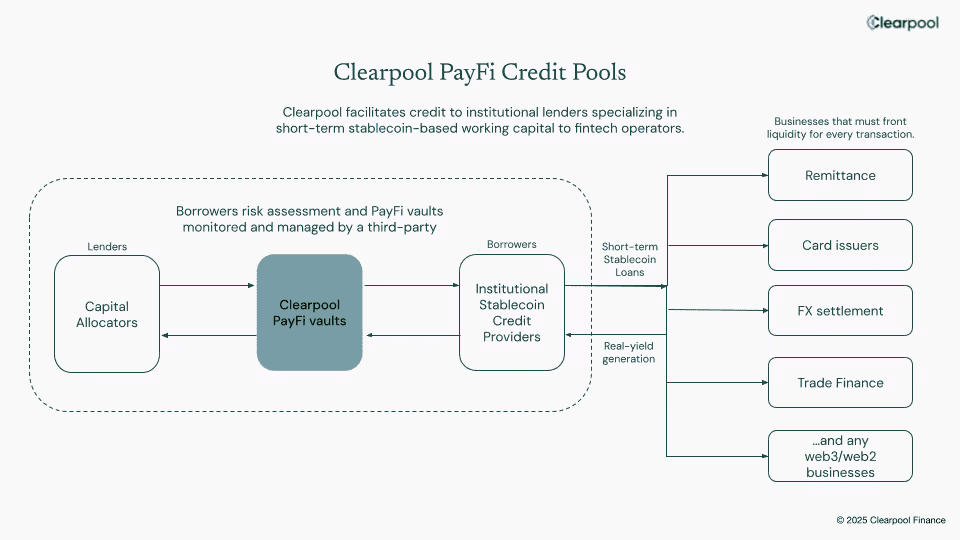
Clearpool Credit Pools (source)
USDX Treasury Pool (T-Pool)
Clearpool’s USDX Treasury Pool gives the protocol a lower-risk, Treasury-linked product. The official docs say the T-Pool is a fully reserved stablecoin yield product launched in partnership with Hex Trust on Flare, offering yield on USDX with additional FLR rewards, full liquidity, and no lock-up periods. Separate lender docs say deposits receive cUSDX and target a Treasury yield of roughly 5% APY plus FLR rewards, though yields can change over time.
This is an important signal about where Clearpool is heading. The project is no longer just about high-yield institutional crypto credit. It is also building products around tokenized Treasuries and more conservative forms of onchain yield.
RLOC and Structured Yield
Clearpool’s introduction page lists Revolving Line of Credit (RLOC) as a product for flexible revolving credit facilities tied to real-world commerce. Its 2026 roadmap expands this vision further, saying Clearpool aims to build structured yield vaults across government debt, private credit, fund strategies, and eventually commodities and currencies.
That roadmap makes Clearpool easier to understand in 2026: it is increasingly trying to become a broad tokenized yield platform, where multiple kinds of credit and yield-producing assets are wrapped into standardized onchain products.
What Are cpTokens?
One of Clearpool’s more interesting design features is the cpToken system. According to the docs, cpTokens represent a lender’s contribution to a specific Credit Vault. Each vault has its own cpToken, and these tokens track the lender’s contribution, automatically compound interest every block, and reflect the borrower risk tied to that vault.
That means a lending position on Clearpool is not just an internal accounting entry. It becomes a tokenized claim on a specific vault. In its 2026 roadmap, Clearpool says this design turns yield exposure into a portable financial primitive that can be held, transferred, and integrated into broader onchain workflows.
This tokenization layer is a big part of the project’s RWA appeal. It lets real-world credit exposure become more modular and composable inside DeFi, which is one of the main reasons Clearpool is increasingly discussed as more than just a lending protocol.
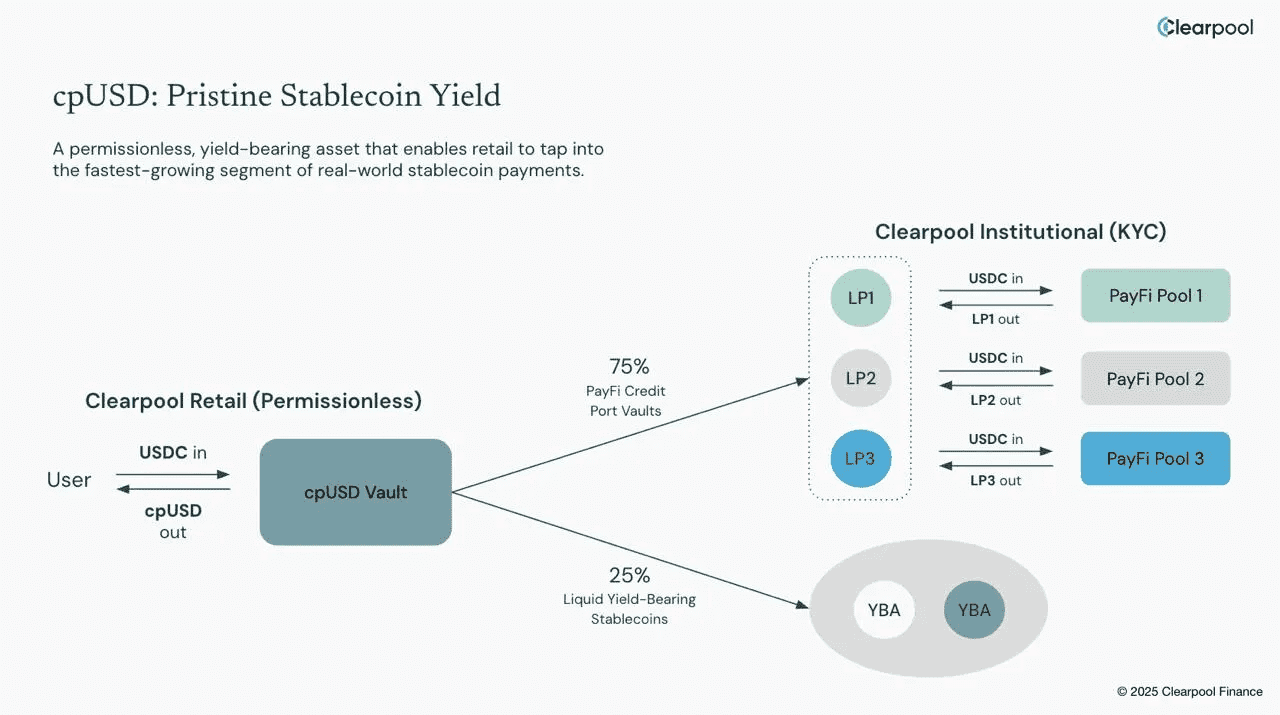
Stablecoin Yield (source)
What Is a Bond NFT?
Clearpool also uses Bond NFTs to handle withdrawals from Credit Vaults. Its docs say that when a user requests a withdrawal, a Bond NFT is created, which continues earning rewards until the repayment date. On redemption, the lender receives the original withdrawn amount plus accrued interest.
This is a useful mechanism because institutional credit is not always instantly withdrawable like a basic liquidity pool. Bond NFTs help bridge that mismatch between lender flexibility and real repayment timing.
What Is CPOOL?
CPOOL is the native utility and governance token of Clearpool. The official token page identifies it as an ERC-20 token with an initial total supply of 1,000,000,000 and lists supported deployments across Ethereum, Solana, Polygon, Mantle, Optimism, and Polygon zkEVM.
The token has several core uses:
Delegated staking: CPOOL holders can stake with Clearpool Oracles to earn yield and support protocol governance and interest-rate infrastructure.
Borrower staking: borrowers need to meet a CPOOL staking requirement to launch a liquidity pool or vault on the protocol.
LP rewards: liquidity providers can earn CPOOL incentives on top of borrower-paid interest.
So while Clearpool’s real value story is about credit and yield, CPOOL acts as the incentive and governance layer that ties users, borrowers, and validators into the ecosystem.
CPOOL Governance and Oracles
Clearpool’s oracle governance model is an important part of how its permissionless credit markets function. Clearpool Oracles are whitelisted participants responsible for setting interest-rate model parameters each epoch. They gain voting power by staking CPOOL, either their own or delegated from others.
The governance page adds that oracle requirements include a minimum stake of 150,000 CPOOL, voting once every two weeks, and a maximum voting power of 15% of total staked CPOOL. Rewards are distributed proportionally to delegators, with oracle operators taking a commission they set themselves.
This model matters because Clearpool’s dynamic pools depend on risk-based and utilization-based pricing. The oracle layer helps adjust those curves over time rather than leaving them static.
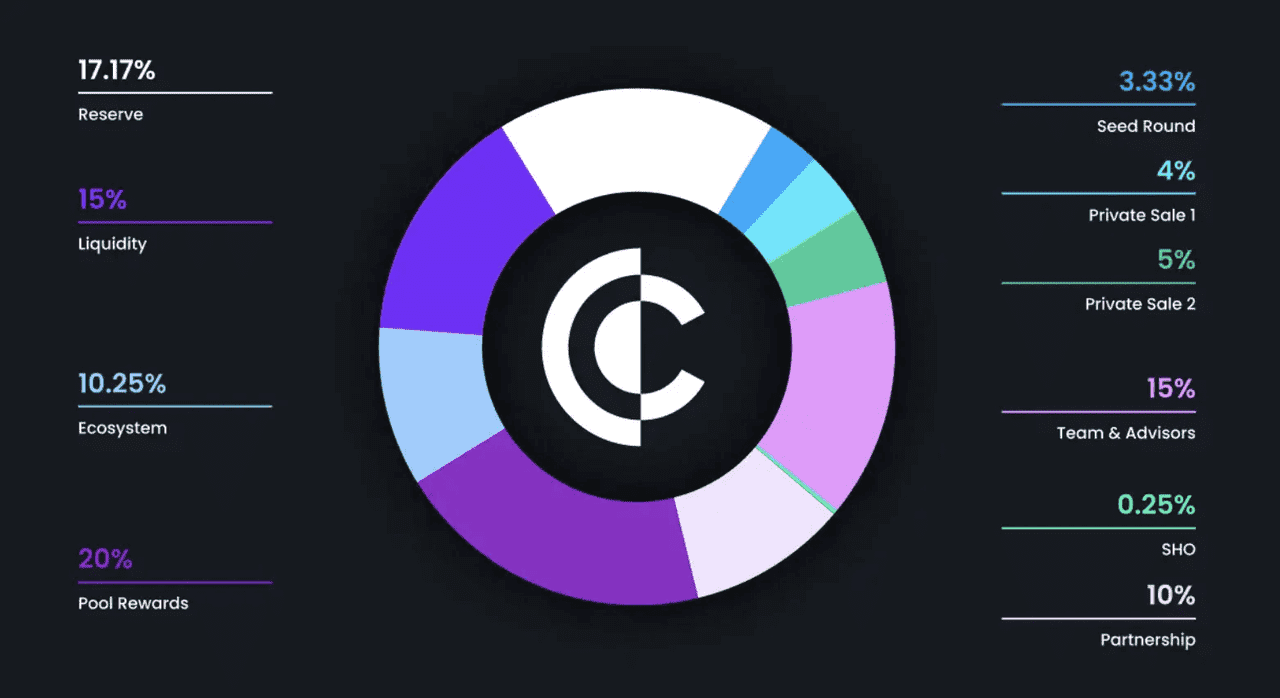
CPOOL Tokenomics (source)
Why Clearpool Matters
Clearpool matters because it sits at the intersection of several major crypto trends at once: DeFi credit, RWAs, stablecoin infrastructure, and tokenized yield. Instead of treating these as separate sectors, the project is increasingly combining them into one platform. Treasury-backed products sit next to fintech financing; permissionless institutional pools sit next to permissioned compliant credit; tokenized lending positions sit next to yield-bearing vault assets.
That makes Clearpool more interesting than a simple lending dApp. If tokenized credit becomes a major part of onchain finance, then projects that can structure, validate, monitor, and tokenize that credit may end up occupying an important infrastructure layer.
Risks and Limitations
Clearpool’s model is promising, but it is not low-risk.
The first risk is credit risk. Unlike overcollateralized DeFi lending, Clearpool explicitly supports unsecured or undersecured institutional borrowing. That opens the door to higher capital efficiency, but it also means lenders are taking real borrower and underwriting risk.
The second risk is execution risk. Clearpool is now trying to operate across multiple categories: Dynamic Pools, Prime, fintech financing, Treasury products, market-neutral yield products, and tokenization infrastructure. Ambition is a strength, but it also increases operational complexity.
The third risk is smart-contract and platform risk. Clearpool publishes multiple audit reports across Dynamic, Prime, Credit Vaults, and T-Pool products, which is a positive sign, but no audited protocol is risk-free.
The fourth risk is regulatory and market risk. Because Clearpool increasingly overlaps with real-world credit and institutional products, it operates in a more sensitive zone than simple DeFi yield farming. Regulatory developments, borrower defaults, or changing stablecoin market conditions could all affect adoption.
Conclusion
The easiest way to understand Clearpool in 2026 is this: it began as a decentralized institutional credit protocol, but it is evolving into something broader—a platform for tokenized yield and onchain credit infrastructure. Its products now cover unsecured institutional lending, permissioned credit, fintech and PayFi financing, Treasury-backed yield, and tokenized credit positions through cpTokens.
That broader positioning is what makes Clearpool worth watching. If the next growth phase of crypto is not just speculation but the tokenization of real credit, real yield, and real financial workflows, then Clearpool is trying to build the rails for exactly that shift. And CPOOL is the token coordinating the staking, incentives, and governance around those rails.
As crypto lending continues to evolve beyond simple overcollateralized DeFi, projects like Clearpool show how onchain credit can connect to real-world financial activity. For traders looking to stay ahead of emerging narratives—from RWAs and tokenized yield to PayFi and institutional DeFi—Phemex offers a secure and user-friendly platform to explore the market, track new opportunities, and sharpen your trading edge.
