









Key Takeaways
Centrifuge is an onchain asset-management and tokenization platform focused on real-world assets (RWAs) such as private credit, Treasuries, and structured investment products. Its official site describes it as infrastructure for tokenized real-world assets and onchain asset management.
The project began in 2017 and first gained traction through Tinlake, an early DeFi platform for financing real-world assets with revolving pools and junior/senior tranches. Centrifuge’s own history says Tinlake pioneered several RWA structures in DeFi.
Today, Centrifuge is positioned less as a niche DeFi experiment and more as institutional-grade infrastructure for launching compliant tokenized real-world assets funds across multiple blockchain networks.
CFG is the protocol’s utility token and governance token. Centrifuge documentation says a new V3 CFG token was introduced in 2025, consolidating legacy CFG and wrapped CFG into a single ERC-20 token on Ethereum.
Centrifuge is one of the most important projects in the real-world asset sector because it has moved beyond the early idea stage and into something much more concrete: infrastructure for bringing traditional financial products onchain. Its official documentation describes Centrifuge as institutional-grade infrastructure for the future of finance, built to bring efficiency, liquidity, and composability to onchain asset management.
That positioning matters because the RWA sector has matured. A few years ago, many tokenization projects were mostly theoretical. In 2026, tokenized Treasuries, private credit funds, and structured vehicles are no longer exotic side experiments. Centrifuge’s own recent research says tokenized Treasuries, equities, and private credit are already operating onchain with institutional structures and expectations.
Centrifuge is a platform that helps asset managers and financial firms create, manage, and distribute tokenized investment products on blockchain rails.
What Centrifuge Actually Does
Centrifuge’s official site says it is the platform for tokenized real-world assets, giving users access to treasuries, credit, index products, and structured vehicles while connecting those assets to DeFi liquidity. Its documentation says the protocol is open-source, decentralized, and built to tokenize and distribute financial products across multiple blockchain networks.
In practical terms, Centrifuge does three things.
First, it provides infrastructure for asset issuers and fund managers to launch tokenized financial products. The docs say the protocol enables the creation of customizable asset-management products with seamless multichain deployment.
Second, it provides a way for investors to access onchain RWAs. Centrifuge’s investing page says users can gain exposure to real-world assets such as treasuries, real estate, and private credit, with yields derived from real economic activity.
Third, it acts as a bridge between traditional finance and DeFi. That has always been one of Centrifuge’s defining ambitions: bringing offchain assets into onchain capital markets in a way that can still satisfy legal, operational, and investor requirements.
Where Centrifuge Came From
Centrifuge’s own mission-and-history page says the project was founded in 2017 to solve inefficiencies in the financial system using blockchain technology. Its first major platform was Tinlake, built on Ethereum, which pioneered multiple tranches and revolving pools for financing real-world assets. The docs specifically call those structures “firsts” for DeFi.
That history matters because Centrifuge did not start as a general-purpose Layer 1 or a speculative token project. It started with a very specific problem: how to finance real-world assets using blockchain infrastructure.
Tinlake was important because it gave DeFi a practical way to interact with things like invoices, private credit, and other offchain receivables. That was a major shift at the time. Most DeFi protocols were still focused on crypto-native collateral only. Centrifuge was among the first to argue that blockchain finance would ultimately need to connect with real economic cash flows, not just digital assets.
Over time, that vision expanded. What began as a protocol for financing real-world assets in DeFi has evolved into a broader tokenization platform for onchain asset management.
How Centrifuge Works Today
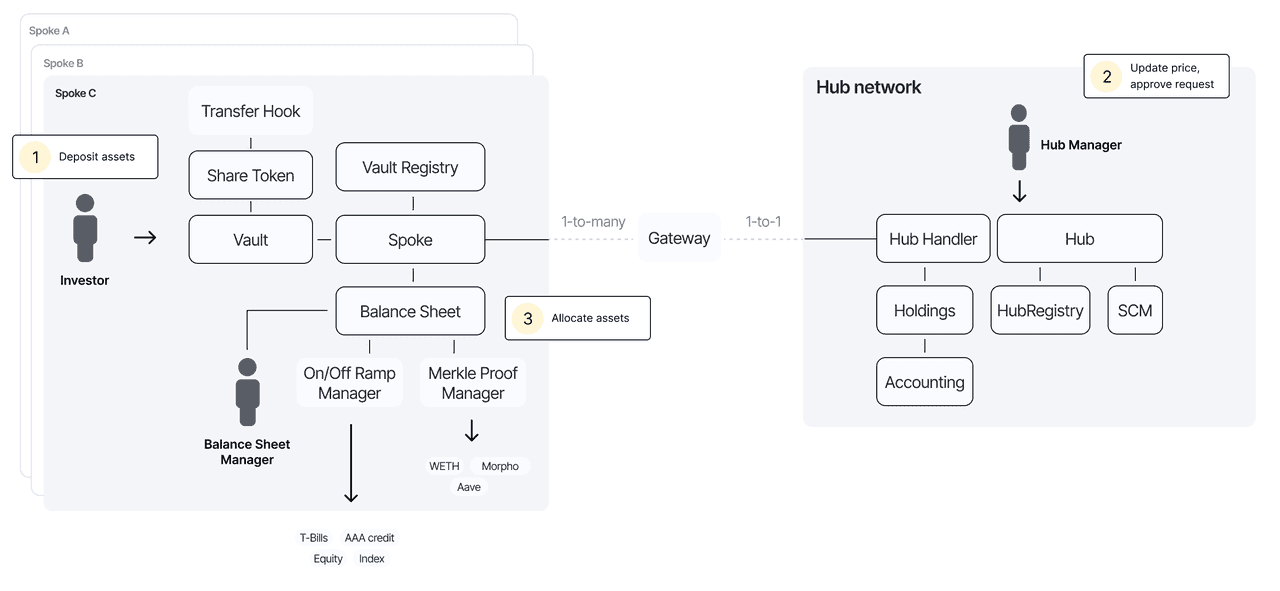
Centrifuge’s current protocol overview describes it as an open-source decentralized protocol that lets users create and distribute financial products across multiple chains. The protocol is built on immutable smart contracts and supports customizable pools, vaults, share classes, and cross-chain actions. The glossary also emphasizes that a pool is a unique investment product identified by a poolId, and that Centrifuge IDs help coordinate activity across supported chains.
That is a very different architecture from the old “single pool on one chain” model that many early DeFi protocols used. Centrifuge is now trying to be modular fund infrastructure.
Its CTO’s February 2025 perspective on Centrifuge V3 says that the platform started with private credit, later expanded into Treasury bills, and is now seeing demand across broader asset classes including credit, tokenized equity, and even natively onchain assets. The same piece argues that Centrifuge V3 matters because it gives asset managers more modular tools to adapt as tokenized markets mature.
So the modern Centrifuge stack is not just about “putting an asset onchain.” It is about giving asset managers a toolkit to create structured financial products that can live across blockchain environments.
What Types of Assets Exist on Centrifuge?
Centrifuge’s own materials highlight several categories of tokenized real-world assets on the platform. Its marketing and investor pages emphasize:
Treasuries
Private credit
Real estate
Index products
Structured vehicles
That list is important because it shows how Centrifuge has expanded beyond its early private-credit roots. The protocol is no longer just a place for experimental invoice financing. It is trying to support a much wider menu of institutional products.
This is also why Centrifuge remains relevant in 2026. The RWA narrative has become much broader than it was during the first wave of tokenized private credit. Institutional demand has shifted strongly toward Treasuries and cash-like instruments, but Centrifuge is building for a future where many different asset types coexist onchain. Its own 2025 and 2026 research emphasizes exactly that trend.
Why Centrifuge Matters in the RWA Sector
Centrifuge matters because it is one of the few projects in crypto that has persisted through multiple market cycles while staying focused on a real financial use case.
Its official docs call it one of the first and largest tokenization platforms. That is not just a branding line. The project has been active since long before RWA became one of crypto’s hottest narratives. It was already trying to build real-world asset infrastructure when much of the market was focused on pure DeFi speculation.
Centrifuge also matters because it has genuine relevance to both sides of the market:
traditional asset managers who want blockchain-based distribution and settlement rails
onchain investors and DeFi protocols who want access to yields from real economic activity
That bridging role is not easy. Many crypto protocols struggle to satisfy institutional expectations. Many traditional firms struggle to operate in crypto-native environments. Centrifuge’s long-term importance depends on whether it can keep serving as usable infrastructure for both.
What Is CFG?
CFG is Centrifuge’s native token. Its token-summary documentation says that in March 2025, governance proposal CP149 introduced a new V3 CFG token that consolidated legacy CFG from the deprecated Centrifuge Chain and wrapped CFG on Ethereum into a single ERC-20 token. Centrifuge’s May 2025 migration blog says this change aligned governance and utility with the upgraded protocol and simplified the token architecture by making CFG natively Ethereum-based.
That token migration is a meaningful development because it reflects Centrifuge’s broader evolution. The project is moving away from legacy chain complexity and toward a more interoperable Ethereum-centered token structure that fits its upgraded protocol architecture.
While the exact utility details are not fully spelled out in the snippets above, CFG remains the protocol’s governance token and utility token, and its migration clearly shows that Centrifuge wants token utility and governance to map cleanly onto the new version of the platform.
CFG Price and Market Position
As of early June 2026, CoinGecko listed Centrifuge (CFG) at approximately $0.25, with a 24-hour trading volume around $13–14 million, a market cap around $146 million, and a circulating supply near 580 million CFG.
That makes CFG a mid-cap token in the current market, not a mega-cap project. This matters because it means Centrifuge is important enough to be taken seriously, but still small enough that future adoption in the tokenization sector could materially affect valuation.
At the same time, CFG is not insulated from crypto market volatility. Even if Centrifuge’s business model is tied to tokenized real-world assets, the token still trades inside broader crypto risk cycles. So investors should separate the strength of the protocol thesis from the short-term movement of the token price.
The Bull Case for Centrifuge
The strongest bull case for Centrifuge is straightforward: real-world assets are becoming one of crypto’s most credible long-term sectors, and Centrifuge is one of the earliest and most established platforms in that space.
A second bullish point is that the project has evolved with the market. It started with private credit, later expanded into Treasuries, and now supports a broader tokenized fund framework. That adaptability matters because the tokenization market itself is still changing. Centrifuge’s own leadership has said exactly this.
A third bullish factor is the institutional angle. Centrifuge is not framing itself as a purely retail DeFi protocol. It is positioning itself as infrastructure for asset managers, fintechs, and DeFi protocols. That gives it potential relevance if tokenized finance continues moving toward professionalized and regulated structures.
Finally, Centrifuge has narrative durability. Unlike hype-driven sectors that appear and disappear quickly, tokenization is increasingly being treated as a foundational shift in market infrastructure. If that trend continues, Centrifuge should remain one of the key names in the conversation.
The Risks and Weaknesses
Centrifuge also faces real risks. The first is execution risk. Tokenization is promising, but it is still early. A lot of institutions are interested in RWAs, yet the pace of full-scale adoption may remain slower than crypto investors expect.
The second is competition. Centrifuge is not alone anymore. The RWA sector now includes tokenized Treasury issuers, onchain credit platforms, fund-tokenization providers, and increasingly traditional financial institutions building their own rails. Centrifuge may be a pioneer, but pioneers do not automatically dominate mature markets.
The third is regulatory and legal complexity. Real-world assets are not just tokens. They are claims on offchain legal structures, cash flows, collateral, and servicing arrangements. Any platform in this space must consistently manage those interfaces well.
The fourth is token-value capture. A strong protocol does not always translate neatly into strong token performance. Investors in CFG still need to ask whether growth in Centrifuge’s usage and institutional footprint creates durable value for the token itself.
What Is Centrifuge in One Sentence?
Centrifuge is a tokenization and onchain asset-management platform that helps financial firms launch and distribute real-world asset products, such as private credit and Treasuries, across blockchain networks.
That is the most accurate one-sentence summary because it captures both the protocol’s history and its current role in tokenized finance.
Conclusion
Centrifuge is one of the foundational projects in crypto’s real-world asset movement. It began by solving financing problems for real-world assets through Tinlake, then grew into a broader platform for institutional-grade tokenized funds and onchain asset management. Today, it is focused on helping asset managers and investors bring Treasuries, private credit, and other financial products onto blockchain rails in a more modular and interoperable way.
That makes Centrifuge more than just another RWA token. It is infrastructure for one of the most important long-term trends in crypto: the migration of traditional financial assets into programmable onchain markets.
The open question is not whether tokenization matters. It clearly does. The question is which platforms become the enduring rails for that shift. Centrifuge has a strong claim to be one of them, but like every protocol in the sector, it still needs to keep proving that it can scale with institutional demand and changing market structure.
