









Key Takeaways
An AI agent wallet is a programmable wallet or account that allows an AI agent to hold, manage, and spend digital assets under defined permissions and policies.
It is different from a normal wallet because it is designed for autonomous or semi-autonomous action, not only direct human signing.
Core use cases include paying for APIs, executing onchain trades, settling agent-to-agent transactions, earning stablecoins, and purchasing services.
Modern agent wallets increasingly rely on guardrails such as spending limits, policy engines, approval flows, and verifiable payment protocols.
Artificial intelligence is getting better at reasoning, searching, planning, and completing tasks. But one major limitation has held many AI agents back from becoming truly useful economic actors: they usually cannot control money safely. An AI assistant may be able to recommend a trade, identify a paid API, compare service providers, or plan a workflow, but without a wallet it still has to stop and wait for a human to complete the transaction. That is exactly the problem an AI agent wallet is trying to solve. Coinbase’s documentation defines Agentic Wallet as infrastructure that enables AI agents to hold, spend, trade, and earn stablecoins with built-in security guardrails, while Base’s AI agents docs say an agent needs a wallet to operate as an independent economic actor.
At a high level, an AI agent wallet is a programmable wallet or financial account designed for software agents rather than humans. Instead of acting as a passive storage account controlled by a person clicking buttons, it gives an AI system a way to receive funds, pay for services, execute transactions, and interact with blockchain protocols under predefined rules. CoinMarketCap’s glossary describes an agent wallet as a programmable financial account that enables autonomous AI agents to hold, manage, and transact digital assets without requiring human approval for every action.
That makes agent wallets one of the most important building blocks in the broader AI x crypto landscape. They sit at the intersection of AI agents, smart wallets, programmable payments, stablecoins, and machine-to-machine commerce. As of April 2026, the category is no longer theoretical: Coinbase has launched Agentic Wallets, Base is publishing developer guidance for autonomous agents, Google and partners have pushed standards work around agent-led payments, and x402-style payment systems are being extended for agent workflows.
What Does an AI Agent Wallet Actually Mean?
An AI agent wallet is not just a normal crypto wallet with a fancy label. The difference is in who or what is expected to act through it.
A traditional wallet assumes a human is in control. Even if there are multisig policies or smart-account features, the baseline expectation is that a person is directly approving actions. An AI agent wallet changes that assumption. It is built so that a software agent can initiate or complete certain financial actions on its own, often within carefully defined rules. Coinbase’s launch materials say Agentic Wallets are designed specifically for AI agents so they can spend, earn, and trade without stopping for human approval at every financial decision point.
That matters because AI agents increasingly need to do more than answer questions. They may need to:
pay for a premium API call,
subscribe to a service,
settle an invoice,
purchase data,
rebalance a portfolio,
or send funds to another agent or smart contract.
Without a wallet, they can only suggest those actions. With an agent wallet, they can execute them. Base’s AI agent docs frame this directly: autonomous agents need a wallet to hold and spend funds, identity standards so others can trust them, and payment protocols for services and commerce.
Why AI Agents Need Wallets
The modern internet was largely built for humans. Logins, checkouts, billing flows, and account permissions all assume a person is clicking through each step. That becomes a problem once software agents start doing meaningful work on a user’s behalf.
Coinbase’s launch post makes this case clearly. It says AI agents can recommend a trade or identify a service they need, but they “hit a wall” when money enters the picture because they cannot actually pay or execute independently. Google’s AP2 announcement makes the same point from a payments perspective, saying the rise of autonomous agents breaks the usual assumption that a human is directly clicking “buy” on a trusted surface.
This is why agent wallets matter. They let agents operate in an economy instead of only analyzing it. Once an agent has a wallet, it can:
receive funds to complete a task,
pay for the tools it needs,
monetize its own services,
interact with DeFi protocols,
or settle value with other agents and merchants.
How an AI Agent Wallet Differs From a Traditional Wallet
The differences are more than cosmetic.
It is policy-driven, not only signature-driven
A normal wallet mainly asks, “Who can sign?”
An agent wallet asks, “What is this agent allowed to do, under which conditions, and with what limits?”
That is why modern agent-wallet systems emphasize spending limits and security guardrails. Coinbase’s docs explicitly highlight built-in guardrails. The recent FIDO-led standards push, with contributions from Google and Mastercard, is also focused on verifying that agents are acting within authenticated user intent and not going rogue.
It is designed for machine-speed action
Humans act occasionally. Agents may act continuously. An agent wallet therefore needs to support repeated, small, automated, or conditional transactions without breaking UX or security. This is especially important for API payments, tool usage, and autonomous trading. Coinbase’s materials emphasize this machine-native use case directly.
It often needs identity and trust layers
If another agent, merchant, or service is going to accept payment or instructions from an AI agent, it may need ways to verify the agent’s authority and legitimacy. Base’s docs explicitly say agents need identity standards so other agents and services can trust them. The FIDO working groups are also targeting cryptographic methods to confirm that agents are accurately carrying out a user’s intent.
It may combine user control with agent delegation
In many cases, the wallet is not “owned” only by the agent in a social sense. It may still be scoped by a human user, business, or app developer that defines the policy boundaries. That means the wallet often represents a delegated financial identity rather than a fully sovereign one. This is consistent with how AP2 and agent-wallet infrastructure talk about authenticated user intent and delegated authority.
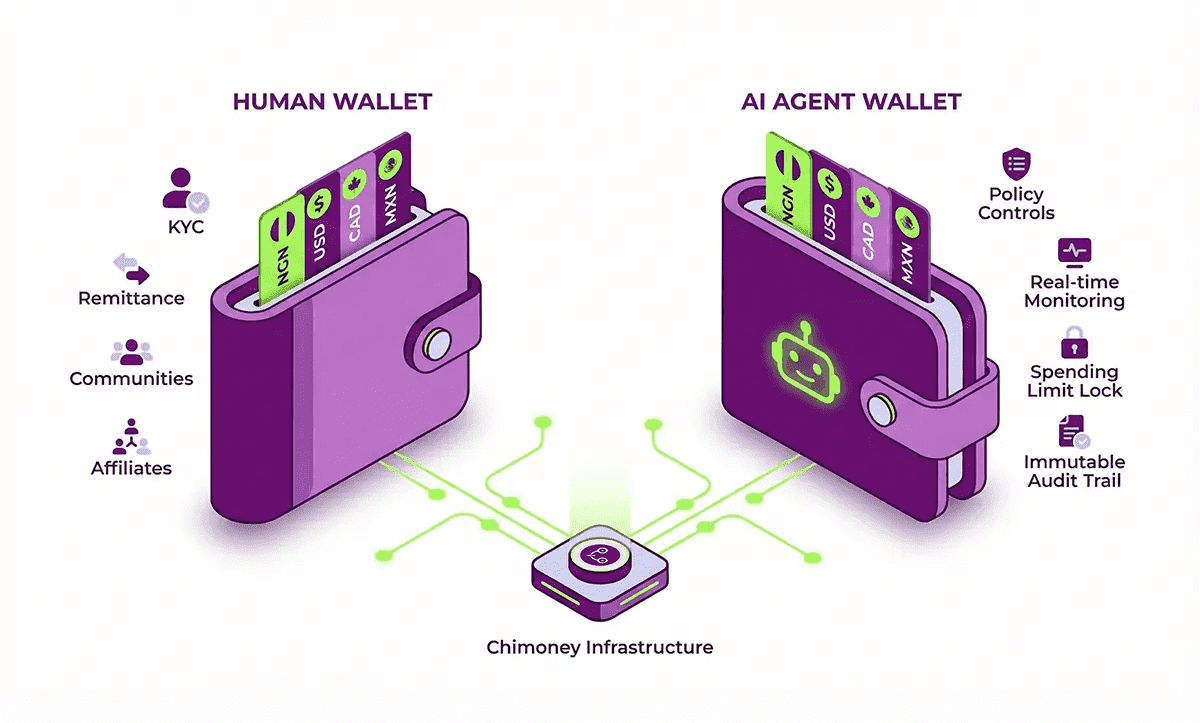
Human vs AI Agent Wallet (source)
Core Features of an AI Agent Wallet
Different products implement these differently, but most agent-wallet systems revolve around a similar feature set.
Wallet ownership and balance management
At minimum, an agent wallet must be able to hold digital assets. Coinbase’s Agentic Wallet docs and product pages focus first on enabling agents to hold and spend stablecoins. Base frames the wallet as the fund-holding layer for autonomous agents.
Spending permissions
Because letting an AI touch funds is risky, a core feature is programmable spending policy. This may include:
maximum spend limits,
allowed counterparties,
approved asset types,
time-based rules,
or category-based restrictions.
While product implementations vary, current standards work around AP2 and FIDO explicitly focuses on authenticated intent and validation of agent actions.
Onchain transaction support
An agent wallet needs a way to interact with blockchains, not just sit idle. Coinbase AgentKit says it gives AI agents secure wallet management and broad onchain capabilities. Agentic Wallet is also described as enabling agents to trade and earn, not merely send funds.
Payment integration
Modern agent wallets are closely tied to payment protocols. x402 on Stellar describes upcoming MCP integration where AI agents can discover paid resources, authorize payments via smart wallets, and chain paid API calls under user-defined spending policies.
Monetization and earnings
Agent wallets are not only about outgoing payments. They also let agents earn. Coinbase’s product language explicitly includes spending, earning, and trading. That makes sense for agents selling services, charging for analysis, or getting paid for task execution.
How AI Agent Wallets Work in Practice
A practical flow usually looks something like this:
A user or developer creates an AI agent.
The agent is given a wallet or linked to one.
Policies are attached: spending caps, allowed actions, approved counterparties, and so on.
The agent receives instructions or goals.
The agent decides it needs to spend funds or move assets to complete a task.
The wallet checks whether the action fits policy.
If allowed, the transaction is executed onchain or through a supported payment protocol.
The outcome is logged or returned to the user.
This is especially useful in cases where the agent is not simply making one big purchase, but many small financial decisions over time.
Common Use Cases for AI Agent Wallets
Paying for APIs and tools
One of the clearest use cases is an agent buying access to paid resources. Coinbase’s launch post highlights agents paying for services and APIs. x402 ecosystems are explicitly designed for this kind of machine-native payment flow.
Autonomous trading
An agent wallet can let an AI trading system execute swaps, rebalance positions, or deploy capital without requiring manual signature at every step. Base’s AI-agent docs explicitly mention agents that trade, earn, and transact autonomously on Base.
Agent-to-agent commerce
As software agents begin buying from other agents, wallets become essential. An agent cannot participate in A2A commerce if it cannot settle value. AP2 and x402 both fit naturally into this world of agent-led transactions.
Subscription and recurring payments
Agent wallets can also support repeat payments under policy, which is useful for always-on systems. Coinbase’s product stack suggests this kind of autonomous spend infrastructure is part of the broader design.
Earning and treasury management
If an agent offers services, it needs a place to collect revenue. Agent wallets can become lightweight treasuries for machine-run businesses or software services. Coinbase’s docs explicitly mention earning stablecoins.
Security and Guardrails
The biggest fear around AI agent wallets is obvious: what if the agent overspends, is hijacked, or misunderstands instructions?
That is why security work is accelerating. Coinbase markets Agentic Wallet as having built-in security guardrails. Google’s AP2 work is focused on securely conveying an agent’s authority to transact. The new FIDO working groups are focused on industry standards so users can authorize agents safely and services can cryptographically verify that agents are acting legitimately.
A good agent wallet therefore needs some mix of:
spending limits,
scoped permissions,
counterparty restrictions,
transaction logging,
user-defined budgets,
approval thresholds,
revocation controls,
and ideally verifiable intent signals.
Without those controls, an agent wallet is less like a useful tool and more like handing your debit card to a hallucinating intern.
AI Agent Wallets and Smart Wallets
An AI agent wallet is often closely related to the broader category of smart wallets or programmable wallets.
The difference is mostly in purpose. A smart wallet is a wallet with programmable logic. An AI agent wallet is a smart or programmable wallet specifically configured so an AI system can use it autonomously or semi-autonomously.
This overlap is why some ecosystems describe agent wallets in terms of smart wallets and programmable permissions rather than inventing completely separate primitives. The Stellar x402 page, for example, explicitly says agents will authorize payments via smart wallets under user-defined spending policies.
So it is often useful to think of an agent wallet as a smart wallet designed for delegated machine action.
Risks and Limitations
AI agent wallets are promising, but they are still early.
Security risk
The most obvious risk is theft, misuse, or policy bypass. If an agent wallet is compromised, funds may be lost quickly. This is exactly why guardrails and standards are being emphasized so heavily.
Authorization ambiguity
What does it mean for an agent to be “allowed” to pay? In some cases, user intent is clear. In others, it is fuzzy. Google’s AP2 work exists largely because agent-led payments raise new questions about authority and validation.
AI reasoning errors
An agent may follow policy and still make a bad decision if its understanding of the task is poor. Wallet guardrails help, but they do not fix bad reasoning.
UX and trust hurdles
Many users are still uncomfortable giving software any financial autonomy. Adoption may therefore depend as much on product design and trust-building as on raw technical capability. The recent FIDO-led effort underscores how central trust is to the category.
Regulatory uncertainty
Agent-led payments and delegated AI commerce will likely raise compliance, liability, and consumer-protection questions. The standards push from major industry participants suggests that these concerns are already becoming central.
Why This Category Could Become Huge
AI agent wallets matter because they unlock a new kind of internet activity.
Without wallets, AI agents remain mostly advisory systems. With wallets, they can become:
tool users,
subscribers,
traders,
buyers,
sellers,
and economic coordinators.
That expands AI from a productivity layer into a commerce layer. Coinbase’s launch framing and Base’s developer docs both point in this direction explicitly.
This category could also grow quickly because it benefits from two already-existing infrastructures:
crypto wallets and smart-contract rails,
and fast-improving AI agents.
When those two curves meet, the result is a new financial primitive: the wallet that belongs not to a human clicking buttons, but to a software system acting under defined rules.
Conclusion
An AI agent wallet is the financial layer that lets AI systems do, not just suggest.
It allows an agent to hold funds, make payments, interact with blockchain protocols, and participate in digital commerce within policy boundaries. That makes it one of the most important enabling technologies for autonomous agents, agentic payments, and machine-to-machine commerce. Coinbase, Base, x402 ecosystems, and emerging standards bodies are all pushing the category forward in different ways.
As AI agents, stablecoin payments, and onchain infrastructure continue to evolve, AI agent wallets are becoming an increasingly important concept for both builders and traders. For users looking to stay ahead of emerging narratives—from AI agents and agentic payments to RWAs, chain abstraction, and PayFi—Phemex offers a secure and user-friendly platform to explore the market, monitor new opportunities, and sharpen your trading edge.
