









Key Takeaways
A2A commerce refers to commercial transactions and workflow coordination conducted between AI agents rather than manually by humans at every step.
A2A handles agent-to-agent communication, while UCP standardizes commerce flows, AP2 handles payment authorization, and x402 enables automatic onchain payments over HTTP.
A2A commerce matters because it can reduce friction in discovery, checkout, API payments, B2B workflows, and machine-to-machine transactions.
The concept is still early as of April 2026, and most of the current standards are infrastructure-layer building blocks rather than fully mature mass-market ecosystems. This is an inference based on the recent announcement dates and current documentation status.
In crypto, A2A commerce is especially relevant because stablecoins and programmable payment rails make low-friction agent payments much more practical.
Artificial intelligence is no longer just answering questions. It is increasingly being asked to take action: compare products, negotiate services, call APIs, book logistics, buy software, pay for data, and coordinate workflows across tools and businesses. Once AI systems begin acting rather than merely advising, a new kind of economic activity emerges: agent-to-agent (A2A) commerce. Google’s April 2025 introduction of the Agent2Agent protocol defined A2A as a way for AI agents to communicate, securely exchange information, and coordinate actions across platforms, while Google’s March 2026 guide to agent protocols explicitly framed A2A as the protocol layer that “connects agents to other agents.”
At a high level, A2A commerce means commercial activity carried out between software agents rather than through direct human clicks at every step. One agent may represent a consumer, business, or workflow. Another may represent a merchant, a service provider, a logistics layer, or a specialized tool. Instead of a human manually browsing, comparing, filling forms, and checking out, agents can discover offers, exchange structured information, negotiate tasks, request payment approval, and complete a transaction programmatically. This concept is increasingly being formalized through open standards such as A2A, UCP, AP2, and payment rails like x402.
That is why A2A commerce is becoming one of the most important ideas in the AI agents x crypto x payments intersection. It is not just “AI shopping” or “AI payments.” It is the idea that economic coordination itself becomes machine-readable and machine-executable. As of April 2026, major ecosystem pieces are already in motion: Google’s A2A protocol for agent interoperability, Google’s Universal Commerce Protocol for commerce flows, Google’s Agent Payments Protocol for payment authorization, and Coinbase’s x402 for internet-native programmable payments over HTTP.
Why A2A Commerce Matters
A2A commerce matters because the current internet was not built for autonomous buying and selling by software agents.
Today’s online commerce stack assumes that humans are present for nearly every important step. Humans browse websites, compare offers visually, authenticate with accounts, type in payment details, and interpret terms and conditions. But AI agents work differently. They need structured discovery, machine-readable capabilities, clear authorization rules, and programmatic payment flows. Google’s March 2026 developer guide makes this division explicit by saying A2A connects agents to agents, UCP standardizes commerce, and AP2 handles payment authorization.
This matters especially in two areas.
First, it matters for consumer commerce. Google’s January 2026 commerce announcement introduced new tools and an open standard for agentic shopping, aimed at helping retailers connect with high-intent shoppers in AI-driven flows. That signals that large platforms see AI-assisted and AI-executed transactions as a real future channel, not just an experiment.
Second, it matters for machine-native commerce, especially in developer and API ecosystems. Coinbase’s x402 documentation describes a world where clients, including AI agents, can programmatically pay for access to APIs and digital content directly over HTTP using stablecoins, without requiring accounts, sessions, or traditional billing infrastructure. That is a major unlock for agents that may need to call many services in real time.
In simple terms, A2A commerce matters because AI agents can only become reliable economic actors if the internet gives them ways to discover, negotiate, authorize, and pay without constant human middleware.
The Core Building Blocks of A2A Commerce
A2A commerce is not one protocol. It is better understood as a stack.
Agent Interoperability
At the base layer, agents need a way to communicate with each other. That is the role of A2A. The official A2A protocol documentation describes it as an open standard for seamless communication and collaboration between AI agents, while Google’s original 2025 announcement said it enables agents to securely exchange information and coordinate actions across platforms.
Without this layer, agent commerce would stay fragmented: every company would build one-off integrations for every other company’s agent system.
Commerce Semantics
Once agents can talk, they still need to understand the structure of commerce. That is where UCP, the Universal Commerce Protocol, comes in. Google’s official UCP materials say it provides a common language and functional primitives for seamless commerce journeys between consumer surfaces, businesses, and payment providers. Google’s merchant docs also say UCP is designed to enable agentic actions on Google AI Mode and Gemini, beginning with direct buying.
This is crucial because buying something involves more than messaging. Agents need structured ways to understand product catalogs, availability, pricing, cart behavior, identity linking, and post-purchase flows.
Payment Authorization
Even if agents know what to buy, they still need permission to spend. That is the role of AP2, the Agent Payments Protocol. Google’s September 2025 announcement describes AP2 as an open protocol developed to securely initiate and transact agent-led payments across platforms, and says it can be used as an extension of both A2A and MCP.
This layer matters because agent commerce cannot scale if every payment requires bespoke ad hoc approval logic.
Payment Settlement
Finally, payments need to settle somewhere. In crypto-native environments, x402 is one of the clearest payment-layer examples. Coinbase describes x402 as a protocol enabling instant, automatic stablecoin payments directly over HTTP by reviving HTTP 402 Payment Required. The x402 docs explain a simple flow: the server responds with payment requirements, the client pays, and the server returns the requested resource.
That is especially relevant for A2A commerce because many agent transactions are not large retail checkouts. They may be micropayments for tools, API calls, datasets, compute, or digital services where traditional billing is too slow or cumbersome.
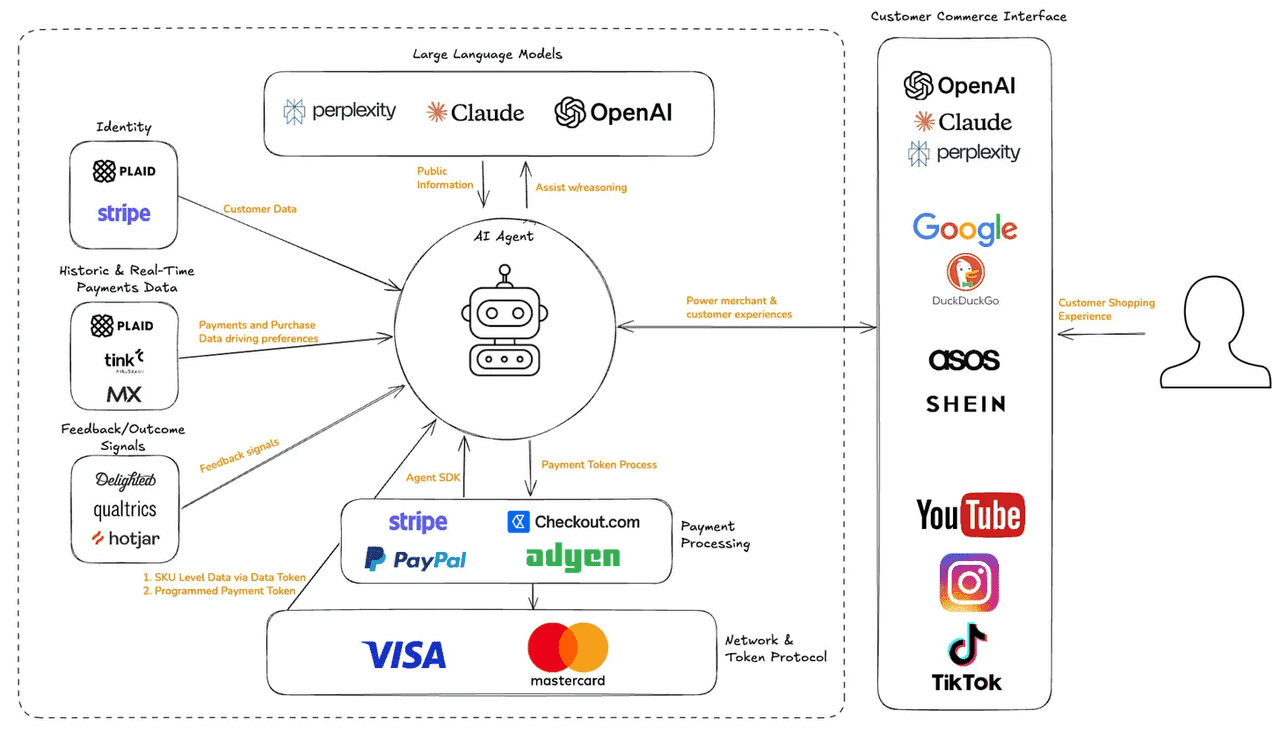
Agent to Agent commerce structure (souce)
How A2A Commerce Works in Practice
A useful way to understand A2A commerce is to walk through an example.
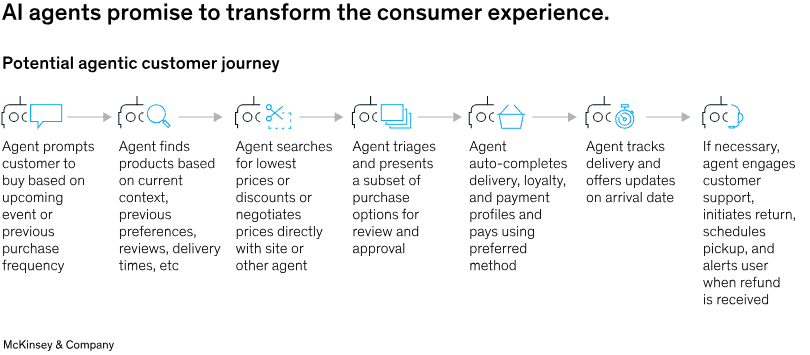
Imagine a user tells an AI assistant: “Find the best flight and hotel bundle for a three-day trip, stay under $1,500, pay with my travel budget, and only book if cancellation is flexible.”
In a traditional flow, the assistant might only recommend options and leave the rest to the human. In an A2A commerce flow:
The user-facing agent interprets the request.
It communicates with merchant or aggregator agents using A2A.
Those agents expose offers and structured purchasing flows through a commerce standard such as UCP.
The buyer-side agent compares terms and builds the preferred option.
If payment is needed, the system uses AP2 or another authorization layer to verify spending rules.
Settlement may occur through traditional rails, or in crypto-native contexts through mechanisms like x402 or stablecoin payment flows.
The agent confirms fulfillment, returns itinerary details, and stores the transaction context.
The same basic structure can apply to many other scenarios:
one agent paying another for API access,
an internal procurement bot sourcing software tools,
a trading agent paying for data feeds,
a research agent purchasing compute or premium content,
or a merchant agent negotiating restocking or shipping terms with supplier agents.
The point is not that every human disappears. The point is that the human moves from execution to policy-setting and approval, while the agents handle the workflow mechanics.
A2A Commerce vs Traditional E-Commerce
Traditional e-commerce is page-centric. A2A commerce is protocol-centric.
In traditional e-commerce:
Products are optimized for human browsing
Checkout relies heavily on forms and sessions
Billing often assumes identity-first account models
Automation is limited
In A2A commerce:
Products and offers need to be agent-readable
Capability discovery becomes important
Payment and authorization can be delegated
Transaction logic can be embedded directly into interfaces and APIs
Another difference is speed and granularity. Traditional e-commerce is great for big human-led purchases, but it is poor at machine-speed micropayments. x402 and similar crypto-native payment standards matter here because they allow low-friction, low-value, recurring transactions that are much harder to justify with card rails and account creation overhead.
That means A2A commerce is not only a replacement for web checkout. It may open up categories of commerce that were previously too small, too frequent, or too automated to be economical.
Why Crypto Matters for A2A Commerce
A2A commerce can exist without crypto, but crypto makes some parts of it much easier.
The main reason is programmable payments. Stablecoins and onchain payment protocols can settle value quickly, globally, and automatically. Coinbase’s x402 framework is explicitly designed so services can monetize APIs and digital content through direct onchain payments over HTTP, including payments made by AI agents. Stellar’s x402 page similarly emphasizes agentic autonomy, micropayments, and programmatic settlement within user-defined spending rules.
That gives crypto three specific advantages in A2A commerce:
Micropayments
Agents may need to buy many tiny services: one inference call, one dataset query, one routing calculation, one premium API response. Traditional payments are bad at this. Crypto rails are better suited to it.
Global Reach
Agents do not care about banking hours or jurisdiction-specific settlement windows. Stablecoin rails can support more continuous global operation. This is one reason x402 is being pitched as an internet-native payment standard.
Programmable Spending Rules
Agent payments need guardrails. AP2 and x402 both speak to this in different ways: AP2 focuses on safe, interoperable agent-led payments, while x402 focuses on payment requirements and automated settlement logic.
For crypto traders and builders, this is why A2A commerce overlaps with themes such as PayFi, stablecoin infrastructure, agentic payments, and machine-to-machine economies.
Key Protocols Shaping A2A Commerce in 2026
A2A
The communication layer. Originally introduced by Google in April 2025, now documented as an open protocol for interoperable agent communication and, according to official project materials, contributed to the Linux Foundation.
UCP
The commerce language layer. Introduced by Google in January 2026 as an open standard for the future of commerce, designed to make AI interactions convertible into direct buying journeys.
AP2
The payment authorization layer for agent-led payments. Announced by Google in September 2025 as an extension compatible with A2A and MCP.
x402
The crypto-native settlement rail. Described by Coinbase as a standard for instant automatic stablecoin payments over HTTP, useful for both humans and machines.
Together, these protocols do not yet form one universal operating system for agent commerce. But they do show a clear direction: interoperability, machine-readable commerce, delegated authorization, and programmatic payment rails.
Real Use Cases for Agent-to-Agent Commerce
AI Shopping and Retail
This is the most obvious use case. Google’s January 2026 announcements around UCP and agentic shopping show that large retail flows are being redesigned for agent participation. Agents can compare products, apply filters, build carts, and complete transactions with user permission.
API and Tool Payments
A developer agent may need to call a premium model, a search endpoint, a compliance API, or a data provider. x402 is almost purpose-built for this type of use case.
B2B Procurement
A sourcing agent could compare suppliers, request quotes, verify capabilities, and place orders within set budget rules. This is a logical use case for A2A plus UCP-style commerce semantics. This is an inference based on the protocol boundaries laid out by Google’s March 2026 guide.
Service-to-Service Commerce
One agent may pay another agent or service for compute, content generation, legal review, translations, routing, or logistics coordination. AP2 and AP2-related documentation explicitly frame themselves around secure interoperable agent commerce.
Autonomous Finance and Trading Workflows
A trading or treasury agent might purchase data, rent model inference, or pay execution infrastructure on demand. This use case is not yet standardized at mass scale, but it fits naturally with x402-style tool payments and AP2-style authorization flows. This is an inference based on the payment and agent protocol stack.
Risks and Limitations
Trust and Accountability
If an agent buys the wrong item, misreads constraints, or overspends, who is responsible? Google’s AP2 announcement highlighted this trust challenge directly by positioning AP2 as a way to make agent-led payments safe and interoperable.
Standard Fragmentation
The ecosystem is improving, but it is still fragmented. A2A, UCP, AP2, MCP, A2UI, AG-UI, and x402 each solve different pieces of the stack, which means builders still need to understand several protocols rather than one universal standard. Google’s March 2026 guide itself exists largely to clarify these boundaries.
Authorization Risk
Agents should not be allowed to spend freely without meaningful controls. Payment delegation needs carefully scoped permissions, limits, and verification. AP2 and x402 both help, but neither removes the need for policy design.
Merchant Readiness
For agent commerce to work at scale, merchants and service providers need structured catalogs, machine-readable capabilities, and protocol support. UCP is meant to help here, but rollout is still underway.
Early Infrastructure Risk
Most of these standards are very new. A2A was announced in 2025, AP2 in late 2025, and UCP in early 2026. That means tooling, adoption, and best practices are still evolving.
Why A2A Commerce Could Become a Major 2026 Narrative
A2A commerce sits at the intersection of several powerful trends:
AI agents,
Stablecoin payments,
Internet-native micropayments,
Protocolized commerce,
Machine-to-machine coordination.
That combination matters because it turns AI from a recommendation system into an economic actor. Once agents can discover opportunities, communicate with merchant systems, receive delegated authorization, and settle payments automatically, a big part of online commerce can become agent-mediated. Google’s protocol stack and Coinbase’s x402 are strong evidence that this transition is being taken seriously by major infrastructure players.
For crypto specifically, this could become a major narrative because crypto already has the payment primitives that machine economies need: stablecoins, programmable wallets, and composable settlement. That makes A2A commerce a natural extension of themes like PayFi, agentic payments, and verifiable AI workflows. This is an inference supported by the overlap between the protocol stack and crypto-native payment rails.
Conclusion
Agent-to-agent commerce is the idea that software agents can transact with other software agents using open standards for communication, commerce, authorization, and payment.
A2A handles the agent communication layer. UCP helps standardize commerce interactions. AP2 handles safe delegated payment authorization. x402 and similar rails make programmatic payment settlement possible, especially in crypto-native environments. Together, these protocols point toward a future where agents do much more than recommend products or answer questions—they can actually buy, sell, and coordinate economic activity.
As AI agents, stablecoins, and programmable payment rails continue to evolve, narratives like A2A commerce are becoming increasingly important for both builders and traders. For users looking to stay ahead of emerging sectors - from AI agents and A2A commerce to chain abstraction, RWAs, and PayFi - Phemex offers a secure and user-friendly platform to explore the market, monitor new opportunities, and sharpen your trading edge.
