








Bitcoin is trading around $60,141 as of late June 2026, going almost nowhere after the multi-week selloff drained momentum out of the market. Price bounces, fades, and bounces again inside a tight band, and trend-following traders who try to ride a breakout keep getting chopped up. A flat tape punishes the habits that work in a trend, and most traders keep using a trend playbook anyway. That is why they bleed fees and small losses while the market does nothing.
There is a strategy built for exactly this environment, and it has worked for as long as markets have had horizontal support and resistance. Here is what a trading range is, how to tell a range from a trend, how to buy support and sell resistance with confirmation, where to put your stops and targets, how to read oscillators inside a range, and how to spot the breakout that ends the whole setup.
What a Trading Range Is and How to Identify One
A trading range is a period where price oscillates sideways between a horizontal support level at the bottom and a horizontal resistance level at the top. Buyers step in every time price falls to support, and sellers step in every time price climbs to resistance. Neither side can win, so price keeps ping-ponging between the two boundaries instead of making sustained higher highs or lower lows. The current Bitcoin tape near $60,000 is a textbook example of this kind of equilibrium.
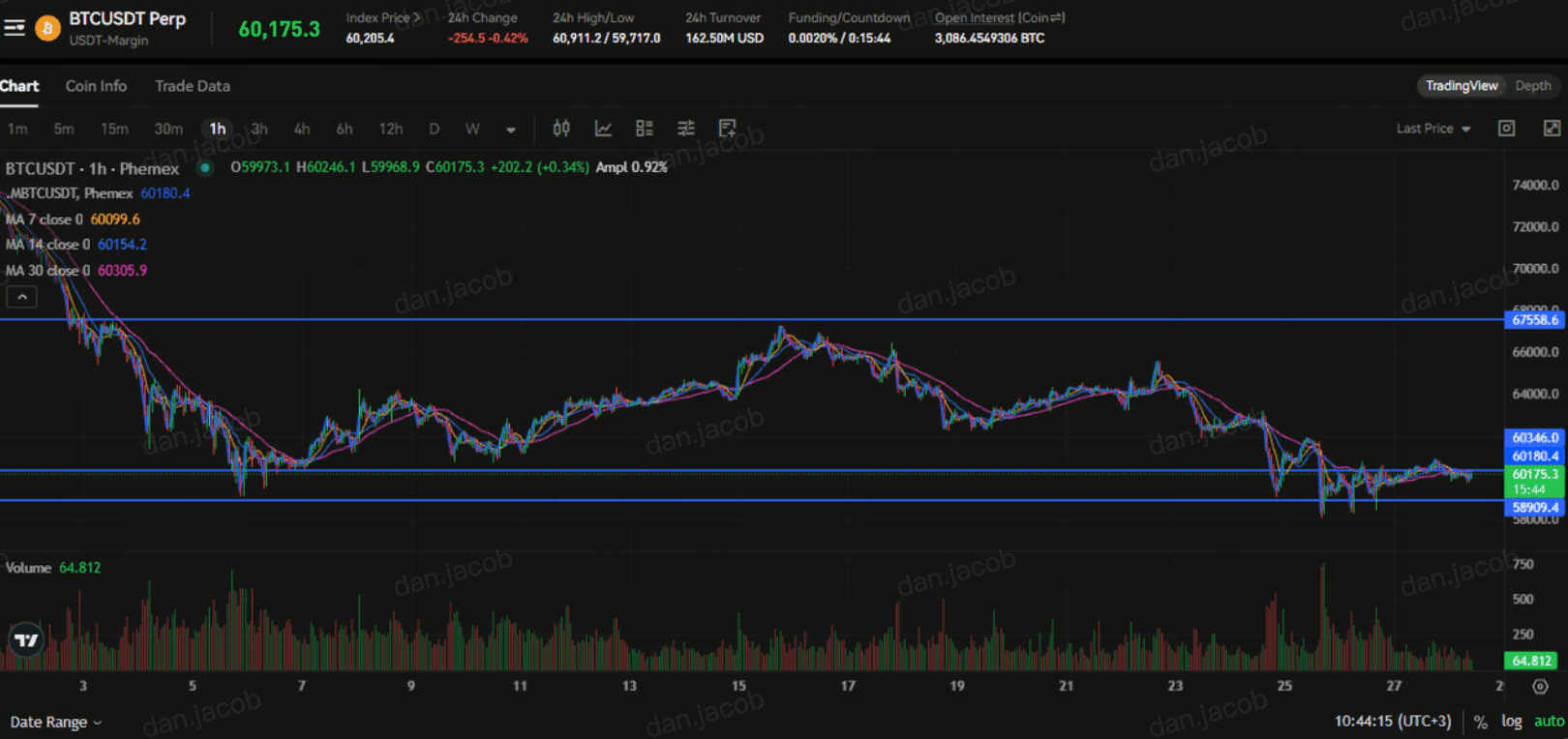
The distinction between a range and a trend is the whole game, because the two demand opposite tactics. In a trend you buy strength and add to winners. In a range you do the reverse. You sell strength near the top and buy weakness near the bottom. Get the regime wrong and every instinct you have works against you.
A trend makes a staircase of higher highs and higher lows (up) or lower highs and lower lows (down). A range makes a flat ceiling and a flat floor, with the swing highs landing at roughly the same price and the swing lows doing the same. The fastest visual check is to draw two horizontal lines, one across the recent peaks and one across the recent troughs. If price has tagged each line at least twice and respected both, you have a confirmed range. One touch is an accident. Two or more touches is a level.
Moving averages give you a second read. When the 50-day and 200-day moving averages flatten out and tangle together instead of fanning apart, the market has no directional conviction and a range is likely in force. A flat moving average is the market telling you it has no opinion. Reading the candles at each boundary helps too, since clusters of rejection wicks and reversal candles confirm where buyers and sellers are actually defending a level.
How to Trade Support and Resistance Inside the Range
The core range strategy is simple to state and hard to execute. You buy near support and sell near resistance, then do it again on the next oscillation. The edge comes from buying low and selling high inside a defined box, over and over, while the range holds.
The mistake that wrecks most range traders is buying the exact moment price touches support, or shorting the instant it tags resistance. Levels do not hold to the penny. Price routinely pokes through support by a fraction, hunts stops, then snaps back. If you enter on the touch alone, you get stopped out right before the bounce you correctly predicted. This is where retail consistently loses money in a chop.
The fix is confirmation. Wait for price to reach the boundary and then show you the rejection before you commit. At support, that means waiting for a bullish reversal candle like a hammer or a bullish engulfing bar to print, or for price to reclaim the level after a brief wick below it. At resistance, you wait for a bearish rejection, a shooting star, a bearish engulfing, or a failed push that closes back inside the range. Learning to read these candlestick patterns at the boundary is the single highest-value skill for range trading, because the candle is the market showing its hand.
One more filter keeps you out of bad trades. Only take the setups with room to run. If support and resistance are very close together, the distance between them may not cover the spread, fees, and a sensible stop. A range worth trading needs enough height that the trip from one side to the other pays you more than the cost of being wrong.
Where to Place Stops and Targets, and How to Use Oscillators
Stops and targets in a range are mechanical, which is one of the strategy's strengths. Your stop goes just beyond the level you traded against, and your target goes at the opposite boundary. The structure tells you exactly where you are wrong and exactly where to take profit, with no guessing.
Here is the framework for both sides of the range.
|
Element
|
Buying at support
|
Selling at resistance
|
|
Entry
|
On bullish confirmation at the floor
|
On bearish confirmation at the ceiling
|
|
Stop-loss
|
A bit below support
|
A bit above resistance
|
|
Target
|
The resistance ceiling
|
The support floor
|
|
Invalidation
|
A daily close below support
|
A daily close above resistance
|
|
Best oscillator read
|
RSI oversold near 30
|
RSI overbought near 70
|
Oscillators are built for ranging markets, which is exactly where trend indicators fail. The Relative Strength Index (RSI) measures how stretched price has become, and in a clean range it tends to push toward oversold near 30 as price hits support and toward overbought near 70 as price hits resistance. The Investopedia explainer on the RSI covers the math, but the practical use in a range is simple. RSI near 30 at support is a buy signal that lines up with your level. RSI near 70 at resistance is a sell signal that lines up with yours.
Stochastics work the same way and are arguably better tuned for sideways conditions. The Stochastic oscillator flags overbought above 80 and oversold below 20, and the crossover of its two lines at an extreme gives you a cleaner trigger than RSI alone. The strongest range entries are when the level, the candle, and the oscillator all agree. Price at support, a hammer printing, and RSI under 30 is a far higher-quality long than any one of those signals on its own. TradingView's chart-patterns education is a useful reference for pairing these readings with the structure on the chart.
How to Spot the Breakout That Ends the Range
Every range ends. Price does not oscillate forever, and at some point buyers or sellers overwhelm the other side and price breaks out of the box into a new trend. The trader who keeps mechanically buying support after the floor has caved gets run over, so reading the end of the range is as important as trading the middle of it.
The tell is the close, not the touch. Price wicking through resistance and snapping back is still a range. A full candle that closes decisively beyond support or resistance, ideally on a higher timeframe like the daily, is a real breakout and a signal to stop fading the level. Volume is the confirmation. A breakout on a surge of volume is far more likely to hold than a quiet drift through the level, which often turns out to be a false break that reverses straight back inside.
Range boundaries also flip roles when they break. Old resistance becomes new support after an upside break, and old support becomes new resistance after a downside break. This is why a clean breakout often retests the broken level before continuing. That retest is one of the higher-probability entries in all of trading, because the range you were just fading now gives you a defined level on the other side. Some ranges resolve through chart formations rather than a clean horizontal break, so it pays to recognize triangle patterns and other compressions that often precede the move, and to know the double top and double bottom reversals that signal a range boundary is about to fail.
The discipline is to respect the breakout once it confirms. If you were long from support and price closes hard below it, that is your stop and your signal that the regime has changed. Fighting a confirmed breakout because you are anchored to the old range is the fastest way to turn a small range loss into a large trend loss.
Risk Management in Choppy Conditions
Choppy markets are death by a thousand cuts, and risk management is what keeps the thousand cuts from adding up to a blown account. Ranges produce a high frequency of small trades, which means small errors compound fast if your sizing is loose. The first rule is to size every position so a single stop costs a small, fixed fraction of your account, typically 1% to 2%, no matter how confident the setup looks.
Position sizing follows directly from the structure. Because your stop sits just past the level and your target sits at the far boundary, you can calculate your reward-to-risk before you enter, and you should skip any trade that does not offer at least a clean payoff for the risk. The flat box that defines a range is also the thing that defines your math, which is one reason disciplined range traders survive chop that destroys discretionary gamblers.
Leverage is the multiplier that turns a survivable chop into a liquidation. High leverage in a range means the normal stop-hunting wicks below support are enough to wipe a position before the bounce you correctly anticipated even arrives. Keep leverage low so the noise inside the range cannot knock you out of a thesis that is actually correct. The flat tape near $60,141 will eventually break one way or the other, and the trader still standing when it does is the one who treated every range trade as a small, controlled bet rather than a swing for the fences.
Frequently Asked Questions
What is range trading?
Range trading is a strategy that buys near a horizontal support level and sells near a horizontal resistance level while price oscillates sideways between the two. It works in flat, non-trending markets where price keeps reversing at the same boundaries instead of breaking out. The edge comes from repeatedly buying low and selling high inside a defined box until the range eventually breaks.
How do you trade a sideways market?
Identify the support floor and resistance ceiling by drawing horizontal lines across the recent swing lows and highs, then buy near support and sell near resistance on confirmation rather than on the bare touch. Use oscillators like RSI and Stochastics to time entries, placing your stop just beyond the level and your target at the opposite boundary. Stay out once price closes decisively through either boundary, because that signals the range has ended.
Is range trading profitable?
Range trading can be profitable in flat markets because the setup gives you a defined entry, stop, and target with a calculable reward-to-risk on every trade. The risk is that ranges eventually break, and a trader who keeps fading a level after it has failed gives back many small wins in one large loss. Profitability depends on confirmation, disciplined stops, and respecting the breakout when it comes.
Which indicators work best for range trading?
Oscillators like the RSI and the Stochastic oscillator are the best fit because they flag overbought and oversold conditions, which line up with resistance and support inside a range. Trend indicators like moving-average crossovers tend to give false signals in a sideways market. The strongest signal is when the level, a reversal candle, and the oscillator all agree at the same boundary.
Bottom Line
Treat the current flat tape as a range until price proves otherwise with a decisive daily close beyond the boundaries. Buy near support and sell near resistance, but only on confirmation, a reversal candle plus an oscillator extreme, never on the bare touch. Put your stop just past the level you traded against, set your target at the opposite boundary, and skip any range too tight to pay you for the risk. Keep leverage low and risk a fixed small fraction per trade so the inevitable stop-hunting wicks cannot knock you out of a correct thesis. When Bitcoin finally closes hard through $60,000 on rising volume, stop fading the level and trade the new trend instead.
This article is for informational purposes only and does not constitute financial or investment advice. Cryptocurrency trading involves substantial risk. Always conduct your own research before making trading decisions.
