









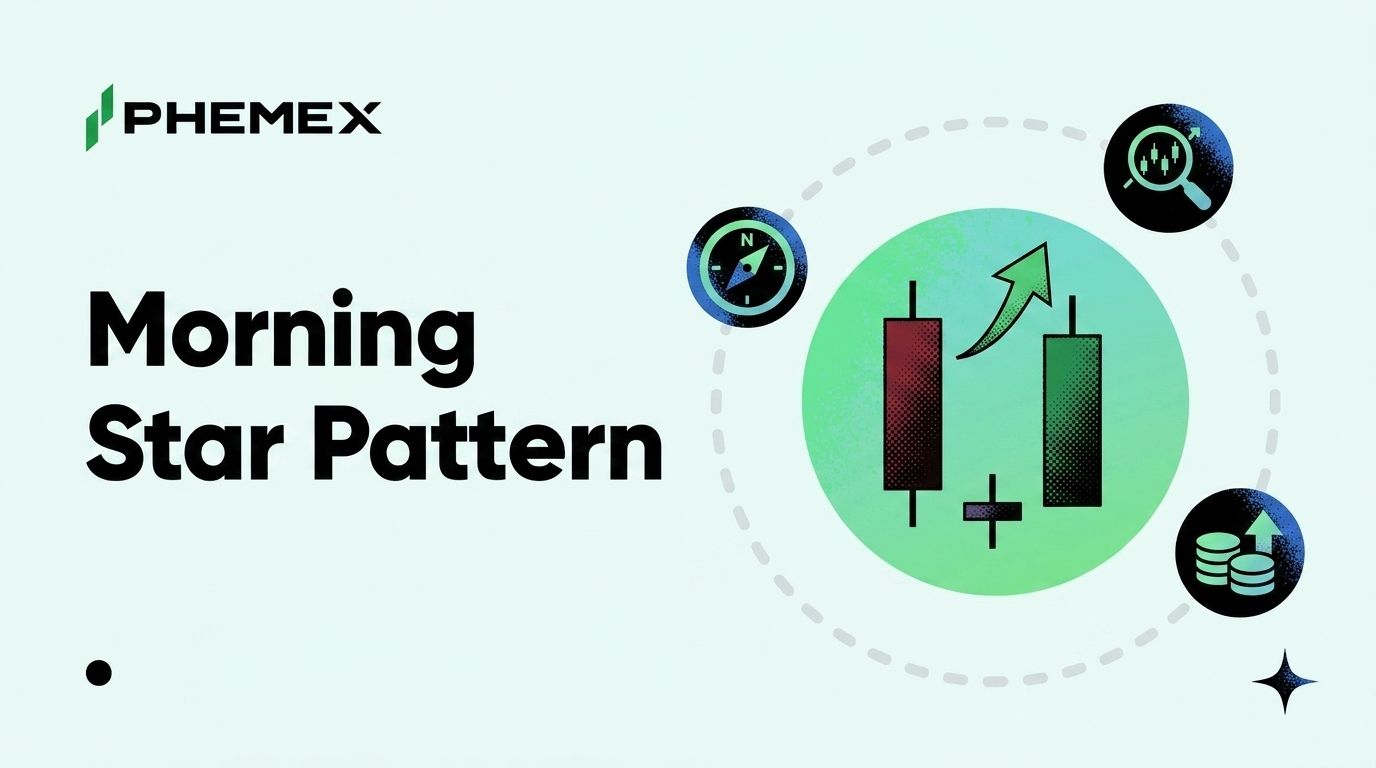
The Morning Star is one of the most widely cited bullish reversal patterns in candlestick analysis and one of the most reliable when it appears at the bottom of a sustained downtrend with the right confirmation context. It is a three-candle setup. A long red continuation candle, a small-body indecision candle that gaps lower, and a long green candle that recovers more than 50% of the first candle's range. The pattern signals exhaustion of selling pressure, then a moment of indecision, then a forceful reclaim by buyers. Traders use it to mark the transition from a downtrend phase into the early base of a recovery.
The pattern showed up most recently on the BTC daily chart in late May 2026, with a textbook three-candle structure forming at the $72,800 zone before BTC stabilized into the current $72,500 to $73,200 range. Here is how to identify the setup correctly, what additional confirmation traders look for before sizing the trade, and how the Morning Star compares to the related two-candle Piercing Line reversal.
For related reversal pattern study, see Phemex's hammer candlestick guide and the long-wick candle trading primer. Investopedia's reference write-up covers the historical statistical baselines for the pattern.
The Three Candles That Form the Pattern
The Morning Star has a strict three-candle structure that has to be present for the pattern to count. The first candle is a long red continuation candle that closes near its low. This candle establishes the downtrend context. It needs to be a clear continuation of the trend that came before it, not a random red candle in an already choppy structure. The body should be larger than the average body size over the prior 10 sessions.
Source: FXOpen
The second candle is the indecision candle, and it can be either red or green because color does not matter for the structural read. What matters is the body size and the position. The body should be small, ideally less than 30% of the first candle's body, and the candle should gap down from the close of the first candle. The gap is the critical element. Without the gap, the structure is not a true Morning Star. The indecision candle represents the moment when selling pressure exhausts and buyers and sellers reach a temporary equilibrium.
The third candle is the confirmation candle. It must be a long green candle that closes above the midpoint of the first candle's body. A close above the midpoint is the technical minimum. A stronger confirmation is a close above the open of the first candle, which signals that buyers have not only absorbed the sellers but reclaimed the structure that was lost during the original breakdown. The body of the third candle should be at least as large as the body of the first candle.
What Makes the Pattern Reliable
The reliability of the Morning Star depends almost entirely on the context in which it appears. A Morning Star at the bottom of a sustained downtrend with the right volume and indicator confirmation is one of the higher-probability reversal patterns in candlestick analysis. The same shape that appears mid-range with no clear downtrend context is essentially noise.
The trend context test is straightforward. The first candle should be the third or fourth consecutive red candle in a clear downtrend rather than the first red candle of a fresh move. The five-day price action leading into the pattern should show a clear lower-highs structure. If the chart was already choppy with no clear trend direction, the pattern has lower reliability and historically converts to a sustained reversal less than 35% of the time.
Volume confirmation is the second filter. The third candle should print on volume materially above the prior session's average. A 1.5x or higher volume increase on the third candle is the standard confirmation threshold. Without rising volume on the reclaim, the pattern is technically present but lacks the institutional participation that converts the visual structure into a sustained reversal.
The Indicator Confirmation Stack
Most discretionary traders pair the Morning Star with a small set of secondary indicators before sizing the trade. The most common is the RSI reading on the first or second candle. An RSI below 30 on either of those candles signals oversold conditions and increases the probability that the reclaim is the start of a real reversal rather than a single-day bounce inside a continuing downtrend.
The second indicator is the position relative to a moving average. The strongest Morning Star setups print at or near a major moving average (the 50-day, 100-day, or 200-day depending on the timeframe being analyzed) that acts as a structural support. A Morning Star that forms at the 200-day moving average with RSI below 30 and rising volume on the third candle is the highest-conviction version of the pattern.
The third filter is the relationship to prior support and resistance levels. A Morning Star that forms at a horizontal support level that has held multiple prior tests is materially more reliable than a Morning Star that forms in open air without a clear technical reference. The May 2026 BTC example formed at the $72,800 zone, which was the third test of that horizontal support, which is the kind of context that elevates the pattern.
How to Trade the Setup
The standard entry on a Morning Star is the close of the third candle. Entering before the close risks the candle reversing into a doji or red bar, which invalidates the setup. The discipline of waiting for the close is what separates the pattern from the related but lower-probability variants.
The stop placement is the low of the second candle. The second candle low is the technical invalidation point for the pattern. If price trades back below that level after the third candle confirms, the structure is broken and the trade should be cut. Setting the stop below that level rather than at a fixed percentage avoids the common error of placing the stop too tight and getting taken out on noise.
The first target is the prior swing high inside the same downtrend structure. A reclaim of the prior swing high confirms that the reversal has converted from a base into the start of a new uptrend. Beyond the first swing high, the second target is the next major resistance level or the next major moving average, depending on which is closer.
Morning Star Versus Piercing Line Versus Bullish Engulfing
The Morning Star is the three-candle version of a broader category of bottom reversal patterns. The two related patterns that traders most often confuse with it are the Piercing Line and the Bullish Engulfing.
The Piercing Line is the two-candle version. It is a red candle followed by a green candle that opens below the prior close and closes above the midpoint of the red body. There is no indecision candle between the two. The pattern is faster than the Morning Star but historically less reliable because the absence of the indecision pause means selling pressure has not had a chance to actually exhaust before the reclaim.
The Bullish Engulfing is also a two-candle pattern. It is a red candle followed by a larger green candle whose body completely engulfs the prior red body. The Bullish Engulfing is the cleanest two-candle reversal pattern and has the highest win rate of the three, but the absolute size requirement on the green candle means it shows up less frequently than either the Morning Star or the Piercing Line.
The hierarchy of reliability across the three, in approximate descending order at proper trend context, is Bullish Engulfing first, Morning Star second, Piercing Line third. The Morning Star compensates for the slightly lower win rate by providing a cleaner stop placement (the second candle low) than either of the two-candle patterns.
The Recent BTC Morning Star Example
The May 26 to May 28 BTC daily structure formed a textbook Morning Star at the $72,800 zone. The first candle on May 26 was a long red continuation that closed BTC at $72,920 after opening at $74,840. The second candle on May 27 was a small red body that opened at $72,650, gapped down from the prior close, and closed at $72,810 with a small range. The third candle on May 28 was a long green candle that opened at $72,810 and closed at $73,420, comfortably above the midpoint of the May 26 body.
The volume profile confirmed the structure. The third candle printed on 1.7x average volume and the daily RSI was at 31 on the second candle. The 200-day moving average sat at $72,400, which was the structural support that gave the pattern context. The trade that traded the setup with entry on the May 28 close had a stop at $72,650 (second candle low) and an initial target at the May 22 swing high of $75,200.
The trade has not yet hit either the stop or the target. BTC has held the range between $72,500 and $73,200 for the past four sessions while the ETF outflow story has weighed on the broader tape. The pattern has not failed but has not yet confirmed either, which is consistent with the choppy macro setup.
Frequently Asked Questions
What is the Morning Star pattern in crypto trading?
The Morning Star is a three-candle bullish reversal pattern that signals the bottom of a downtrend. The first candle is a long red continuation candle, the second is a small-body indecision candle that gaps lower, and the third is a long green candle that closes above the midpoint of the first candle's body. The pattern shows exhaustion of selling pressure, indecision, and a forceful reclaim by buyers.
How reliable is the Morning Star pattern?
Reliability depends almost entirely on the context the pattern appears in. A Morning Star at the bottom of a sustained downtrend, near a major moving average, with RSI below 30 and rising volume on the third candle, converts to a sustained reversal at a meaningfully higher rate than the same shape in open air. Without proper context, the pattern is essentially noise.
What is the difference between Morning Star and Piercing Line?
The Morning Star is a three-candle pattern with an indecision candle in the middle. The Piercing Line is a two-candle pattern with no indecision pause. The Morning Star is slower to confirm but historically more reliable because the indecision candle represents actual exhaustion of selling pressure rather than just a single-session reversal attempt.
Where do traders place the stop on a Morning Star trade?
The standard stop placement is the low of the second candle, which is the technical invalidation point for the pattern. If price trades back below that level after the third candle confirms, the structure is broken and the trade should be cut. Setting the stop based on the candle structure rather than a fixed percentage avoids being taken out on noise.
Bottom Line
The Morning Star is a high-quality bottom reversal pattern when the context is right. The three-candle structure of red continuation, gap-down indecision, and forceful green reclaim provides one of the cleanest visual signals of trend exhaustion and reversal in candlestick analysis. The reliability filter that matters most is context. The pattern at the bottom of a sustained downtrend, near a major moving average, with RSI below 30 and rising volume, is materially different from the same shape in a choppy mid-range chart.
The recent BTC daily example on May 26 to 28 is the textbook setup. The trade entered on the May 28 close has held the range without confirming the upside target, which reflects the broader ETF-outflow tape rather than a pattern failure. Watch for the third candle volume confirmation, the RSI position on the indecision candle, and the relationship to the nearest major moving average. Those three filters separate the high-conviction Morning Star setups from the noise.
This article is for informational purposes only and does not constitute financial or investment advice. Cryptocurrency trading involves substantial risk. Always conduct your own research before making trading decisions.
