









In the high-stakes world of cryptocurrency derivatives, the difference between a profitable trade and a total loss often isn't the market movement itself—it’s the underlying technology that executes your positions.
If you have ever traded crypto futures trading, you have likely encountered terms like "slippage," "liquidation," and "auto-deleveraging." While these sounds like market jargon, they are, in fact, the mechanics of a Liquidation Engine. For traders in the US, Europe, and beyond, choosing an exchange is no longer just about fee structures or UI; it is about choosing an infrastructure capable of protecting your capital during periods of extreme volatility.
In this guide, we will peel back the hood of the Phemex trading engine to explain how a robust Liquidation Engine operates and why performance is your best defense against catastrophic slippage.
1. What is a Liquidation Engine?
At its core, a Liquidation Engine is the automated safety system of a derivatives exchange. Its primary purpose is to ensure the integrity of the market by preventing accounts from falling into a negative balance.
When a trader uses leverage, they are essentially borrowing capital from the exchange (or the pool of liquidity) to amplify their position. If the market moves against the trader, the losses quickly consume the margin (collateral) they have deposited. The Liquidation Engine is the system that monitors this margin in real-time. Once a position’s maintenance margin threshold is breached, the engine automatically closes the position to ensure the debt is repaid.
Why do we need it?
Without a liquidation engine, the exchange would become insolvent during a market crash. If traders could lose more than their deposited capital, the "socialized loss" model would kick in—where profitable traders have their earnings slashed to cover the deficits of losing ones. A high-performance engine prevents this by acting decisively and instantaneously.
2. The Anatomy of a Liquidation: How It Works
Imagine the market is crashing. The Liquidation Engine follows a strictly defined protocol:
Monitoring (The Heartbeat): The engine constantly samples the mark price of every open position.
The Trigger: When a position’s mark price hits the liquidation price, the engine triggers a "takeover."
Order Execution: The engine attempts to liquidate the position in the open market.
Insurance Fund Interaction: If the market is moving too fast and the position cannot be liquidated at a favorable price, the exchange's Insurance Fund covers the gap. If the insurance fund is depleted, the dreaded "auto-deleveraging" (ADL) process begins, affecting other traders.
This is why, as a trader, you want an exchange with a high-performance engine. A slow engine leads to worse execution prices, which leads to more frequent hits to the Insurance Fund, which ultimately puts your own capital at risk.
3. The Silent Killer: Slippage and Why Performance Matters
Slippage occurs when the price you expect to get for an order differs from the price you actually receive. In high-volatility markets, slippage is amplified.
How a Weak Engine Creates Slippage
If an exchange's liquidation engine is slow, it misses the precise moment to liquidate a position. By the time it reacts, the market price has moved further against the position. This results in:
Worse Fill Prices: The engine executes the liquidation at a "stale" price, failing to get the best liquidity.
Cascading Liquidation: A slow engine allows a position to become dangerously under-collateralized, forcing it to dump a large volume onto the order book all at once. This massive sell (or buy) order pushes the price further, triggering other liquidations. This is the definition of a "flash crash."
The Phemex Performance Advantage
At Phemex, we have architected our trading engine specifically to handle 300,000 transactions per second (TPS) with sub-millisecond latency.
Why does this matter to you?
Precision Execution: Our engine detects the liquidation trigger at the exact moment of the breach, rather than waiting for outdated price feeds.
Reduced Market Impact: Because our engine is fast, it can slice large liquidation orders into smaller, more digestible pieces, significantly reducing the downward (or upward) price pressure that causes slippage.
Insurance Fund Stability: By executing efficiently, we minimize the frequency of drawing from the Insurance Fund, keeping the ecosystem stable for everyone.
The Anatomy of Performance: Why the New Phemex Engine Changes the Game
Understanding liquidation engines is only half the battle; the other half is understanding the infrastructure that runs them. In extreme market conditions, when volatility spikes and order books are flooded, a standard exchange might throttle your orders or experience "lag." At Phemex, we have recently completed a massive Futures Engine Performance Upgrade specifically designed to eliminate these bottlenecks.
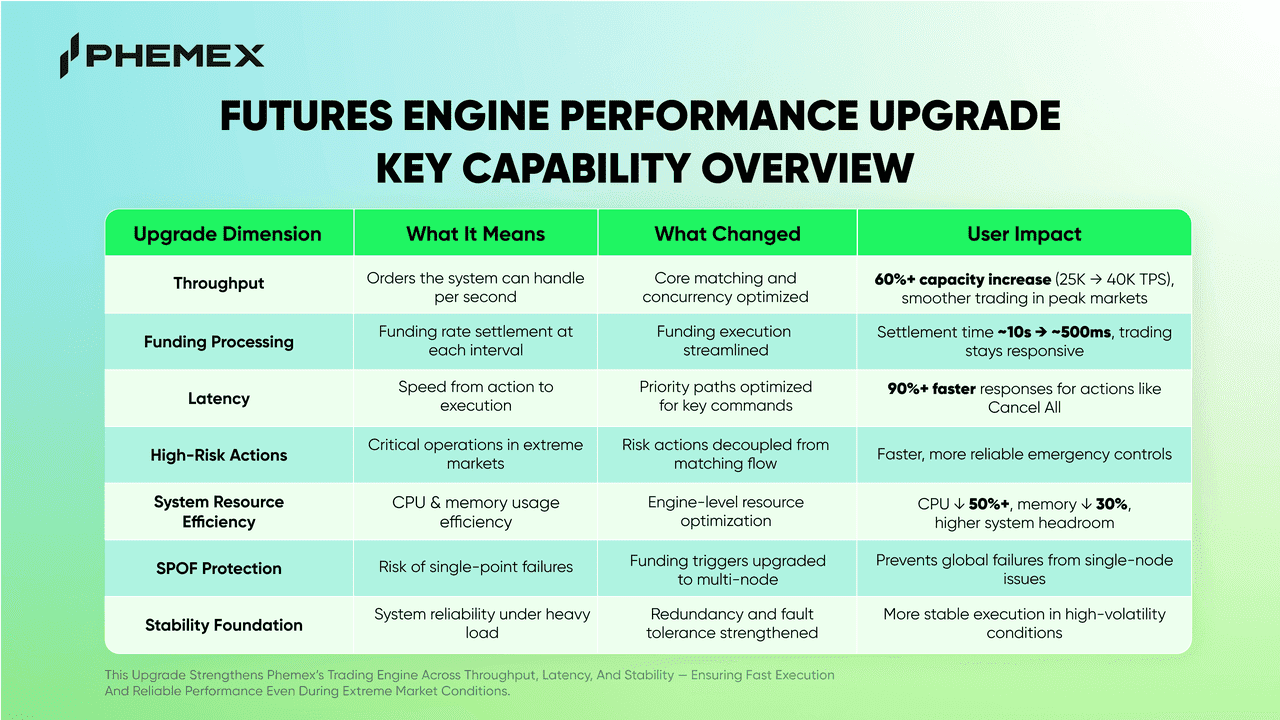
We have moved beyond theoretical speed to tangible user impact:
| Upgrade Dimension | What Changed | User Impact |
| Throughput | Core matching & concurrency optimization | 40K TPS capacity: Smoother trading even during record-breaking market peaks. |
| Funding Processing | Execution streamlined | 20x faster settlement: Funding intervals now process in ~500ms, ensuring your trading never freezes. |
| Latency | Priority path optimization | 90%+ faster response: Essential commands like "Cancel All" execute nearly instantaneously. |
| Efficiency & Stability | Multi-node triggers & resource optimization | Higher Headroom: 50% less CPU usage and 30% less memory usage, ensuring absolute stability under heavy load. |
Why does this matter for your bottom line?
When the market moves against your position, seconds—or even milliseconds—can determine whether you are liquidated at your stop-loss or at a significantly worse price due to slippage.
Reduced Slippage: By increasing our throughput to 40,000 transactions per second (TPS), our engine processes liquidation orders and limit orders with surgical precision, minimizing the impact of large market orders on your fill price.
Reliability in Chaos: By upgrading to multi-node SPOF (Single Point of Failure) protection, we have ensured that even if a single node encounters an issue, your orders remain live and executable.
In the world of high-leverage trading, you are not just trading against the market; you are trading against the latency of the platform. With this upgrade, Phemex ensures that the engine is never the reason you lose a trade.
4. How to Evaluate the "Best Futures Platform"
When searching for the "best futures platform," savvy traders look beyond marketing slogans. Here is your checklist for technical due diligence:
A. Order Matching & Engine Speed
Does the exchange publish its throughput metrics? Can it handle high-frequency trading (HFT) volume without freezing during volatility? Phemex’s infrastructure is designed by former Wall Street engineers to ensure that the order book remains fluid even when the market is chaotic.
B. Mark Price Logic
Does the exchange use a "Mark Price" or "Last Price" for liquidations? At Phemex, we use a weighted average (Mark Price) to prevent "price manipulation spikes" from triggering unfair liquidations. This is a critical feature for protecting traders from malicious wicks.
C. Insurance Fund Transparency
A healthy exchange is transparent about its Insurance Fund. The fund should be large enough to absorb losses from extreme volatility without affecting the profit of other users.
D. System Uptime
If an exchange goes down during a 10% market swing, your liquidation protection effectively disappears. Phemex consistently leads the industry in uptime, ensuring that the safety mechanisms are always live.
5. Risk Management: Tips for Every Futures Trader
While we strive to provide the most robust engine possible, trading crypto futures carries inherent risk. Here is how you can protect yourself:
Understand Your Liquidation Price: Always know exactly at what price your position will be liquidated before you click "Buy" or "Sell."
Use Stop-Losses: Do not rely on the Liquidation Engine to exit your trade. A stop-loss is your order; a liquidation is the exchange's order. You want control.
Adjust Leverage Wisely: High leverage isn't just about higher potential gains; it brings your liquidation price significantly closer to your entry price.
Monitor Funding Rates: Funding rates can increase the cost of holding a position. Understand how these costs interact with your margin balance.
The Phemex Commitment: Built for Speed, Designed for Safety
In the competitive landscape of crypto exchanges, many platforms focus on marketing flashy rewards. At Phemex, we focus on the core: the engine.
We believe that a futures platform should be invisible. It should execute your intent instantly, protect your margin reliably, and stay out of your way during the most volatile moments of the market. Our liquidation engine is a testament to this philosophy—a silent, high-performance safeguard designed to ensure that when you trade with us, you are trading on the strongest infrastructure in the industry.
Ready to experience institutional-grade performance?
Login to your Phemex account or start your futures trading journey today and see the difference that high-performance engineering makes.
Disclaimer: Cryptocurrency futures trading involves significant risk of loss and is not suitable for every investor. The valuation of cryptocurrencies can fluctuate wildly. Please trade responsibly and only invest what you can afford to lose.
