









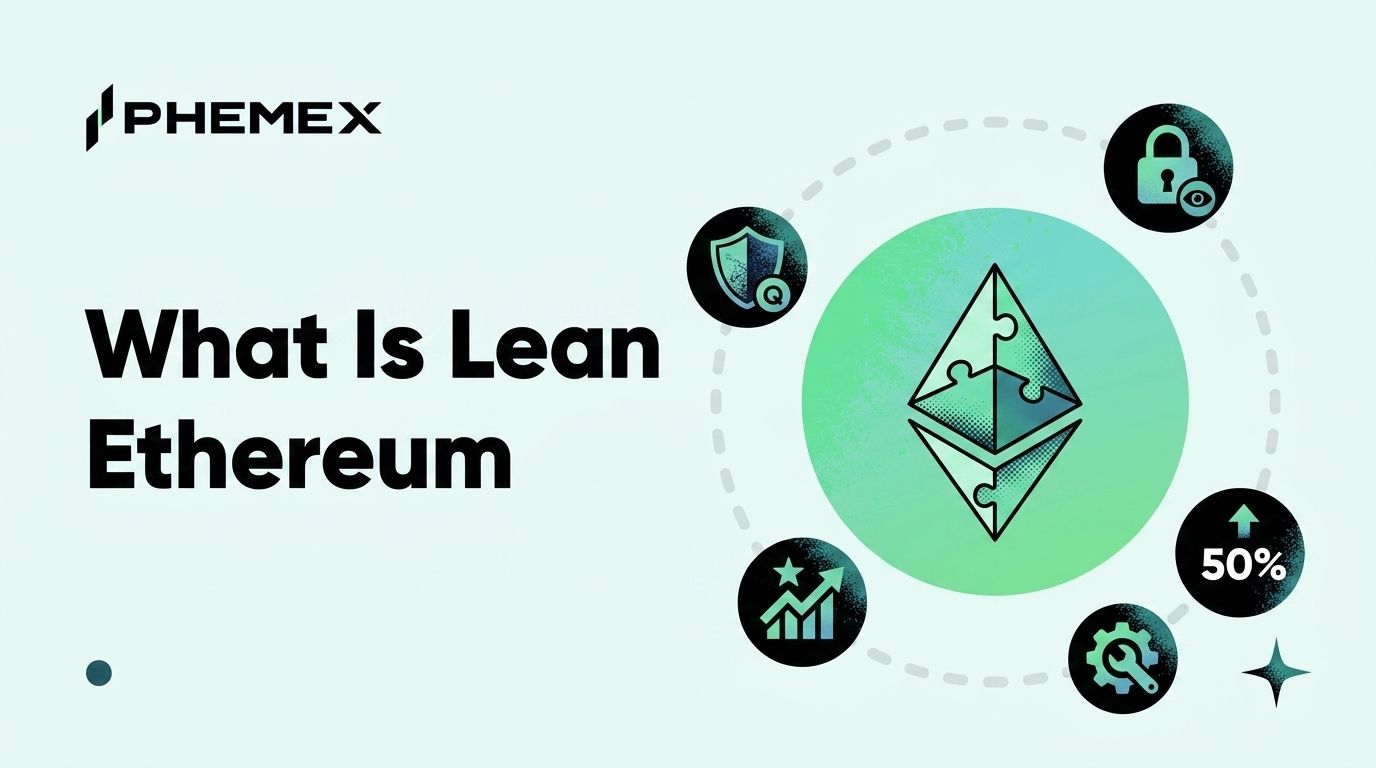
Vitalik Buterin presented the Lean Ethereum roadmap on July 4, 2026, and he framed it as the most significant redesign of Ethereum since the Merge moved the network to proof of stake in September 2022. Where the Merge changed how Ethereum reaches consensus, Lean Ethereum rebuilds what sits at the cryptographic core of the protocol. It is not a single fork you can circle on a calendar. It is a multi-year direction that begins only after the coming Hegotafork ships.
That framing matters because traders have spent the past year tracking named forks like Glamsterdam and Hegota, each a discrete upgrade with its own scope. Lean Ethereum is a different kind of thing. It is the vision for what the base layer becomes once those near-term forks are done, and it answers a question the roadmap had left open for years. What does Ethereum look like when it is built to survive quantum computers, prove itself with math instead of trust, and keep users private by default. Here is what Lean Ethereum actually is, the three pillars it rests on, the timeline Buterin gave, and what it means if you hold ETH.
What Lean Ethereum Is and Where It Sits After Hegota
Lean Ethereum is Buterin's name for the phase that comes after the current fork cycle finishes. The near-term upgrades, Glamsterdam and then Hegota, are incremental. They tune gas costs, blob capacity, and validator mechanics. Hegota is likely the last fork before the Lean era begins, which is why Buterin chose this moment to sketch the longer arc. Once Hegota is live, the roadmap turns toward a deeper rebuild rather than another round of parameter tuning.
The word "lean" points at the goal. Ethereum's protocol has accumulated layers of specialized cryptography and consensus machinery over a decade, and much of it is complex enough that only a handful of client teams fully understand every part. Lean Ethereum aims to replace large sections of that machinery with a smaller set of stronger primitives, so the base layer is simpler to reason about, cheaper to verify, and far harder to break. The reporting since the announcement, including BeInCrypto's Ethereum coverage, has centered on that simplification thesis rather than any single feature.
This is a base-layer story, not an application story. It does not change how you swap tokens or use a Layer 2 rolluptomorrow. It changes the foundation those rollups and applications are built on, and it does so over years, not weeks.
The Three Pillars of Lean Ethereum
Buterin organized the roadmap around three pillars, plus a state redesign aimed squarely at fees. Each pillar targets a specific weakness in how Ethereum works today.
The first is native recursive STARKs. STARK stands for Scalable Transparent Argument of Knowledge, a type of zero-knowledge proof that lets one party prove a computation was done correctly without revealing the underlying data or requiring a trusted setup. Recursive means a proof can verify other proofs, compressing an enormous amount of work into one small, cheap check. Buterin wants this proof system moved to the center of the protocol, replacing older cryptography that is both heavier and, critically, vulnerable to quantum attack.
The second pillar is post-quantum cryptography. Much of today's crypto, including the signatures that secure Ethereum and Bitcoin wallets, relies on elliptic-curve math that a large enough quantum computer could eventually break. Buterin has flagged roughly 2029 as the window when that threat becomes credible enough to plan around, so Lean Ethereum hardens the protocol with signature schemes and proofs that hold up against quantum hardware.
The third pillar is native privacy. Instead of bolting privacy on through separate applications, Lean Ethereum treats it as a base-layer protocol goal, including work to re-anonymize validators so the people securing the network are harder to deprofile and target. In spirit this moves privacy toward the default, the way a dedicated chain like Zcash treats it, rather than an opt-in extra.
|
Pillar
|
What it changes
|
Target window
|
|
Native recursive STARKs
|
Puts a transparent, recursive zero-knowledge proof system at the protocol core, replacing heavier legacy crypto
|
Woven in across the Lean era
|
|
Post-quantum cryptography
|
Swaps quantum-vulnerable signatures for schemes that survive quantum computers
|
Threat framed around 2029
|
|
Native privacy
|
Makes privacy a base-layer goal and re-anonymizes validators
|
Multi-year protocol work
|
|
State redesign
|
New state design targeting 10x or lower fees for many tokens
|
By roughly 2030
|
The Timeline and Why It Runs to 2030
Lean Ethereum is a 3 to 4 year program, not a next-quarter release. Buterin was explicit that these are directional targets, not shipping dates, and Ethereum's official roadmap has always moved slower than its most optimistic estimates. The post-quantum work is oriented around a threat the roadmap frames near 2029, and the state redesign that promises 10x or lower fees for many tokens is described as arriving by roughly 2030.
The sequencing is the part traders should hold onto. Hegota ships first and closes out the current fork cycle. Only then does the Lean work begin in earnest, layered in across multiple forks rather than dropped in one event. That means there is no single "Lean Ethereum day" to trade around. There is a multi-year series of upgrades, each moving the base layer closer to the STARK-centric, quantum-resistant, privacy-preserving design Buterin described.
What Lean Ethereum Means for ETH Holders
For anyone holding ETH near its recent $1,777 level, the honest near-term read is that this roadmap changes little about price action this quarter. Multi-year protocol visions do not move markets the way a fork upgrade or an ETF flow does. What they change is the long-term thesis for why the asset should exist at all.
The strongest argument in the roadmap is durability. A base layer that survives quantum computers is one institutions can build on for decades without a forced migration, and quantum resistance is one of the few genuinely existential risks to every major chain, Ethereum and Bitcoin alike. If Ethereum credibly closes that risk before rivals do, that is a moat measured in years.
The fee argument is the one retail feels directly. A state redesign targeting 10x or lower costs for many tokens attacks Ethereum's oldest complaint, that using the base layer is expensive when the network is busy. Cheaper base-layer settlement also strengthens the rollups that most users actually touch. None of it is live today, and all of it depends on delivery, which is where the caution comes in.
The Risks and the Uncertainty on Delivery
The biggest risk with Lean Ethereum is the calendar. Ethereum has a long record of upgrades that slipped by months or years, and this roadmap is larger and more ambitious than most of what came before. Recursive STARKs at the protocol core and post-quantum signatures are hard research problems, not settled engineering, and a 3 to 4 yearwindow gives plenty of room for those dates to move.
There is also execution risk in touching the cryptographic core of a network securing hundreds of billions of dollars. Rebuilding the foundation under live value is the highest-stakes work a protocol can attempt, and it has to be done without a single consensus failure. The reasonable stance is to treat Lean Ethereum as a strong signal about direction and a weak signal about timing. The vision raises the ceiling on Ethereum's long-term case. The delivery is what turns that ceiling into price, and delivery is exactly the part no one can promise yet.
Frequently Asked Questions
What is Lean Ethereum?
Lean Ethereum is the multi-year roadmap Vitalik Buterin presented on July 4, 2026 for rebuilding Ethereum's cryptographic core. It rests on three pillars, native recursive STARK proofs, post-quantum cryptography, and native base-layer privacy, plus a state redesign aimed at much lower fees. It begins after the coming Hegota fork.
How is Lean Ethereum different from Glamsterdam and Hegota?
Glamsterdam and Hegota are discrete, near-term forks that tune gas, blobs, and validator mechanics. Lean Ethereum is the longer vision for what the base layer becomes after those forks, replacing legacy cryptography with STARKs and quantum-resistant schemes over 3 to 4 years.
Will Lean Ethereum lower Ethereum gas fees?
That is the goal of the state redesign inside the roadmap, which targets 10x or lower fees for many tokens by roughly 2030. It is a directional target rather than a promise, and it depends on multi-year delivery, so it will not change today's fees.
Does Lean Ethereum protect ETH against quantum computers?
Yes, protecting against quantum computers is one of the three pillars of the roadmap. It swaps out signatures and proofs that a future quantum computer could break for post-quantum schemes, with the roadmap framing the quantum threat around 2029.
Bottom Line
Lean Ethereum is a bet on the next decade, not the next quarter. Buterin gave the network a direction that is genuinely ambitious, a STARK-centric, quantum-resistant, privacy-preserving base layer with much cheaper settlement, and he tied it to targets near 2029 for the quantum threat and 2030 for the fee redesign. It begins only after Hegota, so there is no single event to trade. Watch Hegota ship first, then watch if the STARK and post-quantum research holds its timeline. If it does, Ethereum closes an existential risk before its rivals and earns a moat measured in years. If it slips, and Ethereum upgrades have slipped before, the vision stays a vision. At $1,777, you are pricing the direction, and the delivery is the part still unwritten.
This article is for informational purposes only and does not constitute financial or investment advice. Cryptocurrency trading involves substantial risk. Always conduct your own research before making trading decisions.
