









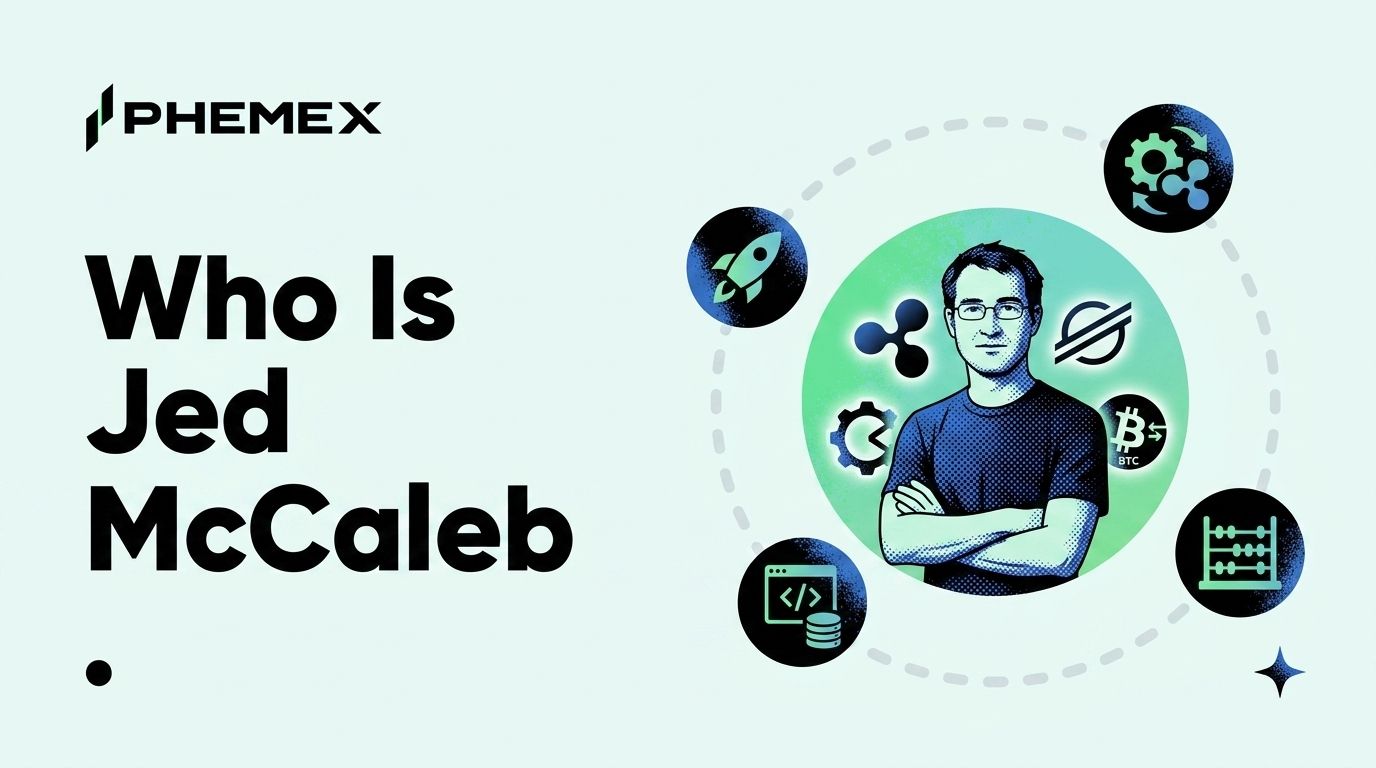
Jed McCaleb is the only person in crypto history with his fingerprints on three foundational projects, and most traders cannot name him. He built the code that became Mt. Gox in 2010, sold it in 2011, and was gone two and a half years before the exchange's catastrophic 2014 collapse. He then co-founded Ripple and created XRP, the asset trading at $1.14 today. After leaving Ripple over a strategic split, he co-founded Stellar, the same network where this week's YieldBlox oracle hack played out. One builder, three chapters that shaped where the market sits right now.
His name barely registers next to Brad Garlinghouse or Vitalik Buterin, yet the assets he helped create move billions in daily volume. Here is the breakdown.
How Mt Gox Started as a Magic Card Trading Site
The most famous exchange disaster in crypto history began as a place to swap fantasy game cards. In 2010 McCaleb registered the domain "Mt. Gox," short for "Magic: The Gathering Online Exchange," originally intended as a marketplace for trading the collectible cards. The idea never took off, so he repurposed the code into something else entirely. Bitcoin was barely a year old, almost no one could buy it, and McCaleb saw the obvious gap. He turned his abandoned card site into one of the first real Bitcoin exchanges in July 2010.
Within months Mt. Gox was handling the majority of global Bitcoin trades. McCaleb had built the market's primary on-ramp almost by accident, and he understood early that running it was a bigger job than he wanted. In March 2011 he sold the exchange to French developer Mark Karpeles, keeping a minority stake and walking away from day-to-day operations.
That sale is the most consequential decision of his career, and almost nobody talks about it. Mt. Gox went on to dominate Bitcoin trading for three more years before it imploded in February 2014, losing roughly 850,000 BTC and freezing the accounts of hundreds of thousands of users. McCaleb was long gone by then. He had handed off the keys in 2011, which means the man who created Mt. Gox carries almost none of the blame for the event that defines its name. The lucky early exit became a pattern. McCaleb tends to build the thing, then leave before the next chapter, good or bad.
Founding Ripple and Creating XRP
By 2011 McCaleb was already thinking past Bitcoin's limits. Bitcoin confirmations were slow and the network was never designed to move dollars, euros, or yen between banks cheaply. He sketched a different approach, a consensus ledger that did not rely on energy-intensive mining and could settle value in seconds. To turn the concept into a company he partnered with Chris Larsen, and in 2012 they founded the operation first called OpenCoin, later Ripple Labs, and eventually just Ripple.
The technical output of that partnership was the XRP Ledger and the XRP token itself, the settlement-rails thesis Ripple still publishes on today. McCaleb was central to the ledger's early design, and the project minted a fixed supply of 100 billion XRP at launch in 2013. The founders and the company took large allocations, with McCaleb receiving roughly 9 billion XRP for his role. That stake would follow him, and the market, for the better part of a decade. If you want the full picture of how the ledger and token actually work, our explainer on what Ripple and XRP are covers the consensus model and the bank-settlement thesis in detail.
McCaleb did not stay to see XRP become a top-five asset. Disagreements over the company's direction, reportedly around strategy and control, pushed him out in 2013, and the separation was finalized in 2014. He left the project he co-founded just as it was finding its footing. For the second time in his career he had built something foundational and then walked away from it before it matured.
Why He Left Ripple and Built Stellar Instead
The split was not only personal. It was philosophical, and the difference still defines how traders think about XRP and XLM today. Ripple was building a for-profit company selling settlement software to banks and financial institutions, monetizing the network as enterprise infrastructure. McCaleb wanted something closer to the original crypto ethos, a payments network aimed at financial inclusion for people the banking system ignores rather than a product sold to the banks themselves.
So in 2014 he co-founded Stellar with Joyce Kim and launched the nonprofit Stellar Development Foundation. Stellar began as a literal fork of the Ripple codebase before it moved to its own consensus protocol, and its native asset is the Lumen, ticker XLM. The mission was deliberately the inverse of Ripple's. Where Ripple chased bank-grade settlement contracts, Stellar focused on low-cost cross-border transfers, remittances, and onboarding the unbanked through nonprofit partnerships.
The table below maps the divide that came directly out of McCaleb's exit.
|
Dimension
|
Ripple / XRP
|
Stellar / XLM
|
|
Structure
|
For-profit company
|
Nonprofit foundation
|
|
Core customer
|
Banks and institutions
|
Individuals and the unbanked
|
|
Primary use
|
Wholesale settlement rails
|
Cross-border payments, remittances
|
|
McCaleb's role
|
Co-founder, left 2013-2014
|
Co-founder, still active
|
|
Native asset
|
XRP
|
XLM (Lumens)
|
That same Stellar network is where the YieldBlox oracle attack drained roughly $10 million this week, exploiting a price-feed manipulation rather than any flaw in Stellar's base layer. For traders, it is a reminder that the chain McCaleb built to bank the unbanked now hosts DeFi protocols with the same oracle risks as everywhere else in crypto. The mission was inclusion, and the wider DeFi attack surface came along with it.
The XRP Holdings Saga and the Tacostand Wallet
McCaleb's 9 billion XRP became one of the most watched balances in crypto. When he left Ripple, the company negotiated a settlement that capped how fast he could sell to avoid crushing the price, and his selling wallet, nicknamed "tacostand," was tracked publicly for years. Every large outflow triggered headlines, because a founder dumping billions of tokens is exactly the kind of supply pressure that spooks holders.
He sold steadily and methodically over roughly seven years, and on-chain trackers reported the tacostand wallet finally emptying out around July 2022. Estimates put his total proceeds in the billions of dollars across that window. The slow, agreement-bound exit is part of why XRP survived the overhang instead of collapsing under it. A disorderly sale could have buried the price. The structured one let the market absorb the supply over time.
That history still matters for anyone trading XRP at $1.14 today. The founder overhang that hung over the chart for years is gone, and the supply McCaleb once held has long since cleared the market. For the current escrow schedule and the regulatory picture shaping XRP this month, our breakdown of XRP's June 2026 price drivers walks through the escrow unlocks, the CLARITY Act, and the ETF question.
Why Jed McCaleb Matters More Than His Name Suggests
Run the list and the scale of it is hard to match. McCaleb created the first dominant Bitcoin exchange, co-founded a top-five cryptocurrency, and then co-founded another top-twenty network with a directly opposing philosophy. Few people in any industry get to architect one project of that size. McCaleb did it three times, and his public profile is a fraction of the people who came after him.
His pattern is consistent and unusual. He builds the core technical engine, hands it off or walks away, and moves to the next problem. He was the engineer behind the early code, not the executive who scaled the business, which is why the spotlight landed on operators like Garlinghouse at Ripple while McCaleb faded into the background. After Stellar he pivoted again, co-founding the AI research company Light Years and later backing other ventures, the same restless build-and-move rhythm that ran through his whole career.
For traders, the takeaway is practical. The two assets McCaleb helped create, XRP and XLM, are not random tickers. They are two sides of one founder's argument about what crypto payments should be, for-profit bank rails versus nonprofit financial inclusion. Understanding that origin tells you why the two chains behave differently, attract different capital, and carry different regulatory baggage. You can compare both against current data on the CoinGecko Stellar page and through the official Stellar Development Foundation site.
Frequently Asked Questions
Who founded Stellar?
Jed McCaleb co-founded Stellar in 2014 alongside Joyce Kim, launching it as a nonprofit through the Stellar Development Foundation. It started as a fork of the Ripple codebase before moving to its own consensus protocol, and its native asset is the Lumen, XLM.
Who created Mt Gox?
Jed McCaleb created Mt. Gox in 2010, repurposing a domain he had registered for trading Magic: The Gathering cards into one of the first major Bitcoin exchanges. He sold it to Mark Karpeles in 2011, nearly three years before the 2014 collapse that lost around 850,000 BTC.
Is Jed McCaleb still involved in Ripple?
No. McCaleb co-founded Ripple in 2012 but left over strategic disagreements, with the separation finalized in 2014. He sold off his roughly 9 billion XRP allocation gradually through 2022 and has had no operational role at the company for over a decade.
Does Jed McCaleb still own a lot of XRP?
On-chain trackers reported his "tacostand" selling wallet emptying out around July 2022 after roughly seven years of structured, agreement-bound sales. The founder supply overhang that pressured XRP for years is widely considered cleared.
Bottom Line
McCaleb's legacy is two live assets and one decision rule for traders watching them. XRP at $1.14 no longer carries the founder-supply overhang that capped it for years, so the relevant levels are now driven by escrow unlocks, ETF flows, and regulation, not by a wallet dumping billions. Hold the $1.10 area and XRP keeps its near-term structure intact. Lose it on volume and the next support zone comes into focus near $1.00. The Stellar oracle hack this week is a reminder that McCaleb's other chain carries DeFi risk that XRP's settlement-focused ledger largely avoids, which is exactly the for-profit-versus-nonprofit split he set in motion in 2014.
This article is for educational purposes only and does not constitute financial advice. Cryptocurrency and stock trading carries significant risk. Always do your own research and consult a qualified advisor.
