










Gold is trading near $4,070 an ounce, sitting close to record territory, at the exact moment Bitcoin has slid to $59,658 in a market the Fear & Greed Index reads at 18, deep in Extreme Fear. The oldest safe haven and the one that was supposed to replace it are moving in opposite directions, and the gap is wide enough that traders are openly questioning the "Bitcoin is digital gold" story. One asset is being bought as protection. The other is being sold like a tech stock.
- Gold price: near $4,070 an ounce, holding close to record highs
- Bitcoin price: $59,658, sitting below the $60,000 line in a deep drawdown
- Fear & Greed Index: 18, deep in Extreme Fear
- The divergence: gold catching a safe-haven bid while Bitcoin trades as a risk asset
- Correlation note: the "digital gold" link has broken in the short term, with BTC tracking risk assets, not bullion
That split is the whole point, because it tells you how each asset is actually being traded right now rather than how it is marketed. Gold is catching a classic flight-to-safety bid while Bitcoin trades with the risk-on crowd it was supposed to hedge against. Here is why gold is at records, why Bitcoin sold off instead of catching the same bid, what the divergence says about Bitcoin's maturity, and what a trader does with all of it.
Why Gold Is Sitting Near Record Highs
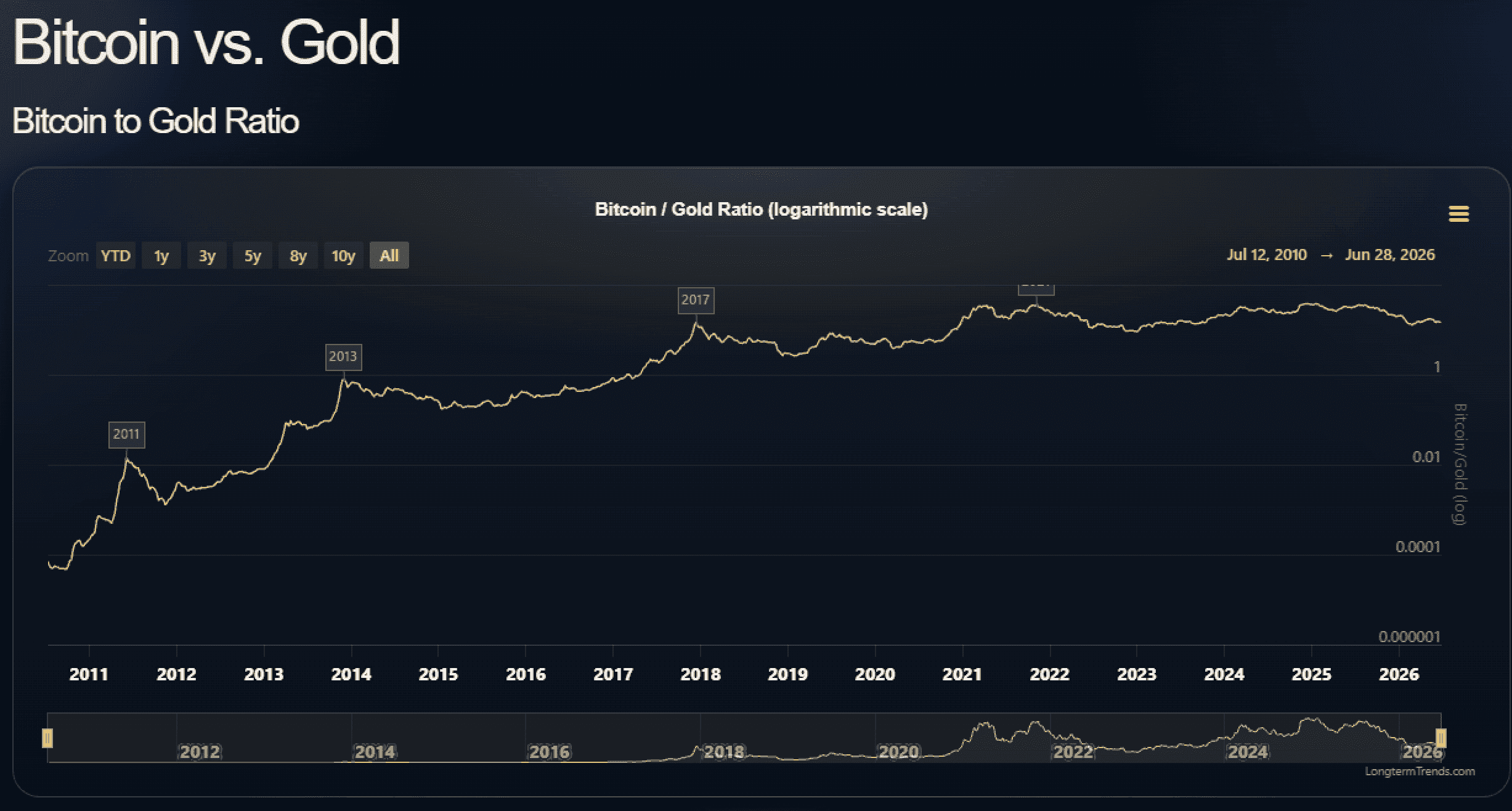
Gold near $4,070 is not a single-story rally. Several forces are pushing the same direction at once, and the biggest one is structural. Central banks have been the dominant marginal buyer of gold for several years running, adding to reserves at a pace that has changed the supply-and-demand math for the whole market. When the largest, least price-sensitive buyers in the world are accumulating, every dip gets absorbed, and the floor under price keeps rising.
Source: longtermtrends
Layered on top of that is the textbook risk-off bid. When investors get nervous about geopolitics, inflation, or the stability of the financial system itself, they reach for the asset with the longest track record of holding value. Gold has been money for thousands of years, it has no counterparty, and it does not depend on any government or company staying solvent. In a tense macro environment, that history is exactly what buyers are paying for.
Real yields matter here too. Gold pays no interest, so its biggest competition is the yield on government bonds. When real yields fall or the market expects them to fall, the opportunity cost of holding a non-yielding asset drops, and gold becomes more attractive on a relative basis. Add in the inflation-hedge demand from buyers who worry paper currencies are losing purchasing power, and you get multiple distinct groups buying the same metal for different reasons. That is how an asset grinds to records instead of spiking and fading.
Why Bitcoin Sold Off Instead of Catching a Safe-Haven Bid
If Bitcoin were trading as digital gold, this is exactly the macro backdrop where it should have rallied alongside the metal. Instead it dropped to $59,658, which tells you the market is treating it as a high-beta risk asset, not a hedge. When fear hits, traders sell the volatile thing and buy the stable thing, and right now Bitcoin is firmly on the volatile side of that trade.
The flows back it up. Spot Bitcoin ETF flows have leaned toward redemptions through this selloff, and the daily net numbers on Farside's BTC ETF flow tracker show institutions trimming exposure rather than adding it. The same desks that bought Bitcoin as a risk position during the rally are reducing that position now, which is the opposite of what a haven asset does in a panic.
There is a leverage element on top of the ETF flows. Crypto carries far more embedded leverage than the gold market, so when price starts falling, liquidations cascade and force more selling into an already weak tape. A flush like that has nothing to do with Bitcoin's long-term thesis and everything to do with the plumbing of a 24/7 leveraged market. Then there is the rotation story, where a slice of speculative capital that might have sat in crypto has been chasing AI equities instead, draining demand at the exact moment Bitcoin needs marginal buyers. Put together, ETF outflows, a leverage flush, and AI-capital rotation explain why the haven bid went to gold and the selling went to Bitcoin.
What the Gold and Bitcoin Split Says About BTC
Source: longtermtrends
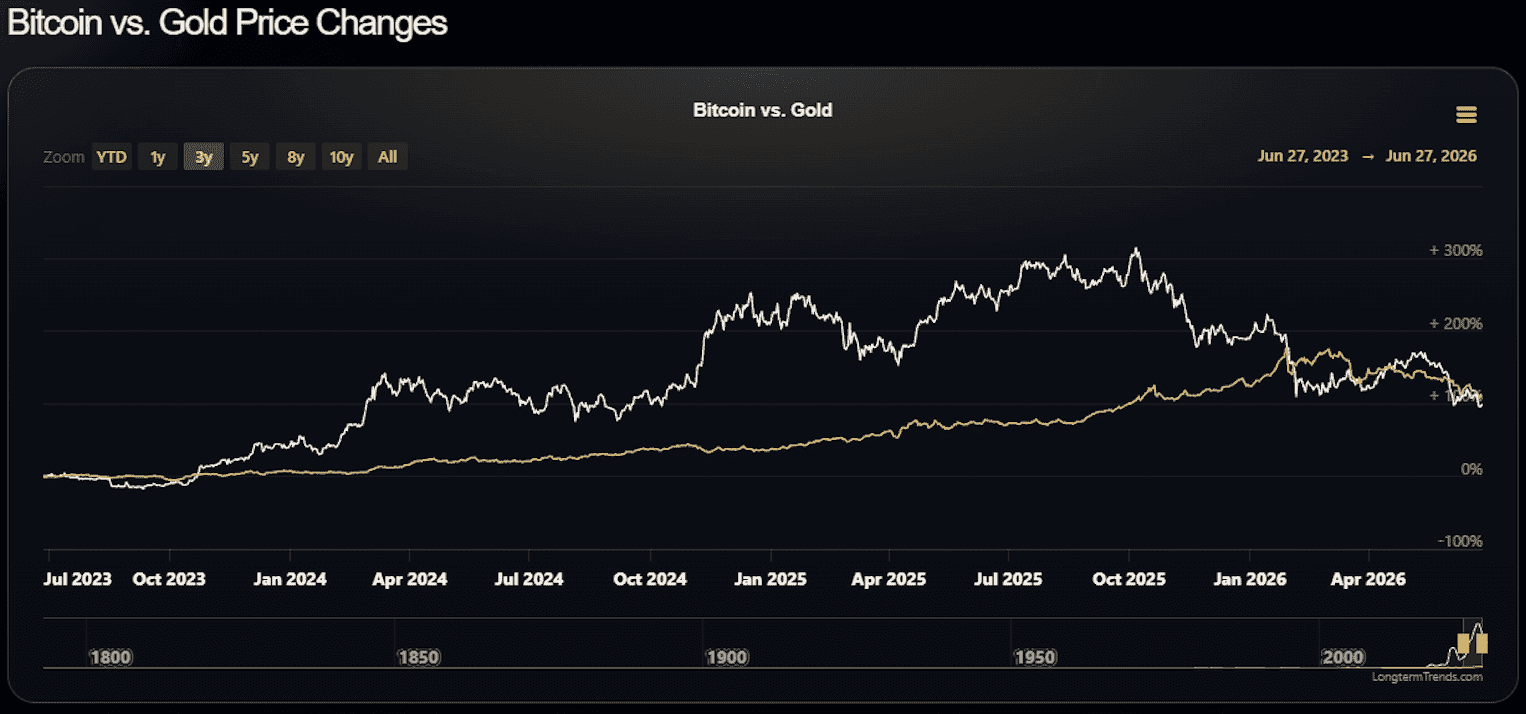
The cleanest read on this divergence is that Bitcoin's correlation profile has shifted, and in the short term it correlates with risk assets far more than with gold. Through 2026 the asset has behaved like the front end of the risk curve, rising hardest when liquidity is loose and selling hardest when it tightens. That is not the behavior of a safe haven. It is the behavior of an asset the market still prices as a leveraged bet on liquidity and risk appetite.
This is uncomfortable for the digital-gold narrative, but it is also a sign of where Bitcoin sits in its maturation. As spot ETFs pulled Bitcoin deeper into traditional portfolios, it inherited the trading behavior of the institutions that hold it. Those allocators bucket it next to equities and growth tech, not next to bullion, so it moves with that bucket. The maturity that came with institutional adoption is the same maturity that, for now, ties Bitcoin to the risk-on complex.
None of this settles the long-term question of what Bitcoin becomes. Fixed supply, no counterparty, and global portability are real properties that overlap with gold's appeal. The honest take is that those properties have not yet overpowered Bitcoin's identity as a risk asset in the eyes of the marginal trader. The divergence shows which identity is winning today, not which one wins over a decade. Slower-cycle frameworks like the Bitcoin rainbow chart exist precisely to keep that long-term lens in view when a short-term split dominates the headlines.
The Bull Case That Bitcoin Follows Gold With a Lag
There is a serious counter-argument, and dismissing it would be lazy. The bull case is that Bitcoin does not move with gold in lockstep. It follows gold with a lag. Gold reacts first to monetary debasement and risk-off conditions because it is the deeper, more institutionally embedded market, and Bitcoin catches up weeks or months later once the same liquidity finds its way down the risk curve.
History offers some support. In past cycles gold has tended to break out before Bitcoin's largest rallies, with the metal moving while crypto was still basing, then Bitcoin playing catch-up with a sharper percentage move once capital rotated into higher-beta assets. If that pattern repeats, today's record gold price is not evidence the digital-gold thesis is dead. It is an early signal that the same macro forces lifting bullion eventually reach Bitcoin, and the current divergence is just the lag in action.
The risk to that view is obvious. A lag is only a lag until it becomes a breakdown, and no rule says the historical lead-lag relationship has to hold this cycle. The rotation into AI equities is a genuine alternative home for the capital that used to flow from gold into crypto, and if that capital stays put, the lag never closes. The bull case is credible. It is not guaranteed, and a trader should size it as a probability, not a certainty. For longer-horizon positioning, slow-moving Bitcoin valuation tools are built to measure how stretched price is from fair value while a thesis like this plays out.
What a Trader Actually Does With This
The practical move is to stop debating the digital-gold label and start trading the asset that is in front of you. Right now Bitcoin is a risk asset at $59,658 with Fear & Greed at 18, and gold near $4,070 is the haven. Treating them as the same trade is how portfolios get caught offside. They are answering different questions for the market, and the table below lays out how they actually compare as safe havens today.
|
Property
|
Gold
|
Bitcoin
|
|
Track record as a haven
|
Thousands of years
|
About a decade and a half
|
|
Current behavior
|
Risk-off bid, near records
|
Risk-on selloff, deep drawdown
|
|
Main buyers right now
|
Central banks, risk-averse capital
|
Leveraged traders, institutional allocators
|
|
Volatility
|
Low to moderate
|
High
|
|
Reaction to fear today
|
Catching the safe-haven flow
|
Trading like a tech stock
|
The takeaway is not that gold wins and Bitcoin loses. They play different roles, and a trader who wants haven exposure during a fear spike currently gets it from gold, while Bitcoin is the higher-volatility bet on the eventual return of risk appetite. You can hold the view that Bitcoin follows gold with a lag and still respect that, in the moment, it is the asset being sold. Position size and patience matter more than narrative conviction when the 200-week moving average and other long-cycle anchors are better reference points than any single day's candle. You can track Bitcoin against gold on its CoinGecko BTC page, follow the broader tape through Reuters markets, and watch live spot quotes on Kitco's gold price page.
Frequently Asked Questions
Is Bitcoin digital gold?
In the long-term thesis, Bitcoin shares gold's core traits of fixed supply, no counterparty, and global portability, which is the basis for the digital-gold label. In the short term right now it is not trading like gold at all, since gold is near $4,070on a safe-haven bid while Bitcoin sits at $59,658 trading as a risk asset. The narrative is a long-horizon argument, not a description of how the two move day to day.
Why is gold going up?
Gold near record highs is driven by sustained central-bank buying, a flight to the oldest safe haven during a tense macro backdrop, inflation-hedge demand, and the falling opportunity cost of holding a non-yielding asset when real yields soften. Several distinct buyer groups are accumulating at once, which is why price has ground higher rather than spiking and fading.
Is Bitcoin a safe haven?
Not in the current market. With Fear & Greed at 18 and capital rotating out of crypto, Bitcoin is trading as a high-beta risk asset rather than a hedge, selling off while gold catches the haven flow. It may carry haven properties over a longer horizon, but today the market is pricing it next to risk assets like equities.
Will Bitcoin follow gold higher eventually?
The bull case argues Bitcoin lags gold and catches up weeks or months later once the same macro liquidity rotates into higher-beta assets, a pattern visible in past cycles. The risk is that capital stays in AI equities instead, so the lag never closes. It is a credible probability to size, not a certainty to bank on.
Bottom Line
Gold near $4,070 and Bitcoin at $59,658 are telling you the same thing from opposite directions. In a fear spike with the index at 18, the market reaches for the asset with the longest haven track record and sells the one it still treats as a leveraged risk bet. The divergence breaks the digital-gold story in the short term while leaving the long-term question open, and the bull case that Bitcoin follows gold with a lag is real but unproven this cycle. The trader move is to respect what each asset is doing now rather than what the narrative says it should do. Watch for the rotation into AI equities to reverse and for Bitcoin's correlation to drift back toward gold, because that is the signal that the lag is closing rather than breaking.
This article is for informational purposes only and does not constitute financial or investment advice. Cryptocurrency trading involves substantial risk. Always conduct your own research before making trading decisions.
