









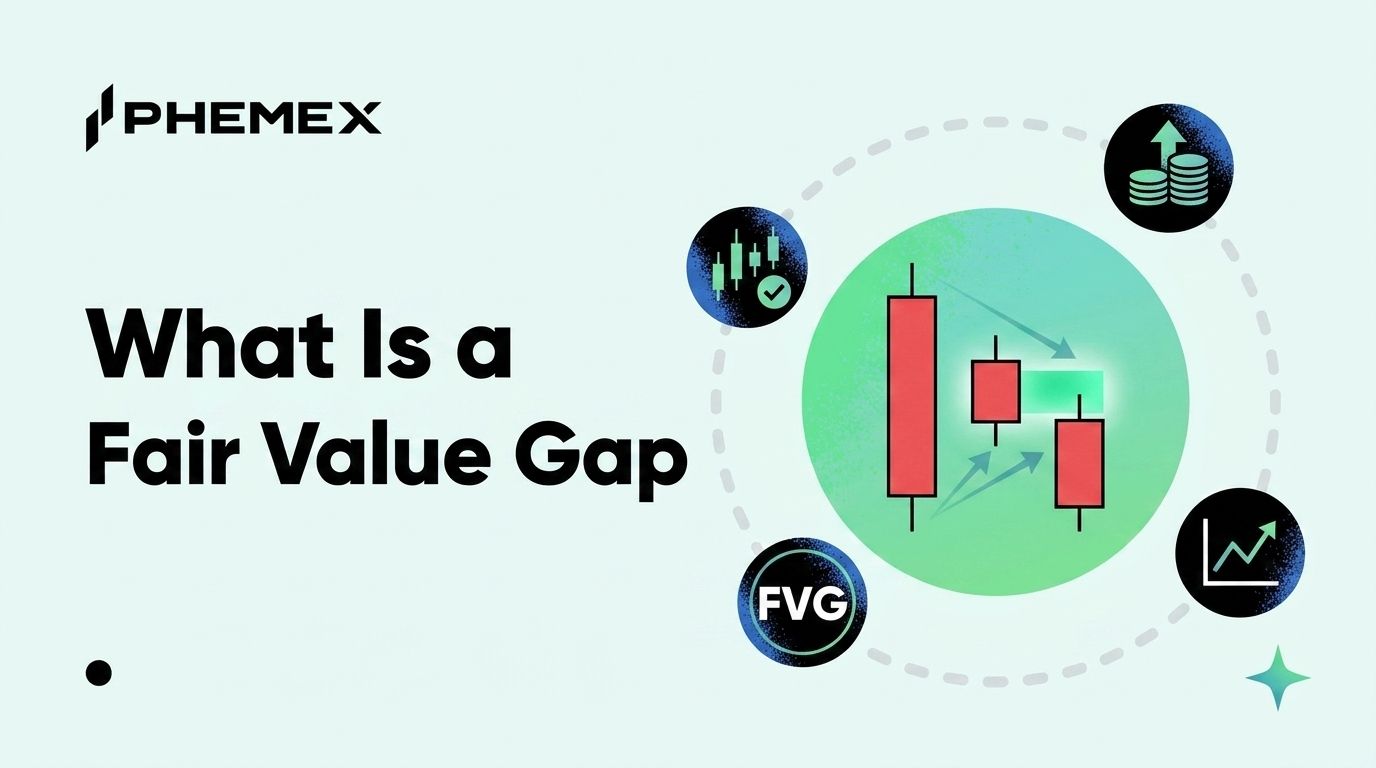
A fair value gap is a three-candle imbalance pattern where the wick of candle one and the wick of candle three never overlap, leaving an untouched price zone in the middle. That untouched zone is the "gap," and price tends to return to it before continuing in the direction of the impulse. The concept comes from the Inner Circle Trader (ICT) school of smart money concepts and has become one of the most-screenshotted setups on crypto Twitter because it gives traders a precise, mechanical zone to fade or join trends instead of guessing pullback depth.
Here is what an FVG actually is, why it forms, how the bullish and bearish versions trade, the confirmation stack that filters noise, and the failure modes that wreck FVG trades on crypto charts.
What a Fair Value Gap Is and How to Identify It
Pull up any chart and look for three consecutive candles where the second is an aggressive impulse. If candle two is a strong green candle and the high of candle one sits below the low of candle three, the empty range between those two wicks is a bullish fair value gap. If candle two is a strong red candle and the low of candle one sits above the high of candle three, the empty range is a bearish fair value gap. The middle candle does the work, and the first and third define the boundaries of the imbalance it left behind.
Think of it like a freeway lane that opened up so suddenly that no cars had time to merge into it. Price is the freeway and that empty lane is the gap, and traffic eventually flows back through to fill it.
On a 1-hour BTC chart, a hypothetical example might look like this. Candle one prints a high of $103,400, candle two closes at $104,600, and candle three opens at $104,700 with a low that never trades back below $104,000. The space between $103,400 and $104,000 is a bullish FVG, and if price later pulls back into that zone, FVG traders treat it as the next demand pocket rather than guessing a Fibonacci retracement level.
Source: Forexbee
Why FVGs Form: The Institutional Imbalance Logic
Big orders move price by clearing book liquidity faster than passive limit orders can refill the other side. When a desk fires a $200 million BTC market buy, the order eats through resting offers in seconds and price prints up into thin air with no time for two-sided trading. The gap is the visible footprint of that one-sided flow, and the same imbalance dynamic drives Investopedia's classic writeup of common gaps in equities.
Whoever moved price that aggressively still has more to do, and the cheapest way to add to the position is to wait for price to retrace into the imbalance and absorb what was missed. That is why FVGs work best when they sit at structural levels institutional desks actually care about. A random FVG inside a chop range is noise, but an FVG that prints right after a break of structure, out of a known order block, or after a London session liquidity sweep is a different animal.
This is where retail consistently loses money. Drawing every FVG on a 1-minute chart produces a screen full of zones that mean nothing, and the FVGs that matter are the ones tied to a higher-timeframe bias and a confluence event.
The Bullish and Bearish FVG Entry Mechanics
For a bullish setup you wait for price to pull back into the gap, watch how it reacts inside the zone, and enter on confirmation with a stop below the gap or the swing low that produced it. The bearish version is the inverse, and three common entry styles live inside the gap itself.
The high-fill entry. Place a limit order at the top of the gap for a bullish setup or the bottom for a bearish one, which gives the best risk-reward but the lowest hit rate because price often only partially fills the gap before rejecting.
The mid-fill entry. Limit order at the 50% midpoint of the gap, sometimes called the "consequent encroachment" level in ICT terminology. Many traders find this the most consistent of the three because it balances hit rate against reward.
The full-fill confirmation entry. Wait for the gap to fully close, then enter on the next lower-timeframe break of structure in the trend direction. Lowest reward per unit of risk but the highest probability of the gap actually holding.
Targets are usually the recent swing high or low, the next liquidity pool above old highs or below old lows, or a higher-timeframe FVG in the opposite direction. Stops live just past invalidation, never inside the gap, because a stop hunt that wicks the gap and reverses is one of the most common ways traders get knocked out of a winning idea.
The Confirmation Stack: BoS, Order Blocks, and Liquidity
An FVG by itself is not a trade, just a zone of interest. The confirmation stack turns a zone into a setup, and serious ICT and SMC traders almost always require at least two of the following conditions before risking capital. The framework owes its modern popularity to Michael Huddleston's ICT mentorship content on YouTube, where the three-candle imbalance definition first reached a mass audience.
|
Confirmation layer
|
What you are looking for
|
Why it matters
|
|
Higher-timeframe bias
|
4H or daily trend, EMA structure, or HTF order flow direction
|
FVGs against HTF bias fail far more often than they work
|
|
Break of structure (BoS)
|
A prior swing high or low taken out in the FVG direction
|
Confirms the impulse that created the gap was directional intent, not noise
|
|
Order block alignment
|
The last opposite-color candle before the impulse sits at the same level as the FVG
|
Two institutional footprints stacked = higher conviction zone
|
|
Liquidity sweep
|
A wick that takes out an obvious old high or low immediately before the FVG forms
|
Tells you the FVG was created by smart money sweeping retail stops before the move
|
|
Session timing
|
The FVG forms during London open, New York open, or the first hour of the US session
|
Liquidity events cluster in these windows. Off-session FVGs are noisier
|
The cleanest setups are the ones where four of those five line up, like a daily uptrend with a 4-hour break of structure, a 1-hour bullish FVG that overlaps a 1-hour bullish order block, a 15-minute sweep of the prior low, and the whole sequence triggering during the New York open. That kind of stacked setup is rare, and when it appears it is worth waiting for.
Candlestick pattern reading inside the gap matters too, because a pin bar rejection off the gap edge or an engulfing candle back in the trend direction is a far stronger entry signal than a blank-looking close. Many traders combine FVG entries with long-wick reversal candles at the gap edge for that reason.
Crypto-Specific Failure Modes and Traps
FVGs were originally formulated on futures markets that close overnight and on weekends, but crypto markets do not close. That single difference produces several traps that did not exist in the original ICT framework.
Weekend wick FVGs. Saturday and Sunday liquidity on most pairs is a fraction of weekday volume, and a single large market order on a Sunday afternoon can print a 3-candle imbalance that looks textbook but represents almost no real institutional flow. These gaps often get violated cleanly when Monday liquidity returns, so filter out FVGs that form during the lowest-volume windows.
Liquidation cascade FVGs. When a perpetual futures liquidation cluster gets hit, the forced selling or buying produces enormous candles with huge gaps. The chart prints what looks like a perfect FVG, but the imbalance was created by margin calls, not directional intent. Liquidation FVGs frequently fill all the way through and keep going, so cross-reference any large FVG against Coinglass liquidation data before treating it as smart money flow.
Micro-cap noise. On low-cap altcoins, almost every other candle leaves an FVG because the order book is too thin for orderly two-sided trading. Drawing FVGs on a token with $30 million in daily volume is curve-fitting, so stick to top-cap pairs where the concept was empirically tested.
The "every FVG fills" myth. Roughly 60 to 70 percent of FVGs fill within a reasonable window, while the rest get partially filled, skipped entirely, or only fill after the trend has already exhausted. Treating fills as inevitable is a fast way to hold losers too long, and if price breaks the swing low that produced a bullish FVG without touching the gap, the gap is dead and you are now trading a different pattern.
Frequently Asked Questions
Do fair value gaps work better on crypto or on traditional markets?
They work on both, but crypto FVGs are noisier because the market never closes and liquidity varies wildly by session. The cleanest crypto setups cluster around the London and New York opens, when global liquidity is highest and order flow is most directional.
Should I use FVGs on the 1-minute chart for scalping?
You can, but only if you anchor every entry to a higher-timeframe bias. A 1-minute FVG that aligns with the 1-hour trend and a 15-minute break of structure is tradable, while a 1-minute FVG in isolation with no higher-timeframe context is statistical noise. Scalpers who skip the HTF anchor usually post good screenshots and bad equity curves.
What is the difference between a fair value gap and an order block?
An order block is the last opposite-color candle before an impulsive move, representing where institutional orders likely sat, while an FVG is the imbalance left behind by the impulse itself. They are two different footprints of the same event, which is why they often appear together. The strongest setups are when both line up at the same price zone.
Does every fair value gap have to fill?
No, around 30 to 40 percent of FVGs never fully fill, either because the trend exhausts before retracing or because price skips the zone entirely on the next leg. Treating fills as guaranteed is one of the most common mistakes, and the gap is a probability zone, not a prediction.
Bottom Line
An FVG is one of the few smart money concepts with a precise, mechanical definition you can spot in seconds, and the edge comes from filtering, not finding. Profitable FVG traders only take setups that stack three or four confirmations and ignore the dozens of unconfirmed gaps that print every day. Focus on top-cap pairs, anchor to the higher timeframe, treat liquidation cascades and weekend wicks with skepticism, and accept that roughly a third of valid FVGs will not fill. Build the discipline before you build the position size, because the framework rewards patience more than it rewards activity.
This article is for educational purposes only and does not constitute financial or investment advice. Cryptocurrency trading involves substantial risk. Always conduct your own research before making trading decisions.
