









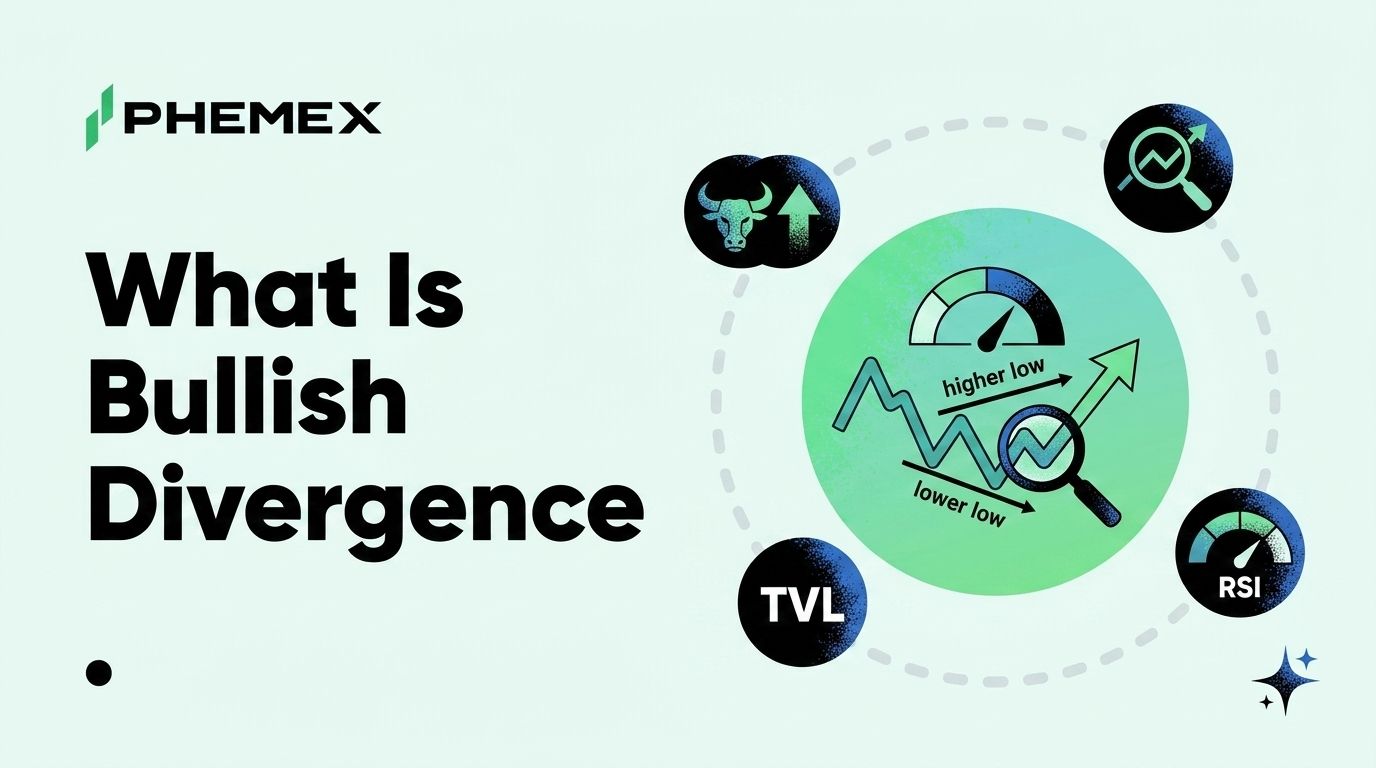
Bullish divergence happens when price makes a lower low while a momentum oscillator like RSI or MACD makes a higher low. Price is still falling, but the engine pushing it down is losing power. That gap between what price is doing and what momentum is doing is one of the earliest hints that a downtrend is running out of sellers. It is the signal traders lean on when they want to be early to a bottom instead of late.
Right now is exactly the kind of backdrop where this setup gets hunted. BTC trades near $64,107 with the Fear & Greed Index at 23, deep in Extreme Fear, the oversold, washed-out condition where divergences tend to print. That does not make divergence a buy button. It makes it a clue you still have to confirm. Here is what bullish divergence actually is, how to read it on RSI and MACD, how to confirm it before you risk a dollar, and where it fails.
What Bullish Divergence Actually Is
Price and momentum usually move together. When an asset sells off hard, the oscillator measuring that selling pressure should print a deeper trough on each new low. Bullish divergence is the moment that relationship breaks. Price carves a fresh lower low, but the indicator refuses to follow and instead prints a higher low. Sellers are still in control of price, but each new push down is weaker than the last.
Source: CryptoHopper
Think of it like a car coasting uphill. The car is still moving forward, but the engine is barely turning over and you can hear it about to stall. The divergence does not tell you the car has stopped. It tells you the force moving it is almost spent, which is the precondition for a reversal rather than the reversal itself.
This is why divergence is a momentum signal, not a price signal. It measures the rate of change behind a move, and a fading rate of change often precedes a turn. The catch is timing. Momentum can fade for days or weeks while price keeps grinding lower, so the signal tells you a bottom is getting closer without telling you it has arrived. Treat it as a reason to start watching closely, not a reason to buy on sight.
Regular vs Hidden Bullish Divergence
There are two flavors, and confusing them is one of the most common mistakes new traders make. They point in opposite directions.
Regular bullish divergence signals a potential trend reversal. Price makes a lower low while the oscillator makes a higher low. It shows up at the end of a downtrend and suggests the selling is exhausting itself, hinting that the move down may be ready to flip up. This is the classic bottom-hunting pattern and the one most people mean when they say bullish divergence.
Hidden bullish divergence signals trend continuation, not reversal. Here price makes a higher low while the oscillator makes a lower low. It appears during an existing uptrend, usually on a pullback, and suggests the dip is just a pause before the uptrend resumes. Traders use it to add to longs in a healthy trend rather than to call a bottom in a falling market.
|
Type
|
Price action
|
Oscillator action
|
What it signals
|
Where it appears
|
|
Regular bullish
|
Lower low
|
Higher low
|
Possible reversal up
|
End of a downtrend
|
|
Hidden bullish
|
Higher low
|
Lower low
|
Trend continuation
|
Pullback inside an uptrend
|
The practical takeaway is to know which market you are in before you read the signal. In a clear downtrend, regular bullish divergence is the one worth tracking. In an established uptrend that is pulling back, hidden bullish divergence is the higher-probability read. Applying the wrong one to the wrong market is how traders talk themselves into fighting a trend.
How to Spot It on RSI and MACD
The two most common tools for this are RSI and MACD, and they show divergence in slightly different ways. The Relative Strength Index is a momentum oscillator that runs from 0 to 100, with readings below 30 generally considered oversold. To spot bullish divergence on RSI, find two price swing lows where the second is lower than the first, then check the RSI lows beneath them. If RSI made a higher low under that lower price low, you have divergence. The signal is strongest when both RSI lows sit in or near oversold territory below 30, because that is where exhaustion is most likely real.
MACD works a little differently because it has two lines and a histogram. The cleanest way to read MACD divergence is off the histogram or the MACD line lows. Mark the two price swing lows, then compare the MACD line troughs underneath. A lower price low paired with a shallower MACD trough is bullish divergence. The histogram bars shrinking on the second low even as price drops is the same message in visual form, with the falling momentum literally getting smaller.
A few rules keep this honest across either tool:
- Only compare like-for-like swing lows. Two clear, distinct pivot lows, not random wiggles in the middle of a candle range.
- Higher timeframes carry more weight. A divergence on the 4-hour or daily chart means far more than one on the 5-minute, where noise produces dozens of fake signals a day.
- The lows should be reasonably spaced. Two lows jammed three candles apart are usually noise, not a structural divergence.
- Do not force it. If you have to squint to draw the line, it is not there.
How to Confirm and Trade It With Risk Management
Divergence on its own is an alert, not an entry. The single biggest reason traders lose money on this pattern is buying the divergence the instant they spot it, before price has done anything to prove the seller exhaustion is real. Confirmation is what separates a setup from a guess. Wait for at least one of these before acting.
The first confirmation is a structure break. Price should reclaim a prior swing high or break the descending trendline that defined the downtrend. Until that happens, a higher low on the oscillator is just a slower decline, not a reversal. The second is a candle signal at the low, like a hammer candlestick or another reversal candle that shows buyers stepping in. Pairing divergence with a recognizable reversal pattern from the broader family of candlestick patterns raises the odds considerably. The third is volume. A genuine bottom usually arrives with a spike in buying volume as the structure breaks, showing real demand rather than a quiet drift higher.
Once confirmation lands, risk management is what keeps a wrong call from becoming an expensive one. The stop placement is straightforward. Put your stop just below the most recent swing low that formed the divergence, because if price takes out that low, the divergence has failed by definition and there is no reason to stay in. Size the position so that hitting that stop costs a small, fixed percentage of your account rather than a number that hurts. Many traders scale in, taking a partial position on the candle confirmation and adding once the structure break is confirmed, which avoids committing everything to a signal that has not fully played out. The target is usually the next clear resistance level or prior swing high, and patterns like the double bottom often form around the same lows where divergence prints, giving a clean reference for where the move could run.
Where Bullish Divergence Fails
This is the part most tutorials skip, and it is the part that costs people money. Divergence is a probability signal, not a guarantee, and in certain conditions it fails repeatedly.
The most dangerous failure mode is a strong downtrend. In a powerful, news-driven selloff, momentum can diverge over and over while price keeps making lower lows for weeks. Each higher RSI low looks like the bottom, and each time price drops further. Traders who buy every divergence in a falling knife get stopped out on a loop. The phrase that fits is that divergence can persist far longer than your account can stay solvent fighting it. This is precisely why the current setup deserves caution. BTC near $64,000 in Extreme Fear is fertile ground for divergence, but Extreme Fear can also deepen before it resolves, and a single oversold reading does not make a bottom.
A few other failure modes are worth keeping in mind:
- Lower timeframe noise. A 1-minute or 5-minute divergence prints constantly and means almost nothing. Stick to higher timeframes for signals you can trust.
- No confirmation. Acting on the raw divergence before a structure break, candle signal, or volume spike is the most common way the pattern burns traders.
- Forced lines. If the divergence only appears after you cherry-pick which lows to connect, it is not a real signal.
- Macro override. A major catalyst, a liquidation cascade, or a broad risk-off move can blow through any chart pattern regardless of what the oscillator says.
The honest framing is that bullish divergence improves your odds of catching a turn, but it does not remove the risk. It works best as one piece of a checklist, not as a standalone trigger. Tools like bull market peak indicators on the other side of the cycle work the same way, useful as confluence, dangerous as a single signal.
Frequently Asked Questions
What is bullish divergence in simple terms?
It is when price makes a new lower low but a momentum indicator like RSI or MACD makes a higher low at the same time. That mismatch shows selling momentum is fading even though price is still dropping, which often comes before a reversal. It is an early warning that a bottom may be forming, not a confirmed buy signal.
Is RSI or MACD better for spotting bullish divergence?
Both work, and many traders watch them together for confluence. RSI is cleaner for seeing oversold exhaustion because of its 0 to 100 scale, while MACD's histogram makes the loss of momentum easy to see visually. The strongest signals are when RSI and MACD diverge at the same swing lows on a higher timeframe.
Can bullish divergence fail?
Yes, frequently, especially in strong downtrends where momentum can diverge for weeks while price keeps falling. That is why confirmation through a structure break, a reversal candle, or a volume spike matters before acting. Without confirmation and a stop below the swing low, divergence is one of the easier patterns to lose money on.
Does bullish divergence work on Bitcoin?
It works on Bitcoin the same way it works on any liquid asset, and traders watch it closely on BTC during oversold, high-fear conditions like the current Extreme Fear reading. The key is using the daily or 4-hour chart rather than low timeframes, and treating it as confluence with structure and volume rather than a standalone trigger. You can learn more about the asset itself in this overview of Bitcoin.
Bottom Line
Bullish divergence is a momentum tell, not a price prediction. When price prints a lower low and the oscillator prints a higher low, selling pressure is fading, but fading is not finished. The pattern earns its keep only when you wait for confirmation. No long until a structure break, a reversal candle, or a volume spike backs up what the divergence is suggesting, and no position without a stop just below the swing low that formed it.
Keep it on higher timeframes, know whether you are reading regular divergence for a reversal or hidden divergence for a continuation, and never buy every divergence in a strong downtrend. With BTC near $64,000 and Fear & Greed at 23, the setup is live and worth watching, but Extreme Fear can stretch further before it breaks. Spot the divergence, demand the confirmation, manage the risk, and let the higher low do its job as a clue rather than a command.
This article is for informational purposes only and does not constitute financial or investment advice. Cryptocurrency trading involves substantial risk. Always conduct your own research before making trading decisions.
