









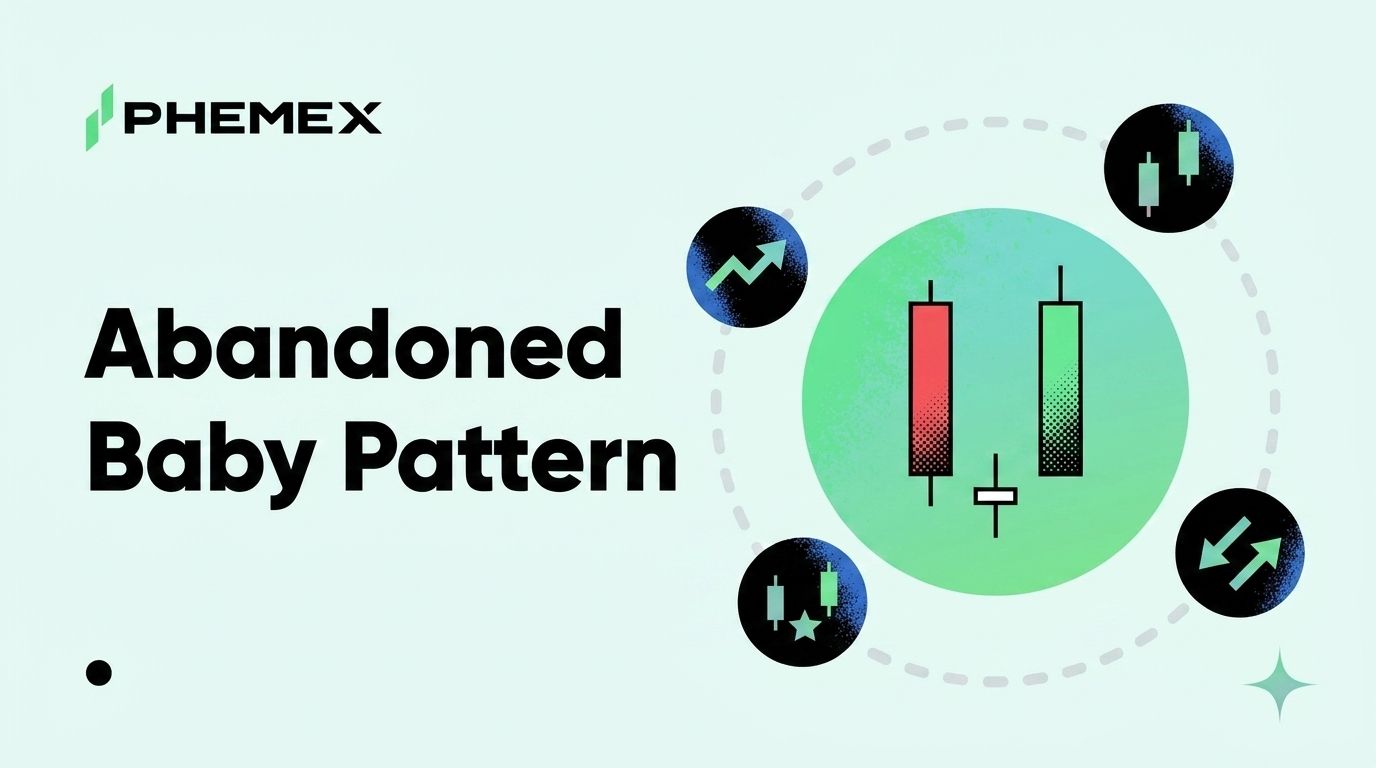
The Abandoned Baby is the candlestick pattern most traders have heard of and almost none have actually traded, because it is genuinely rare. It is a three-candle reversal built around a single isolated Doji that gets stranded by price gaps on both sides, and when it appears at the bottom or top of a sustained trend it is rated one of the most reliable reversal signals in technical analysis. The catch in crypto is that it needs true gaps to form, and gaps barely exist in a market that trades 24 hours a day.
Most reversals show a fight between buyers and sellers inside a tight range. The Abandoned Baby is different. It shows a trend reaching total exhaustion, then a violent sentiment flip that leaves a gap behind. Here is the breakdown.
What the Abandoned Baby Pattern Actually Is
The Abandoned Baby is a three-candle reversal pattern that marks the end of a strong trend with a gapped, isolated Doji at its center. The name comes from that middle candle. Price gaps away from it on one side, forms a Doji that closes near where it opened, then gaps away again on the other side, leaving the small candle stranded like a baby abandoned by the market.
Source: Warrior Trading
The pattern is a close cousin of the candlestick formations every trader learns early, but it sits in a category most never get to use. A standard reversal candle shows hesitation inside a continuous price range. The Abandoned Baby demands a clean break in price on both sides of the middle candle, which is exactly why it carries more weight when it appears.
There are two versions. The bullish Abandoned Baby forms at the bottom of a downtrend and signals a move up. The bearish one forms at the top of an uptrend and signals a move down. Both share the same defining feature, a Doji isolated by gaps, and both depend on that isolation being real rather than imagined.
The Bullish Abandoned Baby, Candle by Candle
The bullish version forms at the end of a downtrend and points to a bottom. It is built from three specific candles in sequence, and each one has to earn its place.
Candle 1 is a long red candle. Price is falling hard, sellers are in control, and the body is large with little upper wick. This confirms the downtrend is intact and momentum still points down.
Candle 2 is a Doji that gaps down. The market opens below the entire range of candle 1, trades in a narrow band, and closes at almost the same level it opened. This is the Doji that gives the pattern its name, its open and close nearly equal, signaling that the relentless selling has stalled into pure indecision. The defining rule is that this candle's entire range sits below candle 1, with a visible gap separating them.
Candle 3 is a long green candle that gaps up. Buyers seize control, price opens above the Doji's entire range, and the candle closes well into the body of candle 1. That second gap, above the Doji this time, completes the isolation. The little candle is now stranded with empty space on both sides, abandoned by a market that flipped from selling to buying in one session.
The two-sided gap is the whole point. A Doji at the bottom of a downtrend is a useful reversal candle on its own, but the Abandoned Baby requires that the Doji be cut off from the candles around it by real gaps. No gap, no Abandoned Baby.
The Bearish Abandoned Baby, the Mirror Image
The bearish version is the exact inverse and forms at the top of an uptrend. The logic flips but the structure is identical in reverse.
Candle 1 is a long green candle confirming the uptrend. Buyers are in control and momentum points up. Candle 2 is a Doji that gaps up, opening above the entire range of candle 1 and closing near its open, signaling that the buying frenzy has stalled into indecision at the highs. Candle 3 is a long red candle that gaps down, opening below the Doji's range and closing well into the body of the first green candle.
The result is the same isolated Doji, this time stranded at a peak rather than a trough. The gap up traps late buyers who chased the top, and the gap down confirms that sentiment has violently reversed. This version warns that an uptrend has run out of buyers, and the people who bought the gap are now underwater.
The Psychology Behind the Pattern
What makes the Abandoned Baby reliable is the story the three candles tell about emotion at an extreme. The pattern only forms at the end of a sustained trend, when one side has been dominant for long enough that positioning is crowded and one-directional.
The first candle is conviction. The trend is strong and the crowd is leaning hard one way. The gapped Doji is exhaustion. Price pushes one final time past the trend, then freezes, with open and close landing in the same place because neither side can take ground. That stall, isolated by a gap, marks the moment the dominant side runs out of fuel at the worst possible spot for it.
The third candle is the flip. Price gaps the other way and closes deep into the original trend candle, confirming the crowd was caught offside and is now reversing. The two gaps are the signature of a sentiment change that happened too fast for orderly trading, which is why the pattern reads as a more violent reversal than a simple Doji or engulfing candle. The market did not drift to a turn. It snapped.
The Crypto Caveat, Why Gaps Are Rare Here
This is the honest part most candlestick guides skip. The Abandoned Baby depends entirely on price gaps, and true gaps barely exist in 24/7 crypto spot markets. Stock charts gap constantly because exchanges close overnight and on weekends, so price can open far from the prior close after news breaks while the market was shut. Crypto spot never closes. Bitcoin trades every minute of every day, so price moves continuously and rarely leaves a clean empty zone between candles.
What you usually see on a 24/7 BTC or ETH spot chart is not a true Abandoned Baby. It is a long candle, then a Doji pressed right against it with touching wicks, then another long candle. That is closer to a Morning Star or Evening Star, a perfectly valid signal, but it is not the gapped pattern. Calling it an Abandoned Baby on a continuous chart forces a label onto a formation that does not meet the definition.
True gaps in crypto appear in a few specific places. CME Bitcoin and Ethereum futures close on weekends, so the well-known "CME gap" forms when price moves while the futures market is shut and Monday opens away from Friday's close. Low-liquidity altcoins can gap when a large order clears the order book with nothing behind it, and tokenized stocks that track equity sessions inherit the gap behavior of their underlying. The takeaway is that the Abandoned Baby is far more reliable on CME futures and tokenized equities than on a 24/7 spot pair, so treat any spot "Abandoned Baby" with suspicion until you confirm the gaps are real.
Abandoned Baby vs Morning Star, Evening Star, and Island Reversal
The Abandoned Baby gets confused with two patterns it closely resembles. The difference comes down to gaps and the middle candle, and getting it wrong means misreading the strength of the signal.
|
Pattern
|
Candles
|
Middle candle
|
Gaps required
|
Reliability
|
How often it appears
|
|
Abandoned Baby
|
Three
|
A Doji, isolated by gaps on both sides
|
Yes, on both sides of the Doji
|
Very high when valid
|
Very rare, especially in 24/7 spot
|
|
Morning Star / Evening Star
|
Three
|
A small body, not necessarily a Doji, no isolation needed
|
No, bodies can touch or overlap
|
High
|
Common across all markets
|
|
Island Reversal
|
Many
|
A cluster of candles isolated by gaps
|
Yes, around the whole cluster
|
High
|
Rare
|
The Morning Star and Evening Star patterns are the everyday version of the same three-act story, a trend candle, a pause, then a reversal candle, but they need no gaps and the middle candle does not have to be a true Doji. They are what most crypto spot reversals actually are. The Abandoned Baby is the strict, gapped upgrade of that family.
The Island Reversal is the larger relative. Instead of a single isolated Doji, an entire group of candles gets stranded by a gap on the way in and a gap on the way out, forming an island detached from the trend. Think of the Abandoned Baby as an Island Reversal compressed into one middle candle.
Confirmation, Entry, Stop, and Target
A valid pattern is the setup, not the trade. Three confirmation checks separate a tradable Abandoned Baby from a chart coincidence.
Gap integrity comes first. Confirm the gaps on both sides of the Doji are real and not an artifact of a thin chart or a 24/7 spot pair pretending to gap. On a CME futures chart, that means the Doji's range genuinely sits clear of the candles around it.
Volume should confirm the flip. The third candle, the one that completes the reversal, ideally prints on rising volume. A reversal candle that gaps the other way but trades on thin volume is weaker, because it suggests the move lacks broad participation.
Location is everything. The pattern only counts at the end of a clear, extended trend. An Abandoned Baby in the middle of a choppy range is noise. It needs an exhausted trend behind it to reverse.
For entry, the conservative approach is to wait for the close of the third candle and enter on the open of the next session, once the reversal is confirmed rather than assumed. Take a round-number example on a bullish Abandoned Baby in BTC. Candle 1 closes near $62,000 in a downtrend, the Doji gaps down and prints around $60,000, then candle 3 gaps up and closes back near $63,000. The stop goes below the lowest point of the pattern, under the Doji's low around $59,500, because a break below the abandoned candle invalidates the whole reversal. The first target is the prior structure or resistance the downtrend came from, often near candle 1's origin, with a secondary target measured by the depth of the preceding move. The bearish version flips exactly, with the stop above the Doji's high and targets to the downside.
Failure Modes and Why It Is Rated So Reliable
The Abandoned Baby fails in a few predictable ways, and knowing them keeps you from trusting a pattern that has already broken. The most common failure is the fake gap. On a 24/7 chart the "gap" is really only a fast candle, the isolation is not real, and the pattern carries no more weight than an ordinary Doji. The second failure is a gap that gets filled immediately. Price gaps to form the third candle, then reverses and closes the gap within a session or two, which signals the reversal lacked follow-through. The third is location failure, where the pattern forms mid-range instead of at the end of a trend and has nothing to reverse.
So why is it rated one of the most reliable reversals despite being so easy to invalidate? Because when the conditions are genuinely met, the signal is unusually clean. The two-sided gap removes the ambiguity that plagues most reversal candles. There is no overlap to argue about, no partial body to interpret. Either the Doji is isolated or it is not. That binary clarity, combined with how rarely the market produces it, is why traders treat a true Abandoned Baby as a high-conviction signal worth waiting for.
Frequently Asked Questions
Is the Abandoned Baby pattern reliable?
When it forms validly, it is rated one of the most reliable reversal patterns in technical analysis, because the two-sided gap removes the ambiguity found in most reversal candles. The reliability collapses if the gaps are not real, which is why it works far better on CME futures and stock charts than on 24/7 crypto spot. Treat any spot "Abandoned Baby" with caution until you confirm the gaps actually exist.
Is the Abandoned Baby bullish or bearish?
It can be either. The bullish Abandoned Baby forms at the bottom of a downtrend with a gapped-down Doji and signals a move up, while the bearish version forms at the top of an uptrend with a gapped-up Doji and signals a move down. The direction is set by where in the trend it appears and which way the third candle gaps.
Why is the Abandoned Baby so rare in crypto?
The pattern needs true price gaps on both sides of the middle Doji, and 24/7 crypto spot markets almost never gap because they trade continuously without an overnight close. You mostly find genuine examples on CME Bitcoin and Ethereum futures, which close on weekends, on tokenized stocks that track equity sessions, or on thin altcoins where a large order can leave a gap.
What is the difference between an Abandoned Baby and a Morning Star?
A Morning Star is a three-candle reversal where the middle candle is small but does not need to be a true Doji and does not need gaps around it. The Abandoned Baby is the stricter version, requiring a real Doji isolated by gaps on both sides. Most reversals on continuous crypto charts are technically Morning or Evening Stars, not Abandoned Babies.
Bottom Line
The Abandoned Baby is a high-conviction signal that you will rarely get to use, and that is by design. Trade it only when three things are true. The gaps on both sides of the Doji are real, the pattern sits at the end of a clear trend, and the third candle confirms on solid volume. On a continuous spot chart, those conditions almost never line up, so look for it on CME BTC and ETH futures, on weekend gaps, and on tokenized stocks where true gaps actually form. Enter on the close of the third candle, set the stop beyond the abandoned Doji, and if price fills the confirming gap, the reversal failed and you are out. Wait for the real thing rather than labeling every gapped Doji an Abandoned Baby, because the rarity is exactly what gives the genuine signal its edge.
You can study this pattern live on TradingView charts, cross-reference the term on Investopedia, and track BTC price history on CoinGecko before you ever risk a position.
Disclaimer: This article is for educational purposes only and does not constitute financial advice. Cryptocurrency and stock trading carries significant risk. Always do your own research and consult a qualified advisor.
