
Summary
In the 2026 digital asset landscape, Zebec Network (ZBCN) and Onyxcoin (XCN) represent two distinct architectural approaches to blockchain utility. ZBCN focuses on the real-time payment sector, specifically addressing liquidity and payroll efficiency through its proprietary streaming payment protocol. In contrast, Onyxcoin (XCN) focuses on modular blockchain infrastructure designed for institutional-grade financial ledgers and tokenized asset management.
The primary distinction between the two lies in their target market and core technology: ZBCN prioritizes consumer and business-facing "continuous settlement" tools, while XCN emphasizes a Layer-3 environment for institutional finance and high-stakes smart contract execution. For users interested in exploring these ecosystems, both ZBCN and XCN are accessible for spot trading on the Phemex platform.
What Is ZBCN (Zebec Network)?
Zebec Network (ZBCN) is a decentralized infrastructure network designed to facilitate continuous, real-time value transfer. Initially launched on the Solana blockchain, Zebec has evolved into a multi-chain ecosystem. Its primary value proposition is the streaming payment protocol, which allows for the per-second distribution of funds—a utility particularly relevant for automated payroll, subscriptions, and real-time tax compliance.
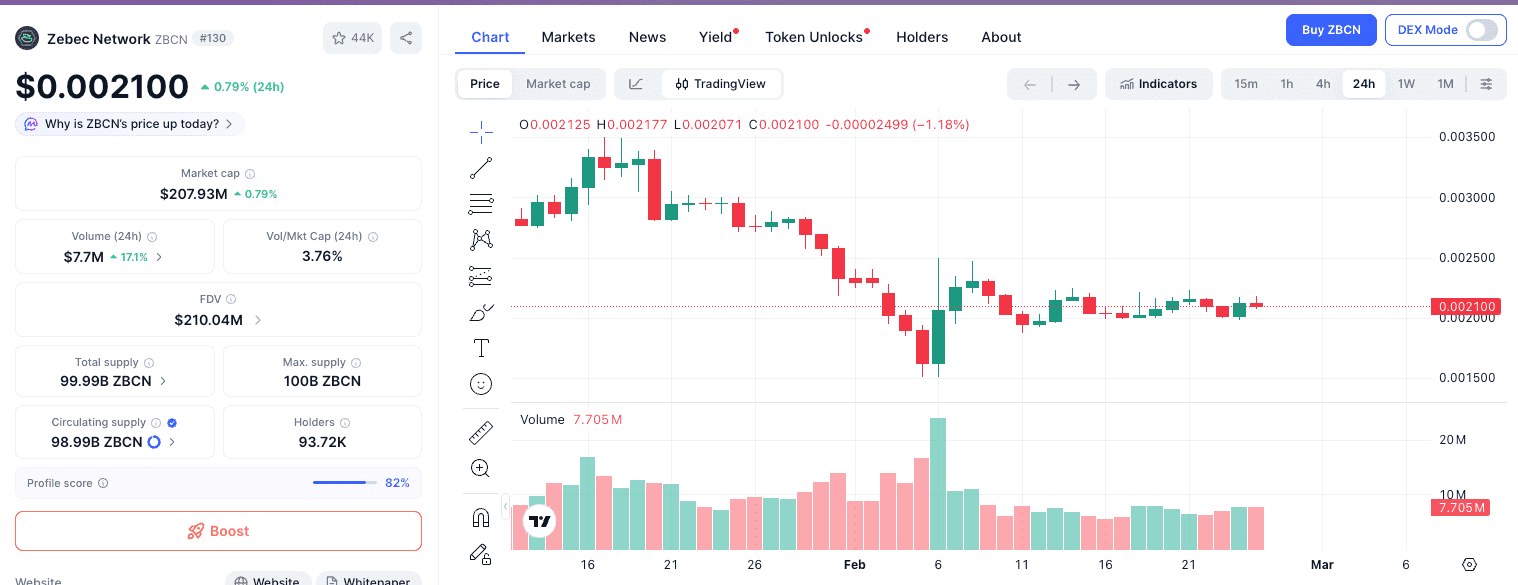
As of late February 2026, ZBCN maintains a market capitalization of approximately $207.93 million. The token functions as the native utility and governance asset within the network. Its supply dynamics are defined by a maximum cap of 100 billion tokens, with the vast majority currently in circulation. The ecosystem has expanded to include the Zebec Card (a multi-chain debit solution) and the Nautilus Chain, an EVM-compatible Layer-3 blockchain that serves as the execution layer for Zebec’s high-throughput payment applications.
What Is XCN (Onyxcoin)?
Onyxcoin (XCN) is the native utility and governance token of the Onyx Protocol, a modular blockchain platform tailored for the requirements of institutional financial services. The protocol is structured to support complex financial-grade applications, ranging from Decentralized Finance (DeFi) to tokenized asset management.
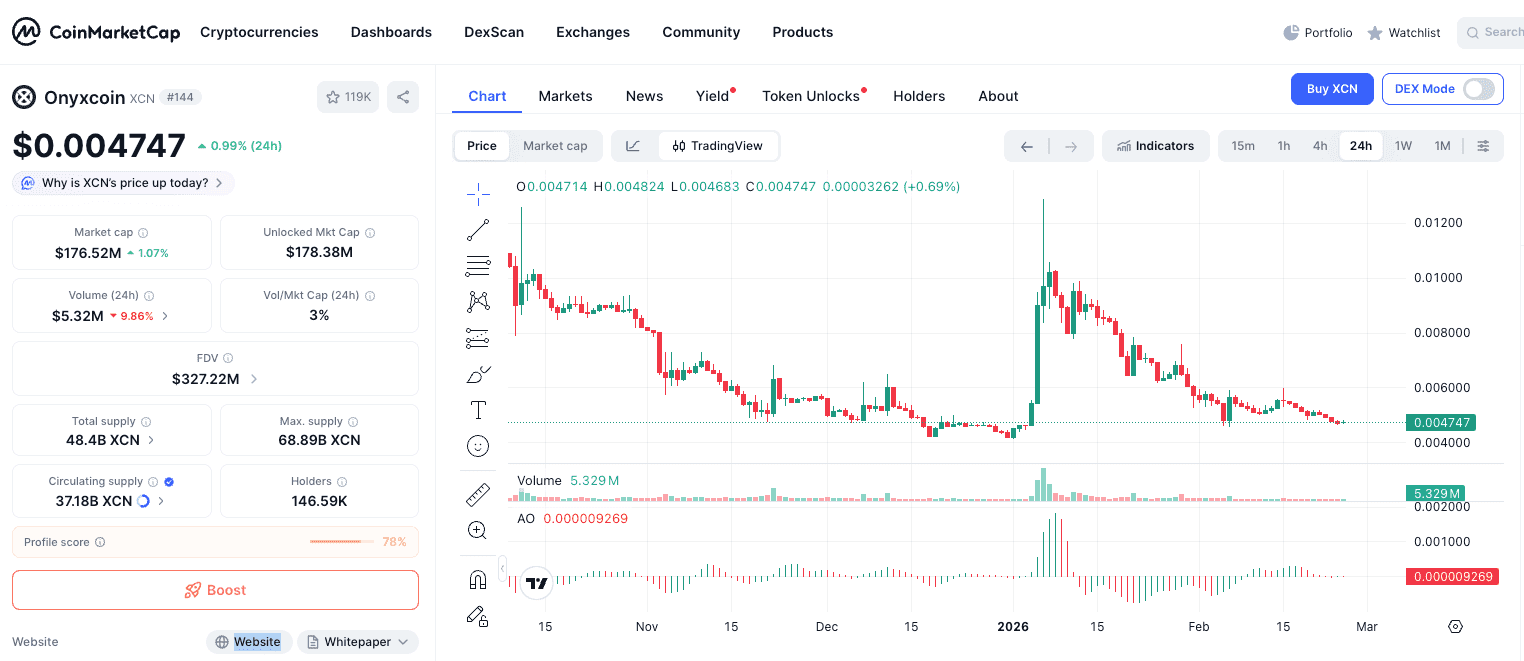
By late February 2026, XCN’s market capitalization is recorded at approximately $176.52 million, with a circulating supply exceeding 37 billion tokens (out of a total supply of roughly 68.9 billion). The Onyx ecosystem comprises several critical components: the XCN Ledger (an Arbitrum-based Layer-3 chain), Goliath (a Layer-1 blockchain focused on institutional interoperability), and the Onyx AI Agent, which assists in automating on-chain operational tasks. These tools aim to bridge the gap between traditional banking infrastructure and decentralized ledger technology.
Key Similarities: ZBCN vs. XCN
| Feature | Zebec Network (ZBCN) | Onyxcoin (XCN) |
| Token Standard | Functions as an [ERC-20](https://phemex.com/academy/erc20-token-ethereum) token on the [Ethereum](https://phemex.com/price/ethereum) network, ensuring broad compatibility with DeFi wallets and protocols. | Functions as an ERC-20 token on the Ethereum network, facilitating seamless integration with the existing EVM ecosystem. |
| Governance Role | Native governance token; allows holders to vote on protocol upgrades and the direction of the Zebec ecosystem. | Native governance token; empowers the community to participate in the decision-making process of the Onyx Protocol. |
| Scaling Architecture | Utilizes a [Layer-3](https://phemex.com/academy/bitcoin-layer-1-vs-2-vs-3) approach via the Nautilus Chain to achieve high throughput and low-cost execution. | Employs a Layer-3 solution via the XCN Ledger (built on Arbitrum) to optimize scalability for financial apps. |
| Sector Focus | Deeply integrated into the [Decentralized Finance](https://phemex.com/academy/what-is-defi) ([DeFi](https://phemex.com/academy/what-is-defi)) and payment sectors, focusing on real-time settlement. | Primarily targets Decentralized Finance (DeFi) and institutional banking infrastructure through modular ledger technology. |
| Utility Functions | Used for transaction fees within its ecosystem, staking for network security, and as a medium for payment streaming. | Used for protocol gas fees, access to Onyx ecosystem services (like Onyx AI), and staking within the Onyx Ledger. |
| Multi-Chain Strategy | Operates across multiple chains ([Solana](https://phemex.com/price/solana), [BNB](https://phemex.com/price/binancecoin), Ethereum) to maximize liquidity and user accessibility. | Operates across a layered ecosystem (L1 [Goliath](https://phemex.com/price/goliath) and L3 XCN Ledger) to bridge traditional and decentralized finance. |
| Trading Availability | Fully integrated and available for spot trading on the Phemex exchange with [USDT](https://phemex.com/price/tether) pairs. | Fully integrated and available for spot trading on the Phemex exchange with USDT pairs. |
Major Technical Differences
Core Technology & Architecture
ZBCN’s infrastructure is optimized for Continuous Settlement. The technology focuses on "locking" funds in a smart contract and streaming them to a recipient over time, which requires high transaction finality. The Nautilus Chain provides the necessary environment for these micro-transactions without congesting the base layer.
XCN, however, utilizes a Modular Layered Approach. The Onyx Protocol separates the execution of DeFi activities (on its L3) from institutional settlement (on its L1). This separation is designed to provide institutions with a more controlled and secure environment for managing large-scale financial obligations.
Transaction Throughput and Fees
The Nautilus Chain (ZBCN) is specifically engineered to handle thousands of small, frequent payment streams at near-zero cost. This is essential for payroll applications where transaction fees must not exceed the value of the "per-second" payment.
The Goliath L1 (XCN) is designed for High-Value Throughput, aiming for speeds comparable to traditional payment processors like Visa. While also maintaining low fees, its focus is on the security and verification of large-block institutional data rather than the micro-streaming frequency seen in Zebec.
Ecosystem Adoption
Zebec (ZBCN) has demonstrated growth in the business-to-business (B2B) sector, with its streaming payroll services currently utilized by hundreds of organizations. It reports an active user base of approximately 50,000 monthly users, driven by its focus on real-world financial utility.
Onyxcoin (XCN) maintains a broader community of over 146,000 holders. Its adoption path is more closely tied to the integration of its Goliath L1 by financial institutions. While it sees high trading volume, its long-term utility is dependent on its ability to secure partnerships within the enterprise blockchain space.
Performance and Market Dynamics
Market data from early 2026 indicates that both ZBCN and XCN are subject to the inherent volatility of the cryptocurrency markets. ZBCN experienced a period of consolidation in February 2026 following a growth phase in the previous quarter, reflecting market stabilization around its Nautilus Chain developments.
XCN’s price action has historically exhibited higher sensitivity to protocol milestones, such as the mainnet stages of the Goliath network. For traders on Phemex, these two assets offer different volatility profiles: ZBCN often moves in correlation with payment-sector adoption, while XCN reacts to broader infrastructure and institutional-grade sentiment.
How to Access ZBCN and XCN on Phemex
For users looking to interact with these tokens, Phemex provides a secure and liquid environment for trading.
Account Setup: Register on the Phemex platform and complete the required Identity Verification (KYC) to ensure compliance with local regulations.
Fund Your Account: Deposit USDT or other supported assets into your Phemex spot wallet.
Market Execution: Navigate to the Spot Trading market and locate the ZBCN/USDT or XCN/USDT trading pairs.
Order Placement: Utilize Limit, Market, or Conditional orders to manage your entry and exit points based on your specific strategy.
By trading on Phemex, users benefit from professional-grade liquidity and security without the technical complexities associated with managing multi-chain bridge transfers on decentralized protocols.
Compliance & Risk Note
While both ZBCN and XCN share structural similarities—such as their reliance on Layer-3 scaling and ERC-20 compatibility—they cater to different operational niches within the blockchain industry.
ZBCN is focused on the granular mechanics of Streaming Finance (Zebec Pay).
XCN is positioned toward Institutional Ledger Infrastructure (Onyx Protocol).
Fact Check (Based on Feb 2026 Data):
Liquidity: Both assets maintain high liquidity on Phemex, supporting various order types for risk management.
Circulation: ZBCN has a higher circulating supply (approx. 98.9B) compared to XCN (approx. 37.1B), which influences their respective unit prices and market dynamics.
Disclaimer: This comparison is for informational purposes only and does not constitute financial advice. Digital asset investments carry significant risk; users should conduct independent research before trading on Phemex.
Conclusion
Zebec Network (ZBCN) and Onyxcoin (XCN) represent the ongoing diversification of the blockchain industry into specialized niches—real-time payments and institutional infrastructure, respectively. As the 2026 market evolves, the success of both projects will depend on their ability to maintain technical stability and achieve further ecosystem integration. Both assets are currently available for real-time monitoring and trading on Phemex.