

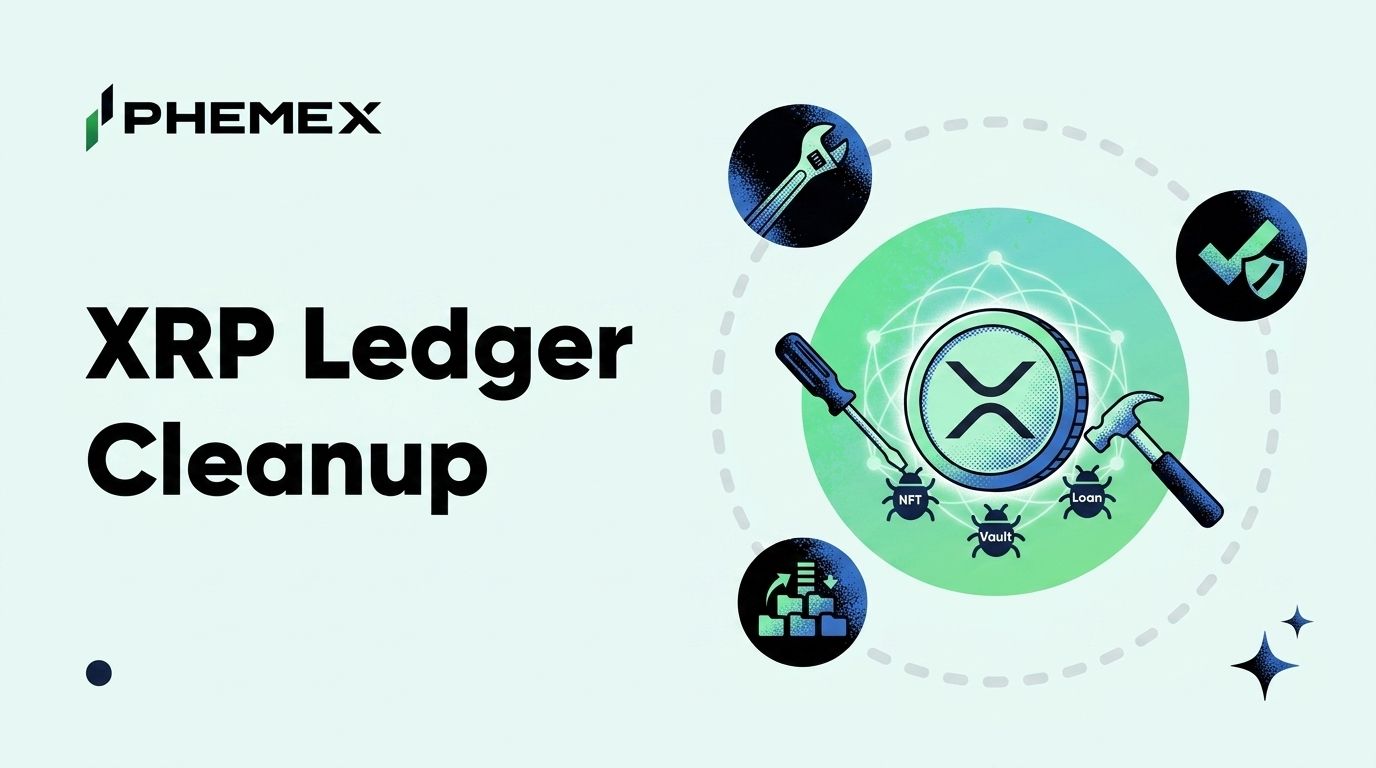
The XRP Ledger is days away from activating fixCleanup3_1_3, an amendment that patches bugs across three different parts of the protocol. The activation window closes on or around May 27, 2026, and the amendment has already cleared the roughly 80% validator threshold that XRPL governance requires. XRP itself is trading near $1.35, down about 1.5% on the day, sitting in the range it has held for most of the month while the bigger Ripple stories play out around it.
This amendment is not a price catalyst. It is the kind of unglamorous maintenance release that tells you how seriously the people running an L1 treat the parts of the protocol most retail holders never look at, and there are three of those parts in this release.
What an XRPL Amendment Actually Is and How Activation Works
XRPL does not do hard forks the way Ethereum or Bitcoin do. New features and bug fixes ship as named amendments inside a release of the rippled server software. Validators upgrade to the new binary, which advertises support for the amendments bundled with that version, and the network counts support over a two-week consensus window. An amendment that holds at least roughly 80% validator support across the window activates automatically at the end of it.
fixCleanup3_1_3 was bundled with the rippled 3.1.3 release and is flagged as a default-yes amendment, meaning a validator running 3.1.3 supports it unless the operator explicitly votes no. That is how the amendment hit effectively 100% consensus inside its voting window. Around 40% of the active validator set had already upgraded to 3.1.3 when the window opened, with the rest pushed to update before May 27 to avoid being amendment-blocked. The XRPL known amendments page tracks the live status. An amendment-blocked validator stops processing new ledgers, which is why XRPL upgrade deadlines are real deadlines and not soft recommendations.
What fixCleanup3_1_3 Actually Fixes
The amendment bundles three distinct bug classes into one cleanup release. None of them are flashy. All of them touch features that real applications on XRPL already depend on.
Expired NFT offers stuck on the ledger. Before this amendment, an `NFTokenOffer` entry that had passed its expiration time was still treated as a real ledger object. It took up state, it showed up in queries, and it had to be cleaned up by a separate transaction or it just sat there forever. After activation, accepting an expired offer with `NFTokenAcceptOffer` deletes the offer as part of normal transaction processing. The offer fails as it should, but the stale record finally leaves the ledger.
Vault withdrawals that ignored trust line limits. XRPL vaults let issuers and protocols hold pooled assets that users can withdraw against. The bug here was a missing check. A `VaultWithdraw` transaction could push tokens into a destination account even when that account's trust line had a balance limit that the withdrawal would exceed. After activation, `VaultWithdraw` enforces the destination trust line limit for both share-denominated and asset-denominated withdrawals, which is the behavior the rest of the protocol already assumes.
Loan accounting that did not update when loans changed state. This one matters for anyone building on the XRPL lending protocol. When a loan was impaired, defaulted, or restored from impaired status, the accounting fields inside the related `Loan`, `LoanBroker`, and `Vault` entries did not always update to reflect the new state. The borrower record changed, but the totals other contracts read from the broker and vault objects did not. After activation, those fields update on every state transition, so downstream logic sees an accurate balance.
Why These Specific Bugs Matter for XRPL Builders
At first read, fixCleanup3_1_3 looks janitorial. It is more pointed than that. Each fix plugs a place where an application built on top of the ledger could quietly do the wrong thing.
The expired NFT offer fix sounds cosmetic until you remember that NFT marketplaces query offers as part of their core listings logic. Stale offers inflate apparent liquidity and force every marketplace operator to write their own filtering layer. Cleaning those records up at the protocol level removes a class of edge case every NFT app on XRPL has had to work around.
The vault withdrawal fix is bigger than it reads. Trust line limits exist so an account can refuse to hold more than a chosen amount of any issued asset. If a vault could ignore that limit on withdrawal, the destination account ends up holding a position it explicitly capped, and that is the kind of invariant violation that makes auditors nervous.
The loan accounting fix is the one that touches the most fragile surface. The XRPL lending protocol is recent, and the loan, broker, and vault objects it introduces are the building blocks any onchain credit product has to read from. If those totals do not update when a loan defaults, every system reading them is making decisions on stale data.
|
Bug class
|
What was wrong
|
Who notices
|
|
Expired NFT offers
|
Offers stayed on ledger past expiry
|
NFT marketplaces, indexers
|
|
Vault withdrawals
|
Trust line limit ignored on payout
|
Vault issuers, audited DeFi apps
|
|
Loan accounting
|
Loan, broker, and vault totals stale after state changes
|
Lending protocols, credit products
|
None of this changes the XRP token's monetary properties. All of it changes what developers can trust the ledger to do.
How This Fits Into the Broader XRP Institutional Story
XRP holders have spent most of 2026 watching macro and regulatory stories rather than protocol stories. The SEC and CFTC joint commodity classification in March, the CLARITY Act markup clearing Senate Banking, and the Trump executive order on May 19 directing the Fed to consider Reserve Bank account access for fintechs and digital asset firms have all dominated the conversation. Phemex's own coverage of the Trump-Fed payment order walks through what Ripple's master account application would actually do for cross-border payments.
Against that backdrop, a default-yes cleanup amendment looks small. The honest read is that the institutional story and the protocol story reinforce each other. CLARITY matters because it removes legal ambiguity for institutions. A Fed master account matters because it would plug XRP-denominated payments into the rails banks already use. A clean, well-maintained ledger underneath both of those stories matters because that is the surface institutions would actually transact on. fixCleanup3_1_3 is invisible from the price chart but expensive to skip if you want institutional capital deployed on the chain.
For more context on what the underlying asset does, the Phemex Academy guide to Ripple and XRP and the XRP ETF rundown are both useful starting points before tying this protocol upgrade into a broader thesis.
Trade Crypto Futures on Phemex →
What to Watch Post-Activation
The first thing to track after May 27 is mechanical. Did the amendment activate cleanly, did any meaningful validator percentage end up amendment-blocked, and did the network keep producing ledgers at the same cadence. Those answers usually arrive within hours and are visible on validator dashboards and in the crypto.news coverage of the deadline.
The second thing is how quickly XRPL NFT marketplaces and active lending protocols ship visible follow-up changes that lean on the new behavior. Expired offer cleanup lets indexers simplify their filtering logic, and corrected loan accounting lets brokers publish more accurate position data. Those small UX and reporting wins signal builders are actually using the new ledger surface rather than just tolerating it.
Broader XRP pricing is the third thing, and it will mostly follow whatever CLARITY, the Fed master account question, and ETF flow data do over the next few weeks. XRP's $1.30 to $1.50 range has held while all three of those stay unresolved. A clean ledger upgrade does not change that range, but it does add a data point to the case that the chain underneath the story is being maintained properly.
Frequently Asked Questions
What is fixCleanup3_1_3?
It is the named bundle of bug fixes inside the rippled 3.1.3 release of the XRP Ledger server software. The amendment patches expired NFT offer cleanup, vault withdrawal trust line enforcement, and loan accounting updates inside the lending protocol, and it is scheduled to activate on or around May 27, 2026.
Does the upgrade change anything for XRP holders who just hold the token?
Not directly. The token's supply, issuance schedule, and transaction mechanics are unchanged. The upgrade affects how applications built on top of the ledger behave, which matters more for builders and audited DeFi protocols than for someone holding XRP in a wallet or on an exchange.
How does the XRPL amendment process compare to a hard fork?
It does not require a coordinated cutover. Validators upgrade to a new server version that advertises support for an amendment, and if support holds at the roughly 80% threshold across a two-week window, the amendment activates automatically. Validators that have not upgraded by activation become amendment-blocked and stop processing new ledgers until they update.
Is the activation a buy signal for XRP?
No, and treating a protocol cleanup amendment as a trading catalyst is usually a fast way to lose money on a low-conviction setup. The XRP price drivers right now are CLARITY Act progress, the Trump executive order on Fed account access, ETF flow data, and the broader macro tape. The amendment matters for the chain's long-term health, not for the next leg of the price chart.
Bottom Line
fixCleanup3_1_3 activates on or around May 27, 2026, and what it actually changes is small, specific, and useful. Expired NFT offers stop cluttering the ledger, vault withdrawals stop ignoring trust line limits, and loan accounting stops drifting when loans change state. The institutional story around XRP gets the headlines, but the chain underneath that story is the surface every serious counterparty has to trust. The reasonable thing to watch is not the post-activation tape on XRP. It is the next two or three rippled releases. A protocol that ships cleanup amendments on schedule and gets them past the validator threshold without drama is signaling that it is being maintained for the institutional load it claims to want.
This article is for informational purposes only and does not constitute financial or investment advice. Cryptocurrency trading involves substantial risk. Always conduct your own research before making trading decisions.