ORE is a Solana mining token that closed at 78.13 dollars on Friday 11 September 2026, a 40.93 percent gain on the session before. It runs no hashing at all. Miners stake SOL on a twenty-five square board, and an on-chain draw pays the winner in freshly minted ORE.
The token's freeze authority reads null and its mint authority is live. A checklist trained on Solana scams treats the first as safe and the second as a rug. On ORE both readings are backwards. The mint authority is an immutable program that refuses any mint above two tokens and blocks a second mint inside 150 slots. It also cannot push supply past a 3,000,000 hard cap.
ORE at a Glance
|
Metric
|
Details
|
|
Token name
|
ORE
|
|
Ticker
|
ORE
|
|
Blockchain
|
Solana
|
|
Contract address
|
oreoU2P8bN6jkk3jbaiVxYnG1dCXcYxwhwyK9jSybcp
|
|
Token program
|
Classic SPL Token, account space 82, 11 decimals
|
|
Maximum supply
|
3,000,000 ORE, fixed as a constant in the mint program
|
|
Supply minted
|
490,737.04 ORE on a 12 September 2026 chain read, 16.36% of the cap
|
|
Mint authority
|
BiN8KJqtGanTmHzgTyJA3ALwLaqygt5KzRydH7gX5rf4, live, owned by a program with no upgrade key
|
|
Freeze authority
|
None
|
|
Metadata update authority
|
J5K5tWj3nKfxuSkAJ25WTMf4u5EsxJRfUoRKKxgrfFGV, an ordinary wallet, metadata still mutable
|
|
Core narrative
|
SOL-staked mining on a 25 square board, funding buybacks that burn ORE
|
|
Close, Friday 11 September 2026
|
78.13 dollars, CoinGecko dated close
|
|
Availability on Phemex
|
Not listed. No ORE spot pair and no ORE futures contract
|
What Is ORE and What Does the Token Do?
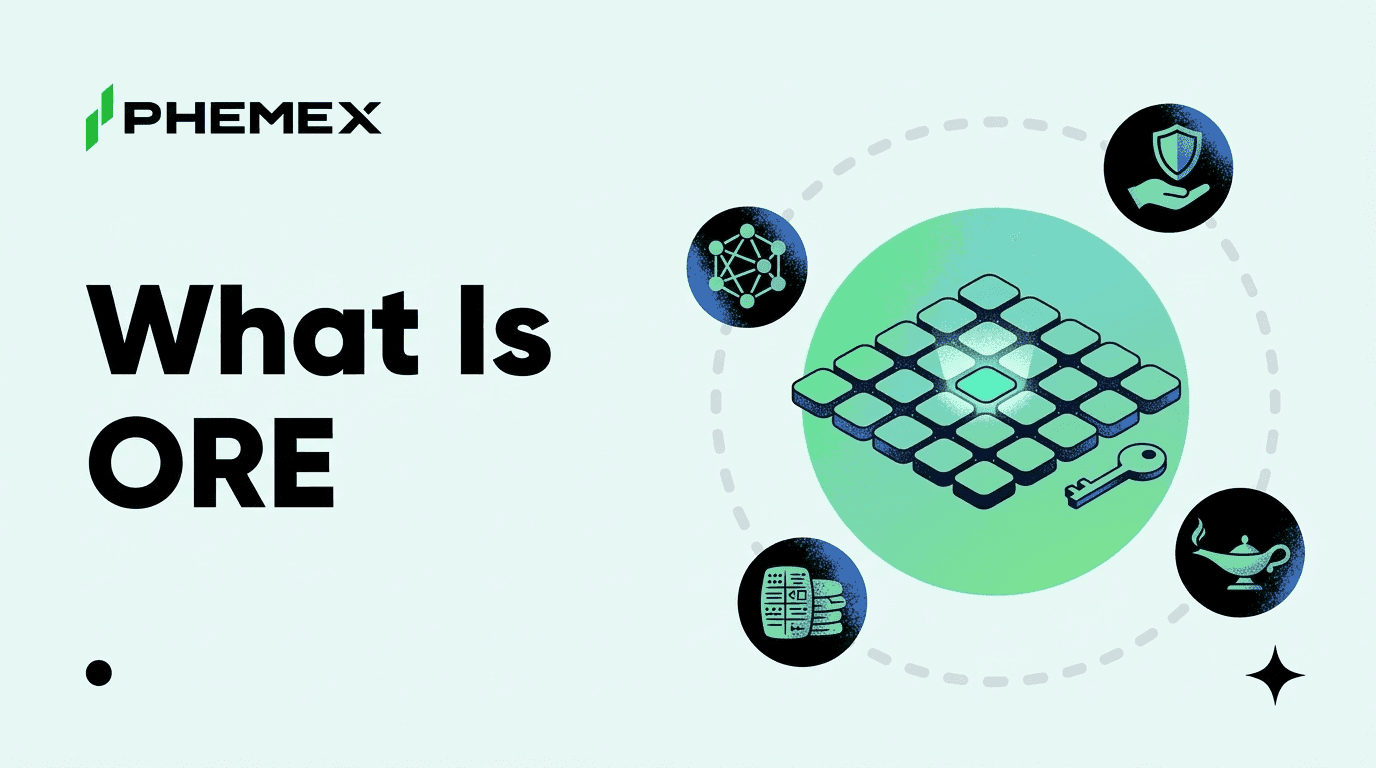
ORE is the reward token of a mining game that lives entirely inside a Solana program. You don't buy hardware and you don't run a hash function. You pick squares on a five-by-five board and you deploy SOL onto them. When a round closes, the program reads a random value and picks one winning square. The miner who claimed that square collects one freshly minted ORE. Another 0.2 ORE drops into a jackpot pool the code calls the motherlode, and that pool pays out on about one round in 500.
Two more rules shape what a round actually pays. On roughly half of all rounds the program splits the winning ORE across everyone who claimed that square, and on the other half a single claimant takes the whole token. Round length is a configurable number of Solana slots, so the clock on this game is a setting and not a constant.
That design is why the ORE contract address reads the way it does. The mint has to stay open, because the game mints the rewards round by round. Anyone running the standard Solana safety pass, the one our guide to auditing a new crypto contract walks through, hits a live mint authority and stops reading.
Stopping there is the mistake, and the program's own code says why.
Why Is the ORE Mint Authority Still Live?
The mint authority on the ORE token points at an account that a second program owns, and not at a wallet. That program carries no upgrade authority at all. Its last deployment landed on 9 December 2025, and no key exists that could amend its code afterwards.
Method: I read the ORE mint account through a Solana mainnet node on 12 September 2026, using the contract address in the table above. It returned 11 decimals, a null freeze authority and a live mint authority, against a raw supply of 49,073,703,958,776,294 base units. I then pulled the program that owns that mint authority account, and its loader record came back with the upgrade field empty.
A null mint authority proves one narrow thing. It tells you the deployer gave up the power to print more, at the moment you read the account, and it tells you nothing else. It says nothing about a transfer hook, nothing about a fee extension and nothing about who can amend the program that governs the token. ORE answers two of those questions by the shape of its mint account. That account runs 82 bytes under the classic SPL token program, the plain layout with no extensions bolted on, so no transfer fee and no hook waits on your next send.
Those 11 decimals matter more than they look. One ORE splits into 100 billion base units, which the program's comments call grams. That precision lets the game pay a winner every round without rounding the reward down to nothing.
Three constants and three refusals do the actual work, and you can read them in the mint program's published file of program constants on GitHub. The maximum supply constant sets 3,000,000 ORE. A second constant caps any single mint request at two ORE. A third forces at least 150 Solana slots between requests, which lands near a minute of wall clock.
The mint instruction throws out a request that breaks any one of those, and it throws out any signer that is not the ORE treasury account. So a live mint authority here can add at most two ORE at a time, at a pace the chain enforces, and it can never carry supply past the cap.
How Does ORE Mining Work on Solana Without Hashing?
Classic mining spends electricity on a hash function, and the security argument behind that sits in our explainer on proof of work and network security. ORE mining spends SOL on board position. A miner deploys lamports onto any of the 25 squares, the round runs for a fixed number of slots, and the program then draws one square from a chain randomness source.
Fees are where the token gets its bid. Every square pays a one percent admin fee on the SOL deployed to it. Every losing square then pays a further ten percent of what remains into the protocol vault, and the winning square pays nothing.
That vaulted SOL is what buys ORE back. The treasury wraps it, swaps it through an on-chain aggregator, and then splits the ORE it receives. Ten percent goes to ORE stakers and the program burns the other ninety, which the buy-and-burn instruction in the ORE program spells out line by line.
Stakers sit on the other side of that burn. Their ten percent doesn't arrive as a lump, because the same instruction that burns the remainder routes the shared portion into a staking treasury on a vesting schedule. One pot of losing SOL funds two constituencies, and both of them want the board busy.
So ORE mining pays in two directions at once. New ORE enters on the winning square and bought-back ORE leaves in the burn. The ORE token supply number you read on any data feed is the net of those two flows at whatever moment that feed last looked.
What Moves the ORE Crypto Price?
The Session Move
ORE crypto ran from 55.44 dollars at the 10 September 2026 close to 78.13 at the 11 September close, a gain of 40.93 percent in one session. Over seven sessions to the same date it added 29.28 percent, and over thirty it added 19.22 percent. Those three figures are CoinGecko dated closes, requested one day forward, which is how that feed labels a completed day.
Supply Mined Against the Cap
The chain read on 12 September 2026 put 490,737.04 ORE in existence, or 16.36 percent of the 3,000,000 cap. That leaves about 2,509,263 ORE for the game to pay out, two tokens per request, with 150 slots between requests. Emission runs slow and the code schedules it, so the float grows on a curve a reader can compute.
Board Activity, Which Funds the Burn
The burn side scales with how much SOL loses. Ten percent of every losing square funds the vault, so a quiet board buys back little and a busy one buys back a lot. A trader watching this token is really watching deployed SOL per round.
The Depth Behind the Quote
Thirty Solana pairs quote ORE and they held 1,174,757 dollars of pooled liquidity on a 12 September 2026 read. The three deepest pools carried 902,749 of that, or 76.8 percent of all the depth on the token. An order sized against a book that thin moves the print, and the mechanics are laid out in our piece on market makers versus market takers.
The Cap Two Feeds Cannot Agree On
Circulating supply times the dated close is the defensible way to build a capitalisation, and our walkthrough on how to calculate market cap shows that arithmetic. Run it with the 12 September chain supply and the 11 September close and you get 38,340,933 dollars. CoinGecko published 38,326,255 for the same close, which implies 490,549.17 ORE in circulation, or 187.87 tokens behind the chain.
CoinPaprika, the second feed I checked, carries ORE with a market cap of zero and no circulating supply at all. So the capitalisation in wide circulation rests on one source, and a live mint pulls it out of date between reads.
Risks of Buying or Trading ORE
One wallet holds two keys that matter on this token. The same address is the upgrade authority on the mining program and the update authority on the token's Metaplex metadata, and that metadata still carries its mutable flag set. Whoever holds that key can redeploy the game's logic and can rewrite the token's on-chain name, symbol and image.
Someone used that key on 10 September 2026. A commit landed in the ORE repository at 18:16 UTC reading bump liq to 2 percent, and a new build of the mining program hit mainnet at 18:50 UTC the same day. Thirty-four minutes between a public commit and a live redeploy tells you the economics of this game can change on a weekday afternoon.
The round clock is a setting as well. Round length and the intermission between rounds live in a protocol config account the program authority can update, so the cadence you measure in September is no promise for October. Emission per round is fixed in code and the pace of rounds is not.
Eleven decimals will catch a tool out. Most Solana tokens carry six or nine, and any reader that assumes nine reports an ORE balance a hundred times too large. Check the decimals before you trust a balance from anything except the chain.
The ticker is crowded. One data feed I searched returns at least three separate assets under the ORE name, including a wrapped version and an entry labelled Ore OLD, the pre-fork mint. The ORE token Solana traders mean is the one at the contract address in the table, and a null mint authority reading would never have separated them.
I could not verify holder distribution. Nine attempts at the largest-accounts call across three Solana nodes came back rate limited, so this article says nothing about who owns the float. A failed pull is a gap in the record, not a clean bill.
Phemex lists no ORE market. The product set pulled on 12 September 2026 carries 116 futures contracts and 291 spot pairs, and ORE appears in neither, so every price above comes from public feeds and on-chain pools.
How to Check the ORE Contract Address Yourself
Four reads settle the identity question, and a public node answers all of them in a couple of minutes.
What to watch: read the mint account and record the decimals, the supply and both authorities. Read the metadata account and check the name bytes for homoglyphs, because a Cyrillic character passes for a Latin one at small sizes. Read the owner of any live mint authority, since a program-owned authority and a wallet-owned one carry completely different risk. Compare two price feeds last, and treat a disagreement as a question, not as noise.
The bytes came back clean on ORE. The on-chain name and symbol are three ASCII characters with no invisible padding, and the metadata pointer resolves to a 201 byte file repeating the same name and symbol, so the chain and the pointer agree.
Position size is the check that belongs before the trade. Our guide to risk management in derivatives trading covers the sizing arithmetic on an asset this thin.
Final Thoughts
The safety pass most traders run on a Solana token filters for one kind of fraud, and ORE is a reminder that every filter has a false positive rate. Null authorities are a snapshot of what a deployer chose to give up. They say nothing about what the surviving code may do, and on this token the surviving code is the entire argument.
The checkable guarantee here isn't an empty field. It's a program deployed once in December 2025 with three refusals written into it and no key left to amend them, which is a harder promise than a revoked authority and almost no screener reports it.
Disclaimer: This article is for informational purposes only and is not financial advice. Cryptocurrency trading involves substantial risk. Always do your own research before making investment decisions.