


 Rewards Hub

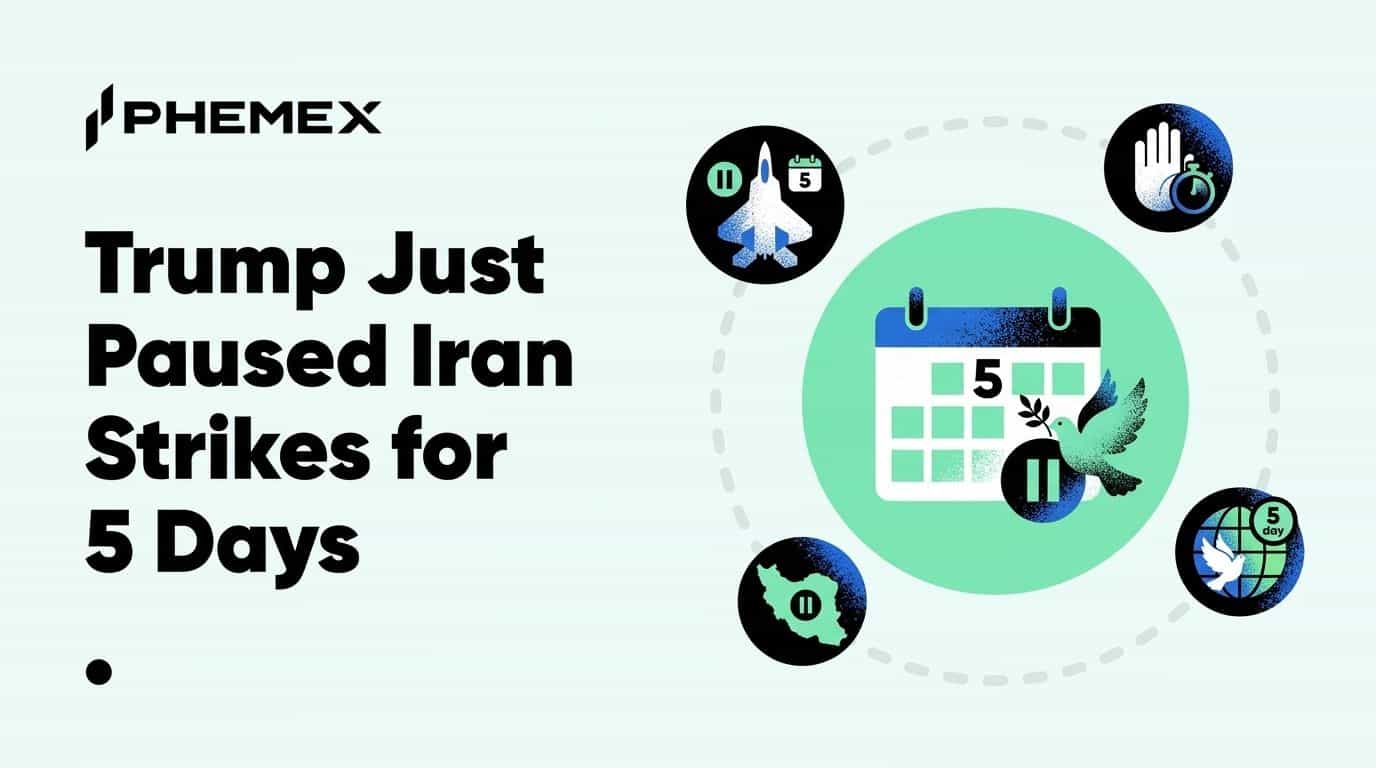
Bitcoin jumped from roughly $68,000 to $71,000 on March 23 after President Trump announced a five-day pause on strikes against Iranian energy infrastructure. The move happened in under four hours, triggering $280 million in short liquidations and $135 million in long liquidations as leveraged traders on both sides got caught in the whipsaw.
That $3,000 candle tells you something about the current market. BTC has been stuck in a $65,600-$72,500 range since the March 18 FOMC selloff, and the Fear and Greed Index was sitting at 22 before the rally. Extreme fear plus a sudden geopolitical relief catalyst is the exact recipe for a violent short squeeze. The question now is what happens when the five days are up.
Why BTC Reacted to a Geopolitical Event This Hard
Bitcoin is supposed to be the "uncorrelated" asset, but in practice it trades like a high-beta risk asset during active conflict escalation. Oil at $112 per barrel had been pushing equities and crypto lower for weeks because rising energy costs squeeze corporate margins, raise inflation expectations, and make the Fed less likely to cut rates.
Think of oil as a tax on everything else in the financial system. When oil spikes, money flows into energy and out of risk assets like BTC, and when oil drops, that pressure reverses almost immediately. Trump's pause on strikes removed the immediate tail risk of $130+ oil, and the market priced that out in minutes.
The $415 million in total liquidations across the crypto market tells you just how crowded the short side had become. When positioning gets that one-sided, any positive catalyst creates a reflexive feedback loop where forced buying drives price higher, which triggers more liquidations, which drives more buying.
The Messy Part Nobody Is Talking About
Here is where it gets complicated, because Iran denied that any talks with the U.S. were happening, according to Fars news agency. Trump meanwhile said "very good, productive" conversations were underway, and the market briefly flinched on the denial but ultimately held most of the gains through the session.
This disconnect matters for the next five days. If Iran is genuinely at the negotiating table, the pause likely extends and oil comes back toward $105-$108. If Iran is not negotiating and Trump is using the pause as a reset before escalating further, the clock runs out around March 28 and everything reverses.
Crypto liquidation. (CoinGlass/CoinDesk)
The reason most traders get caught in situations like this is they pick a side before the information arrives. Right now, there is no edge in guessing which scenario plays out, but there is an edge in knowing what to watch and at what levels to act.
What History Says About Geopolitical Shocks and BTC
Bitcoin recovers faster from geopolitical shocks than from monetary policy shifts. This pattern has held consistently over the past three years. When Russia invaded Ukraine in February 2022, BTC dropped about 8% in two days and recovered the entire move within 10 days. But when the Fed pivoted hawkish in late 2021, BTC spent over a year in a downtrend.
The logic is straightforward enough once you see the pattern. Geopolitical events create uncertainty and fear, but the actual economic damage is usually priced in quickly once the initial shock passes. Monetary policy shifts, on the other hand, change the fundamental cost of capital for months or years. That repricing takes much longer.
|
Shock Type
|
Initial BTC Drop
|
Recovery Time
|
|
Russia-Ukraine invasion (Feb 2022)
|
~8%
|
~10 days
|
|
Iran drone strike on Israel (Apr 2024)
|
~6%
|
~7 days
|
|
March 2022 Fed rate hike cycle start
|
~12%
|
10+ months
|
|
March 2026 FOMC hawkish hold
|
~5%
|
Still in range
|
The current Iran situation fits the geopolitical category. If strikes do not resume, history says the recovery completes quickly and BTC pushes toward the top of the range.
Two Scenarios and the Levels That Matter
Scenario 1: Strikes do not resume. Oil drops back toward $105-$108, the pressure on risk assets lifts, and BTCpushes through $72,500 resistance toward the $74,000 pre-FOMC high from March 17. Spot Bitcoin ETF inflows would likely confirm this move within 24-48 hours of the pause holding.
Scenario 2: Strikes resume after March 28. Oil pushes above $115 and possibly toward $120, which would send shockwaves through every risk market. BTC retests $65,600, the bottom of the current range. If that level breaks, the next support sits around $62,000-$63,000 based on the January consolidation zone. ETF outflows would accelerate this move.
The honest answer is that neither scenario is clearly more likely right now. But both scenarios have defined levels and defined confirmation signals, which means you do not need to predict the outcome. You need to recognize which scenario is activating and position accordingly.
ETF Flows Are Your Confirmation Signal
Forget the headlines for a moment. The single best real-time indicator for which direction BTC breaks from here is spot Bitcoin ETF net flows. Institutional money moving through ETFs like BlackRock's IBIT and Fidelity's FBTC reacts to geopolitical risk with a 12-24 hour lag compared to futures markets.
If ETF flows turn positive on March 24-25 and hold through mid-week, institutions are betting the pause becomes permanent or at least extends. That is your signal that Scenario 1 is in play.
If ETF flows stay flat or go negative despite the price rally, the smart money is not buying the relief. That would suggest the bounce is purely short-squeeze mechanics and the next leg down is more likely once the squeeze exhausts itself.
What to Watch This Week
The five-day window creates a clear timeline. Here is what matters each day.
March 24-25 is about ETF flow data and oil price action. If oil stays below $110 and ETF inflows are positive, the relief trade has legs. March 26-27 is about diplomatic signals. Any credible reports of actual negotiations between Iran and the U.S. would extend the window and push BTC higher. March 28 is the hard deadline, and if no extension is announced by end of day, expect volatility to spike sharply in either direction.
The levels worth watching are straightforward. Above $72,500 with ETF confirmation, the path to $74,000 opens up. Below $68,000 on a resumption of hostilities, $65,600 gets tested fast. A break of $65,600 invalidates the range entirely and brings $62,000 into play.
And if you are sitting in a leveraged position right now, the $415 million in liquidations from March 23 should be a reminder. Size matters more than direction in a headline-driven market. The traders who survived the whipsaw were the ones with manageable position sizes, not the ones who guessed the right direction.
Frequently Asked Questions
Why did Bitcoin pump when Trump paused Iran strikes?
The pause removed the immediate risk of oil spiking above $120, which would have crushed all risk assets including crypto. BTC was heavily shorted going into the announcement with the Fear and Greed Index at 22, so the relief catalyst triggered a massive short squeeze that drove price from $68,000 to $71,000 in hours.
Does Bitcoin go up or down if Iran strikes resume?
Historically, BTC drops 5-8% on active military escalation events but recovers within 7-10 days once the initial shock is absorbed. If strikes resume after March 28, expect a retest of $65,600, but the longer-term trajectory depends more on Fed policy and ETF flows than any single geopolitical event.
What is the best way to trade Bitcoin during geopolitical uncertainty?
Keep position sizes smaller than normal and avoid high leverage. The $415 million in liquidations on March 23 hit traders on both sides of the trade because the market moved violently in both directions within hours. Use defined levels like $72,500 resistance and $65,600 support as your decision points rather than trying to predict headlines.
Should I buy Bitcoin during the Iran pause?
The historical pattern favors buying geopolitical fear when the Fear and Greed Index is below 25, but confirmation matters more than timing. Wait for ETF flow data on March 24-25 before committing. Positive inflows alongside price holding above $70,000 is a stronger setup than buying the initial spike alone.
Bottom Line
The five-day pause gives the market a defined window to watch instead of reacting to every headline in real time. BTC sitting at $71,000 with the Fear and Greed Index still in extreme fear territory means the crowd has not caught up to the price move yet, and that disconnect usually resolves with further upside if the catalyst holds. The confirmation checklist is short but specific. ETF inflows positive by March 25, oil staying below $110, and BTC holding above $70,000. If all three conditions are met by mid-week, the path to $74,000 is the higher-probability outcome. If any of those conditions fail, the $65,600 floor becomes the next battleground. The traders who do well this week will not be the ones who predicted the outcome of U.S.-Iran diplomacy. They will be the ones who had a plan for both scenarios and waited for the market to tell them which one was playing out.
This article is for informational purposes only and does not constitute financial or investment advice. Cryptocurrency trading involves substantial risk. Always conduct your own research before making trading decisions.