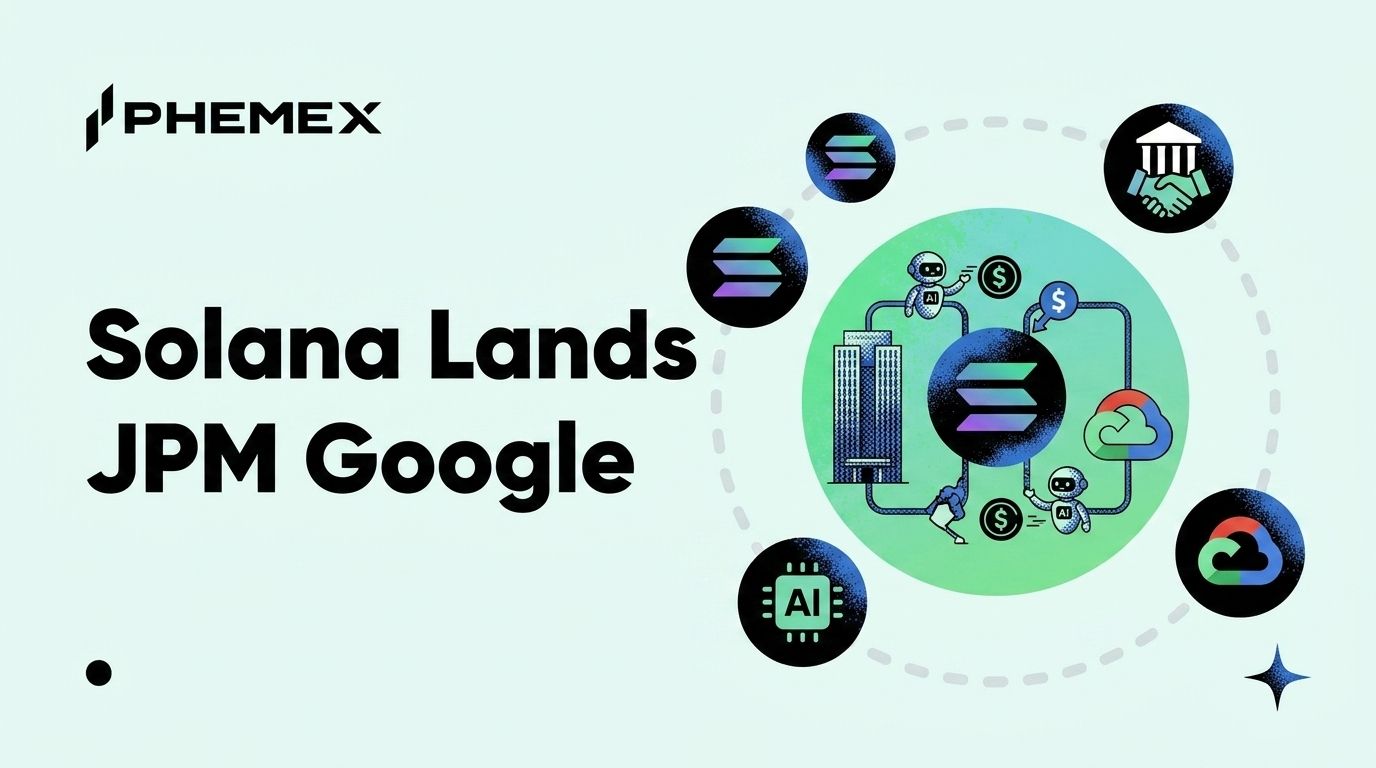
SOL is trading around $92.38, up roughly 10% on the week and the strongest large-cap performer in the top 10. The price move did not happen in a vacuum. Inside the same week, JPMorgan Asset Management partnered with Anchorage Digital to build tokenized stablecoin reserves on Solana, and the Solana Foundation rolled out Pay.sh with Google Cloud to settle AI agent payments in stablecoins. Two separate enterprise picks in seven days, both choosing Solana over Ethereum, both pointed at the largest growth categories in the next cycle.
This is not a coincidence. It is a positioning shift that has been building for months, and the deals this week confirm a thesis the market only half-believed at the start of the year. Here is what each partnership actually does, why both names chose Solana specifically, and what it means for the broader institutional and AI agent narratives.
What Anchorage and JPMorgan Are Actually Building
Anchorage Digital, the only federally chartered crypto bank in the United States, announced it is working with JPMorgan Asset Management on a new stablecoin reserve model called Cashless Reserves. The structure is exactly what it sounds like. Instead of stablecoin issuers holding billions in idle cash to back redemptions, the reserves sit on Solana in tokenized, yield-bearing, low-risk instruments that can be converted into liquidity on demand.
The mechanics matter because the stablecoin market is now north of $300 billion in total issuance, and the cash drag on those reserves is real. A typical large stablecoin issuer holds a meaningful portion of reserves in short-duration Treasuries or money market funds that already yield 4-5%, but the operational layer (the part that actually moves money when redemptions come in) still sits in idle cash buffers that earn nothing. Cashless Reserves replaces that buffer with on-chain tokenized instruments that throw off yield until the moment they are redeemed for liquidity.
For JPMorgan Asset Management, this is a way to bring institutional-grade tokenized money market products into the stablecoin reserve stack at scale. For Anchorage, it is a way to offer stablecoin issuers a more capital-efficient backing model without giving up the redemption guarantees that make a stablecoin a stablecoin in the first place. For Solana, it is the part that matters most. JPMorgan picked Solana to host the tokenized instruments, not Ethereum, not a private permissioned chain, not its own internal Kinexys network.
What Solana and Google Cloud Just Launched
Two days after the Anchorage news, the Solana Foundation and Google Cloud rolled out Pay.sh, a payments gateway built for AI agents. The product solves a problem that has been theoretical for two years and is now becoming a real bottleneck. AI agents need to autonomously pay for API access, compute, data, and external services, and they need to do it without a human in the loop, without a credit card on file, and without setting up an account for every provider they touch.
Pay.sh handles all of that. An AI agent connects a Solana wallet, gets funded with USDC in about 60 seconds, and from that point can find and pay for any service that supports the gateway on a per-request basis. The launch already covers Google Cloud's own AI stack (Gemini, BigQuery, Vertex AI) along with more than 50 third-party API providers across blockchain data, infrastructure, and developer tools. Payments settle on Solana, the service provider gets fiat on the other end, and the agent never has to handle a subscription or a key.
The technical foundation is built on x402 and MPP, machine-native payment protocols designed specifically for agent-to-API commerce. The x402 standard is backed by Google, Stripe, AWS, Visa, and Mastercard through the Linux Foundation, which is the kind of consortium that does not usually attach itself to a single chain unless that chain is going to be the default settlement layer.
Why Both Names Picked Solana Over Ethereum
The question is not why JPMorgan or Google chose to put institutional rails on a public blockchain. That decision was made a year ago when the regulatory environment in the US opened up and the SEC and CFTC commodity ruling gave institutional desks the legal cover they had been waiting for. The question is why both picked Solana specifically over Ethereum, which still has the deeper liquidity, the larger developer community, and the longer institutional track record.
The honest answer is throughput and cost. Stablecoin reserve operations and AI agent payments share a profile that breaks Ethereum's design assumptions. Both involve high-frequency, low-margin transactions where a $5 gas spike during a NFT mint or a memecoin rotation is fatal to the use case. An AI agent paying $0.01 per API call cannot tolerate $2 gas. A stablecoin issuer rotating reserves cannot wait 12 seconds per block for confirmation when redemption demand spikes.
Solana's block times of roughly 400 milliseconds and fees in fractions of a cent are not academic specs. They are the difference between the use case working and not working at production scale. JPMorgan and Google are not picking Solana for the narrative. They are picking it because the alternative does not run their workload reliably.
And there is a second-order effect that is easy to miss. Each time TradFi or Big Tech picks Solana, it functions as a vote against Ethereum being the default institutional chain. That assumption has been the implicit base case for institutional crypto strategy since 2020. The Anchorage and Google deals do not break that assumption on their own, but combined with Meta's USDC payment rails on Solana, Circle's $38 billion in USDC issued on Solana this year, and a growing list of comparable picks, the default is shifting.
The Broader Context Around Solana Right Now
Two things are happening to Solana simultaneously, and they reinforce each other.
First, the network's on-chain activity has hit new records. Solana's total value locked recently crossed an all-time high of 80 million SOL, driven by liquid staking growth, DeFi expansion, and the Pay.sh launch generating real transaction demand. The TVL number matters less than the composition. The chain is not running on speculative meme cycles alone anymore. It is running on enterprise integrations, stablecoin float, and institutional product flow.
Second, the AI agent narrative is starting to find an actual home. NEAR has been pushing its AI Agent Market hard. Virtuals Protocol has built a real ecosystem of autonomous tradeable agents. SKYAI is positioning its MCP Hub as the registry layer. All of those are valid plays, but the settlement layer question has been open. Pay.sh effectively answers it for the largest cluster of agents (those built on Google's Gemini and Vertex stack) by giving them Solana as the default rail. If AI agents do proliferate at the scale the bull case implies, that is potentially a massive structural driver for Solana usage that has nothing to do with retail speculation.
|
Recent Solana institutional and enterprise picks
|
Year
|
What it enables
|
|
Visa stablecoin settlement
|
2023
|
USDC merchant payments via Solana
|
|
Shopify Solana Pay
|
2024
|
Merchant checkout in USDC
|
|
Meta USDC creator payouts
|
2026
|
Creator economy stablecoin rails
|
|
Cash App USDC on Solana
|
2026
|
Consumer P2P stablecoin transfers
|
|
Anchorage and JPMorgan reserves
|
2026
|
Institutional stablecoin backing
|
|
Google Cloud Pay.sh
|
2026
|
AI agent API payments
|
|
Multiple spot SOL ETFs
|
2026
|
Regulated retail and RIA exposure
|
The list is not exhaustive. It is the highlight reel of integrations where the customer is a real enterprise with a budget, a procurement process, and a multi-year roadmap. Each one took 12 to 24 months of evaluation before the announcement. They are not impulse picks.
What This Means for SOL the Asset
There is a gap between Solana the network and SOL the token that is worth being honest about. Enterprise integrations on a chain do not automatically translate into upward price pressure on the chain's native token. Ethereum learned this the hard way during the institutional adoption push of 2024-2025, when ETH underperformed for stretches even as institutional product launches accelerated. The mechanism connecting protocol usage to token price is indirect, and it runs through staking demand, fee capture, and the speculative premium attached to "the chain TradFi picked."
For SOL specifically, the connection is tighter than it was for ETH at the equivalent stage. Solana's fee burn mechanism is more direct, validator economics are more dependent on real transaction volume, and the staking yield (around 6-7% APY) gives long-duration holders an incentive that is not diluted by Layer 2 fragmentation. Spot SOL ETFs are already live across multiple issuers, which means the institutional capital that wants Solana exposure has a regulated wrapper to express the view.
None of this guarantees that the SOL price tracks the institutional flow in the short term. The 10% week-over-week move probably already priced in some of the headline impact. What the deals change is the longer-term thesis. Solana is no longer a story about being a "faster Ethereum" or "the chain that survived FTX." It is a story about being the chain that enterprise and AI workloads actually run on.
Frequently Asked Questions
Why did JPMorgan choose Solana for stablecoin reserves instead of Ethereum?
The Cashless Reserves model requires high-frequency, low-cost transactions to convert tokenized instruments into liquidity on demand. Solana's sub-second finality and fractions-of-a-cent fees match that operational profile better than Ethereum's mainnet. JPMorgan's tokenized money market products need to settle reliably under load, and Solana's throughput is the practical reason for the pick.
Will Pay.sh actually drive meaningful Solana volume?
The honest answer is it depends on how fast AI agents adopt. If autonomous agent commerce proliferates at the scale Google and the broader x402 consortium are betting on, the volume could be substantial. If AI agents stay mostly experimental for another year or two, the impact is real but slower to show up in on-chain metrics. Either way, the infrastructure is now in place for the scaling case to play out when the demand arrives.
Is SOL a buy on this news?
Anything that registers as a structural shift rather than a one-week headline takes time to play out in price. SOL is already up 10% on the week, so the immediate reaction has happened. The longer-duration case rests on continued enterprise picks and on AI agent volume actually materializing. Position sizing should reflect that this is a multi-quarter thesis, not a 48-hour trade.
How does this compare to Meta's USDC payments on Solana?
Meta's pick was about creator payouts in emerging markets. JPMorgan's deal targets institutional stablecoin reserve mechanics, and Google's launch addresses AI agent settlement at the API layer. The three picks address completely different verticals, which is the reason the broader pattern matters. Solana is being chosen across categories rather than for a single use case.
Bottom Line
Solana just landed two of the biggest enterprise picks of the year inside seven days, and the picks are not duplicates. JPMorgan is using Solana for stablecoin reserve mechanics at the institutional layer. Google Cloud is using it for AI agent payments at the machine-to-machine layer. Both bypassed Ethereum to do it, both for the same underlying reason, and both inside a week that also saw SOL outperform every other large-cap by a wide margin.
The signal worth watching from here is which enterprise picks Solana next, and if the AI agent transaction volume on Pay.sh shows up in on-chain throughput data within the next two quarters. If Pay.sh produces measurable daily payment counts and a second tier-one institutional name announces a Solana integration before the end of Q3, the "chain enterprises actually deploy on" thesis stops being a thesis and starts being a description. The price will follow that story long before retail finishes telling itself the old one.
This article is for informational purposes only and does not constitute financial or investment advice. Cryptocurrency trading involves substantial risk. Always conduct your own research before making trading decisions.