






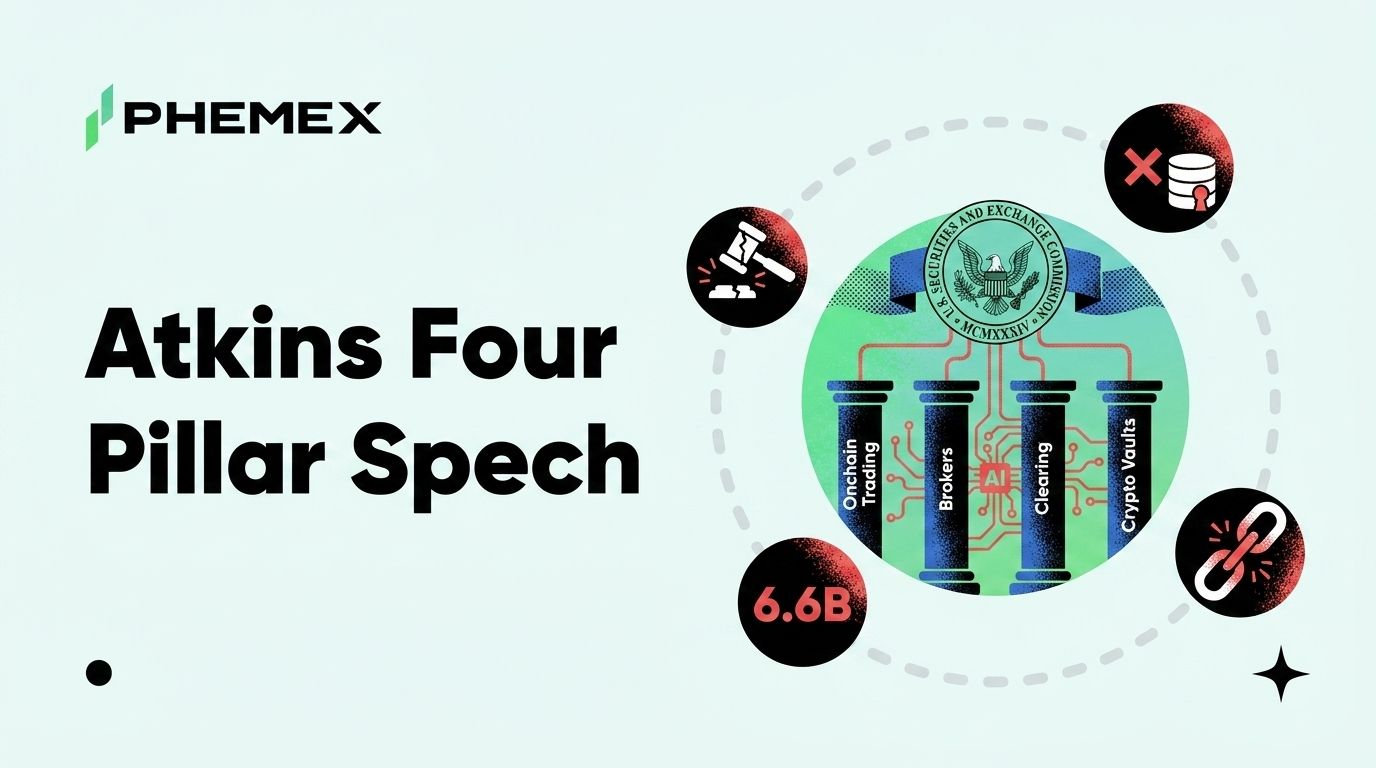
On May 8, 2026, SEC Chairman Paul Atkins walked onto the stage at the Special Competitive Studies Project AI+ Expo in Washington and put every onchain protocol, DEX frontend, staking app, and agentic finance product on formal notice. The speech outlined four specific areas where the Commission is preparing rulemaking for blockchain-based markets and AI in finance. This is the clearest signal yet that the Gensler-era enforcement-by-litigation playbook has been replaced with a notice-and-comment rulebook that names the targets explicitly.
Below is what Atkins actually said, what each of the four pillars covers, and what it changes for traders and builders operating on these rails right now.
What Atkins Actually Said on May 8
The speech itself is short by SEC standards and unusually direct. Atkins framed the moment as the Commission's chance to "clarify how the Commission views the spectrum of models that may implicate our statutes through notice and comment rulemaking, using our exemptive authorities where necessary and prudent." That single sentence is the regulatory thesis for the next 12 to 24 months.
He named four specific areas where the SEC wants industry detail before drafting rules, including onchain trading, broker and dealer definitions for software interfaces, clearing and settlement under instant-finality assumptions, and crypto vaults that pay passive yield. Each one is a distinct rulemaking workstream targeting a different chunk of the onchain stack. Atkins also signaled that the Commission will consider a "limited innovation pathway" soon to give builders room to operate while the larger framework is written. The full transcript sits on the SEC newsroom page, and CoinDesk's coverage captures the institutional reaction in real time.
Pillar 1: Onchain Trading and How Securities Law Maps to Blockchains
The first area Atkins flagged is the most foundational. How do blockchain-based trading systems fit inside existing securities law that was written for centralized exchanges and broker-dealer infrastructure?
The current SEC rulebook assumes a trading venue is a legal entity with operators, employees, and a defined order book. An onchain order book or AMM pool has none of those things in the traditional sense. The protocol runs autonomously, liquidity is provided permissionlessly, and price discovery happens via smart contract logic rather than a matching engine someone owns. Atkins is asking which parts of Reg ATS, Reg NMS, and Exchange Act Section 6 should apply, which parts need to be modified, and which parts simply cannot be applied to code that runs without a custodian.
For traders, this is the workstream that decides if onchain perpetuals, spot DEXs, and prediction markets get a formal US regulatory home or remain in a gray zone where geoblocking and offshore routing are the operational default. If the Commission lands on a workable framework, US users get cleaner access, and if it lands somewhere restrictive, the offshore-routing pattern that defines the current market continues.
Pillar 2: Broker and Dealer Definitions for DEX UIs and Agentic Interfaces
The second pillar is the one that should make every frontend operator pay attention. Atkins specifically named "software interfaces" as a target category, calling out DEX UIs, aggregator frontends, and agentic AI interfaces that route orders through smart contracts.
The legal question is if the interface that connects a user to an onchain protocol counts as a "broker" or "dealer" under federal securities law. Under current case law, the answer is genuinely unclear. A wallet that displays prices is probably not a broker, while a frontend that custodies funds and routes orders for a fee starts to look like one. An AI agent that holds user keys, executes trades autonomously, and pays itself a cut sits in a category nobody has written rules for yet.
This is where the rulemaking gets concrete. If the SEC defines "broker" narrowly to exclude non-custodial frontends, the entire DEX UI category stays legal. If it defines it broadly to capture any interface that displays prices and helps route orders, half the DeFi frontend market needs to register or geoblock US users. The same question applies to agentic finance products that take custody of keys and execute strategies, including the AI-agent trading bots that have become a real category over the past 18 months.
Builders operating in this space should treat the May 8 speech as an open invitation to file comments. The Commission has now publicly said it wants industry input before drafting these definitions. That window will not stay open forever.
Pillar 3: Clearing and Settlement When Trades Are Final in One Block
The third pillar rewrites the most boring and most expensive part of the existing securities infrastructure. Clearing agencies are massive regulated entities (DTCC, OCC, NSCC) that exist because traditional trades take days to settle and counterparty risk needs to be managed by a third party for the duration.
An onchain trade settles in one block. Risk is managed by collateral posted in a smart contract and a liquidation engine that runs without human intervention. The clearing agency model, as currently written into Section 17A of the Exchange Act, does not have a clean place to put a protocol that does all of this with code.
Atkins is asking how the "clearing agency" definition should evolve when the technical premise underneath it has shifted. The implications run through perpetuals exchanges with built-in liquidation engines, lending protocols with onchain risk management, and onchain options markets where the protocol itself is the central counterparty.
Cryptopolitan's analysis of the speech notes that this pillar is the most likely to produce a workable carve-out for protocols that already manage risk on-chain. The argument writes itself. A smart contract that auto-liquidates undercollateralized positions and posts collateral transparently is structurally safer than a manual clearing agency that relies on overnight risk reports.
Pillar 4: Crypto Vaults and How the Securities Act Treats Onchain Yield
The fourth pillar is the one that directly touches retail users. Atkins called out "crypto vaults" by name, describing them as apps that let users earn passive yield on digital assets. That definition captures a huge surface area, from Lido and EigenLayer style staking products to Pendle yield tokenization to Ethena's synthetic dollar strategy to every onchain vault that compounds returns programmatically.
The legal question is if passive yield on a deposited asset crosses the line into an investment contract under the Securities Act. The Howey test asks four things, including investment of money, in a common enterprise, with expectation of profit, derived primarily from the efforts of others. A pure validator-staking product where the user retains custody and the protocol simply distributes block rewards has a clean answer. A vault that pools deposits, runs a strategy operated by a development team, and pays out variable yield based on that team's decisions has a much harder time threading the Howey needle.
Atkins is asking the industry to detail where each category sits on that spectrum so the Commission can write rules that draw the line in a place that lets non-securities products operate freely and treats actual managed strategies as the investment contracts they probably are. OurCryptoTalk's breakdown walks through the practical implications for the biggest vault categories.
How This Compares to the Gensler-Era SEC
The break from the previous SEC approach is the part that matters most for builders and traders.
Under former Chair Gary Gensler, the operating framework was enforcement first, rules later. The agency sued exchanges for listing tokens it had decided were securities, sued issuers for selling them, and never published the actual list. Builders had to guess which tokens triggered which obligations, which exposed them to liability they could not price.
The Atkins approach inverts that sequence by publishing the framework first, taking industry comment, using exemptive authority where the existing rules do not fit, and codifying the result through rulemaking rather than litigation. This is the same procedural posture that produced the joint SEC-CFTC commodity classification rule, which Phemex broke down in its SEC 5-category token taxonomy explainer and the coverage of Atkins announcing the shift to rulemaking.
For traders, the practical difference is predictability. A rule published through notice and comment is durable in a way that an enforcement action settlement is not. A future Commission can reverse it, but reversal requires the same procedural process that created it. The PYMNTS write-up of the speech calls out exactly this shift as the structural change that makes the May 8 framework worth taking seriously.
What Each Pillar Means for the Stack
The four pillars hit different layers of the onchain stack, and a clean way to see what is exposed to rulemaking is to map each one to the products that already exist.
|
Pillar
|
What the SEC wants to figure out
|
Products in scope
|
Timing risk
|
|
Onchain trading
|
How Reg ATS and Section 6 apply to DEXs and AMMs
|
Uniswap, Curve, GMX, Hyperliquid, dYdX, prediction markets
|
12-24 months
|
|
Brokers and dealers
|
If DEX UIs and AI agents qualify as brokers under federal law
|
DEX frontends, wallet aggregators, agentic trading bots
|
9-18 months
|
|
Clearing and settlement
|
How clearing-agency rules apply when settlement is one block
|
Onchain perpetuals, lending protocols, options vaults
|
12-24 months
|
|
Crypto vaults
|
When passive yield crosses into Howey investment contract territory
|
Lido, EigenLayer, Pendle, Ethena, every yield vault
|
6-12 months
|
Vaults are the fastest workstream because the Howey analysis is the most familiar to SEC staff. The other three pillars require the Commission to either modify existing definitions or carve out exemptions, which takes longer. None of these timelines is official. They are pattern-matched to how long similar rulemakings have taken under the same procedural framework.
Why Traders Should Care Now Rather Than When Rules Drop
The temptation is to wait until the actual rules show up and then react. That is the wrong move because the comment period is where the rules actually get shaped. Every protocol team and trading firm that files substantive comments has direct input on the language, and the protocols that ignore the process get the rules other people wrote for them.
For active traders, the immediate read is that liquidity will eventually consolidate onto protocols positioned to operate cleanly under the new rules. The platforms designed for permissioned compliance, native KYC routing, and clear separation between interface and protocol are the ones most likely to capture US institutional flow once the framework is final.
Frequently Asked Questions
When will the SEC actually publish proposed rules from these four pillars?
Atkins did not give a specific timeline. Based on past notice-and-comment cycles for similar rulemakings, the first proposed rules likely arrive between Q4 2026 and mid-2027, with crypto vaults possibly moving faster because the Howey framework already exists. Final rules typically arrive 12 to 18 months after proposed rules.
Does this mean DEX frontends will need to register as broker-dealers?
It is not yet decided. The whole point of the May 8 speech was to invite comment on exactly that question. If non-custodial frontends end up captured by the broker definition will depend on how the Commission draws the line, and the industry has a formal window to argue for a narrow reading.
Will the SEC actually use its exemptive authority for compliant protocols?
Atkins explicitly mentioned exemptive authority as part of the toolkit. The Commission has used Rule 3a-1 and similar exemption frameworks before to give specific products legal cover while broader rulemaking proceeds. A "limited innovation pathway" is the most likely first deployment of this tool.
What is the difference between this and the joint SEC-CFTC commodity classification?
The March 17, 2026 joint rule classified 16 named tokens as digital commodities, settling the asset-classification question. The May 8 speech addresses the next layer: the platforms, interfaces, settlement systems, and yield products built on top of those commodities. Both pieces are needed for a complete regulatory framework.
Bottom Line
The May 8 speech is the procedural starting gun for the most important crypto rulemaking cycle since the Bitcoin spot ETF approval. Four pillars are now public: onchain trading rules, broker-dealer definitions for software interfaces, clearing and settlement under instant-finality assumptions, and how the Securities Act treats crypto vaults. The Commission has invited comment on each pillar before drafting actual rules. The protocols and firms that file substantive comments shape the framework. The ones that wait inherit whatever language the engaged parties produce.
The watch items are concrete. The first formal proposed rule from any of the four pillars confirms the timeline is real. A "limited innovation pathway" exemption order is the cleanest signal that the framework is moving from speech to operational reality. And the protocols that voluntarily align their architecture with the four pillars during the comment period are the ones most likely to capture institutional flow when the rules finalize. The era of guessing what the SEC thinks is over. The era of reading the proposed rules and pricing them is just starting.
This article is for informational purposes only and does not constitute financial or investment advice. Cryptocurrency trading involves substantial risk. Always conduct your own research before making trading decisions.