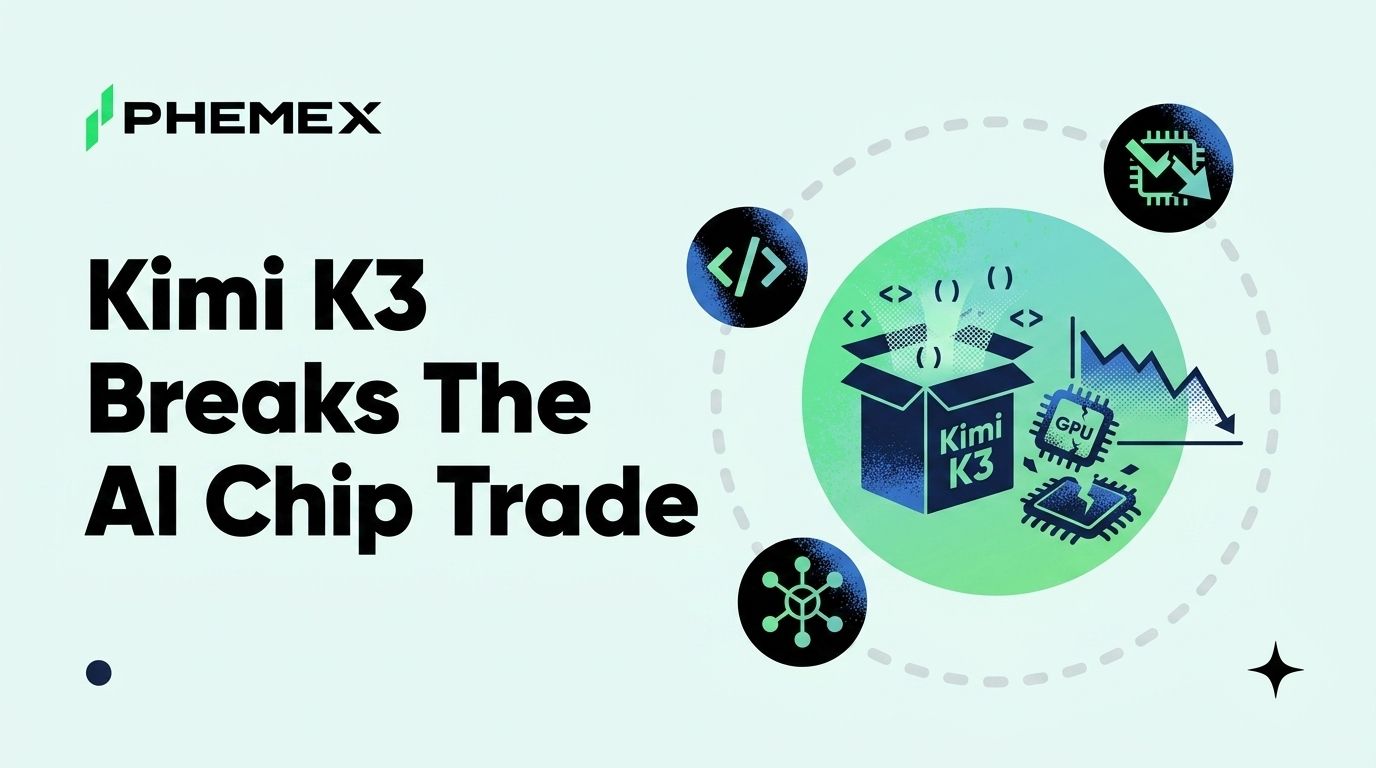
A Chinese AI lab released a free model on Friday July 17, 2026, and the PHLX Semiconductor Index fell into a bear market. Moonshot AI's Kimi K3 carries 2.8 trillion parameters, native vision, a 1 million token context window, and a "LatentMoE" architecture, which makes it the largest open-weight model anyone has ever shipped. Moonshot claims it substantially outperforms the leading closed models, and one Arena.AI benchmark placed it first overall. The weights become freely downloadable on July 27.
Markets did not treat that as a research announcement. They treated it as a repricing event for every company whose valuation depends on frontier AI staying scarce.
Friday July 17, 2026 session snapshot
- TSMC closed 7% lower on the day, despite reporting a 77% jump in quarterly operating profit
- SoftBank fell 9.0%, Z.ai fell 30% in Hong Kong, Cadence fell 9.47%
- Netflix fell 7% and Intuitive Surgical fell 14.15% as the selling widened beyond chips
-
Index closes: Nasdaq -1.4%, S&P 500 -1.0%, Dow -0.7%
-
On the week: S&P -1.5%, Nasdaq -2.9%, and the SOX entered a bear market, down more than 20% from its high
A model release does not normally break a hardware index. Here is why this one did, and why the bear case is weaker than Friday's tape suggests.
What the SOX Bear Market Actually Signals
The PHLX Semiconductor Index is the cleanest single expression of the AI hardware trade. It holds the designers, the foundries, the equipment makers and the memory suppliers, which means it prices one assumption above all others. That assumption is that demand for compute grows faster than anyone can build it, forever.
A 20% drawdown does not mean the assumption is dead. It means enough capital decided to stop paying full price for it in the same week.
TSMC is the tell. The company reported a 77% jump in quarterly operating profit, which is the single strongest confirmation available that the buildout is still happening at scale, and on Friday the stock closed 7% lower anyway. When a business beats on the fundamentals it was supposed to be judged on and the market sells it regardless, the market is no longer trading the current quarter. It is trading the terminal value, and Kimi K3 attacked exactly that.
Watch the rest of the earnings calendar with the same lens. Good prints that get sold are the signature of a de-rating rather than a slowdown, and they behave very differently from a genuine demand miss.
Why a Free Model Broke a Hardware Trade
The AI-silicon trade rests on a chain of assumptions, and it is worth naming each link because the market just tested one of them directly.
Frontier AI is scarce, and that scarcity supports pricing power for the labs. Pricing power supports revenue projections that justify effectively unlimited capital expenditure on GPUs. That capex is chip demand. Break the first link and the whole chain wobbles.
Kimi K3 breaks the first link on purpose. If a lab outside the US can release something at or near the frontier and give the weights away on July 27, then the premium a closed model can charge for being the best available answer starts to compress. Enterprises that were negotiating for API access suddenly have a credible alternative they can run themselves, and every credible alternative is leverage in that negotiation.
That is the whole story behind Friday's chip selling. Nobody downgraded a chip. The market downgraded the pricing power of the customers who buy chips.
The breadth of the damage tells you the same thing. Netflix at -7% and Intuitive Surgical at -14.15% on Friday's close are not semiconductor names, and the selling reached them because that session was a repricing of anything carrying a long-duration AI premium. Cadence at -9.47% sits closer to the center of the blast radius, since design software revenue tracks the same buildout the foundries do.
Moonshot AI, backed by Alibaba, is also planning a Hong Kong IPO within six months, which turns this release into a commercial statement as much as a technical one.
The Jevons Argument Against Panicking
Here is the case Friday's tape ignored, and it is a serious one.
Cheaper AI can raise total compute demand rather than shrink it. Economists call this the Jevons paradox, the observation that efficiency gains in a resource often increase total consumption of it because the cheaper thing gets used in far more places. Coal did this in the nineteenth century, electricity did it in the twentieth, and cheap bandwidth did it again within living memory.
Apply the same logic here. Today's compute bill is dominated by training runs at a handful of labs. If open-weight frontier models get deployed by every mid-sized company that previously could not afford the API cost, the bill shifts toward inference, and inference runs continuously rather than once. A world with a thousand deployments of a free frontier model can consume far more silicon than a world with five expensive closed ones.
The precedent is recent enough to check. The DeepSeek shock in early 2025 produced the same panic, the same "compute is commoditized" headlines, and the same violent day in chip stocks. Chip demand kept growing afterward.
The honest version is that both things can be true. Aggregate compute demand can rise while the specific margin structure that justified today's multiples compresses. Traders keep collapsing that into one binary answer, and that is where the money gets lost.
|
Bear case
|
Bull case
|
|
Open weights compress closed-model pricing power
|
Cheaper inference expands total deployment
|
|
Capex plans get trimmed as ROI math tightens
|
Inference workloads run continuously, not once
|
|
SOX already confirmed a 20% drawdown
|
DeepSeek 2025 panic was followed by demand growth
|
|
Terminal-value assumptions get re-rated lower
|
Frontier training budgets have not actually been cut
|
Reference Levels Across the AI Complex
These are the levels the complex is working from as the new week opens, useful as anchors rather than as predictions.
|
Ticker
|
Level
|
|
NVDA
|
$203.48
|
|
AMD
|
$503.10
|
|
AVGO
|
$375.69
|
|
MRVL
|
$190.14
|
|
INTC
|
$95.70
|
|
MU
|
$848.95
|
TSMC sits at the center of the story without needing a level, because its quarterly results are the cleanest read on how much of this is a genuine slowdown and how much is simply a re-rating. Memory is the other place to watch closely, since Micron sells into both training and inference and would benefit from a deployment wave rather than suffer from it. The same logic applies to Marvell and to the broader custom-silicon competition, where an inference-heavy world favors different chips than a training-heavy one. NVDA remains the index's largest single sentiment driver either way.
What This Means for Crypto
Crypto's high-beta corners and the AI-compute trade run on the same fuel, which is the willingness to pay today for cash flows that arrive years from now. A semiconductor index entering a bear market is a genuine risk signal for every long-duration asset, and Bitcoin sits squarely in that bucket regardless of how the store-of-value framing is presented.
The current backdrop is already defensive. BTC is trading around $64,785 and flat, ETH is around $1,878, and crypto is carrying its own risk-off weight from US-Iran escalation with Brent above $86. That combination means crypto is unlikely to get a sympathy bid from a wobbling AI trade, since the two are correlated on the way down more reliably than on the way up.
There is a second-order angle worth tracking. Genuinely cheap open-weight models make AI agents far more economical to run onchain, which is a tailwind for that sector even while the equity side of the AI trade struggles. And for traders who want the AI exposure without an equities account, NVDA trades as a tokenized proxy on Phemex.
Frequently Asked Questions
What is Kimi K3?
Kimi K3 is an open-weight AI model from Chinese lab Moonshot AI, released July 17, 2026, with 2.8 trillion parameters, native vision, a 1 million token context window and a LatentMoE architecture. The weights become freely downloadable on July 27, which is what makes it different from the closed frontier models it is being compared against.
Why did semiconductor stocks fall on an AI software release?
Because chip demand is downstream of AI economics, not upstream of them. If frontier capability stops being scarce, the revenue projections that justify enormous GPU spending get harder to defend, and the market repriced that risk before any actual order was cancelled.
Is the semiconductor index in a bear market?
Yes, and it met the standard definition on Friday July 17, 2026 by falling more than 20% from its high. That is a confirmed drawdown rather than a forecast, though it says nothing on its own about what happens next.
Does cheaper AI mean less demand for chips?
Not necessarily, and the historical record argues fairly strongly in the other direction. The Jevons paradox describes how efficiency gains often increase total consumption, and the DeepSeek shock in early 2025 was followed by continued growth in chip demand rather than the collapse the tape implied at the time.
The Bottom Line
The SOX bear market is a verdict on pricing power, not on demand. Nothing in Friday's session showed a single cancelled order, and TSMC's 77% operating profit jump argues the buildout is proceeding exactly as planned, which is why the selling was a multiple compression rather than an earnings problem. The thing to watch this week is not the chip tape but the capex language from the companies actually writing the checks, because that is where an open-weight frontier either does or does not change behavior. If the hyperscalers reaffirm their spending plans, the Jevons case gets the stronger hand. If any of them start hedging the language, Friday was the first day of a much longer repricing rather than the whole of it.
This article is for informational purposes only and does not constitute financial or investment advice. Cryptocurrency trading involves substantial risk. Always conduct your own research before making trading decisions.