


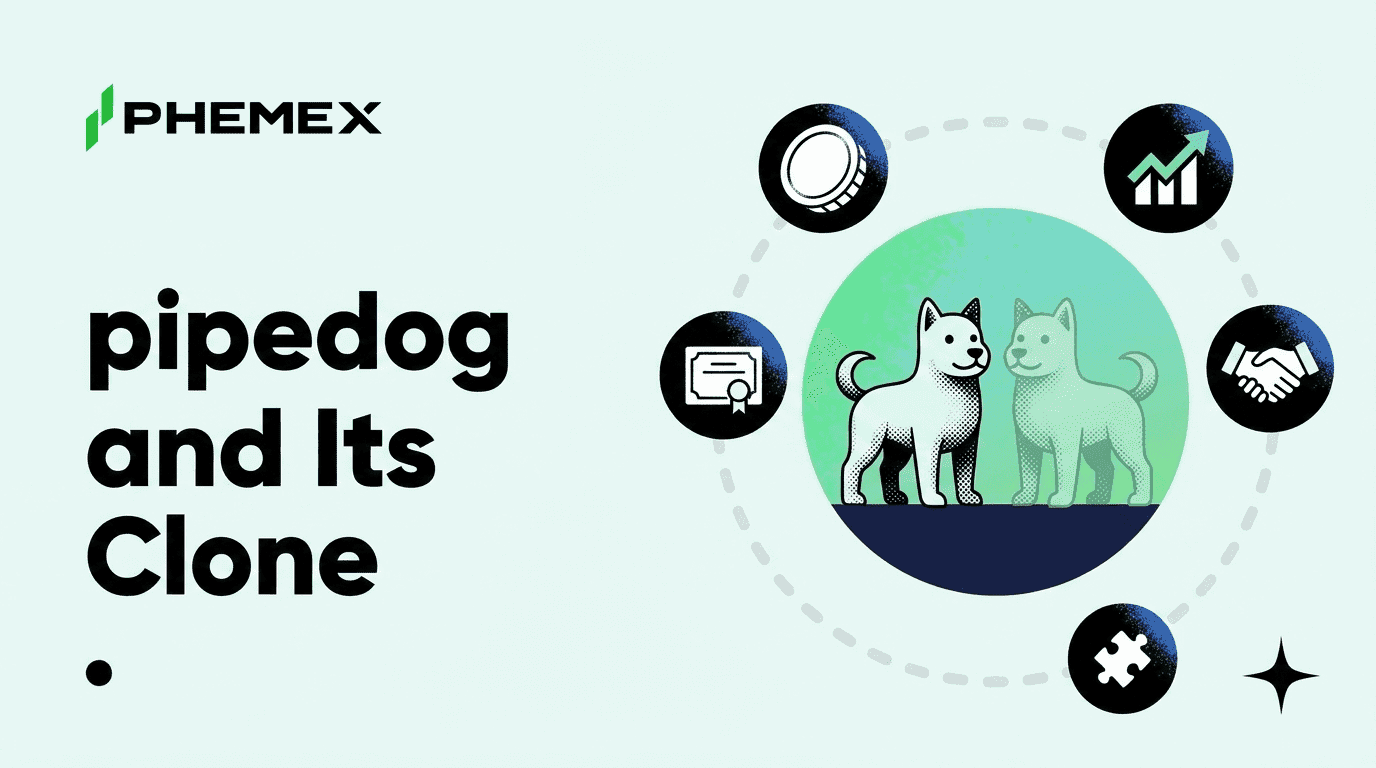
pipedog (PIPEDOG) is a dog-themed meme token on Robinhood Chain, an Ethereum-compatible network, carrying a fixed supply of 12,345,678,912 units and no mint function in its code. It trades against wrapped ether in Uniswap pools. Searches for it climbed through August 2026 because a second contract carries the same name, the same symbol and the same compiled code.
Most token guides settle identity by reading a contract, and that method fails here. Every property a reader is normally told to check returns the same answer on both addresses, so the separation has to come from somewhere else entirely.
pipedog at a Glance
|
Metric
|
Details
|
|
Token name
|
pipedog
|
|
Ticker
|
PIPEDOG
|
|
Blockchain
|
Robinhood Chain (chain ID 4663, EVM-compatible)
|
|
Contract address
|
0x5Cb6F181081301b44905F3ae15419112ecaBd8A6
|
|
Same-name decoy contract
|
0x030E66Ec580d44a4015b07BaF4F2bdA24D039560
|
|
Total supply
|
12,345,678,912, matching circulating supply, so market cap and fully diluted value are the same number
|
|
Decimals
|
18
|
|
First pool
|
Uniswap V3 PIPEDOG/WETH created 20:31 UTC Tuesday 28 July 2026
|
|
Core narrative
|
Early meme liquidity on a new exchange-operated chain
|
|
Token type
|
Fixed-supply ERC-20 with no mint, no owner and no admin functions in its bytecode
|
|
Primary risks
|
A byte-identical same-name contract, depth concentrated in a single pool, no cash flow, and two major data feeds that disagree by thousands of rank places
|
|
Availability on Phemex
|
Not listed. PIPEDOG has no Phemex spot pair and no Phemex perpetual futures market
|
What Is pipedog (PIPEDOG)?
pipedog is one of the meme tokens that appeared in the opening days of Robinhood Chain, the EVM network the brokerage operates for onchain trading. The token does nothing beyond existing and moving between wallets. There is no protocol behind it, no fee switch, no staking module and no treasury, and reading the deployed bytecode makes that concrete rather than rhetorical.
The compiled contract runs to 1,825 bytes. Inside it are the standard ERC-20 function selectors for transfer, transferFrom, approve, allowance, balanceOf, totalSupply, name, symbol and decimals. Absent from it are mint, burn, owner, transferOwnership, renounceOwnership, and any pause or blacklist selector. Nobody can issue new units, nobody holds an administrative key over it, and there is no function that can freeze a wallet.
That is a genuinely clean token in the narrow sense the phrase usually carries. The supply is fixed at deployment, and 15.4838 units have since been sent to the burn address, a rounding error against twelve billion and the only supply change the contract has recorded.
Think of the code as a shipping container with the doors welded shut. Nothing new goes in, nothing comes out, and the welds are visible to anyone who looks. What the welds cannot tell you is which container on the dock is the one you paid for, because the identical container beside it was welded by the same machine.
Why Did PIPEDOG Become Popular?
The token launched into about the loudest window a meme coin ever gets. Its first pool went live at 20:31 UTC on Tuesday 28 July 2026 with an opening print of $0.0000413, and by the following daily bar it had touched a high roughly 148 times that, valuing the whole fixed supply at about $75 million. Robinhood Chain was new, meme deployment on it was cheap, and a dog token with a memorable name caught the first wave of attention aimed at the chain.
Then it did what almost every launch of that shape does. Measured against the Saturday 29 August 2026 close, PIPEDOG sits between 49% and 57% below its launch-window peak, and the width of that range is itself part of the story, because the three records of the peak do not agree. CoinPaprika logs an all-time high of $0.005154 at 16:31 UTC on Wednesday 29 July, CoinGecko logs $0.005298 at 01:59 UTC the same day, and the main pool's own daily bar for 29 July printed a high of $0.006102. Divide the Saturday close into each and the drawdown comes out at 48.9%, 50.3% and 56.9% respectively.
The second reason it is searched has nothing to do with the launch. A second contract using the identical name and symbol has been trading beside it since the same evening, and buyers arriving from a search result keep landing on the wrong one.
How Does the PIPEDOG Token Work?
Four contract calls settle the supply question without leaving any ambiguity. The name call returns pipedog, the symbol call returns PIPEDOG, decimals returns 18, and totalSupply returns 12345678912000000000000000000, which is 12,345,678,912 whole units. Both CoinGecko and CoinPaprika publish that exact integer, so there is no reconciliation gap between the chain and the feeds on supply, which is rarer than it sounds.
Because circulating supply equals total supply, there is no vesting schedule and no team allocation waiting to hit the market, and price times supply gives market cap and fully diluted value at once. At the Saturday 29 August close that arithmetic produced a valuation of roughly $31.7 million using CoinGecko's snapshot price and roughly $32.5 million using the pool's own closing print.
Trading happens almost entirely in one place. Twenty Uniswap pools carry the token across V3 and V4, and one of them, the PIPEDOG/WETH 1% pool on V3, holds about $10.2 million of the roughly $10.6 million pooled across all of them. More than 97% of trading volume settles in that single pool, and every other pair, including several against other meme tokens, is decorative.
The relationship between that depth and the token's valuation is the most useful number on the page. That liquidity pooldepth backs a market cap near $32 million, so close to a third of the token's paper value could in principle transact against pooled capital rather than against hope. Across the Saturday 29 August session that pool traded $610,410, about 6% of its own depth, which is a book behaving like a market rather than like a wash-trading loop.
What Is the Byte-Identical PIPEDOG Clone?
The contract at 0x030E66Ec580d44a4015b07BaF4F2bdA24D039560 is not similar to pipedog. It is the same code.
Pulling the deployed bytecode from both addresses returns 1,825 bytes each, and the SHA-256 hash of both blobs is identical, beginning 5579165887fbce7d. Both return the name pipedog, the symbol PIPEDOG, 18 decimals and the same 12,345,678,912 supply. Both revert on the EIP-165 interface probe that some guides recommend for separating a token from an NFT collection, and they revert for the same reason, which is that neither contract implements that function at all. That check has failed to distinguish a real token from its copy three times in our desk records, and it should be retired.
The checks a reader is most often told to run fail here too, and they fail in a way that is worth stating plainly. Mint authority and freeze authority both read null on both contracts, and automated honeypot screening returns clean on both. Pool age, usually the strongest timing tell, points the wrong way. The decoy's oldest pool was created at 20:21 UTC on Tuesday 28 July 2026, ten minutes and twenty-four seconds before the canonical token's first pool. Anyone applying the earliest-pool rule to this pair would pick the copy.
What actually separates them is the order book and the crowd standing behind it.
|
Check
|
pipedog 0x5Cb6...d8A6
|
Decoy 0x030E...9560
|
Separates them
|
|
Deployed bytecode
|
1,825 bytes
|
1,825 bytes, identical hash
|
No
|
|
Name, symbol, decimals
|
pipedog, PIPEDOG, 18
|
pipedog, PIPEDOG, 18
|
No
|
|
Total supply
|
12,345,678,912
|
12,345,678,912
|
No
|
|
EIP-165 interface probe
|
Reverts
|
Reverts
|
No
|
|
Mint and freeze authority
|
Null
|
Null
|
No
|
|
Automated honeypot flag
|
Clean
|
Clean
|
No
|
|
Earliest pool timestamp
|
20:31 UTC 28 July 2026
|
20:21 UTC 28 July 2026
|
Yes, and it points at the copy
|
|
Pooled liquidity
|
About $10.2 million in one pool
|
About $6,300 in its largest pool
|
Yes
|
|
Holders
|
8,774
|
192
|
Yes
|
|
Top 10 wallet share
|
20.92%
|
83.11%
|
Yes
|
|
Listed on a major price aggregator
|
Yes
|
No
|
Yes
|
pipedog vs Bitcoin
Readers arriving from a meme-token search sometimes want the comparison against the asset they already hold. The two sit at opposite ends of almost every axis that matters.
|
Category
|
pipedog
|
Bitcoin
|
|
Main identity
|
Meme token on an exchange-operated EVM chain
|
Independent monetary network with its own proof-of-work chain
|
|
Blockchain
|
Robinhood Chain, launched 2026
|
Bitcoin, live since 2009
|
|
Core value driver
|
Attention, and the depth of one liquidity pool
|
Monetary demand, settlement assurances, institutional allocation
|
|
Supply model
|
Fixed 12,345,678,912, fully circulating from day one
|
Capped at 21 million, issued on a halving schedule to roughly 2140
|
|
Market maturity
|
About one month of trading history
|
Seventeen years, with deep spot and derivatives markets
|
|
Risk profile
|
Same-name decoy field, single-pool depth, no cash flow
|
Volatility and regulatory risk, but no identity ambiguity
|
The comparison is not there to embarrass the smaller asset, but to make the position-sizing question obvious before the last section answers it.
What Can Move the PIPEDOG Price?
There is very little price story here, and that is the accurate description rather than a hedge. The Saturday 29 August session moved the token by less than one percent in either direction, and the two methods available do not even agree on the sign. The on-chain daily bar for the main pool opened at $0.002613 and closed at $0.002631, a gain of 0.70%. CoinGecko's daily snapshot series puts the same session at a loss of 0.61%. Anchored from the previous Saturday close, the week gained between 16.2% and 16.8% depending on the method. The token is structure rather than momentum, so these are the things that would change the structure.
Attention Flowing Toward Robinhood Chain
PIPEDOG has no product roadmap to deliver against, so the chain is its catalyst calendar. New venues integrating Robinhood Chain, new tokens launching on it, or the brokerage promoting onchain trading all widen the funnel of arrivals who buy something.
The Depth of the Single Main Pool
More than 97% of trading settles in one Uniswap V3 pool. If liquidity providers withdraw from it, the same order size starts moving price several times further, and the slippage on a given trade is a direct function of that depth rather than of any news.
Concentration Among the Largest Holders
The top ten wallets hold 20.92% of supply, with a further 9.57% across ranks 11 to 30. That is unusually well distributed for a month-old meme token, and it is also the number to watch, because a rising top-ten share ahead of a price move is the classic setup for the exit that follows.
Screener Visibility and Feed Reconciliation
CoinPaprika reports PIPEDOG's market capitalisation as $0 despite carrying both the correct supply and a live price for it. A feed publishing zero drops the token out of every market-cap-sorted screen its data powers. If that record is repaired, the token appears in ranked lists it is presently invisible to, and visibility on a meme token is demand.
Broad Risk Appetite for Meme Tokens
Meme assets move together far more than their individual stories suggest, and the ANSEM token frenzy on Solana is a reminder of how quickly capital rotates into and out of the category as a block. When the sector bid fades, a fixed-supply dog token with no revenue has nothing else to price against.
Risks of Buying or Trading pipedog
The Same-Name Decoy Field Is Real and Active
A second contract carrying identical code and identical metadata trades alongside the canonical token, and it is not dormant. Its largest pool recorded five buys and one sell inside a single day at around $48 of volume, which means somebody is arriving there and paying real money for the wrong asset.
Null Mint and Freeze Authority Does Not Identify the Canonical Contract
This is the single most misused safety check in retail crypto. Both PIPEDOG contracts show null mint authority, null freeze authority and a clean automated honeypot flag. The check tells you the deployer cannot print more units or freeze your wallet, which is worth knowing, and it tells you nothing whatsoever about which address is the one the market is trading.
Pool Age Fails on This Pair Specifically
The standard advice is to prefer the older pool, on the reasoning that a copy has to respond to a catalyst it did not create. Here the decoy's earliest pool predates the canonical one by just over ten minutes, so the rule inverts. Timing evidence is still worth gathering, but it has to be weighed rather than obeyed.
Depth Sits in One Pool and Can Leave
The roughly $10.2 million backing the token is provided liquidity, not locked capital. Concentrated V3 positions can be pulled in a single transaction, and the difference between a token that trades and a token that gaps is often one provider deciding they are finished. The same mechanism sits behind most rug pull outcomes even where no malice is involved.
The Feeds Disagree by Thousands of Places
CoinGecko ranks PIPEDOG 544th by market capitalisation. CoinPaprika's ticker record ranks the same token 5,931st, and CoinPaprika's own search record returned 6,978th for it in the same session, so the feed does not even agree with itself. Any figure taken from a single source here is a coin toss about which source you happened to open.
There Is No Cash Flow and No Floor
The contract generates nothing. No fees accrue to holders, no treasury buys back supply, and no protocol revenue exists to discount. Price is the sum of what people will pay for a name, which is a legitimate thing to trade and a terrible thing to value.
How to Research pipedog Safely
Run these in order, and treat the first three as the ones that settle it.
1. Sort by volume and holder count, never by liquidity alone. Volume costs real fees to fake and holder count needs thousands of separately funded addresses. In this pair the gap is 45 times on holders, which no deployer buys cheaply. Liquidity happens to point the same way here, and it is still the weakest of the three because a pool is self-fundable.
2. Read the holder distribution, not only the holder number. A top-ten share near a fifth of supply and a top-ten share above four fifths describe two completely different assets before you even look at the price.
3. Take the contract address from the project's own published channel and paste it into the screener, rather than searching the name and clicking the first result. This is the fifteen-second check that turns every other check into a confirmation.
4. Run the authority check, and then refuse to let it decide anything. Null mint and freeze authority is necessary and nowhere near sufficient, as this pair demonstrates twice over.
5. Compare the pool creation timestamps against the catalyst, knowing the answer can invert. Gather the timing, then weigh it against the order-book evidence rather than treating it as a verdict.
6. Pull the same number from two independent feeds before trusting it. A 5,000-place rank disagreement and a $0 market cap on a live token are not edge cases, and a second feed that agrees to the last decimal place is usually a passthrough of the first rather than confirmation.
Our earlier desk piece "How to Tell a Real Token From One That Copied Its Name" sets out the general version of this method, and PIPEDOG is the case where two of its checks break. The same habit applied to a cat token on Base is worked through in our Basecat verification guide, and Robinhood Chain's own contract documentation is the reference for the network's system addresses. The canonical PIPEDOG contract and its holder count can be read on the Robinhood Chain block explorer and cross-checked against the CoinGecko listing.
Is pipedog a Good Investment?
The honest answer is that this is a speculation on attention with unusually clean plumbing, and those two halves have to be judged separately.
What is genuinely good about it. The supply is fixed and fully circulating, so nothing waits overhead, and the contract has no owner, no mint function and no admin key, so no discretionary action can be taken against holders. Roughly a third of the market capitalisation is backed by pooled liquidity, which is high for a token of this size and age, holder distribution is broad, and the trading is real rather than manufactured.
What is not. It is a month-old meme token, roughly half its launch valuation, with no revenue, no product and no floor, trading on a chain whose own history is measured in weeks. Its price barely moved across the last complete weekly close, which tells you the launch bid is gone and nothing has replaced it. A same-name contract with identical code trades beside it and catches buyers who do not check.
No forecast belongs in that assessment, and anyone offering one is guessing. What can be said is that position sizing should treat a total loss as a live outcome, and that the verification step costs nothing while the mistake it prevents costs everything.
Final Thoughts
The check that decides this case is not a contract call. It is the count of people already standing on the other side of the trade, 8,774 of them against 192, holding a token whose code is indistinguishable from the copy. Watch the top-ten holder share for a climb ahead of any price move, and watch the depth in the main Uniswap V3 pool, because that number is the token's real market and it can be withdrawn. And watch the CoinPaprika record, because a token that appears in market-cap-ranked screens for the first time behaves differently from one that is invisible to them.
The broader lesson survives PIPEDOG entirely. Two contracts on the same chain can be byte-for-byte identical, pass every automated safety flag identically, and still be worth roughly $32 million and roughly $4,000 respectively. When the code cannot tell you which one is real, the order book can.
Frequently Asked Questions
Is pipedog available on Phemex?
No, PIPEDOG has no Phemex spot pair and no Phemex perpetual futures market. A futures page rendering for a ticker is not evidence of a listing, because those pages render for symbols that do not exist at all.
What is the real pipedog contract address?
The canonical contract on Robinhood Chain sits at the address 0x5Cb6F181081301b44905F3ae15419112ecaBd8A6, and it is worth verifying against the project's own published channel before pasting it anywhere, because at least one other contract carries the same name, symbol and compiled code.
Can I check a token's identity from its bytecode?
Not on its own, and this pair is the clearest demonstration available. Identical bytecode means two deployments came from the same compiled source, which is exactly what happens when someone copies a contract deliberately. Verified source code on an explorer proves the published code matches the deployed code, which is a transparency claim rather than an identity claim.
Why do PIPEDOG market cap figures differ so much between sites?
Because one of them is publishing a broken record rather than a different supply assumption. CoinPaprika carries the correct 12,345,678,912 supply and a live price for the token and still reports its capitalisation as zero. Divide any reported market cap by that site's own price to recover the supply basis it is using, and the one that reconciles is the one to trust.
This article is for informational purposes only and does not constitute financial or investment advice. Cryptocurrency trading involves substantial risk. Always conduct your own research before making trading decisions.