
Today's Snapshot
Gold spot (XAU/USD) is trading at $5,156 on March 12, slipping $20.08 (−0.39%) after touching an intraday high of $5,238 earlier in the session. The pullback comes as markets digest yesterday's softer-than-expected US CPI print, which initially lifted risk assets and strengthened the US Dollar Index (DXY) toward 99.45 — creating a short-term headwind for bullion.
Despite today's dip, gold remains up +1.53% on the week, +4.77% over the past month, and an extraordinary +75.81% over the trailing 12 months, underscoring the structural bull market that has defined precious metals since late 2024.
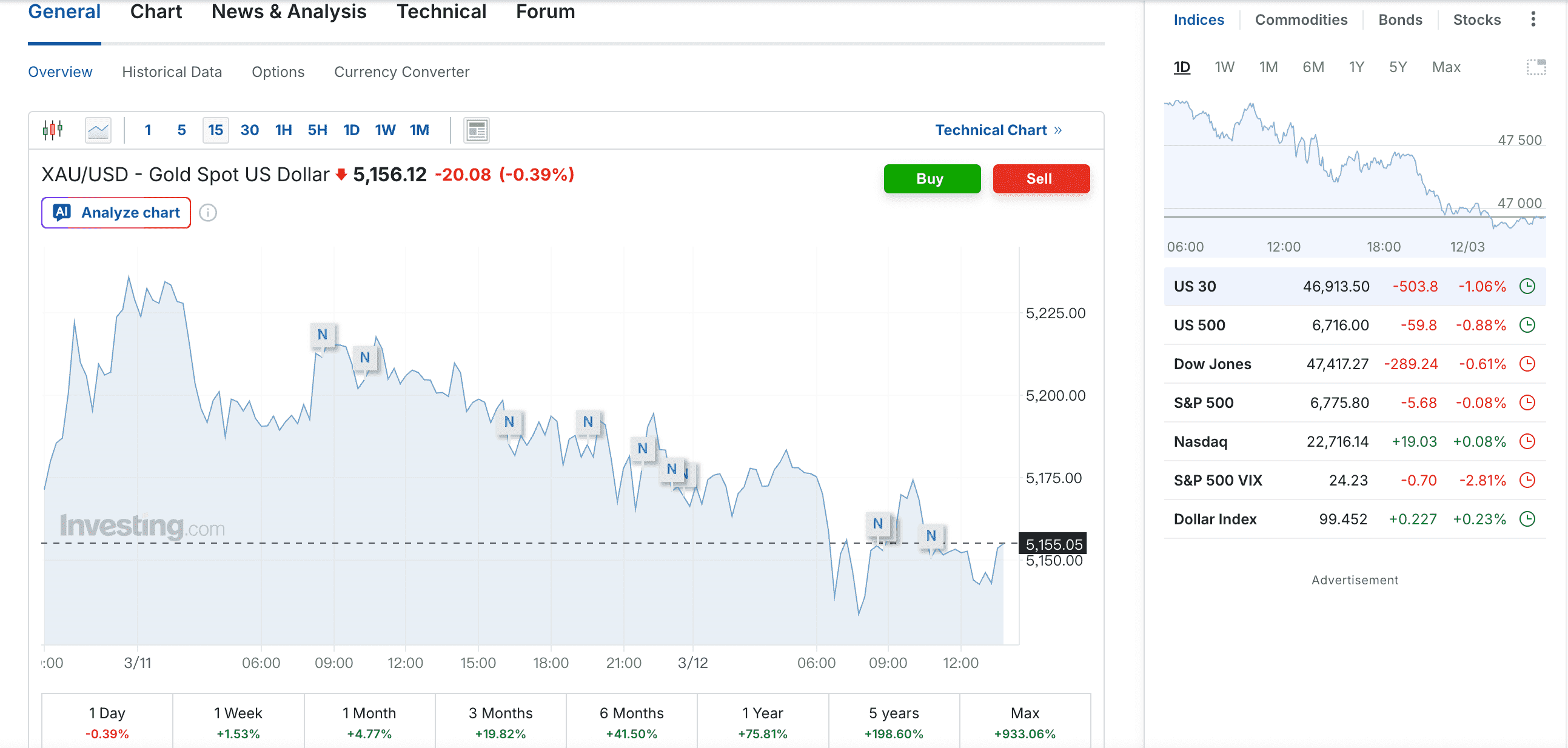
Chart source: Investing.com
CPI Drop, Dollar Pop: Why Gold Faded From $5,238
The Bureau of Labor Statistics released the February 2026 Consumer Price Index on March 11, showing headline inflation at 2.4% year-over-year — right on consensus — with a 0.3% month-over-month increase. Core CPI, stripping out food and energy, came in at 2.5% annually with a 0.2% monthly gain. The standout: shelter costs rose just 0.2%, and rents posted a 0.1% monthly increase — the smallest since January 2021.
For gold, the read is nuanced. On one hand, cooling inflation reduces the urgency for safe-haven positioning. On the other, it keeps the door open for the Federal Reserve to resume rate cuts later this year, which would lower the opportunity cost of holding non-yielding assets like gold. The initial market reaction, however, favored the dollar: DXY firmed to 99.45 (+0.23%), and gold gave back its early-session gains.
Treasury yields dipped modestly, with the 10-year falling toward 3.85%, providing a partial offset. But with equities mixed — the S&P 500 down −0.08%, the Dow Jones off −0.61%, and the Nasdaq eking out +0.08% — risk appetite is fragmented, and gold found itself caught between cross-currents.
Explore Phemex TradFi Markets Now
Macro Drivers: The Structural Bull Case Remains Intact
Central Bank Demand
The World Gold Council's latest data shows central bank purchases averaging 585 tonnes per quarter in 2026, with roughly 190 tonnes per quarter coming from central bank reserves alone. China, India, Poland, and emerging-market central banks continue to diversify away from US Treasuries and into physical gold — a trend that has provided a structural floor under prices since 2023.
Geopolitical Premium
Escalating tensions in the Middle East, including disruptions to global energy supply chains, have kept the geopolitical risk premium embedded in gold. Brent crude remains above $80/barrel, reigniting inflation fears and reinforcing gold's role as the ultimate hedge against uncertainty. Any further escalation could quickly reverse today's pullback.
Fed Policy Path
After cutting rates through much of 2025, the Federal Reserve has signaled a patient approach in early 2026. Markets are pricing in one to two additional 25bps cuts by year-end, but the timing remains data-dependent. Each dovish signal — like today's benign CPI — theoretically supports gold, even if the immediate FX reaction favored the dollar.
Technical Analysis: Key Levels to Watch
From today's price action:
- Immediate Support: $5,150 — the intraday low and a level that aligns with the session's dashed trendline. A sustained break below here opens the door to $5,117 (today's absolute low).
- Secondary Support: $5,100 — a psychological round number and prior consolidation zone from early March.
- Resistance: $5,200 — where a Spinning Top candle formed, indicating indecision. A close above this level would signal a resumption of the bullish trend.
- Breakout Target: $5,238 (today's intraday high) and then $5,300 — the next major psychological barrier.
RSI sits at 69, just below overbought territory, suggesting momentum is fading but hasn't fully reversed. MACD values are declining within positive territory — a classic sign of weakening bullish momentum rather than a bearish reversal. The near-term read: consolidation between $5,150 and $5,200 is the most likely scenario unless a fresh catalyst forces a breakout.
Gold vs. Crypto: The Digital Safe Haven Narrative
Gold's 12-month return of +75.81% has outpaced Bitcoin's performance over the same period, reigniting the debate over which asset serves as the superior inflation hedge. However, the two are increasingly complementary rather than competitive. Institutional portfolios now routinely allocate to both, and the correlation between XAU and BTC has tightened during periods of acute geopolitical stress.
For traders looking to capitalize on this convergence, Phemex's TradFi platform offers a unified environment where gold, equities, and crypto instruments sit side by side — accessible 24/7 with no market-hours restrictions. The XAU-USDT perpetual contract on Phemex allows traders to go long or short [gold with leverage, without leaving the crypto-native interface they already know.
What to Watch Next
- US GDP Data (Q4 2025 final): Due later this week. A stronger-than-expected print could further strengthen the dollar and pressure gold toward $5,100.
- Initial Jobless Claims: Scheduled for Thursday. Labor market resilience would reinforce the Fed's "patient" stance.
- Geopolitical Developments: Any escalation in the Middle East or new sanctions could trigger a rapid flight to safety, pushing gold back above $5,200.
- DXY Trajectory: The Dollar Index at 99.45 is at a key inflection point. A break above 100 would be a meaningful headwind for gold; a reversal below 99 would be supportive.
Bottom Line
Gold pulled back from $5,238 as the benign February CPI gave the dollar a short-term boost, but the structural drivers — central bank accumulation, geopolitical risk, and a still-accommodative Fed trajectory — remain firmly in place. The $5,150–$5,200 range is the battleground for the next directional move. Traders positioned for either scenario can access gold exposure around the clock through Phemex TradFi and the XAU-USDT perpetual contract.
This article is for informational purposes only and does not constitute financial advice. Gold prices are volatile and past performance is not indicative of future results. Always conduct your own research before making trading decisions.